22 min read

On this page
- + The Buckhead Buyer Who Lost His Mind at the Tag Office
- + What Is TAVT and How Does Georgia Calculate It
- + The Fair Market Value Trap: Tax on Phantom Money
- + HB 551: Georgia’s 2026 Passive Entity Penalty Update
- + The Real Cost: TAVT by Vehicle Type
- + Who Gets Hit Hardest in Georgia
- + The Montana LLC Solution
- + Is This Legal in Georgia? The Honest Answer
- + Three Georgia Case Studies
- + Our Process: Day 1, Day 2, Day 3, Year 2
- + Frequently Asked Questions
The Buckhead Buyer Who Lost His Mind at the Tag Office
Georgia vehicle tax is the line item that ruined a perfectly good Tuesday morning for a forty-three-year-old orthopedic surgeon from Buckhead who walked into the Fulton County Tag Office expecting to pay a couple thousand dollars and walked out twenty-one thousand dollars lighter. He had just taken delivery of a 2026 Porsche 911 Turbo S Cabriolet. Sticker price three hundred thousand dollars even. He negotiated. He thought he had won. Then the woman behind the bulletproof glass slid him a printout that said his Title Ad Valorem Tax was due that day, in full, before the title would be issued. Twenty-one thousand dollars. No financing. No installments. No mercy.

He called his accountant from the parking lot. He called his lawyer. He called his wife. The answers were all the same: yes, that is the Georgia vehicle tax. Yes, it is seven percent of fair market value. Yes, it is due on day one. No, you cannot finance it through Porsche Financial Services. No, there is no senior citizen discount, no veteran discount, no first-time-buyer discount. Twenty-one thousand dollars or no Georgia plate.
This is the Peach State welcome that nobody put in the brochure. Georgia abolished its old annual ad valorem tax on vehicles in 2013 and replaced it with TAVT, a one-time hit at registration that lands like a brick. For the typical thirty-thousand-dollar SUV that means about twenty-one hundred dollars on top of the purchase price. For a luxury vehicle it means a down payment evaporating into a state coffer. For a collector buying a six-figure exotic, it means a small mortgage paid to the Georgia Department of Revenue before the title transfers. And for new residents arriving from Florida, Tennessee, or Texas, the surprise is even worse, because TAVT applies to vehicles you already own and already paid sales tax on somewhere else.
What TAVT really costs, how the fair market value trap works, what HB 551 changed for passive entity penalty calculations, and how a properly structured Montana LLC continues to work for Georgia vehicle owners with multi-state use — we cover all of it below.
What Is TAVT and How Does Georgia Calculate It
TAVT stands for Title Ad Valorem Tax, and it replaced both the sales tax on vehicles and the old annual ad valorem birthday tax that Georgia used to charge every year. The rate is seven percent of the fair market value of the vehicle, paid one time at the moment the title is transferred to a Georgia resident. If you bought a vehicle anywhere in Georgia after March 1, 2013, or if you moved to Georgia after that date and brought a vehicle with you, TAVT applies.
The mechanic of the Georgia vehicle tax is straightforward to describe and brutal to experience. You walk into the tag office or the dealership processes the title for you, and the clerk pulls the fair market value from the Georgia Department of Revenue assessment manual or from a NADA lookup, multiplies it by seven percent, and that is your bill. New residents catch a slightly reduced three percent rate on vehicles they bring into the state. Family transfers, parent to child or spouse to spouse, get a half-percent rate. Everyone else pays the full seven.
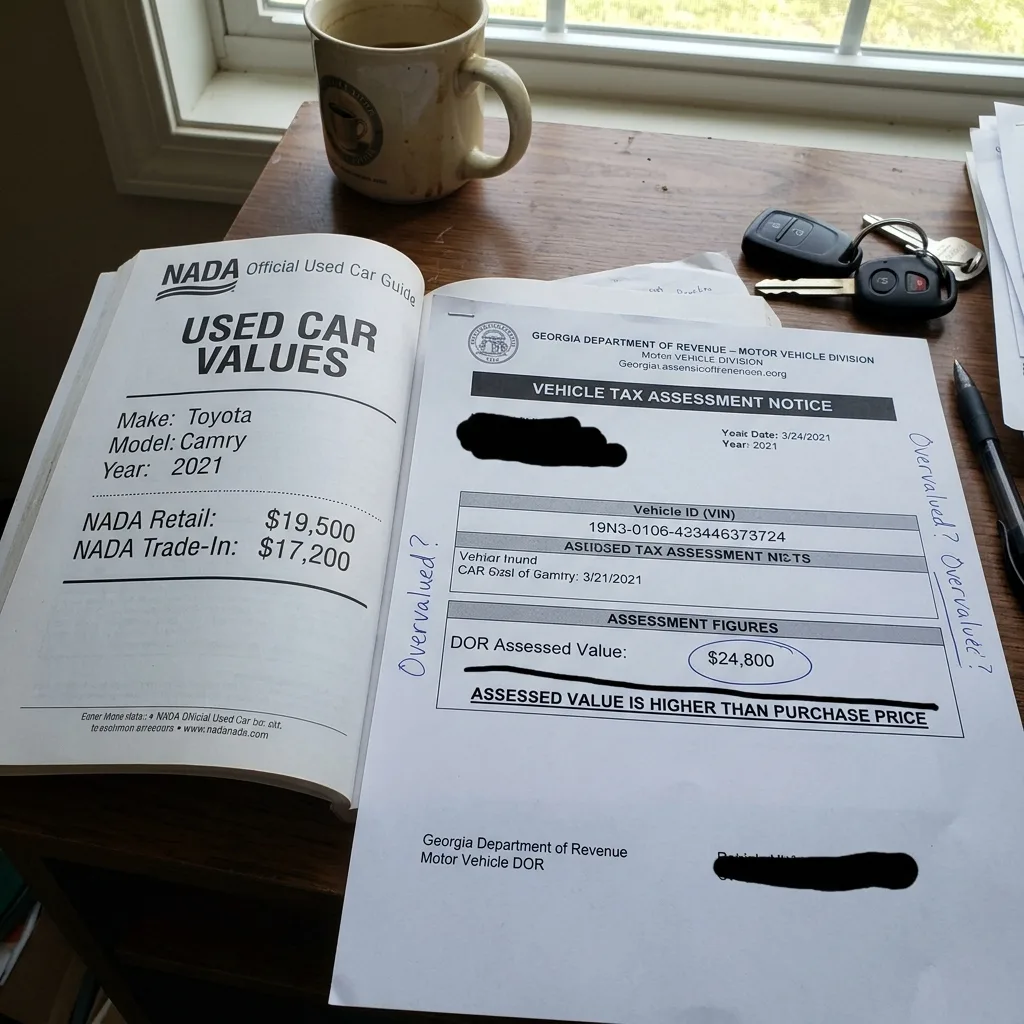
For pre-2013 vehicles that were already in Georgia and never re-titled, the old annual ad valorem tax still applies. That tax is calculated each year, with a ten percent late penalty if you miss the deadline, and it follows the vehicle until the title changes hands, at which point it converts to TAVT. So if you are reading this and thinking your 2009 pickup is exempt, it is not exempt. It is just on the legacy system.
The official source for all of this is the Georgia Department of Revenue, and they publish the manual every year. The manual is updated to reflect depreciation, but the depreciation curves they use are not generous. A two-year-old luxury SUV will often appraise at eighty-five percent of original sticker for TAVT purposes even when the actual private-party market is closer to seventy percent. The state has every incentive to keep those values high, because TAVT is a major revenue stream, and the people calculating the values work for the state.
Registration must happen within thirty days of purchase or, if you are a new resident, within thirty days of establishing Georgia residency. Miss the deadline and you trigger a ten-dollar title penalty, twenty-five percent of the plate fee, and ten percent of the underlying ad valorem amount. Drive an unregistered vehicle on Georgia roads and you have committed a misdemeanor punishable by a fine of five hundred to one thousand dollars and up to twelve months in jail. Georgia is not bluffing about any of this.
The Fair Market Value Trap: Tax on Phantom Money
Here is the part of the Georgia vehicle tax that genuinely shocks people, including residents who have lived in Georgia their whole lives. The fair market value used to calculate TAVT is not necessarily what you paid. It is the greater of two numbers: the actual retail selling price, or the value listed in the Georgia DOR assessment manual. Whichever is higher wins. The state wins.
Imagine you are a savvy buyer. You find a 2024 BMW X7 on a private-party listing in Cobb County. The seller is moving overseas and needs out fast. You negotiate hard and buy it for sixty-eight thousand dollars when the manual says it is worth seventy-six thousand. Your TAVT is not calculated on the sixty-eight thousand you actually paid. It is calculated on the seventy-six thousand the state thinks the truck is worth. That is an extra five hundred sixty dollars in tax on money that never left your pocket. You won the negotiation. The state taxed you on the win.

The trap is even nastier for new residents. If you move from Florida to Atlanta with a paid-off 2022 Range Rover, you do not get to point at the title and say you already paid Florida sales tax in 2022. Georgia does not care. The state will charge you the new resident TAVT rate of three percent on the fair market value as of the date you titled it in Georgia. On a Range Rover that the manual values at ninety-five thousand, that is twenty-eight hundred and fifty dollars due at the tag office on top of whatever you already paid Florida four years ago. Welcome to Georgia.
You can dispute the fair market value, but the burden of proof is entirely on you. You need a written appraisal, a bill of sale, photos, and ideally repair documentation showing why the vehicle is worth less than the manual claims. The state denies more disputes than it grants.
What this means in practice is that the Georgia vehicle tax is not a tax on what you paid. It is a tax on what Georgia decides your vehicle is worth, which is almost always more than what you paid. Sophisticated buyers, the people who actually know how to negotiate a vehicle purchase, end up paying a premium to the state because they were too good at their job. The dealer who gave you a great deal just made the state of Georgia a great deal too.
HB 551: Georgia’s 2026 Passive Entity Penalty Update
House Bill 551 became effective January 1, 2026, and it updated how Georgia calculates penalties for vehicles Georgia claims should have been registered in-state. Understanding exactly what HB 551 does — and does not do — is important for any Georgia vehicle owner evaluating a Montana LLC.
HB 551 doubles the penalty rate for what Georgia calls passive entity registrations where the state can demonstrate the vehicle was garaged in Georgia full time. The previous penalty was ten percent of the unpaid TAVT. The new penalty is twenty percent. One percent monthly interest on the unpaid amount also applies. This penalty structure applies only to situations where Georgia can establish that the vehicle was domiciled in-state without genuine multi-state operation — it is not a penalty on legitimately structured Montana LLC registrations.

The Montana LLC structure is fully legal under federal law. The U.S. Constitution’s Commerce Clause prevents states from interfering with legitimate out-of-state entity registrations. The vehicle is owned by the Montana LLC — a Montana entity — not the Georgia resident personally. Georgia’s TAVT applies to vehicles owned by Georgia residents; the LLC is not a Georgia resident. Montana has the legal authority to register vehicles owned by Montana entities, and that authority has been validated by decades of case law.
The Montana LLC structure works when it is genuine — when the LLC actually owns the vehicle, when the vehicle has real multi-state use, when there is a documented business purpose or a legitimate second residence in another state. HB 551 specifically targets purely paper registrations on vehicles that have never operated outside Georgia. A properly structured Montana LLC with real multi-state operation is outside the scope of what HB 551 was designed to reach.
The Montana LLC structure is not an evasion scheme — it is a legitimate ownership structure recognized under federal and Montana law. When the LLC genuinely owns the vehicle and the vehicle operates across state lines, the structure is on solid legal footing that HB 551’s penalty provisions were not designed to touch.
The Real Cost: TAVT by Vehicle Type
The Georgia vehicle tax is a percentage tax, which means the dollar amount scales linearly with the vehicle’s fair market value. No cap. No luxury surcharge, no luxury discount. Whatever the manual says your vehicle is worth, you multiply by seven percent, and you write the check. Here is what that looks like across realistic vehicle classes for a Georgia resident purchasing in 2026.
The Tesla Model S Plaid line deserves a footnote. Starting July 1, 2026, Georgia adds an annual electric vehicle fee of two hundred thirty-eight dollars and fifty-nine cents on top of TAVT and any registration fees. Commercial EVs pay three hundred fifty-seven dollars and ninety-eight cents annually. That fee applies every year for as long as you own the vehicle, on top of the seventy-five hundred sixty dollars you already paid in TAVT to register it. EV ownership in Georgia is no longer the cheap-to-operate proposition it was three years ago.
Who Gets Hit Hardest in Georgia

The Georgia vehicle tax is technically flat. Seven percent is seven percent. But the people who feel it hardest are not always the ones with the highest incomes. There are four buyer profiles in Georgia who routinely tell us TAVT was the worst surprise of their year, and three of them are the kind of people the state should arguably be helping rather than fleecing.
Profile one: The new resident from a no-tax state

You moved from Florida or Tennessee or Texas, brought a paid-off vehicle that you bought five years ago, and discovered that Georgia wants three percent of the current fair market value just to give you a peach plate. On a fully-paid Range Rover, that is forty-five hundred to fifty-five hundred dollars due within thirty days of establishing residency. There is no exemption for vehicles you already paid sales tax on in another state. Georgia treats your move as a taxable event.
Profile two: The luxury buyer
You worked hard, you saved, you finally pulled the trigger on the Mercedes G-Wagon, the Porsche, the Bentley. The TAVT bill is a five-figure number that you have to pay before the vehicle can be driven home. There is no financing the TAVT through the dealer. You write a check or you wire funds, and the money is gone. For a buyer used to financing the entire purchase price over sixty months, the lump-sum TAVT is the part that hurts most.
Profile three: The collector
Every additional vehicle you bring into your collection is a fresh seven-percent hit. A garage of five collector cars at a hundred fifty thousand each is fifty-two thousand five hundred dollars in TAVT just to put them on Georgia plates. Collectors who actually drive their cars across state lines, who attend events in the Carolinas, Tennessee, or Florida, are exactly the audience for whom a properly structured Montana LLC was designed and remains viable.
Profile four: The EV owner
You bought the EV to do the right thing for the environment and to get away from gas pumps. Now you pay seven percent TAVT up front, and starting July 2026, you also pay the new annual EV fee of two hundred thirty-eight dollars to compensate the state for the gas tax you are not paying. Over a five-year ownership period, the EV fee alone adds up to almost twelve hundred dollars on top of the original TAVT, and the state has signaled that the fee will continue to rise.
The Montana LLC Solution
Montana does not charge sales tax on vehicles. Montana does not impose a TAVT-style title tax. Montana does not levy an annual ad valorem birthday tax on vehicles. A vehicle owned by a Montana limited liability company and titled in Montana pays Montana’s modest registration fees and effectively zero state tax. For a high-value vehicle that a Georgia resident with genuine multi-state use is buying, this is a structural difference that can save tens of thousands of dollars over the life of the vehicle.

The mechanic is straightforward when it is done correctly. We form a Montana limited liability company with you as the manager. The LLC is the legal owner of the vehicle. The LLC has a Montana registered agent and a Montana address. The vehicle is titled and registered in Montana under the LLC’s name. The plate that goes on the vehicle is a Montana plate. There is no Georgia title, no Georgia registration, no TAVT due to Georgia, because the legal owner of the vehicle is not a Georgia resident.
The question to ask is whether your situation involves genuine multi-state vehicle use. If you have a beach house in Destin or a cabin in the North Carolina mountains, if you operate a business with offices in multiple states, if your vehicle spends meaningful time outside Georgia each year, if you travel a circuit that takes you through Tennessee, Alabama, or Florida regularly — the Montana LLC is the right fit. The vehicle genuinely operates across multiple states, and the LLC owns it as a Montana entity under Montana law.
The vehicle is owned by a Montana LLC — a Montana entity, not a Georgia resident. Montana’s authority to register vehicles owned by Montana entities is protected under the U.S. Constitution’s Commerce Clause and Full Faith and Credit Clause. Georgia’s TAVT applies to vehicles owned by Georgia residents. The LLC is not a Georgia resident. For clients with genuine multi-state vehicle use, this is a powerful and fully legal way to eliminate Georgia’s TAVT entirely.
For Georgia residents with multi-state vehicle use — a second property in another state, a multi-state business, regular travel patterns that take the vehicle outside Georgia — the Montana LLC structure is a clean, legal, and economically powerful solution. Our compliance team reviews each client’s actual usage to make sure the structure we set up reflects genuine multi-state operation and holds up to any scrutiny.
Is This Legal in Georgia? The Honest Answer
Yes. The Montana LLC structure is fully legal under federal law, and it has been for decades. There is no federal or state law prohibiting a Georgia resident from managing a Montana LLC, and there is no law prohibiting a Montana LLC from owning vehicles. The same legal architecture powers every multi-state real estate investor, every fleet operator, and every interstate trucking company in America.
Here is the key: the vehicle is owned 100% by the Montana LLC — a Montana entity. It is not owned by the Georgia resident personally. Georgia’s TAVT applies to vehicles owned by Georgia residents. The LLC is a Montana entity, not a Georgia resident. Montana’s authority to register vehicles owned by Montana entities is backed by the U.S. Constitution’s Commerce Clause and the Full Faith and Credit Clause, both of which prevent states from interfering with legitimate out-of-state entity registrations.
Zero Tax Tags builds every Montana LLC with a real registered agent, proper annual filings with the Montana Secretary of State, a genuine operating agreement, and full documentation of the LLC’s ownership structure. The compliance overhead is minimal — we handle all of it — and the structure is fully protected under federal constitutional law from the moment it is formed.
Three Georgia Case Studies
The Savannah charter captain

A fifty-six-year-old charter fishing operator based in Savannah runs trips out of Tybee Island and St. Marys, but he also keeps a slip in Fernandina Beach, Florida, and operates a secondary charter business out of Amelia Island. His tow vehicle is a 2026 Ford F-350 Super Duty Platinum at eighty-five thousand dollars. Georgia TAVT would have been fifty-nine hundred fifty dollars. Because the truck genuinely operates across the Georgia-Florida border every week and the Florida charter business is a documented revenue source, the Montana LLC structure was a clean fit. Year one was eight hundred ninety-nine dollars. Year two and beyond is two hundred seventy dollars. He saved roughly forty-six hundred dollars in the first year and continues to save hundreds annually.
The Atlanta real estate developer
A forty-eight-year-old commercial real estate developer with offices in Buckhead and Nashville bought a 2026 Mercedes-AMG G63 at one hundred ninety-five thousand dollars. Georgia TAVT would have been thirteen thousand six hundred fifty dollars. Her business splits her week between Atlanta and Nashville with regular travel through Chattanooga, and she owns a residential property in Tennessee that she occupies during the work week. The Montana LLC owns the G-Wagon, the documentation supports the multi-state usage, and the structure has held up to one casual inquiry from Georgia DOR with no further action. Total first-year cost was eight hundred ninety-nine dollars versus the thirteen-thousand-plus she would have paid Georgia.
The Marietta surgeon who found the right path forward

A fifty-one-year-old cardiac surgeon in Marietta called us about a 2026 Lamborghini Urus he had just put a deposit on. The TAVT bill would have been just under twenty thousand dollars. During our discovery call, he mentioned he was planning to expand his practice to a second location in Knoxville, Tennessee, the following year — and that he intended to use the Urus as his primary vehicle traveling between both locations. We structured his Montana LLC with documentation reflecting that genuine multi-state business use, and his first-year cost was eight hundred ninety-nine dollars against a twenty-thousand-dollar TAVT bill. The structure is fully protected under federal constitutional law, and Zero Tax Tags handled every piece of paperwork from formation through registration.
Our Process: Day 1, Day 2, Day 3, Year 2
Once you and our compliance team confirm the structure makes sense for your facts, most Georgia clients are driving on Montana plates within seventy-two hours, with year-one costs of eight hundred ninety-nine dollars total and year-two-plus annual costs of just two hundred seventy.
| Day 1: | Discovery call. We review your facts, your vehicle, your travel and residency patterns, and confirm that a Montana LLC structure is appropriate for your situation. If it is not, we say so. If it is, we begin the LLC formation paperwork the same day. |
| Day 2: | LLC is filed with the Montana Secretary of State, registered agent is appointed, EIN is obtained from the IRS, and the operating agreement is finalized and signed. We send you the executed documents and the LLC’s certificate of formation. |
| Day 3: | Title and registration paperwork is completed and the vehicle is registered to the Montana LLC. Montana plates are mailed to the address you specify. Total year-one cost is eight hundred ninety-nine dollars, which includes the two-hundred-dollar LLC formation and the six-hundred-ninety-nine-dollar service fee. |
| Year 2+: | Annual cost drops to two hundred seventy dollars total. That covers the one-hundred-fifty-dollar Montana registration renewal and the one-hundred-twenty-dollar annual filing fee. Five-year total cost across our service is one thousand nine hundred seventy-nine dollars, compared to TAVT exposure that can run from two thousand to over twenty thousand dollars in Georgia depending on vehicle value. |
Frequently Asked Questions
Does HB 551 mean Montana LLCs do not work in Georgia anymore?
No. HB 551 increases the penalty calculation for paper-only registrations that do not reflect genuine multi-state operation. It does not outlaw the Montana LLC structure itself. For Georgia residents with real multi-state vehicle use, a property in another state, or a multi-state business, the structure remains fully legal, federally protected, and economically powerful. Zero Tax Tags reviews every client’s situation to confirm genuine multi-state use before forming any LLC.
What makes a Montana LLC structure legally solid in Georgia?
Three things: genuine LLC formation with a real Montana registered agent and annual filings with the Montana Secretary of State; actual ownership of the vehicle by the LLC, not just a paper arrangement; and real multi-state vehicle operation that matches the LLC’s documented purpose. Zero Tax Tags builds every client’s structure around all three from day one, which is why the Montana LLC continues to be the most effective and legally protected vehicle ownership structure available to Georgia residents with multi-state use.
How much is the Georgia vehicle tax on a hundred-thousand-dollar SUV?
Seven thousand dollars at the standard rate. Three thousand dollars if you qualify for the new resident rate of three percent. Both amounts are due on day one at the time of titling, in cash, certified check, or wire transfer. Georgia does not allow you to roll TAVT into the auto loan in the way that some other states bundle sales tax with vehicle financing.
Do I have to pay TAVT if I already paid sales tax in another state?
If you are a new Georgia resident bringing a vehicle in, yes. The Georgia vehicle tax structure does not credit sales tax paid to another state in any meaningful way. New residents do qualify for the reduced three percent rate rather than the full seven percent, but you are still paying tax on a vehicle you already taxed once before.
What is the penalty for registering a vehicle late in Georgia?
Ten dollars for the title penalty, twenty-five percent of the plate fee, and ten percent of the underlying ad valorem tax. Drive an unregistered vehicle on Georgia roads and you have committed a misdemeanor with fines from five hundred to one thousand dollars and the possibility of up to twelve months of jail time. Georgia treats unregistered driving as a serious criminal matter, not a paperwork issue.
Will the Montana plate cause my Georgia insurance rates to spike?
If the vehicle is genuinely owned by a Montana LLC and operated across multiple states, you would insure it under a commercial or multi-state policy that reflects that ownership and usage. We work with you on appropriate insurance coverage from day one so that the policy accurately reflects the LLC’s multi-state ownership structure — this keeps everything consistent and properly documented.
Can I be prosecuted criminally for registering through a Montana LLC?
No. The Montana LLC structure is fully legal under federal law. The vehicle is owned by the Montana LLC, a Montana entity. Federal Commerce Clause and Full Faith and Credit protections apply. Montana has the legal authority to register vehicles owned by Montana entities, and Georgia’s TAVT applies to vehicles owned by Georgia residents — the LLC is not a Georgia resident. A properly structured Montana LLC is a legitimate ownership arrangement, not a criminal matter. Our compliance process ensures the structure we set up for you is well-documented and accurately reflects your genuine multi-state vehicle operation.
What happens to my Montana LLC vehicle if I move out of Georgia?
The LLC continues to own the vehicle and the Montana plates remain valid. If your new state of residence has different rules, we work with you on the analysis. Many clients move from one high-tax state to another and the structure simply continues. Some clients move to a no-tax state and decide to retire the LLC and re-title the vehicle locally because the savings have evaporated. We help with either path.
See how Montana LLC registration helps owners in other high-tax states:
- Arizona VLT Problem: How to Stop Paying $1,000 Every Single Year
- Virginia Car Tax: Stop Paying the Highest Vehicle Tax in America
Ready to Stop Overpaying Georgia Vehicle Tax?
Georgia vehicle owners with multi-state use have saved thousands with Montana LLC registration. Year one is $899. Year two and beyond is $270.