
26 min read

On this page
- The “No Inspections” Bait-and-Switch
- Understanding the South Carolina Vehicle Tax System
- The Infrastructure Maintenance Fee (IMF)
- The Annual Property Tax: How SC Calculates Your Bill
- County-by-County Millage Rate Table
- The Real 5-Year Cost of SC Vehicle Ownership
- The Biennial Registration Deception
- The 10.5% Business Vehicle Trap
- The Electric Vehicle (EV) Penalty
- The 45-Day New Resident Deadline
- Real-World Stories: Who Pays the Most
- The Montana LLC Solution: How It Works
- Is This Legal? The Strategic Advantage
- Who Benefits Most from Montana Registration
- Our Process: Zero Tax Tags
- Timeline: From South Carolina to Montana
- Frequently Asked Questions
The “No Inspections” Bait-and-Switch

In 1995, South Carolina pulled off one of the greatest public relations masterstrokes in state history. They completely eliminated mandatory vehicle safety and emissions inspections. The marketing pitch to residents and incoming transplants was irresistible: *Come to South Carolina, we are a car-friendly, low-regulation haven.* The reality of the south carolina vehicle tax system, however, tells a drastically different story.
If you own a high-value vehicle—whether it’s a luxury SUV, a high-end sports car, a luxury RV, or a fleet of business vehicles—that “no inspection” policy is nothing more than a bait-and-switch. Sure, you save $30 a year and an hour of your time at a local mechanic’s shop. In exchange, the state and your local county lock you into an annual property tax system that acts as a relentless wealth extraction mechanism.
According to the South Carolina Department of Motor Vehicles, registering a vehicle requires a complex dance between the county auditor, the county treasurer, and the DMV. It is designed to be confusing, and it is designed to be expensive. The state taxes your vehicle as if it were a piece of real estate, subjecting it to annual assessments that cost high-net-worth owners thousands, and sometimes tens of thousands, of dollars every single year.
For owners of luxury vehicles, exotics, and RVs, the South Carolina property tax system is essentially a subscription model where you are forced to buy your own vehicle back from the government over a five-to-ten-year period. But there is a legal, strategic, and highly effective way out. Smart vehicle owners are legally registering their assets in Montana via a Montana LLC, dropping their annual tax burden to zero.
Understanding the South Carolina Vehicle Tax System
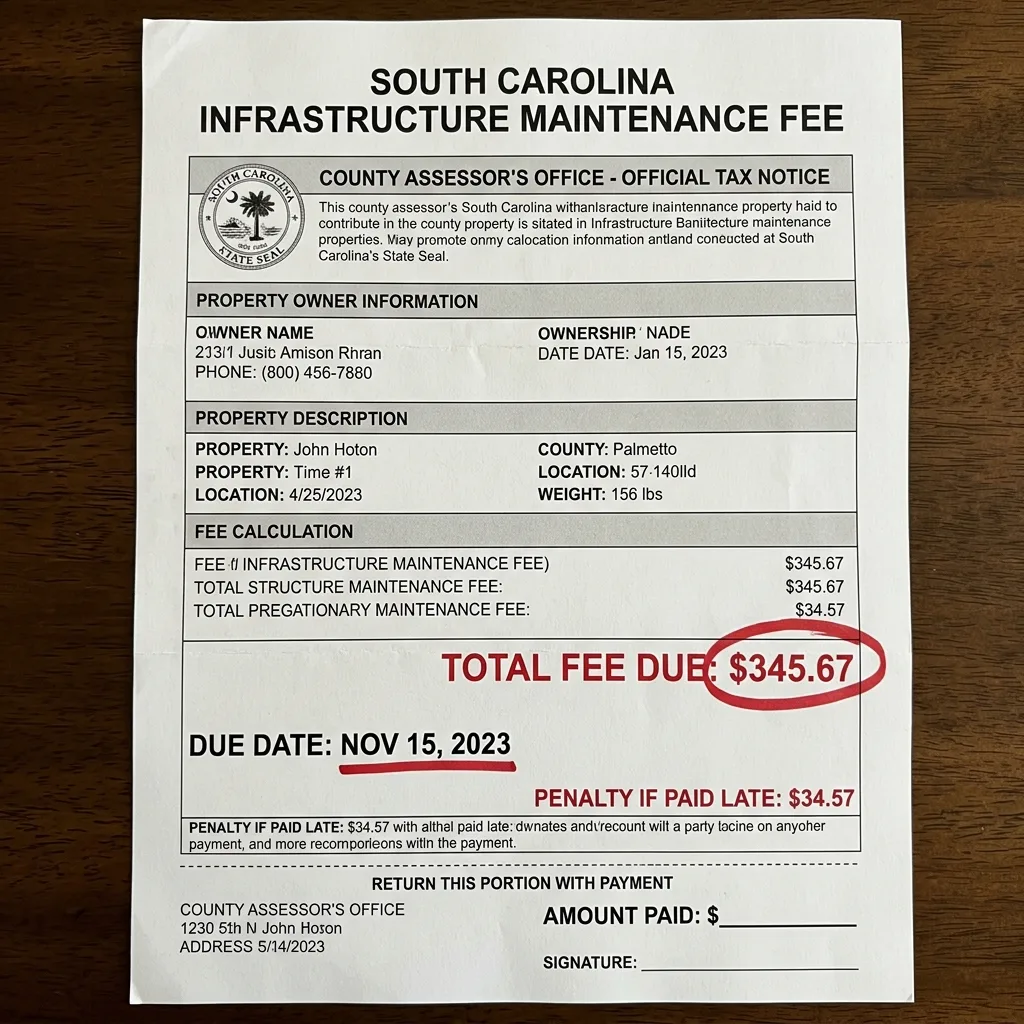
To understand how to legally bypass the south carolina vehicle tax, you first have to understand the anatomy of the trap. South Carolina does not have a traditional “vehicle registration fee” that covers everything in one simple transaction. Instead, the state utilizes a two-part taxation system designed to maximize revenue while obfuscating the true cost of ownership.
The system is split into two distinct financial burdens:
1. The Infrastructure Maintenance Fee (IMF): A one-time fee paid when you purchase a vehicle or move into the state.
2. The Annual Personal Property Tax: A recurring, yearly tax based on the assessed value of your vehicle and the specific millage rate of the county in which you reside.
Most new residents focus entirely on the IMF because it replaces the traditional sales tax on vehicles, and at first glance, it looks like a bargain. But the IMF is merely the cover charge to get into the club. The real financial bleeding happens at the county level with the annual property tax.
Worse, South Carolina employs a biennial registration system. You pay the DMV $40 for a license plate sticker that is valid for two years. This creates a psychological illusion that you are “good to go” for 24 months. You are not. While the sticker lasts two years, the property tax bill arrives every single year. If you fail to pay the Year 2 property tax, your two-year registration is automatically suspended, and you are driving illegally.
The Wealth Trap: South Carolina’s system is aggressively progressive against high-value assets. While a 15-year-old Honda Civic might generate a $45 annual tax bill, a new Porsche 911 or luxury Class A Motorhome will generate a tax bill of $4,000 to $8,000 every single year.
The Infrastructure Maintenance Fee (IMF)
Before 2017, South Carolina charged a standard sales tax on vehicles. To fund road repairs, the state legislature passed a law replacing the vehicle sales tax with the Infrastructure Maintenance Fee (IMF).
For residents buying a vehicle from a dealership in South Carolina, the IMF is calculated at 5% of the purchase price, but it is strictly capped at $500.
If you buy a $10,000 used car, you pay $500. If you buy a $400,000 Rolls-Royce, you pay $500. On the surface, this heavily favors high-net-worth buyers. A $500 tax on a half-million-dollar asset is statistically negligible.
For new residents moving into South Carolina with vehicles they already own, the state offers what looks like an incredibly warm welcome: a flat $250 IMF per vehicle, regardless of the vehicle’s value.
Because of this capped IMF system, many wealthy individuals moving to places like Hilton Head, Charleston, or Myrtle Beach believe they have stumbled into a tax haven. They happily write their $250 check to the DMV, completely unaware of the devastating property tax bill that the county auditor is already preparing to mail them. The low IMF is the cheese in the mousetrap.
The Annual Property Tax: How SC Calculates Your Bill

This is where the financial damage is done. South Carolina taxes vehicles as personal property, meaning you are taxed continuously on the value of the asset every year you own it.
The calculation relies on three specific factors:
1. Fair Market Value: The county auditor determines what your vehicle is worth using guides like NADA or Kelley Blue Book.
2. Assessment Ratio: By state law, personal vehicles are assessed at 6% of their fair market value. (Business vehicles are assessed at a devastating 10.5%, which we will cover shortly).
3. County Millage Rate: This is your local tax rate. A “mill” represents one-tenth of one cent (or $1 per $1,000 of assessed value). Each county, city, and school district sets its own millage rates, meaning your tax bill depends entirely on your zip code.
The Formula:
(Fair Market Value × Assessment Ratio) × (Millage Rate ÷ 1,000) = Annual Property Tax
Let’s look at the math for a $150,000 Mercedes G-Wagon owned personally in a county with a 300 mill rate:
- Fair Market Value: $150,000
- Assessment Ratio: 6% ($150,000 × 0.06 = $9,000 Assessed Value)
- Millage Rate: 300 mills (0.300)
- Annual Tax: $9,000 × 0.300 = $2,700 per year.
You will pay this $2,700 in Year 1. In Year 2, the car might depreciate slightly, so you’ll pay $2,400. In Year 3, $2,100. Over five years, you will pay over $11,000 in property taxes just for the privilege of keeping your own car in your own driveway.
The Depreciation Myth: Many SC residents accept the tax because they believe “it goes down over time.” But county auditors can and do increase assessed values on appreciating vehicles. If you own a classic car, a rare Porsche, or a limited-production Ferrari, its fair market value goes up. Therefore, your annual tax bill goes up. The “depreciation” argument completely fails for desirable vehicles.
County-by-County Millage Rate Table
Millage rates vary wildly across South Carolina. Coastal counties with massive tourism revenue tend to have slightly lower rates, while inland urban centers have punishingly high rates to fund municipal projects and school districts.
Here is a breakdown of the approximate millage rates for major South Carolina counties, and what that means for a personal vehicle valued at $100,000 (Assessed Value: $6,000).
Note: Millage rates fluctuate annually and vary based on exact municipal and school district lines. These figures represent typical combined county/school rates.
The Real 5-Year Cost of SC Vehicle Ownership

To truly grasp the magnitude of the south carolina vehicle tax, you have to look at the cumulative cost over a standard five-year ownership period. We have modeled five different high-value vehicle scenarios.
For this model, we assume a standard 10% annual depreciation rate for modern vehicles, a flat value for the RV, and an appreciating value for the classic car. We will use a baseline millage rate of 300 mills (standard for Charleston or Greenville).
When you look at the raw data, the reality of the South Carolina system becomes undeniable. An RV owner is handing over $54,000 over five years just to park their coach in Myrtle Beach. A collector car owner is penalized as their asset gains value. This is not a fee for road usage; this is a tax on your net worth.
The Biennial Registration Deception
One of the most frequent complaints from new South Carolina residents revolves around the biennial registration system. When you register your vehicle, the DMV hands you a license plate sticker that is valid for two years, and they charge you a nominal $40 fee for it.
Many residents logically assume that because their registration sticker says “Valid until 2028,” they do not owe the state any more money until 2028. This is a dangerous assumption.
The county auditor operates on an annual schedule. Exactly twelve months after you register your car, the county will mail you a property tax bill. Because your license plate sticker is still valid, thousands of residents throw this bill in the trash, assuming it’s an error or a scam.
It is not an error. If you fail to pay the Year 2 property tax, the county immediately notifies the DMV. The DMV will then suspend your vehicle’s registration electronically. You will be driving a vehicle with a “valid” sticker on the back, but if a police officer runs your plate, it will show as suspended for unpaid taxes. You can be ticketed, fined, and in severe cases, your vehicle can be impounded.
The 10.5% Business Vehicle Trap
If you are a business owner, contractor, or real estate investor in South Carolina, the vehicle tax system is explicitly designed to penalize you.
Many smart entrepreneurs title their vehicles under their South Carolina LLC to protect their personal assets from liability and to claim business depreciation on their federal taxes. However, the moment a vehicle is titled to a South Carolina business entity, the state reclassifies it.
Instead of the standard 6% personal assessment ratio, business vehicles are assessed at a staggering 10.5%. This is nearly double the tax rate of a private citizen.
Let’s look at the math for a $75,000 Chevy Suburban used for executive transport.
- Personal Registration (6%): $4,500 assessed value. At 300 mills, the tax is $1,350/year.
- SC Business Registration (10.5%): $7,875 assessed value. At 300 mills, the tax is $2,362/year.
By simply protecting your personal liability through a corporate structure, South Carolina punishes you with a $1,000+ per year surcharge per vehicle. If you run a fleet of five or ten vehicles, this 10.5% assessment ratio is a severe drag on your company’s cash flow.
Conversely, vehicles titled to a Montana LLC are subject to Montana’s tax laws. Montana charges 0% property tax regardless of whether the vehicle is owned personally or by a business entity.
The Electric Vehicle (EV) Penalty
As if the property tax wasn’t enough, South Carolina actively penalizes owners of electric and hybrid vehicles. Because the state relies on the gas tax to fund infrastructure, they view EV owners as freeloaders who are avoiding their “fair share” at the pump.
To compensate, the SC DMV slaps a biennial surcharge on any vehicle that utilizes a battery.
- Pure Electric Vehicles (EVs): $120 biennial surcharge.
- Hybrid Vehicles: $60 biennial surcharge.
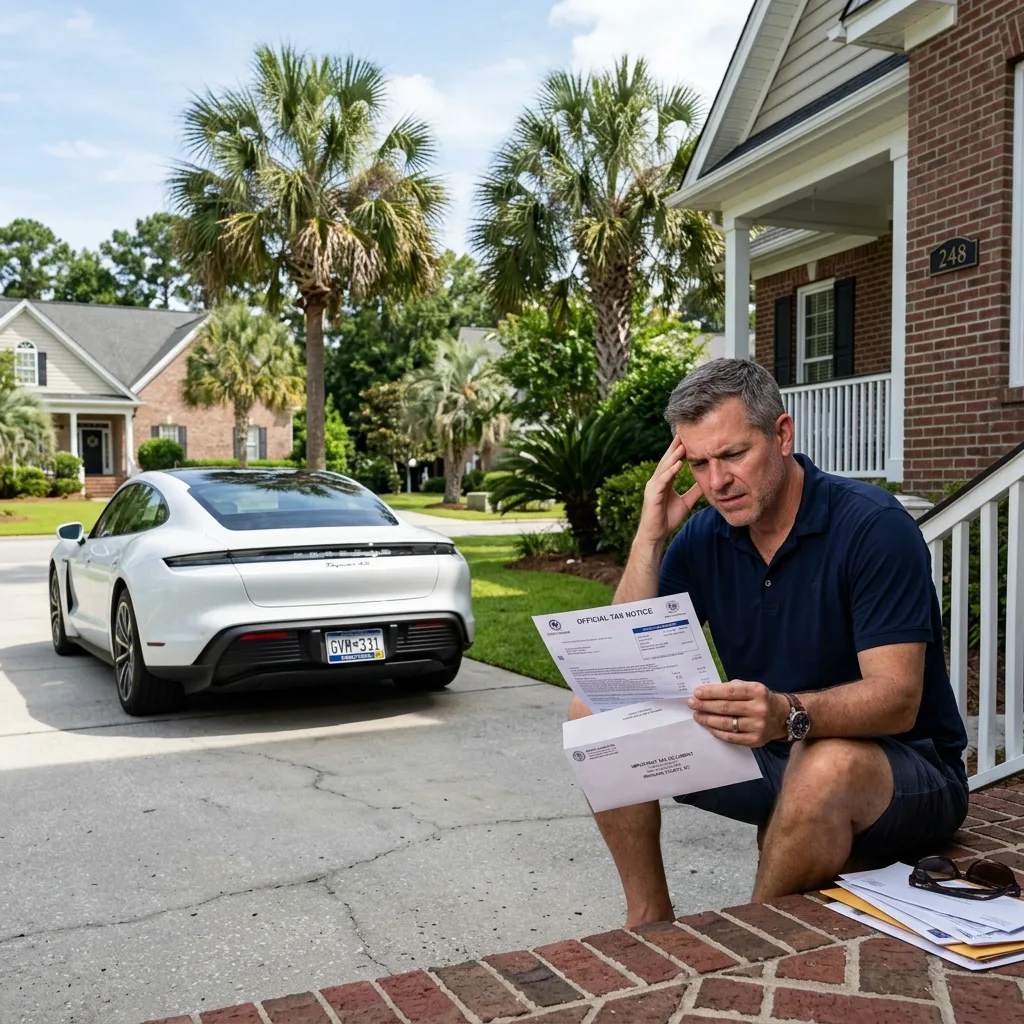
This fee is tacked on *in addition* to your annual property tax. If you own a $130,000 Porsche Taycan, you are already paying nearly $2,400 a year in property taxes. The state then demands an extra $120 every two years just because the car doesn’t have a tailpipe. It is death by a thousand cuts, and it disproportionately targets owners of high-end, modern technology.
The Montana Alternative: Montana does not charge an EV penalty on light vehicles in the same punitive manner, and more importantly, because there is zero property tax, any minor registration fees in Montana pale in comparison to the thousands you save by avoiding the SC county auditor.
The 45-Day New Resident Deadline
If you are moving to South Carolina, the clock is ticking the moment you cross the state line. By law, new residents have exactly 45 days to transfer their out-of-state vehicle titles and registrations to South Carolina.
The state enforces this deadline aggressively. If you miss the 45-day window, the penalties escalate rapidly:
- 15 days late: $25 penalty.
- 30 to 90 days late: $50 penalty.
- Over 90 days late: $75 penalty, potential impoundment, and a misdemeanor charge for operating an unregistered vehicle.
The problem is that registering a car in South Carolina is not a one-stop process. You cannot just walk into the DMV. You must first go to the County Auditor to have your vehicle appraised and added to the tax rolls. Then, you must go to the County Treasurer to pay the extortionate property tax bill. Only after you have a physical tax receipt can you go to the DMV to pay your IMF and get your plates.
This bureaucratic nightmare forces new residents to scramble, often writing massive checks under duress just to avoid misdemeanor charges.
Real-World Stories: Who Pays the Most
To understand the true impact of the south carolina vehicle tax, we need to look at actual numbers from real-world scenarios. Here are four case studies demonstrating how the system extracts wealth, and how a Montana LLC stops the bleeding.

1. The Charleston Attorney
Dr. Marcus Whitfield, 52, Charleston County
Marcus is a successful attorney who owns two high-end vehicles: a 2024 Porsche 911 GT3 (valued at $220,000) and a 2024 Mercedes G-Wagon (valued at $180,000). Charleston County has a combined millage rate of approximately 300 mills.
- Total Asset Value: $400,000
- SC Assessed Value (6%): $24,000
- Annual SC Property Tax: $24,000 × 0.300 = $7,200 per year.
- Montana LLC Solution: By forming a Montana LLC and transferring the titles, Marcus’s annual property tax drops to $0. Over five years, he saves $36,000, which he can invest back into his portfolio rather than handing it to the Charleston County Treasurer.
2. The Hilton Head Retiree
Sandra Calloway, 67, Beaufort County
Sandra retired from a corporate career in Atlanta and moved to a gated community in Hilton Head. She brought her 2023 Rolls-Royce Ghost ($350,000) and a 2022 Bentley Bentayga ($230,000). Beaufort County has one of the lower millage rates in the state at around 200 mills, but the math is still brutal.
- Total Asset Value: $580,000
- SC Assessed Value (6%): $34,800
- Annual SC Property Tax: $34,800 × 0.200 = $6,960 per year.
- Montana LLC Solution: Sandra utilizes Zero Tax Tags to set up a Montana holding company. She legally registers both ultra-luxury vehicles in Montana. Her annual savings: $6,960.
3. The Myrtle Beach RV Owner
Craig and Donna Hutchins, Horry County
The Hutchins purchased their dream retirement vehicle: a 2024 Tiffin Allegro Bus 45OPP, a luxury Class A diesel pusher valued at $600,000. Horry County taxes at roughly 220 mills.
- SC Assessed Value (6%): $36,000
- Annual SC Property Tax: $36,000 × 0.220 = $7,920 per year.
- Montana LLC Solution: RVs are the biggest victims of the South Carolina property tax system because they hold high values for long periods. By registering the Tiffin to a Montana LLC, Craig and Donna wipe out nearly $8,000 a year in unnecessary taxes, allowing them to spend that money on actual travel.
4. The Greenville Manufacturer
David Chen, 44, Greenville County
David runs a precision manufacturing firm and maintains a small business fleet: three Mercedes Sprinter vans ($85,000 each) and two executive Chevy Suburbans ($75,000 each). Because these are business vehicles, South Carolina hits them with the 10.5% assessment ratio. Greenville County’s millage rate is roughly 300 mills.
- Total Fleet Value: $405,000
- SC Business Assessed Value (10.5%): $42,525
- Annual SC Property Tax: $42,525 × 0.300 = $12,757 per year.
- Montana LLC Solution: David structures a Montana LLC specifically for fleet management. The vehicles are titled to the Montana entity, bypassing the 10.5% SC business penalty entirely. Annual tax: $0.
Join Thousands Who Stopped Paying SC Vehicle Taxes →
The Montana LLC Solution: How It Works

If you are tired of writing a massive check to your South Carolina county treasurer every single year just to keep a license plate on your car, there is a proven, highly effective alternative. It is called the Montana LLC vehicle registration strategy, and it leverages the corporate laws of a tax-friendly state to protect your assets from local wealth extraction.
Here is the core principle: Montana is one of the few states in America that charges 0% personal property tax on vehicles and 0% sales tax. When you form a Limited Liability Company (LLC) in Montana, that LLC is recognized as a legal entity—essentially a “person” in the eyes of the law—that resides in Montana.
By purchasing or transferring your vehicle’s title to your Montana LLC, the vehicle is legally owned by a Montana resident (your company). Because the vehicle is titled and registered in Montana, it is subject to Montana’s tax laws, not South Carolina’s. This means no annual South Carolina property tax applies. You completely bypass the brutal local millage rates and assessment ratios that drain your wallet every year.
Furthermore, because the purchase and registration are processed through your Montana entity, you do not pay South Carolina’s Infrastructure Maintenance Fee (IMF). The 5% vehicle sales tax equivalent simply does not apply to a Montana transaction.
One of the most powerful benefits of the Montana system is the permanent registration option. For many vehicles (especially those 11 years or older, as well as motorcycles, trailers, and RVs depending on specific classifications), Montana offers permanent plates. You pay a one-time fee, and you never have to renew your license plates again. No more annual property tax notices, no more biennial registration fees, and no more waiting in line at the SCDMV.
South Carolina loves to boast about having no vehicle inspections, using it as a justification for their high taxes. Well, Montana has no vehicle inspections either. You keep that exact same “benefit” without paying the exorbitant South Carolina premium for it.
Finally, there is a massive benefit for high-net-worth individuals: Privacy. When your vehicle is owned by a Montana LLC, it is the name of the LLC—not your personal name—that appears on the title, the registration, and public records. If someone runs your license plate, they see a business entity, keeping your personal identity and home address shielded from public view.
Is This Legal?
When vehicle owners first hear about the Montana LLC strategy, their immediate reaction is often, “This sounds too good to be true. Is this actually legal?” The answer is a resounding yes, it is completely legal.
Montana has been offering business-friendly LLC vehicle registration for decades. The state has intentionally structured its corporate and tax laws to attract out-of-state business formation. Montana is a sovereign state with its own absolute right to dictate its vehicle registration and corporate ownership laws. South Carolina cannot dictate how a Montana LLC operates, nor can it levy property taxes on an asset legally owned by an out-of-state corporation.
Thousands of vehicle owners across the country—from exotic car collectors in California to RV owners in Florida and business fleet managers in South Carolina—use this exact corporate structure every single day. The roads are filled with Montana license plates driven by out-of-state residents.
It is important to frame this correctly: using a Montana LLC is not a “loophole” or a shady trick; it is informed financial planning. It is the exact same legal tax optimization strategy that major corporations use when they incorporate in Delaware for corporate law benefits, or when families establish trusts in Nevada or South Dakota for asset protection. You are simply applying smart corporate structuring to your depreciating assets.
At Zero Tax Tags, we have successfully helped thousands of clients navigate this process legally and efficiently, ensuring full compliance with Montana state laws while legally avoiding South Carolina’s predatory property tax system.
Who Benefits Most
While almost anyone paying high property taxes can benefit, the math is undeniably spectacular for certain types of vehicle owners. If you fall into any of the following categories, you are essentially throwing money away by registering in South Carolina:
- Luxury vehicle owners ($100K+): This is where the math hits the hardest. A $150,000 Porsche or G-Wagon in South Carolina will generate an annual property tax bill of $3,000 to $5,000 depending on the county. A Montana LLC eliminates that entirely.
- RV and motorhome owners: Class A motorhomes can easily cost $300,000 to $1,000,000+. South Carolina’s property taxes on these high-value assets are financially devastating. Montana allows permanent registration for many RVs, saving owners tens of thousands of dollars over the vehicle’s lifespan.
- Classic and collector car owners: Classic cars appreciate in value, which means in South Carolina, your property tax bill can actually increase year over year. Montana protects your appreciating assets from escalating tax assessments.
- Multi-vehicle households: If you have three, four, or five vehicles in your driveway, the combined annual property tax burden is staggering. The savings multiply rapidly when you move the entire fleet to a single Montana LLC.
- Business fleet owners: South Carolina punishes businesses with a brutal 10.5% assessment ratio on commercial vehicles (compared to 6% for personal). Moving fleet vehicles to a Montana LLC instantly stops this corporate wealth extraction.
- High-value EV owners: Not only are EVs generally more expensive (triggering higher property taxes), but South Carolina also slaps you with a biennial EV surcharge just to register it. Montana LLCs eliminate the annual personal property tax entirely — which is the main savings. Montana does charge $130/yr for battery electric vehicles, but that replaces the South Carolina surcharge rather than stacking on top of it.
- New SC residents facing 45-day deadline pressure: If you just moved to SC, you have 45 days to pay the IMF and property taxes to switch your plates. Setting up a Montana LLC beforehand bypasses this stressful and expensive welcome tax.
- Snowbirds and part-time SC residents: If you split your time between states, there is absolutely no reason to subject your vehicles to South Carolina’s aggressive local tax jurisdictions.
Our Process: Zero Tax Tags

You might be thinking that setting up an out-of-state corporation sounds complicated. That is exactly why Zero Tax Tags exists. We have streamlined the entire procedure into a completely hands-off, done-for-you service. You do not need to travel to Montana, you do not need to hire a corporate attorney, and you do not need to spend hours navigating DMV paperwork.
1. Consultation: It starts with a simple conversation. We review the vehicles you currently own (or are planning to buy) and calculate your exact projected savings. We ensure that the Montana LLC strategy makes financial sense for your specific situation.
2. LLC Formation: Once you give the green light, our team immediately files the paperwork with the Montana Secretary of State to legally form your new LLC. We act as your required Montana Registered Agent.
3. Vehicle Titling: We handle all the intricate DMV paperwork to transfer your vehicle’s title from your personal name (or your current state) into the name of your new Montana LLC. If you are buying a new car, we work directly with the dealership to ensure the initial title is processed correctly through Montana.
4. Registration: We process the registration with the Montana Motor Vehicle Division. We secure your Montana license plates, tags, and official registration documents.
5. Done: We FedEx your new Montana plates and documents directly to your front door in South Carolina. You bolt them onto your car, and you are finished. No annual property tax bills from your South Carolina county ever again.
Start Your Montana LLC Today →
Timeline: From Signup to Montana Plates
We know you want to stop paying taxes as quickly as possible. Our process is highly optimized for speed. Here is what you can expect from the moment you sign up:
| Day 1: | Submit your MCO and supporting paperwork through our secure portal. We review for completeness and file your Montana LLC the same day. |
| Days 1–2: | Montana LLC formation complete — same business day in most cases, second business day at the latest. |
| Days 2–4: | Title transferred into the LLC name at the Montana county treasurer. |
| Days 4–7: | Permanent Montana plates shipped directly to your door within 3–5 business days of title completion. |
Frequently Asked Questions
Q: What exactly is the South Carolina Infrastructure Maintenance Fee (IMF)?
The IMF is essentially South Carolina’s version of a vehicle sales tax. When you buy a vehicle or move to the state and register a vehicle for the first time, you are charged 5% of the vehicle’s purchase price, capped at a maximum of $500. While the $500 cap seems reasonable for expensive cars, it is an upfront fee that hits you immediately, in addition to the annual property taxes you will owe. By purchasing your vehicle through a Montana LLC, the IMF does not apply because the transaction and registration occur in Montana, a state with 0% sales tax.
Q: How is South Carolina vehicle property tax calculated each year?
South Carolina calculates your vehicle property tax using a complex formula: Vehicle Value × Assessment Ratio × Local Millage Rate. The state uses guides (like the NADA guide) to determine your vehicle’s value. The assessment ratio is 6% for personal vehicles and a punishing 10.5% for business vehicles. Finally, the local millage rate is applied, which varies wildly by county and school district. Because local governments constantly tweak millage rates, your tax bill can remain high even as your vehicle depreciates in value.
Q: Why is SC’s biennial registration system confusing for vehicle owners?
South Carolina operates on a confusing split timeline. You are required to pay your vehicle personal property taxes to your county every single year. However, your actual license plate registration (the sticker you put on your plate) is renewed biennially (every two years) through the SCDMV. This creates a scenario where owners get a tax bill every year, but only get a new sticker every other year, leading to immense confusion, missed payments, and suspended licenses when owners assume they don’t owe anything on the “off” year.
Q: Do business vehicles in South Carolina really pay more property tax?
Yes, significantly more. South Carolina penalizes commercial success by taxing business-owned vehicles at an assessment ratio of 10.5%, compared to the 6% ratio applied to personally owned vehicles. This means a $50,000 truck owned by your business will incur nearly double the property tax of the exact same truck owned personally. Moving business fleets to a Montana LLC instantly neutralizes this aggressive commercial tax penalty.
Q: Will my SC property tax go down as my vehicle depreciates?
In theory, yes. In reality, not always. While the assessed value of your vehicle drops as it ages, county councils and school boards frequently vote to increase local millage rates to cover budget shortfalls. It is incredibly common for a South Carolina vehicle owner to watch their car depreciate by thousands of dollars, yet receive a property tax bill that is exactly the same—or even higher—than the year before.
Q: How does a Montana LLC eliminate South Carolina vehicle tax?
Property taxes in South Carolina are levied on residents and businesses located within the state. When you form a Montana LLC, that LLC is a distinct legal entity residing in Montana. When the LLC buys the vehicle, the LLC is the legal owner. Because the legal owner is a Montana resident, the vehicle is titled and registered under Montana law. Montana charges zero personal property tax on vehicles. Therefore, there is no SC property tax bill generated because South Carolina does not own jurisdiction over a Montana corporate asset.
Q: Is registering through a Montana LLC completely legal?
Yes. Forming a business entity in another state to take advantage of favorable corporate and tax laws is a standard, 100% legal practice utilized by businesses and wealthy individuals worldwide. Montana explicitly designed its LLC laws to welcome out-of-state vehicle registrations. As long as you maintain your LLC properly, you are operating entirely within the bounds of corporate law and state sovereignty.
Q: How much does Zero Tax Tags charge for this service?
We charge a transparent, flat-fee structure for forming your LLC, acting as your registered agent, and processing your title and registration. The exact cost depends slightly on the type and age of the vehicle (as Montana’s registration fees vary slightly for permanent vs. standard plates), but our clients typically recoup our fees in tax savings within the very first year. Contact us for a free, exact quote based on your specific vehicle.
Conclusion: Stop Funding the System
South Carolina has built a massive, relentless revenue-generating machine on the backs of vehicle owners. Between the punishing annual property taxes, the confusing biennial registration system, the massive penalties for business fleets, and the ever-increasing local millage rates, owning a nice vehicle in the Palmetto State feels like a financial punishment.
You do not have to accept this as the cost of living in South Carolina. The Montana LLC strategy provides a fully legal, highly effective shield against local wealth extraction. By taking control of how your assets are structured, you can permanently eliminate annual vehicle property taxes and keep your hard-earned money exactly where it belongs: in your own pocket.
See how Montana LLC registration helps owners in other high-tax states: