22 min read
On this page
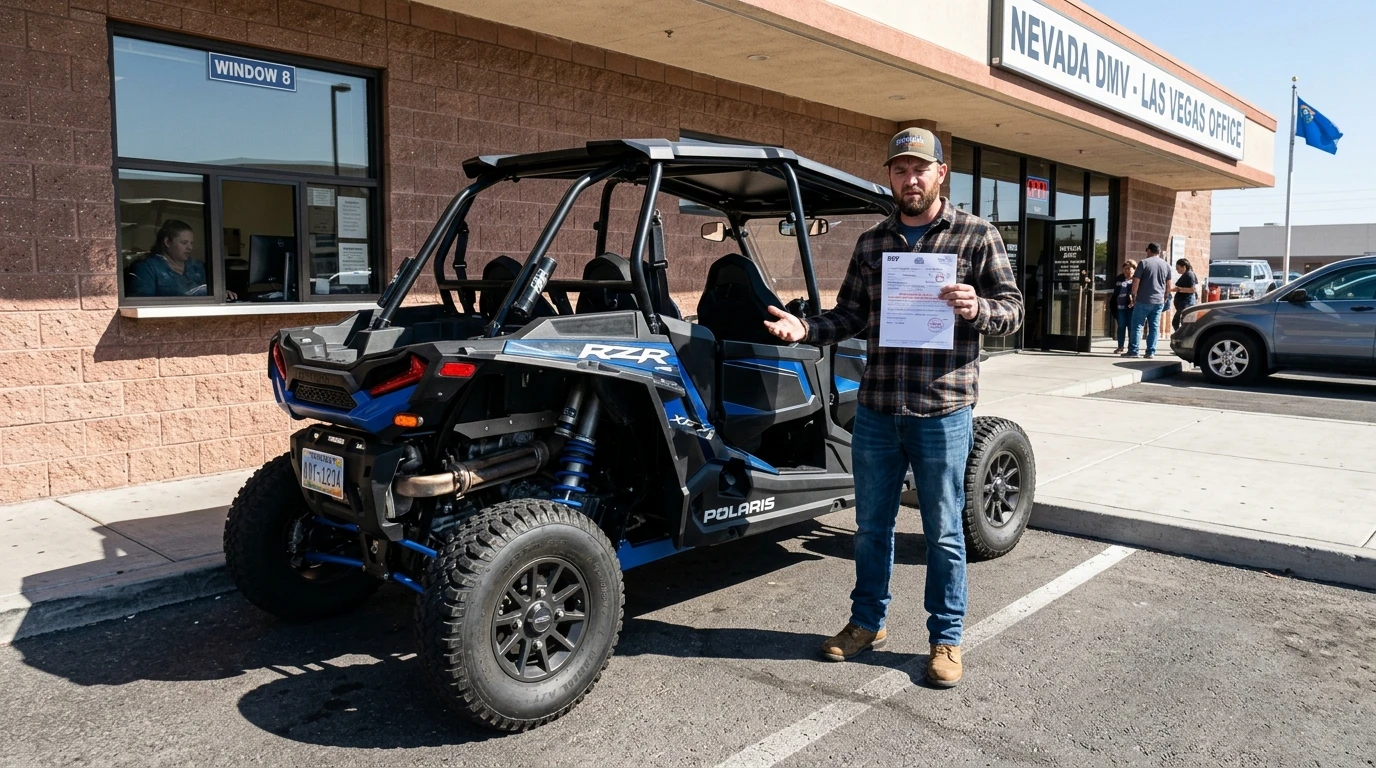
Nevada UTV street legal registration is the impossible dream that thousands of side-by-side owners chase every year, only to slam face-first into a brick wall built out of state statute. Tyler walks into the Henderson DMV with paperwork in hand. He has spent $47,000 on his 2023 Can-Am Maverick X3 X RC Turbo RR and another $6,500 on a complete street legal conversion kit — DOT tires, turn signals, horn, mirrors, windshield, LED headlights, a full taillight assembly. He has a folder full of receipts and what he believes is an airtight case for street registration.
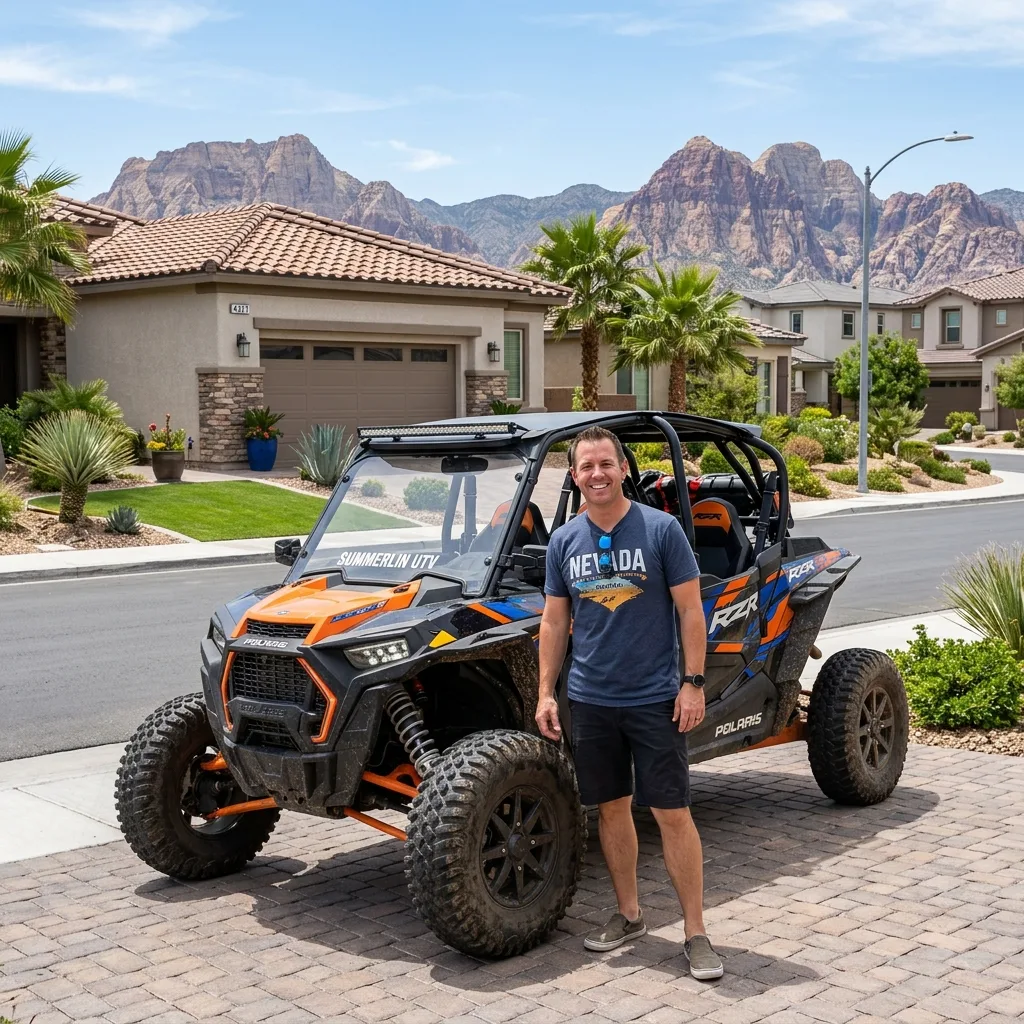
The DMV clerk does not even open the folder. She slides a single-page handout across the counter explaining that Nevada does not register utility task vehicles for highway use. Not now. Not after modifications. Not ever. She recommends an OHV decal — one hundred dollars per year, which grants Tyler the right to cross paved roads for up to two miles on his way to off-highway terrain. Tyler points out that he lives in Summerlin and that the nearest legal trailhead is eight miles from his driveway. The clerk shrugs. That, she says, is what trailers are for.
Marcus has it worse. He is a retired Army master sergeant who bought a 1994 AM General M998 HMMWV at a GovPlanet auction for $18,500. The auction shipped the vehicle with the SF-97 Certificate to Obtain Title for a Vehicle. Nevada DMV looks at the SF-97, looks at the Humvee, and says no. Off-road use only. No FMVSS sticker on the door jamb. Marcus parks the Humvee in his Henderson garage and tries to figure out how a five-ton armored truck built to drive across war zones cannot legally drive three blocks to the grocery store.
Nevada is a UTV paradise — Red Rock Canyon, Lake Mead, Mount Charleston, the Black Rock Desert, the Humboldt-Toiyabe National Forest. More legal places to ride a side-by-side than almost any state in the country. And paradoxically, no legal way to get a UTV from your driveway to any of those places under its own power. The trailer is mandatory. The fuel costs are mandatory. The two hours of loading and unloading every weekend are mandatory. Unless you do what a growing number of Nevada UTV owners are doing: register in Montana through a Montana LLC and let federal reciprocity solve the problem Nevada refuses to solve.
The Nevada DMV wall: a statute, not a suggestion
The single most important fact about Nevada UTV registration is also the one most owners refuse to accept: it is not a paperwork problem. It is not an equipment problem. It is a statute problem. Nevada Revised Statutes section 490.060 defines an off-highway vehicle as a motor vehicle “designed primarily for off-highway use and not intended for public highways.” That definition is the legislative wall. Once a vehicle falls inside it, no amount of modification, no amount of equipment, no amount of pleading with the DMV clerk will get it out.
This is a different model from how most states handle the question. In California, Tennessee, Utah, and Arizona, a UTV can sometimes be street registered if it meets a list of equipment requirements — turn signals, mirrors, DOT tires, horn, windshield, and so forth. Nevada chose differently. Nevada looks at what the manufacturer designed the vehicle to do. If the factory built it for off-highway use, Nevada will not register it for highway use, even if the owner installs every piece of safety equipment ever invented. The statute does not care what is bolted onto the frame. It cares what the frame was designed for.
That distinction is why so many UTV owners burn through thousands of dollars on street legal kits before they discover the truth. The kits are real. The equipment is real. The modifications work in plenty of states. They just do not work in Nevada, because Nevada is not asking the equipment question. Nevada is asking the design question, and the answer is decided in Valcourt, Quebec, or Roseau, Minnesota, the day the UTV rolls off the assembly line.
The substitute Nevada offers is the OHV decal. One hundred dollars per year. It looks like a license plate. It is not one. The OHV decal is permission to operate on designated unpaved roads and trails, and it grants exactly one paved-road privilege: the right to cross a paved road, perpendicular to traffic, for up to two miles, on the way to or from off-highway terrain. That is not driving on the road. That is crossing the road. The distinction matters when you live in Summerlin and the nearest unpaved access point is eight paved miles away.
The Summerlin Problem is the textbook example. You live in the master-planned community of Summerlin, on the western edge of the Las Vegas valley. The Red Rock Canyon trail system is approximately eight paved miles from your driveway. There is no legal way to drive your UTV from your house to the trail system on its own wheels. Not with turn signals. Not with DOT tires. Not with a windshield. Not with anything. The OHV decal does not help — eight miles of paved road is four times the maximum crossing distance the decal allows. Your only legal option is to load the UTV onto a trailer and tow it eight miles to the same trailhead you could have driven to in twelve minutes.
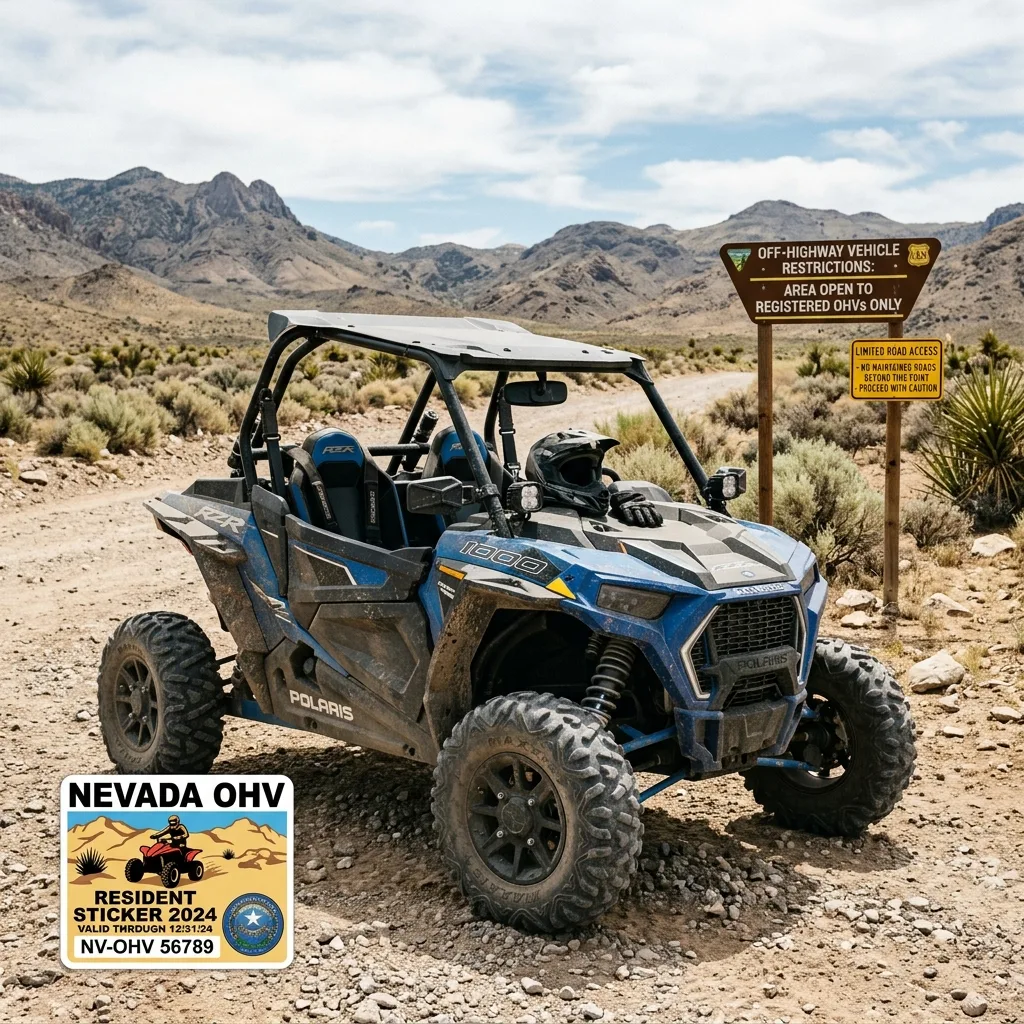
County rules layer additional restrictions on top of the state ban. Washoe County (Reno and Sparks) is the most permissive — it allows OHVs on designated, posted county roads provided the vehicle is OHV-registered, insured, and operated by a licensed driver. Clark County, which contains Las Vegas and the bulk of the state’s population, is the most restrictive: outside specifically designated recreation areas, Clark County does not permit OHV operation on its roads at all. Carson City prohibits OHV operation outside formally designated recreation areas, period. Elko County, in the rural northeast, opens much of its sprawling unpaved road network to OHV traffic. None of these counties can override the state statute on paved highway access. The wall is the same wall.
The result, for the typical Nevada UTV owner, is a strange split existence. The vehicle is fantastic on the trail. It is illegal on every paved road between your house and the trail. The OHV decal is a placebo for owners who do not understand the difference between trail registration and street registration. Once you understand that difference, you understand why the Montana option exists.
The military vehicle problem: Humvees, Deuces, and the FMVSS trap
Surplus military vehicle collectors face a harsher version of the same wall. When the Department of Defense disposes of a HMMWV, an M35 Deuce and a Half, an LMTV, or an FMTV, it does so through an auction process administered by GovPlanet, IronPlanet, or the General Services Administration. The vehicle leaves federal custody with one of two pieces of paperwork: an SF-97 Certificate to Obtain Title for a Vehicle, or a DD Form 1348 Issue Release/Receipt Document. Both are legitimate transfer documents. Both have been honored by dozens of state DMVs for decades.
Nevada is not one of those states. Nevada’s DMV looks at an SF-97 for a Humvee and sees three problems. First, the SF-97 is typically annotated “Off Road Use Only” by the disposal agency — that phrase alone lands the vehicle inside the off-highway statute. Second, the vehicle lacks a Federal Motor Vehicle Safety Standards certification label, the small sticker on the door jamb of every civilian vehicle documenting compliance with the NHTSA regulations. Military vehicles do not have those stickers because they were built to military specifications, not civilian ones. Third, Nevada lumps surplus military vehicles into the same regulatory bucket as UTVs and ATVs. The Humvee, in Nevada’s view, is a heavy off-highway vehicle, not a truck.
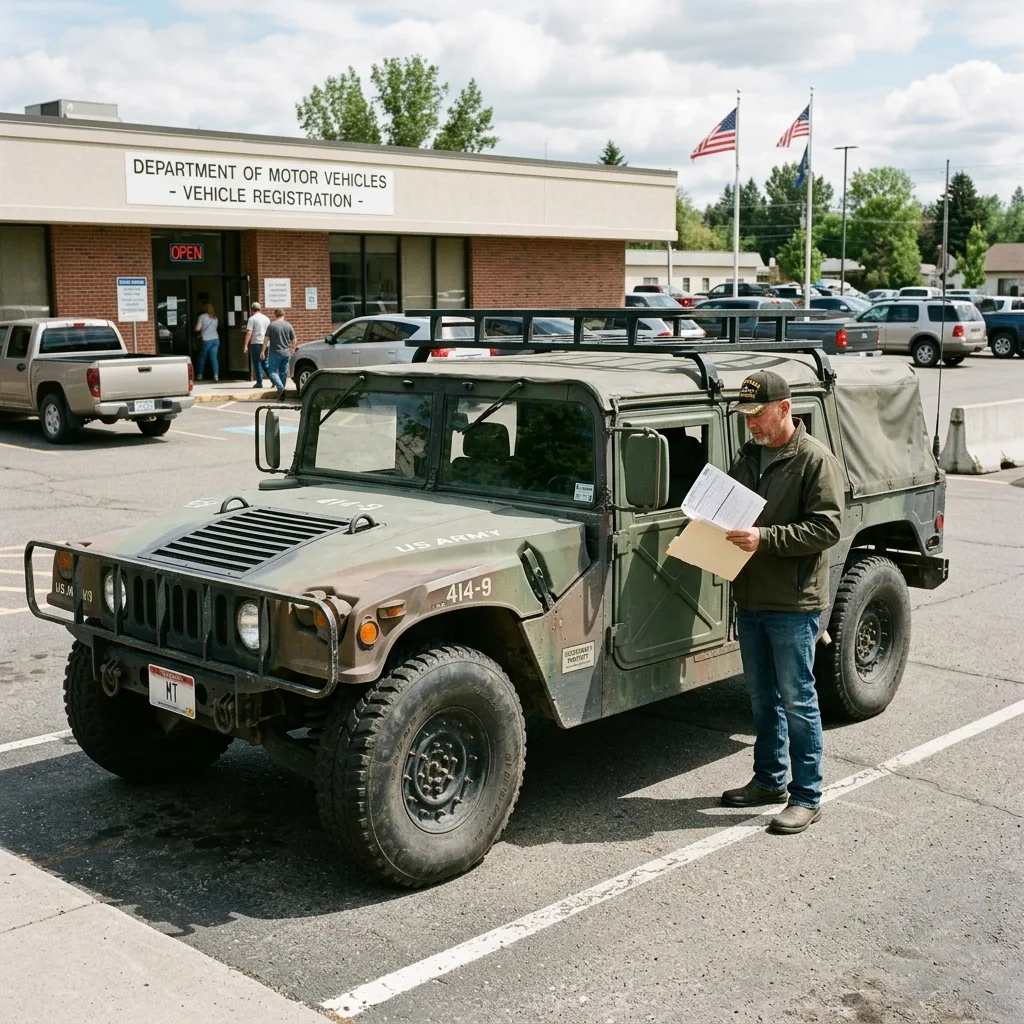
The result is one of the great absurdities of vehicle regulation in the western United States. A Humvee built to drive across mined desert under fire is treated, by the Nevada DMV, as too unsafe for Las Vegas Boulevard. The same vehicle the United States Army drove around Baghdad for two decades cannot legally drive from a Henderson driveway to a Veterans Day parade. The owner is left with an extremely expensive lawn ornament — a vehicle that can only move on the back of a trailer, which defeats the point of owning one.
Montana takes a different view. Montana titles surplus military vehicles based on the SF-97 or DD-1348 paperwork, treats them as the trucks they actually are, and registers them with standard Montana plates. Vehicles 11 years old or older qualify for permanent registration immediately. A 1994 HMMWV is 31 years old as of 2025, which means it qualifies for the permanent plate the moment the title processes. Marcus, the retired master sergeant, registered his Humvee through a Montana LLC. The vehicle now wears a Montana plate that will never be renewed. He drives it to veterans’ events, parades, and the occasional cruise-in, all on its own wheels, without a trailer.
The same approach works for M35 Deuce and a Half trucks, M923 five-ton cargo trucks, LMTVs, FMTVs, M939-series cargo trucks, M998-series HMMWVs in all variants, and a long list of other surplus military equipment that would otherwise sit in Nevada garages collecting dust. Montana does not require an FMVSS sticker. Montana does not interpret “Off Road Use Only” annotations on disposal paperwork as a permanent disqualification from street use. Montana looks at the vehicle and sees a truck.
The equipment fallacy: why $2,500 in modifications will not save you
The most common mistake Nevada UTV owners make is assuming that the right combination of modifications will get them across the line. Add a windshield and a horn and a mirror and surely the UTV becomes a street vehicle. The mistake is logical. The mistake is also expensive.
A complete street legal conversion kit, professionally installed, runs between $800 and $2,500 depending on model and component quality. A turn signal kit from ThumperFab or Kemimoto runs $150 to $300. DOT-approved tires for a sport UTV cost $800 to $1,200 per set. A windshield runs $300 to $600. LED headlights and taillights add $200 to $400. Mirrors, horn, and hardware fill out the rest of the budget.
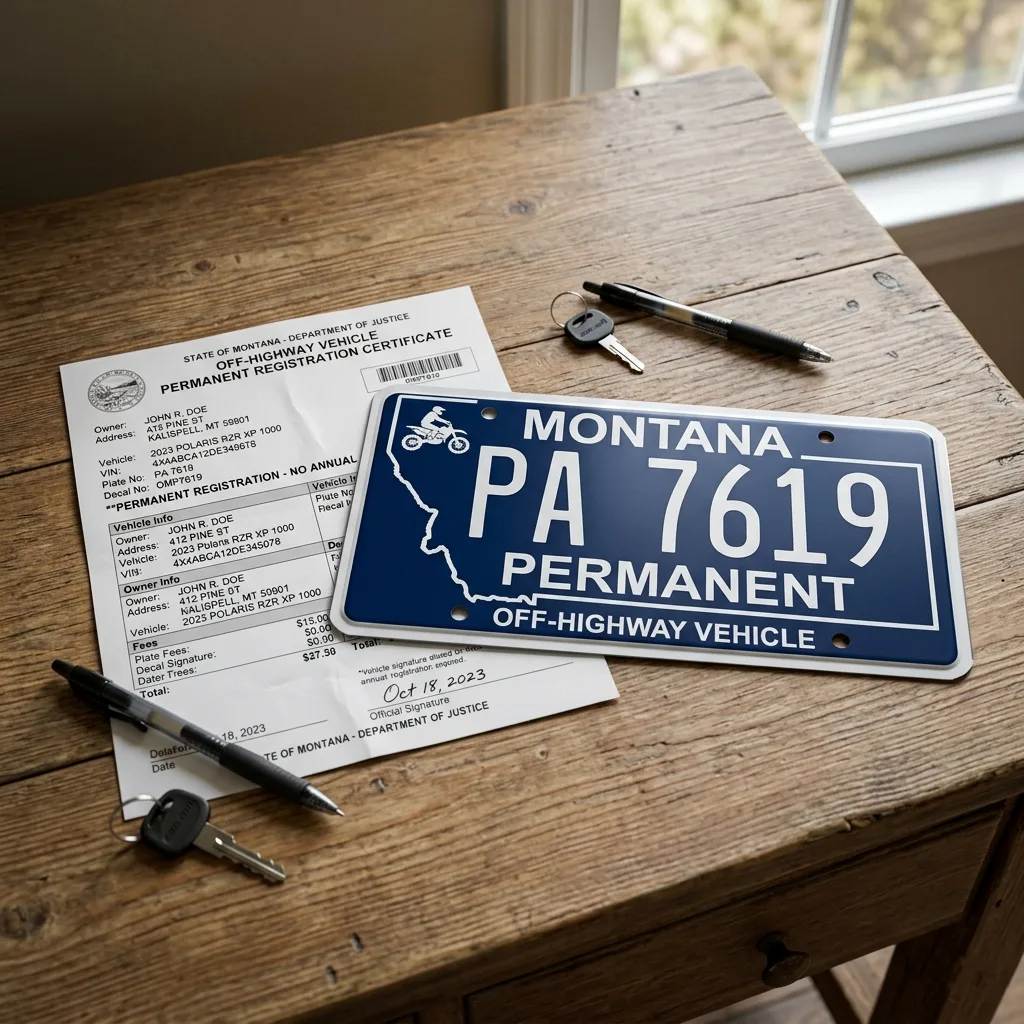
Add it up and a Nevada UTV owner can easily spend $2,500 converting a Polaris RZR or a Can-Am Maverick into something that looks every bit as street legal as the average Jeep Wrangler on the road. After all of that, the Nevada DMV still says no — not because the equipment is wrong, but because the statute does not ask the equipment question. A Polaris RZR is, by Polaris’s own engineering documentation, designed primarily for off-highway use. Aftermarket modifications do not change factory-published intent.
The cruel irony is that a Can-Am Maverick X3 with a full kit — DOT tires, horn, windshield, mirrors, turn signals, brake lights, disc brakes, four-point harnesses, and a roll cage built to desert racing standards — is objectively safer than the 2002 Honda Civic with a cracked windshield that just passed you on Sahara. Nevada will register the Civic and refuse the Maverick. Objective safety is not the question Nevada is deciding.
The good news: the modifications you have already paid for are not wasted. Montana requires a working headlamp, a stop lamp, brakes, an electric horn, at least one rearview mirror, a muffler, and a spark arrestor. That is the entire list. Montana does not require DOT tires, a windshield, or turn signals. Your existing modifications meet Montana’s minimums with significant margin to spare. The kit you bought to satisfy a Nevada law that does not actually exist will satisfy a Montana law that does.
The Montana solution: quadricycles, permanent plates, and federal reciprocity
Montana solves the Nevada UTV street legal problem by asking a different question. Where Nevada looks at manufacturer intent and refuses to budge, Montana looks at vehicle equipment and asks whether the machine can be operated safely on a public road. If the answer is yes — the vehicle has the minimum equipment package described above — Montana issues a registration. The legal category Montana uses is “quadricycle,” a term that exists in Montana state law specifically to cover four-wheeled, motor-powered vehicles that fall outside the traditional automobile definition. UTVs and side-by-sides slot directly into it. The registration is real. The plate is real. The vehicle becomes, in every legal sense that matters on the road, a street-legal motor vehicle.
Montana’s equipment requirements are minimal by design. A working headlamp, visible at a reasonable distance ahead. A working stop lamp activated by the brake pedal. Functional brakes. An electric horn. At least one rearview mirror. A muffler. A spark arrestor. Every UTV currently on the market either has these from the factory or can have them added with a basic street legal kit. The cost of Montana compliance is far below the cost of the modifications most owners have already made trying to satisfy Nevada.
The permanent plate is where Montana goes from useful to extraordinary. Vehicles 11 years old or older receive permanent registration — pay the fees once, the plate is yours forever. No annual renewal. No biennial renewal. No DMV trip in five years to update a sticker. The plate goes on the vehicle once and stays there for the life of the machine. For a UTV that, with reasonable maintenance, can easily last 15 or 20 years, the permanent plate is effectively a one-and-done registration.
The Montana LLC is what allows out-of-state residents to take advantage of this system. Montana state law permits anyone to form a Montana LLC, regardless of where they live. The LLC is a real legal entity, registered with the Montana Secretary of State, with a registered agent in Montana. The LLC owns the UTV. The LLC, as a Montana resident entity, registers the UTV in Montana. The owner of the LLC — you — controls the vehicle as the LLC’s manager and operator. Montana courts and Montana DMV have processed this arrangement for decades. It is not a loophole. It is the standard model for thousands of high-value vehicle registrations across the state.
Federal reciprocity is what makes the Montana plate work in Nevada. The Full Faith and Credit Clause of the United States Constitution requires each state to recognize the public acts, records, and judicial proceedings of every other state. A vehicle registration is a public act. When a Montana-plated UTV operates on a Nevada road, Nevada is constitutionally required to recognize the Montana registration as valid. Nevada law enforcement officers see a Montana plate, run it, and get back a current, valid Montana registration on a vehicle owned by a Montana LLC. The traffic stop ends. The UTV continues on its way.
Compare that to the Nevada OHV decal at $100 per year. Five years of OHV decals costs $500 and gives you a vehicle you cannot legally drive on paved roads. Five years of Montana registration costs $749 total — one payment, made once — and gives you a vehicle you can legally drive on every paved road from your driveway to the trailhead. The math is not subtle.
Real world case studies: how three Nevada UTV owners solved the problem
Case study 1: Tyler, Summerlin — the driveway-to-trail commuter
Tyler owns a 2023 Can-Am Maverick X3 X RC Turbo RR purchased new for $47,200, with a $6,500 ThumperFab street legal kit installed. He lives eight paved miles from Red Rock Canyon. His pre-Montana Saturday routine: hitch the enclosed trailer, drive to the storage facility, load the Maverick, drive eight miles to the trailhead, unload, ride, reload, reverse the entire process. About two hours and $80 in fuel and storage per ride. Across 30 rides per season, 60 hours and $2,400 annually in pure logistics overhead.
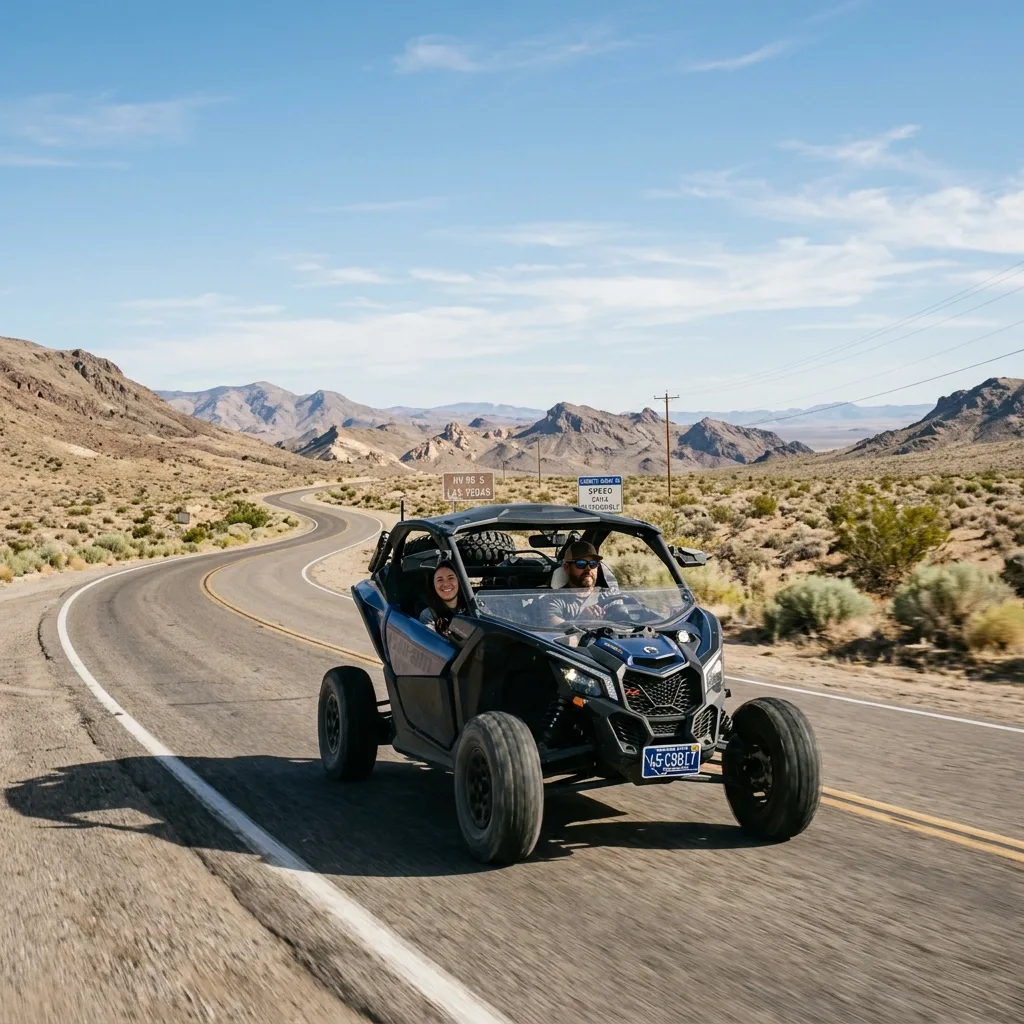
Tyler registered his Maverick through a Montana LLC for $749 one-time. The plate arrived in 11 days. His new routine: open the garage, fire up the Maverick, drive 12 minutes to Red Rock. No trailer. No truck. No storage facility. Annual savings on fuel, storage, and time work out to over $4,000. The break-even arrived in month three.
Case study 2: Sarah, Reno — the overlanding photographer
Sarah owns a 2021 Polaris RZR Pro XP 4 built into a serious overlanding rig — roof tent, 40-gallon water tank, light bar, long-travel suspension, auxiliary fuel cell, custom camera platform. $55,000 all in. She uses it for multi-day trips into the Humboldt-Toiyabe National Forest and the Great Basin.
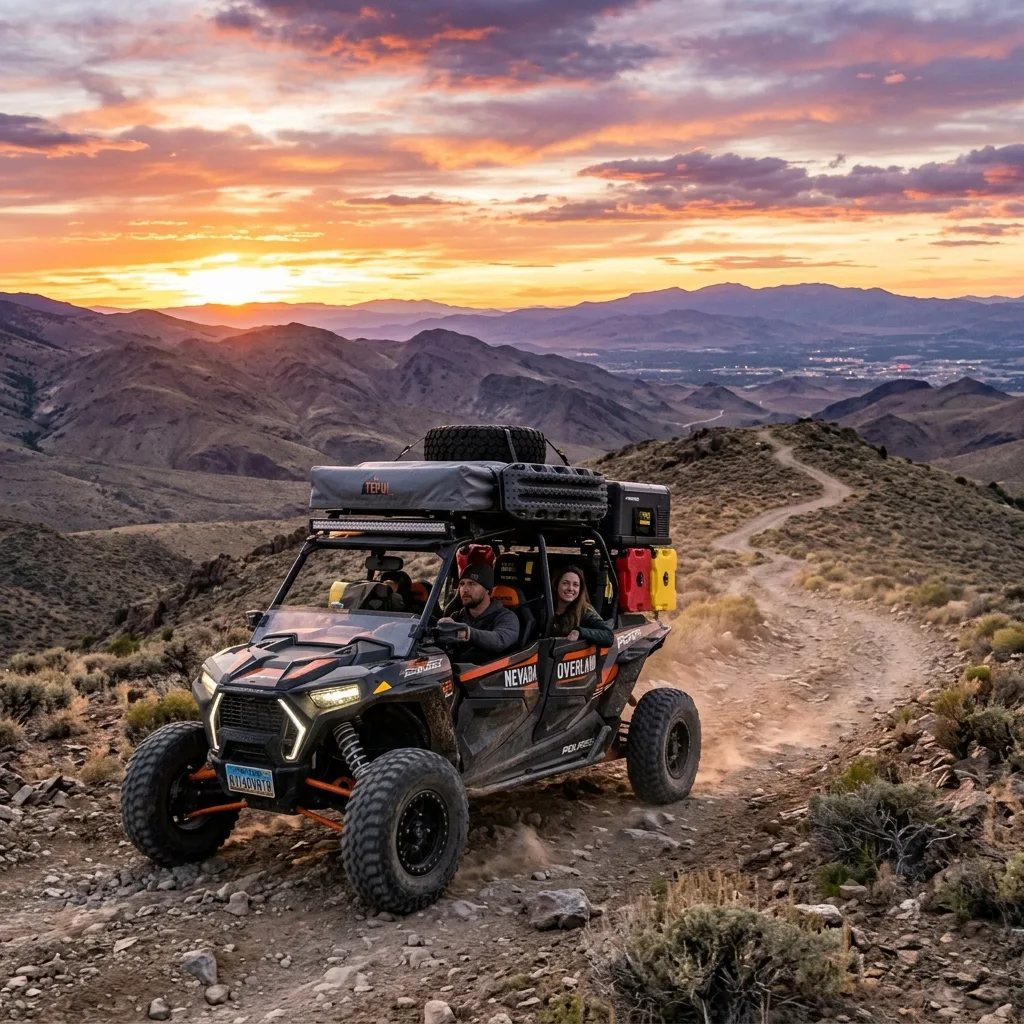
Washoe County is permissive but patchwork. Some routes cross paved county roads where OHV operation is restricted; others cross municipal jurisdictions where the state ban applies in full. Every trip required overlaying the route map with the OHV-permitted-roads map to identify gaps. With Montana registration, the planning problem disappears. Sarah staged her last trip from her driveway, drove south Reno county roads, picked up Highway 395 north for 40 miles, exited onto a forest service road, and was at camp by sunset. Total Montana cost: $749, one-time.
Case study 3: Marcus, Henderson — the Humvee veteran
Marcus is a retired Army master sergeant who bought his 1994 AM General M998 HMMWV at GovPlanet auction for $18,500, plus $6,000 in mechanical refurbishment.
Nevada DMV refused to title the Humvee for street use — the SF-97’s “Off Road Use Only” annotation, the missing FMVSS sticker, state classification of military vehicles as off-highway equipment. Marcus tried letters, a hearing request, and a Nevada vehicle-law attorney. Every path dead-ended at the same statutory wall.
The Montana route took 11 days. Zero Tax Tags formed the LLC, transferred the SF-97, and registered the Humvee. Because the vehicle is over 11 years old, it qualified for permanent registration immediately. Marcus now drives it to veterans’ events, the Henderson Veterans Day parade, and occasional cruise-ins. One Highway Patrol stop — the trooper ran the plate, confirmed the registration, and waved him on. Total cost: $749, plus zero dollars in renewal fees, ever.
Is it legal? Montana LLC UTV registration explained
Yes, with conditions. The longer version is worth understanding because it explains why this works particularly well for UTVs.
Montana’s authority to register vehicles owned by Montana LLCs is established state law. The legislature has explicitly chosen to allow LLCs to register vehicles regardless of where members reside. Montana courts have upheld it. Thousands of vehicles are registered through Montana LLCs every year. The legal framework is settled.
Federal reciprocity is the second leg. The Full Faith and Credit Clause and a long line of federal decisions require Nevada to recognize Montana’s vehicle registrations. Nevada cannot refuse a Montana plate, cannot impound a Montana-plated vehicle for being out-of-state registered, and cannot force re-registration simply because the owner spends time in Nevada.
Zero Tax Tags structures every registration around a genuine Montana LLC: real registered agent, proper annual filings with the Montana Secretary of State, full documentation. The compliance overhead is minimal — Zero Tax Tags handles all of it — and the structure is fully protected under federal constitutional law from day one.
Our process: $749, 11 days, done forever
Getting from initial contact to Montana plates in roughly 11 days. The pricing is flat and includes everything: LLC formation, vehicle registration, plate issuance, and shipping.
| Day 1: | Initial consultation with Zero Tax Tags. We collect your UTV details, photos, title or MSO, and VIN. You choose the LLC name. |
| Day 1–3: | Montana LLC formation. The LLC is filed with the Montana Secretary of State and assigned its operating documents. |
| Day 3–7: | Vehicle registration. Zero Tax Tags submits the registration paperwork to the Montana DMV with the LLC as the titled owner of your UTV. |
| Day 7–14: | Montana plates ship to your address. Mount the plate on the UTV. Legally street-registered. |
| Year 2: | Nothing. The plate is permanent. There is no annual renewal. |
What you provide: the UTV title or Manufacturer’s Statement of Origin if the vehicle is new and unregistered, the VIN, basic photos of the vehicle, and payment of the $749 flat fee. What you receive: a Montana LLC, a Montana title in the LLC’s name, a Montana registration, a permanent Montana plate, and registration documents to keep with the vehicle. No add-on fees, no shipping surprises, and no annual renewal bills coming six months later.
Models and equipment: what this works for
Montana registration through an LLC works for essentially every UTV, side-by-side, and off-highway four-wheeler currently in production, plus a wide range of other vehicles Nevada refuses.
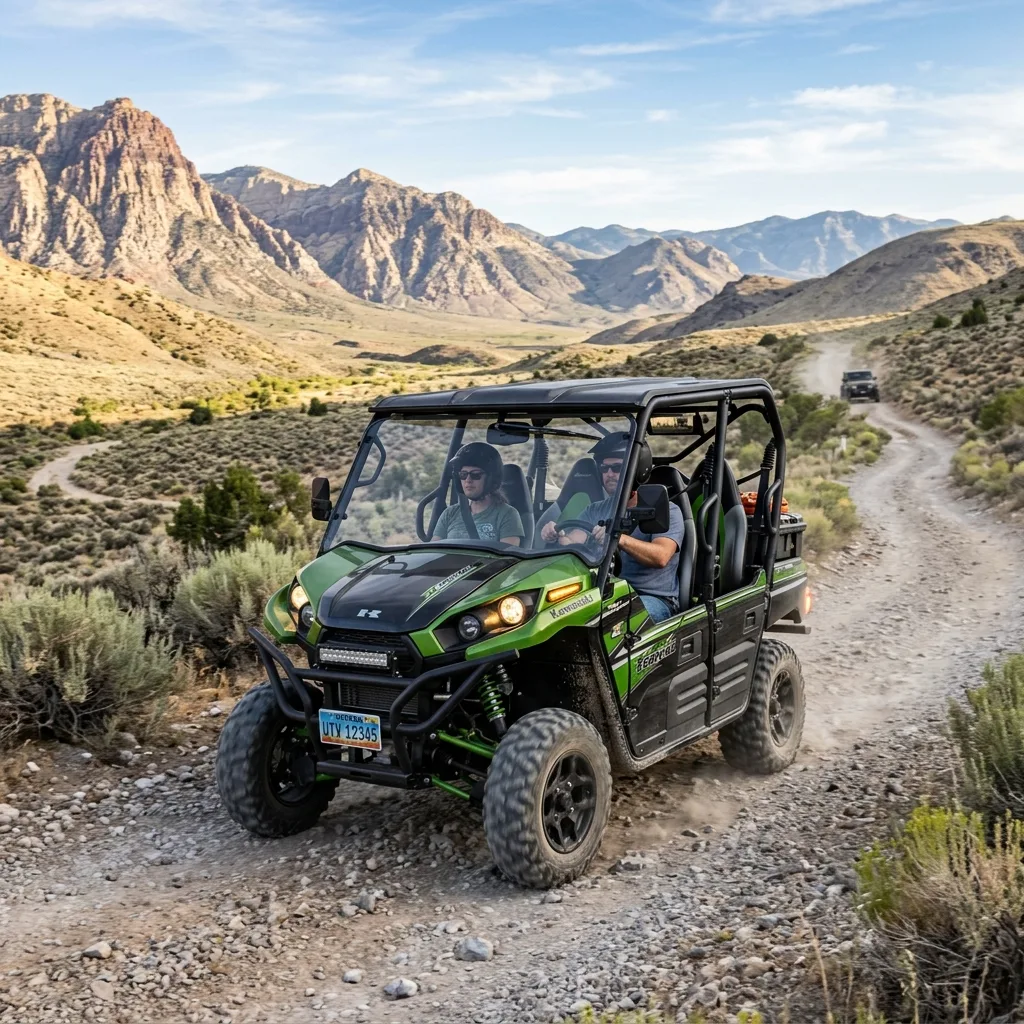
The Can-Am Maverick family is the dominant Nevada UTV and a perfect candidate — every variant from the X3 Turbo RR through the new Maverick R, plus the older Trail and Sport models. The Polaris RZR family registers the same way: Pro XP, XP Turbo S, XP 1000, X4, and the new RZR Pro R. Yamaha’s YXZ1000R, Kawasaki’s KRX 1000 and Teryx4 S, Honda’s Talon and Pioneer series, and the Polaris General all register without issue.
Beyond UTVs, the same approach works for dirt bikes the owner wants to dual-sport, traditional ATVs, ranch side-by-sides, surplus military vehicles from Humvees through the M35 Deuce and the LMTV/FMTV families, kit cars, hot rods without original VIN documentation, and modified trucks that fail Nevada emissions or safety inspections. If Nevada has refused to register it, Montana is worth a phone call.
The kit recommendation: Montana’s minimum — headlamp, stop lamp, brakes, horn, mirror, muffler, spark arrestor — is met by the most basic kits. A complete kit that adds turn signals, DOT tires, and a windshield makes the vehicle safer and better integrated with traffic. Montana asks for the minimum; the owner who installs more is the owner who comes home from every ride.
Frequently asked questions about Nevada UTV street legal registration
Why won’t Nevada DMV register my UTV for street use even with turn signals and DOT tires?
Nevada Revised Statutes section 490.060 defines off-highway vehicles by manufacturer design intent, not by installed equipment. If the UTV was designed primarily for off-highway use — and every UTV sold by Polaris, Can-Am, Yamaha, Kawasaki, and Honda is — the statute classifies it as an off-highway vehicle regardless of what equipment the owner adds afterward. The Nevada DMV has no statutory authority to issue street registration to a vehicle that falls inside the off-highway definition. The clerk’s hands are tied at the legislative level.
What is an OHV decal and why isn’t it the same as street registration?
The OHV decal costs $100 per year and allows a UTV to operate on designated unpaved trails and county roads, and to cross paved roads perpendicular to traffic for up to two miles when traveling between off-highway routes. It is not a street registration. It does not allow paved-road travel beyond the two-mile crossing limit. It does not allow highway use. It does not allow driving from a residential driveway to a trailhead unless the entire route is unpaved or qualifies under the limited crossing exception.
Can I register my military Humvee in Nevada?
No. Nevada DMV interprets the SF-97 disposal paperwork’s “Off Road Use Only” annotation as binding, and additionally cites the absence of FMVSS compliance certification as grounds for refusal. Montana takes a different approach — treating the HMMWV as a truck and registering it normally. Vehicles 11 years old or older qualify for permanent Montana plates, which means a 1990s-era Humvee can be permanently registered in Montana the moment the title transfers.
Does Montana registration really let me drive my UTV on Nevada roads?
Yes. The Full Faith and Credit Clause of the United States Constitution requires Nevada to recognize Montana’s vehicle registrations. A Montana-plated UTV is, in the eyes of Nevada law enforcement, a registered street vehicle from another state. It can be operated on any Nevada paved road, any Nevada highway, and any Nevada interstate, just like any other out-of-state-plated vehicle.
What equipment does Montana require for UTV registration?
Montana requires a working headlamp, a working stop lamp, functional brakes, an electric horn, at least one rearview mirror, a muffler, and a spark arrestor on the exhaust. No DOT tires required. No windshield required. No turn signals required, though nearly every street legal kit includes them and operating in traffic without them is asking for trouble.
Is there an annual renewal fee for Montana UTV registration?
No. Montana issues permanent registration on UTVs and other off-highway vehicles. The $749 one-time payment covers LLC formation, vehicle registration, plate issuance, and shipping. There is no annual renewal, no biennial renewal, and no scheduled DMV trip in the future. The permanent plate is permanent.
See how Montana LLC registration helps owners in other high-tax states:
- Nevada vehicle tax: the 8.25% trap and how to escape it
- Arizona VLT problem: how to stop paying $1,000 every year
Ready to drive your UTV home without a trailer?
Nevada won’t register your UTV for street use. Montana will. $749 one-time, $0 per year, permanent plate, forever. From your Summerlin driveway straight to Red Rock — legally.