
24 min read

On this page
- + The 13-County Emissions Dragnet
- • Ground Zero: Fulton County
- + The Birthday Month Bomb
- • The “Not Ready” Nightmare
- + Modifications Kill Your Registration
- + The $25 Test That Destroys Everything
- + The Montana LLC Solution
- + Cost Comparison: Atlanta vs. Montana
- + The TAVT Ambush: Georgia’s Hidden Tax
- + FAQ: Atlanta Enthusiast Edition
- + Real-World Case Studies
- + Stop Paying Rent on Your Freedom
Atlanta emissions testing has made owning a performance car inside the Perimeter a nightmare. If you live anywhere within the 13-county metro strap, you know the drill. Traffic on I-285 is the least of your problems. The Georgia Clean Air Force (GCAF) is running your registration into the ground.
For the guy in the Camry, it’s a $25 annoyance. If you actually care about your car, it’s a death sentence for your registration.
The system is designed to penalize performance. Atlanta’s rigorous emissions regime doesn’t care that your 2018 M3 is mechanically flawless; it cares that your O2 sensor readings don’t match the factory econobox parameters. They don’t care that your track-day WRX runs clean; they care that you modified the ECU.
This is the reality of the Atlanta Emissions Trap. If you are driving a gasoline-powered vehicle from model years 2002 through 2023, you are in the crosshairs.
I. How Atlanta Emissions Testing Blocks Modified Vehicles in 13 Counties
In the eyes of the Environmental Protection Division (EPD), Atlanta is a “non-attainment” zone requiring strict surveillance. While the rest of Georgia drives freely, residents of Cherokee, Clayton, Cobb, Coweta, DeKalb, Douglas, Fayette, Forsyth, Fulton, Gwinnett, Henry, Paulding, and Rockdale counties are subject to mandatory OBDII scanning and visual inspections.
The state claims this is about air quality. When you look at the economics, it looks a lot like a tax on the enthusiast lifestyle.
The Scope of the Surveillance
According to the Georgia EPD, approximately 3 million vehicles are tested annually in this region. The state has deputized over 700 testing stations — mostly lube shops and mechanics — to act as the gatekeepers of your right to drive. Of those 3 million, between 178,000 and 195,000 fail initial testing every year.
The trap is simple: No Pass = No Tag.
If your vehicle fails its emissions inspection, the Georgia Department of Revenue places a hard block on your registration renewal. You cannot renew online. You cannot renew at a kiosk. You cannot renew at the County Tag Office. Your vehicle becomes legally undrivable on public roads.
The “New Car” Illusion
A lot of Atlanta residents think newer cars are safe from the test. They’re not.
- The Rule: For the 2026 registration year, all gasoline vehicles from model years 2002 through 2023 must be tested.
- The Exemption: Only the three newest model years (2024, 2025, 2026) are exempt. Vehicles 25 years old and older (2001 and earlier) are also exempt.
This means a 2023 model — a car that is practically brand new — has just entered the testing cycle. If you bought a 2023 Mustang GT500 and put a tune and long-tube headers on it, your grace period is over. You are now in the system.
Ground Zero: Fulton County
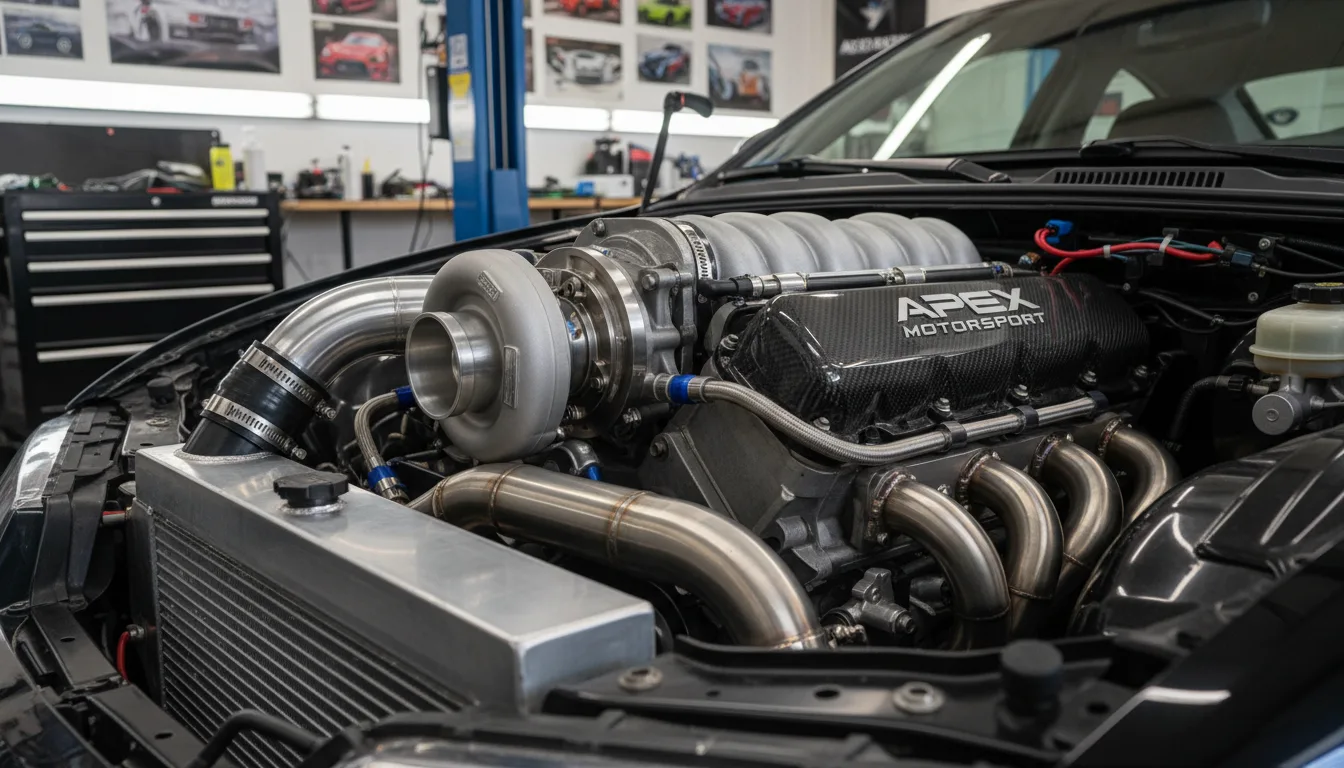
Fulton County is the epicenter of enforcement. Because the City of Atlanta sits primarily here, enforcement regarding “tampering” and visual inspections is notoriously aggressive. Unlike rural counties where a mechanic might look the other way, inspectors in the metro area are under high scrutiny from GCAF auditors. They are required to perform:
- OBDII Port Scan: To check for “readiness monitors” and diagnostic trouble codes (DTCs).
- Fuel Cap Inspection: Testing the seal integrity.
- Catalytic Converter Check: A visual confirmation that cats are present and not tampered with.
If you have a straight-piped 350Z, a deleted-DEF diesel, or a catalytic converter delete on your Hellcat, you aren’t just failing a test — you are flagging your vehicle as “tampered.”
The Reality Check:
A $25 test stands between you and your property rights. The moment you fail, your asset — whether it’s a $15,000 daily driver or an $80,000 weekend toy — becomes a 4,000-pound paperweight.
II. The Birthday Month Bomb: 30-Day Compliance Deadline Creates Registration Hell

In Georgia, your vehicle registration expires on your birthday. The state frames this as a convenience. In reality, it ensures that your birthday month is filled with anxiety, expenses, and potential legal threats.
The Georgia Clean Air Force explicitly recommends you test your vehicle “four to six weeks prior to the registration renewal date.”
Why such a long lead time? Because they know modified and older performance vehicles are likely to fail, and the diagnostic path to fixing them often takes longer than 30 days.
The “Not Ready” Nightmare
The most common frustration for Atlanta car enthusiasts isn’t a hard failure — it’s the “Not Ready” rejection.
Modern cars have onboard computers that run self-diagnostics called “Readiness Monitors.” If you have recently:
- Disconnected your battery (common during storage or modifications).
- Cleared a Check Engine Light with a scanner.
- Flashed a new ECU tune.
Your monitors will be reset to “incomplete.” For 2001 and newer vehicles, only one monitor can show “Not Ready” and still pass. Roll into a testing station in Gwinnett or Cobb County with two or more incomplete monitors and you will be turned away. You cannot pass until the car completes a “Drive Cycle.” That means 50 to 100 miles of specific driving patterns — extended steady-state cruising at 50 to 60 mph, periods of coasting in gear, deliberate idling — all of it nearly impossible in Atlanta stop-and-go traffic.
The Drive Cycle Trap:
Performing a factory drive cycle on I-285 or I-85 is physically dangerous and nearly impossible. You end up burning tank after tank of gas, driving endlessly at 3 AM, hoping the computer clicks over to “Ready.” Track-day cars with aggressive cams may never complete the drive cycle satisfactorily — their idle characteristics prevent certain monitors from ever setting.
The 30-Day Clock
The moment you fail an inspection, the clock starts ticking.
- The Free Retest: You get one free retest within 30 days at the same station.
- The Expiration: If your birthday passes while you are diagnosing a vacuum leak or trying to get your O2 sensor to read correctly, your tag expires.
- The Suspension: Driving on an expired tag in Atlanta is high-risk. Automatic License Plate Readers (ALPRs) are everywhere — from patrol cars to stationary poles in Buckhead. If you pass an ALPR with an expired tag, you risk a citation, fines, and vehicle impoundment.
No Grace Period for Hardware Failures
Let’s say you own a $50,000 BMW M4. You go for your test three weeks before your birthday. You fail because of a “Catalyst Efficiency Below Threshold” code — common with high-flow downpipes.
This is the Birthday Month Bomb. It turns a celebration into absolute registration hell.
III. Modifications Kill Your Registration: Aftermarket Exhausts, ECU Tunes, & Performance Parts
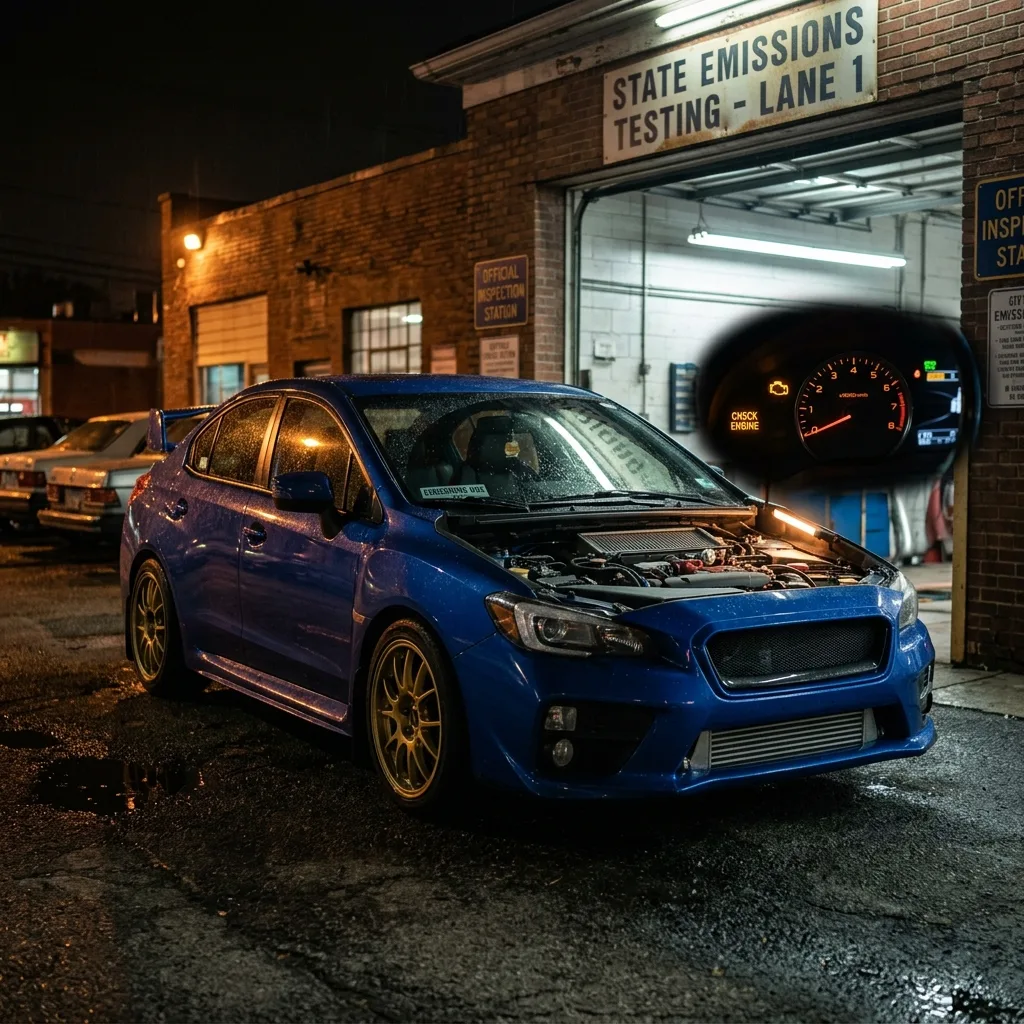
The Georgia emissions program is hostile to the aftermarket industry. If you are a tuner, you are the enemy. The parameters for passing an emissions test in Fulton or DeKalb counties are based strictly on Original Equipment Manufacturer (OEM) standards.
If you’ve modified your car at all, you’ve probably compromised its ability to pass the Georgia test.

Real-World Failure Scenarios
The $45,000 Modified Challenger (Exhaust Audit Fail)
- The Build: A Dodge Challenger Scat Pack with long-tube headers and a high-flow exhaust system.
- The Fail: The testing station inspector performs the required visual inspection of the catalytic converter. Because the long-tube headers moved the location of the cats, the inspector flags the vehicle for tampering.
- The Consequence: The owner must reinstall the restrictive factory headers and exhaust system to pass. Labor cost: $1,500+.
The $35,000 Tuned WRX (O2 Sensor Voltage)
- The Build: A Subaru WRX with an aftermarket downpipe and a “Stage 2” ECU tune.
- The Fail: The tune is designed to ignore the rear O2 sensor so it doesn’t throw a Check Engine Light. However, the Georgia emissions computer queries the OBDII system for sensor readiness. It sees that the O2 sensor monitor is “Unsupported” or “Not Ready.”
- The Consequence: Automatic rejection. The owner must flash the stock ECU map back onto the car. But running the stock map with an aftermarket downpipe causes a P0420 code. The owner is trapped in a loop: The tune fails readiness, but the stock tune fails the tailpipe reading.
The $50,000 BMW 335i/M3 (The “Tuner” Chip)
- The Build: A simple “piggyback” ECU tuner (like a JB4) to increase boost pressure.
- The Fail: Even if the car runs clean, these systems can interfere with the OBDII communication protocol or cause skewed fuel trim data. If the Short Term Fuel Trim (STFT) is outside the allowable range, the car fails.
Why They Fail: The Technical Breakdown
The 13-county testing area does not care why your light is on. If the Malfunction Indicator Lamp (MIL) is illuminated, you fail. Period.
IV. The $25 Test That Destroys Your Car Meet: Check Engine Lights & Failure Rates

The advertised cost of an emissions test in Georgia is “up to $25.” That $25 is the entry fee. The repair bill is what gets you.
The Georgia Clean Air Force proudly lists the “Top Reasons a Vehicle Fails Inspection,” but they gloss over the financial ruin these failures cause for enthusiasts.
The “Check Engine Light” (MIL) Guillotine
The GCAF states: “If the ‘Check Engine’ or ‘Service Engine Soon’ light is on… the light notifies motorists when something in the emissions control system fails.”
For a commuter, this might be a loose gas cap. For an enthusiast, this is often a fatal flaw in the build.
- Scenario: You are heading to the Caffeine and Octane car meet in Kennesaw.
- Problem: Your registration is due. Your Check Engine Light is on because of your aftermarket modifications.
- Reality: You cannot renew. You show up to the meet with an expired tag. Police patrol these heavy-traffic events specifically looking for expired registrations.
The Repair Waiver Trap
Georgia offers a “Repair Waiver,” but it is designed to bleed you dry before offering relief.
To get a waiver, you cannot simply say “I tried.” You must prove you spent a specific amount on emissions-related repairs to the vehicle.
The 2026 Repair Waiver Requirements:
Minimum Spend: $1,176 on qualified emissions repairs (adjusted up from $1,146 in 2025 by CPI — it goes up every year).
What Counts: Only emissions-related parts and documented labor. No estimates, no warranty work, no shop supplies, no disposal fees, no environmental fees.
The Result: You have to pay a shop more than $1,176 — in emissions-specific line items — just to get a piece of paper that lets you drive the car for one year. Then you do it all over again next birthday. The waiver is non-renewable and non-transferable.
The Diagnostic Hell
When you fail an emissions test in Atlanta, you lose your commute.
If you fail your test 10 days before your birthday, and the shop has a 2-week waitlist, you are guaranteed to have a lapsed registration.
The Bottom Line:
The Fulton County emissions test is a $25 toll booth that leads to a $2,000 repair bill. It penalizes you for maintaining your vehicle your way. It forces you to choose between your passion for cars and your ability to drive legally.
V. Escape Atlanta Emissions Testing Forever: The Montana LLC Solution

Stop letting Atlanta’s emissions bureaucracy dictate what you can do with your own property. The solution is not detuning your car every year just to satisfy a government computer. The solution is removing your vehicle from Georgia’s registration system entirely.
The solution is Jurisdictional Arbitrage.
By forming a Montana Limited Liability Company (LLC), you create a legal entity that exists specifically to hold assets. Your vehicle is titled to the LLC, and the LLC resides in Montana.
Why Montana?
According to the Montana Motor Vehicle Division, registration requirements are purely administrative. Nowhere in the registration statute is checking your catalytic converters or reading your OBDII port mentioned.
- Zero Emissions Testing: Montana has no statewide emissions testing. No sniffer tests. No visual inspections. No OBDII plug-in.
- The “Check Engine Light” is Irrelevant: In Atlanta, a CEL is a death sentence for your registration. In Montana, a CEL is just a light on your dashboard. You can run aggressive cams, catless downpipes, and heavily modified ECUs without fear.
- Federal Law Requires Recognition: The Commerce Clause and Full Faith and Credit Clause of the U.S. Constitution require every state — including Georgia — to recognize Montana’s vehicle registrations and titles. The vehicle belongs to a Montana business entity. The plate is correct everywhere.
The Legal Foundation: The Montana Motor Vehicle Division registers vehicles owned by Montana LLCs. Federal constitutional law — the Commerce Clause and Full Faith and Credit Clause — requires Georgia and every other state to recognize that Montana plate. Your car lives in Alpharetta. Its title lives in Montana. Georgia never gets a vote.
VI. Cost Comparison: Atlanta Emissions vs. Montana Freedom
The hard numbers. Comparing a 10-year period for a modified performance car kept in Fulton County versus the same car in a Montana LLC.
The Atlanta “Emissions Trap” Scenario (10 Years)
The Montana LLC “Freedom” Scenario (10 Years)
The Result: You save over $3,400 across 10 years and gain the ability to modify your car without restriction. And that’s before factoring in the TAVT you’ll never pay.
VII. The TAVT Ambush: The Tax Georgia Forgot to Tell You About

Here’s the part of the Georgia ownership story nobody warns you about until the title clerk slides the invoice across the counter: the Title Ad Valorem Tax, or TAVT. Emissions testing is the recurring annual punch. TAVT is the haymaker that lands the moment you try to put a car in your name. And it lands hard.
TAVT is a one-time tax of 7.0% of the fair market value of any vehicle you title in Georgia, charged the moment paperwork hits the county tag office. It replaced the old annual ad valorem “birthday tax” back in 2013, and the rate jumped to its current 7.0% on July 1, 2023. Every car titled in Georgia after March 1, 2013 gets hit. There is no escape clause for enthusiasts. There is no break for “I already paid sales tax in another state.” If the title goes Georgia, the tax goes with it.
And here’s where it gets vicious for car people: the calculation is not based on what you actually paid when you buy from a private seller. Georgia uses its own state assessment manual — a wholesale-plus-retail average — and taxes you on that number. So when you find a guy on Bring a Trailer willing to let his GT3 go for ten grand under market because he needs to fund a divorce, Georgia doesn’t care. The state looks up its book value, averages the wholesale and retail figures, and bills you on that. Your “deal” gets taxed at near-retail. Welcome to Atlanta.
What TAVT Actually Costs on a Performance Car
A vehicle titled in Montana via an LLC is never titled in Georgia. No Georgia title means no Georgia TAVT — not reduced, not deferred, not whittled down. Just zero. Georgia never sends the bill.
The Win: An $80,000 enthusiast car titled in Montana skips the $5,600 TAVT entirely. Add ten years of dodged emissions failures, repair-or-waiver cycles, and the 13-county dragnet, and the Montana LLC structure isn’t just saving you tags — it’s saving you a down payment on the next car.
This is the part the Georgia tag office never volunteers. They wait until you’ve signed the bill of sale, driven the car home, and walked in feeling proud of your purchase. Then the clerk hits Enter and quietly tells you that you owe five-figure tax on a private transaction the state had nothing to do with. The Montana LLC doesn’t argue with that system. It simply opts out before the trigger ever fires. The car is titled, registered, and plated in Montana — a state that does not levy TAVT, does not run emissions tests, and does not care how loud your exhaust is. Your car lives in Alpharetta. Its title lives in Montana. Georgia never sends the invoice.
VIII. FAQ: Atlanta Enthusiast Edition
Q: Can I drive my Montana-plated car to Caffeine & Octane at Perimeter Mall?
A: Yes. Walk around the lot next month. Count the Montana plates on the McLarens, Ferraris, and tuned Supras. You aren’t hiding; you are operating under a different tax jurisdiction. It is a status symbol of the smart enthusiast.
Q: My birthday is in November. When do I renew my Montana tags?
A: Forget your birthday. Montana registration isn’t tied to your birth month like Georgia. It is generally 12 months from the registration date, unless you choose Permanent Registration (available for vehicles 11+ years old), in which case you never renew again.
Q: Will I fail a Montana inspection if I have a Check Engine Light (CEL) for an O2 sensor?
A: No. There is no inspection. There is no OBDII scan. Montana does not care if your dashboard is lit up like a Christmas tree.
Q: I have a heavily modified WRX that won’t pass Fulton emissions. Can this fix it?
A: Absolutely. Since there is no sniffer or OBDII test, your catless downpipe and aggressive tune are non-issues.
Q: Does avoiding the TAVT in Georgia offset the LLC cost?
A: Often, yes — and dramatically so. Georgia charges a 7.0% TAVT on the fair market value of the car upon titling. For a $50,000 car, that’s $3,500 — covering the entire first-year Montana LLC cost nearly four times over. For a $80,000 car, you save $5,600 on TAVT alone. The math gets better the more the car is worth.
Q: My car is from 2001. Am I subject to Georgia emissions testing?
A: No. Vehicles 25 model years and older are exempt from testing in the 13-county Atlanta area, and for the 2026 registration year, 2001 is exactly the cutoff — just outside the testing window. The tested range for 2026 is model years 2002 through 2023. The newest three model years (2024, 2025, 2026) are also exempt. Your 2001 sits in the sweet spot. Enjoy it.
Q: I bought my $75,000 Porsche privately, not from a dealer. Does Georgia’s TAVT still apply?
A: Yes, and private buyers get hit hardest. $75,000 at 7.0% equals $5,250 in TAVT — but it gets worse, because the state doesn’t use what you actually paid. Georgia pulls its own assessment manual, averages the wholesale and retail values, and taxes you on that number. If you negotiated a $5,000 discount, the state pretends the discount never happened and bills you on near-retail value anyway. There are no trade-in deductions on private sales either. The Montana LLC avoids the entire situation because your vehicle is never titled in Georgia.
Q: The repair waiver threshold keeps going up. What’s it at for 2026?
A: $1,176 for 2026, up from $1,146 in 2025. Georgia adjusts the threshold every year by the Consumer Price Index — it creeps higher annually. And the rules on what counts toward that number are brutal. Only emissions-related parts and documented labor qualify. No estimates, no warranty work, no shop supplies, no disposal fees, no environmental fees. Walk out with a $2,000 invoice where only $800 is classified as emissions-related, and you don’t qualify. The waiver is also non-renewable and non-transferable — you get one shot per cycle.
Q: I tuned my ECU last week. Now my monitors won’t set. Can I do a drive cycle in Atlanta?
A: Theoretically yes. Practically, Atlanta is the worst city in the South to attempt a drive cycle. After an ECU tune, battery disconnect, or monitor reset, your vehicle needs roughly 50 to 100 miles of mixed city and highway driving to set its monitors back to “Ready” status. The cycle requires extended steady-state cruising at 50 to 60 mph, periods of coasting in gear, deliberate idling, and gradual acceleration — all without hard launches. Picture doing that on I-285 at 4:30 PM. Track-day cars with aggressive cams have it even worse — their idle characteristics may prevent the EVAP and oxygen sensor monitors from ever setting, meaning the car never becomes test-ready no matter how far you drive it. Montana removes you from this equation entirely.
Q: Be honest, will my insurance cover me?
A: Only if you are honest with your carrier. Tell them: “The car is owned by my LLC in Montana, but I keep it at my house in Atlanta.” If they verify the VIN and the garaging zip code, they will write the policy. Progressive, State Farm, Hagerty, and Grundy all write Montana-LLC-titled vehicles routinely.
IX. Real-World Case Studies
Case Study 1: The Multi-Car Tuner (Marcus)

Profile: Sandy Springs (Fulton County) resident with three modified cars:
- Subaru WRX STI: Catless downpipe, protune
- Mustang GT: Long tube headers, ghost cam tune
- E46 Drift Missile: Gutted, straight-piped
The Horror Story: Marcus’s birthday is in June. Every May, he enters a living hell. None of his cars will pass the OBD-II plug-in test.
The Georgia Math: To qualify for Repair Waivers, he must spend $1,176 per vehicle annually on qualified emissions repairs. The GCAF explicitly states that his own labor does not count.
Total Annual Burn: $3,500+ per year, every year, just to drive his own property.
Case Study 2: The “Heavy Duty” Miscalculation (Jason)
Profile: Marietta (Cobb County) resident with a supercharged Ford F-150 (5.0L).
The Horror Story: Jason assumed his truck was big enough to be exempt. Wrong. Georgia only exempts vehicles with a GVWR of more than 8,500 lbs. His half-ton truck is rated at 7,050 lbs.
Because of his supercharger and high-flow cats, he fails immediately. His option? Revert the truck to stock — roughly $2,000 in labor and parts — or park it. He can’t even sell it locally because Georgia law requires the seller to provide a passing VIR at the time of sale within the 13-county area.
Case Study 3: The Track Day Purist (Sarah)
Profile: Alpharetta resident with an E92 M3 track build.
The Horror Story: Sarah keeps her M3 street-legal solely to drive to Road Atlanta and Barber Motorsports Park. She kills the battery switch during winter storage. When she wakes the car up, all OBD monitors reset to “Not Ready.”
She missed the first two track weekends of the year because her tag expired while she was doing laps on I-285 trying to get her Oxygen Sensor monitors to set. She got a ticket for expired tags while doing the drive cycle required to renew the tags.
Case Study 4: The Budget Project (Tyler)
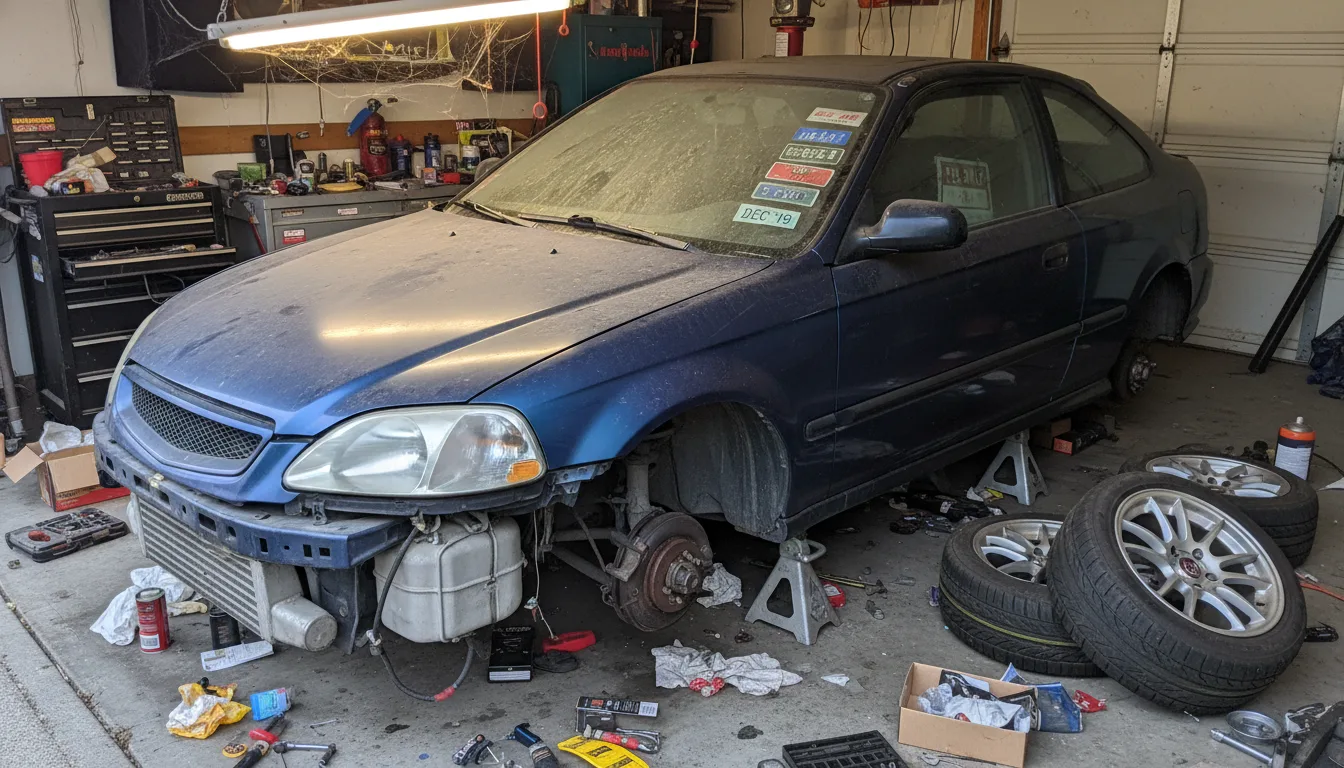
Profile: Atlanta car meet regular with a Honda Civic Si project car.
The Horror Story: Tyler bought the car cheap. The previous owner pulled the bulb on the Check Engine Light. Tyler goes to the kiosk, pays his $25 test fee, and fails instantly for a missing catalytic converter.
The Financial Ruin: Replacing the cat with an OEM unit costs $1,800. Tyler bought the car for $4,000.
He applies for a waiver, but the $1,176 repair minimum applies to everyone, regardless of the car’s value. Tyler can’t afford the repairs. He can’t afford the waiver. The car sits on jack stands, collecting dust and code enforcement fines.
Case Study 5: The TAVT Gut-Punch — Derrick
Profile: Alpharetta resident in Forsyth County. Tech executive who has been collecting Porsches for a decade. Owns a 2014 Cayman S, a 2018 Macan GTS, and has been hunting for a track weapon for two years.
The Purchase: Derrick finds a 2019 Porsche 911 GT3 RS — Lizard Green, 12,400 miles, second owner. The seller is a doctor in South Carolina who wants it gone fast. Asking price was $200,000; Derrick negotiates it to $185,000. He trailers the car back to Alpharetta on a Saturday afternoon. He’s never been more excited about a purchase.
The TAVT Gut-Punch: Monday morning, he walks into the Forsyth County Tag Office to title the car in Georgia. The clerk types in the VIN. The state assessment manual returns a fair market value of $195,000 — ten thousand dollars higher than what he actually paid. Georgia uses its own assessment manual on private sales, period. The TAVT calculation runs: $195,000 multiplied by 7.0% equals $13,650 due today. Not financed. Not deferred. Due now, before the title transfer can be completed.
Derrick had also already modified the car: the previous owner installed an Akrapovič titanium exhaust with race headers — a $9,800 system that is a guaranteed visual emissions failure at the next biennial inspection. He is staring down $13,650 in TAVT plus a near-certain repair-or-waiver cycle within 24 months. Total first-year Georgia cost: $13,675+ and climbing.
The Montana Solution: Derrick’s accountant referred him to Zero Tax Tags before he completed the Georgia title transfer. We formed his Montana LLC in 48 hours. The Porsche was titled directly to the LLC in Montana — never registered in Georgia at all. No TAVT trigger. No Georgia title. No emissions testing. The Akrapovič stays bolted on. Plates were FedExed to his Alpharetta address within 10 days. First-year total: $899. Net savings versus Georgia title: $12,751 minimum.
X. Stop Paying Rent on Your Own Freedom
The State of Georgia has built a four-layer trap for car enthusiasts, and if you live in the 13-county metro area, you are already in it.
- The TAVT Hit: 7.0% of fair market value the moment you title the car in Georgia. $5,600 on an $80,000 car. Due at the tag office before you can legally drive it.
- The Birthday Deadline: They tie your registration to your birthday, ensuring your panic sets in exactly when you should be celebrating.
- The Modification Penalty: They scrutinize your ECU, your fuel cap, and your catalytic converters, actively punishing you for improving your vehicle’s performance.
- The Repair Waiver Extortion: Raising the “pay-to-play” waiver fee to $1,176 for 2026 ensures that only the wealthy can buy their way out of compliance — and even then, only temporarily.
The Financial Summary: Georgia vs. Montana LLC (3 Cars, 5 Years)
You modify your cars because you refuse to drive a boring appliance. Stop accepting a boring, restrictive, and expensive bureaucracy.
- Montana doesn’t care about your catalytic converters.
- Montana doesn’t care about your ECU tune.
- Montana never taxes you on the purchase.
- Montana doesn’t require you to bring your car to them.
By registering your vehicle through a Montana LLC, you act as your own fleet manager. You strip the power away from the local tag office and the Georgia Clean Air Force. You get a permanent plate (for vehicles 11+ years old) or a simple, emissions-free renewal process. Your car lives where you do. The title lives where the taxes don’t.
Ready to Escape Atlanta’s Emissions Trap?
Atlanta car enthusiasts have saved thousands with Montana LLC registration — on TAVT alone, before a single emissions test. Your car. Your mods. Your way.