
25 min read

On this page
- + The Paradise Tax Shock
- + Understanding Hawaii Vehicle Tax: The GET Trap
- + The Weight Tax Trap: Honolulu’s 7-Cent Hammer
- + The Shipping Cost Trap
- + The 2025 EV Surcharge Surprise
- + 5-Year Cost Comparison Tables
- + Real Hawaii Vehicle Tax Case Studies
- + The Montana LLC Solution
- + Is the Montana LLC Strategy Legal?
- + Who Benefits Most from Montana Registration
- + Our 10-Day Process Timeline
- + Who This Is Built For
- + Hawaii Vehicle Tax FAQs
- + Stop Overpaying Hawaii Taxes
The Paradise Tax Shock: Aloha to Your Money
Hawaii vehicle tax hits different. You move to paradise — or you finally treat yourself after years of dreaming about it — and you decide to buy the SUV you’ve always wanted. A $185,000 Porsche Cayenne Turbo. A $92,000 Toyota Land Cruiser. Maybe a $1.2 million Prevost motorhome to chase sunsets along Oahu’s North Shore. You hand over the cashier’s check, sign the paperwork, and assume the worst is behind you. Then the dealer slides one final invoice across the desk.
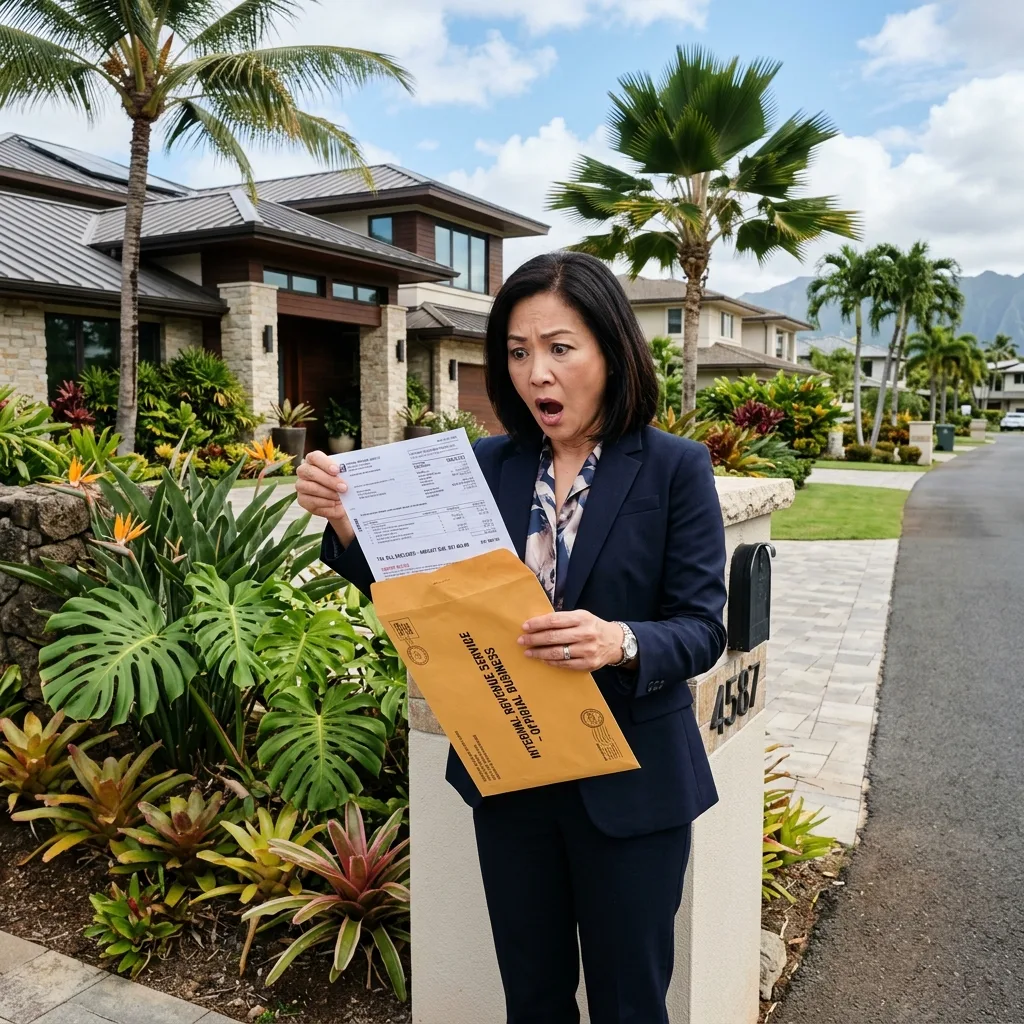
That last invoice is the moment Hawaii residents discover the cruelest secret of island car ownership. The state’s General Excise Tax (GET) — combined with brutal county weight taxes, mandatory inter-island shipping fees, and a brand-new EV road usage charge that took effect July 1, 2025 — creates one of the most punishing vehicle tax structures in America. According to the Hawaii Department of Taxation, the GET applies to virtually every dollar that changes hands in the islands, including the price of a vehicle, the cost of shipping it across the Pacific, and even the gross receipts of the dealership itself in many cases.
The result? Hawaii residents routinely pay $8,000, $12,000, even $50,000 or more in upfront tax just for the privilege of registering a vehicle in the 50th state. And then the weight tax kicks in every single year for as long as you own the vehicle. By the time five years pass, a luxury SUV owner in Honolulu has often paid more in Hawaii vehicle tax than the entire purchase price of an equivalent used vehicle on the mainland. This is why physicians, retirees, contractors, RVers, and collectors across Hawaii are quietly registering their high-value vehicles in Montana through a properly formed LLC. The savings are immediate and often top $50,000 on a single luxury vehicle over five years.
Understanding Hawaii Vehicle Tax: The GET Gross-Up Trap

Most states call it sales tax. Hawaii calls it General Excise Tax. The difference is far more than semantic. The GET is technically a tax on the gross receipts of the seller, not on the buyer’s purchase. But because Hawaii law allows sellers to pass the GET on to buyers, and because they are also allowed to charge GET on the GET itself (a process called the “gross-up”), the effective rate paid by consumers is higher than the statutory rate.
The Statutory Rate vs. the Effective Rate
The base GET rate is 4 percent statewide. Each county can add a 0.5 percent surcharge, which Honolulu, Kauai, and Hawaii County all have done. So the statutory rate in Honolulu is 4.5 percent. That sounds reasonable until you realize that the seller is allowed to gross up the price to recover the GET they themselves owe. After the gross-up math is applied, the effective rate paid by Honolulu consumers is 4.712 percent. Outside Honolulu, in counties with no surcharge, the effective rate is 4.166 percent. Maui, which had no surcharge for years, now has its own 0.5 percent county tax, bringing its effective rate to 4.712 percent as well.
This may seem like a small difference, but on a $185,000 vehicle, the gap between 4.5 percent and 4.712 percent is roughly $392 — and that’s just the gross-up alone. The Hawaii vehicle tax structure is designed to extract maximum revenue at every step.
No Trade-In Credit — A Brutal Difference
Critical warning: Hawaii does NOT allow a trade-in credit against the GET. If you trade in a $50,000 vehicle toward a $150,000 purchase, you still pay GET on the full $150,000 — not on the $100,000 difference. Most mainland states allow a trade-in credit. Hawaii does not. This single rule costs Hawaii buyers thousands of extra dollars on every transaction.
This rule alone makes Hawaii vehicle tax punishing for anyone who upgrades vehicles regularly. A Hawaii resident who trades up every five years can pay tens of thousands more in GET over their lifetime than a mainland resident making identical decisions. The trade-in penalty is invisible to most buyers until they do the math — and by then the check has already been written.
GET Applies to Everything
The GET is one of the broadest consumption taxes in the United States. It applies to the vehicle purchase price, dealer documentation fees, dealer-installed accessories, optional warranties, and the cost of shipping the vehicle to Hawaii from the mainland. Every dollar of the transaction is taxed. There are no meaningful exemptions for private-party sales between residents either; private vehicle sales are subject to GET when the seller is engaged in a regular activity of selling.
Understanding Hawaii vehicle tax requires more than just reading the rate. The structure of the tax, combined with the broad base, makes it one of the most expensive vehicle taxes in America for anyone purchasing a high-value car, truck, SUV, or motorhome.
The Weight Tax Trap: Honolulu’s 7-Cent Hammer
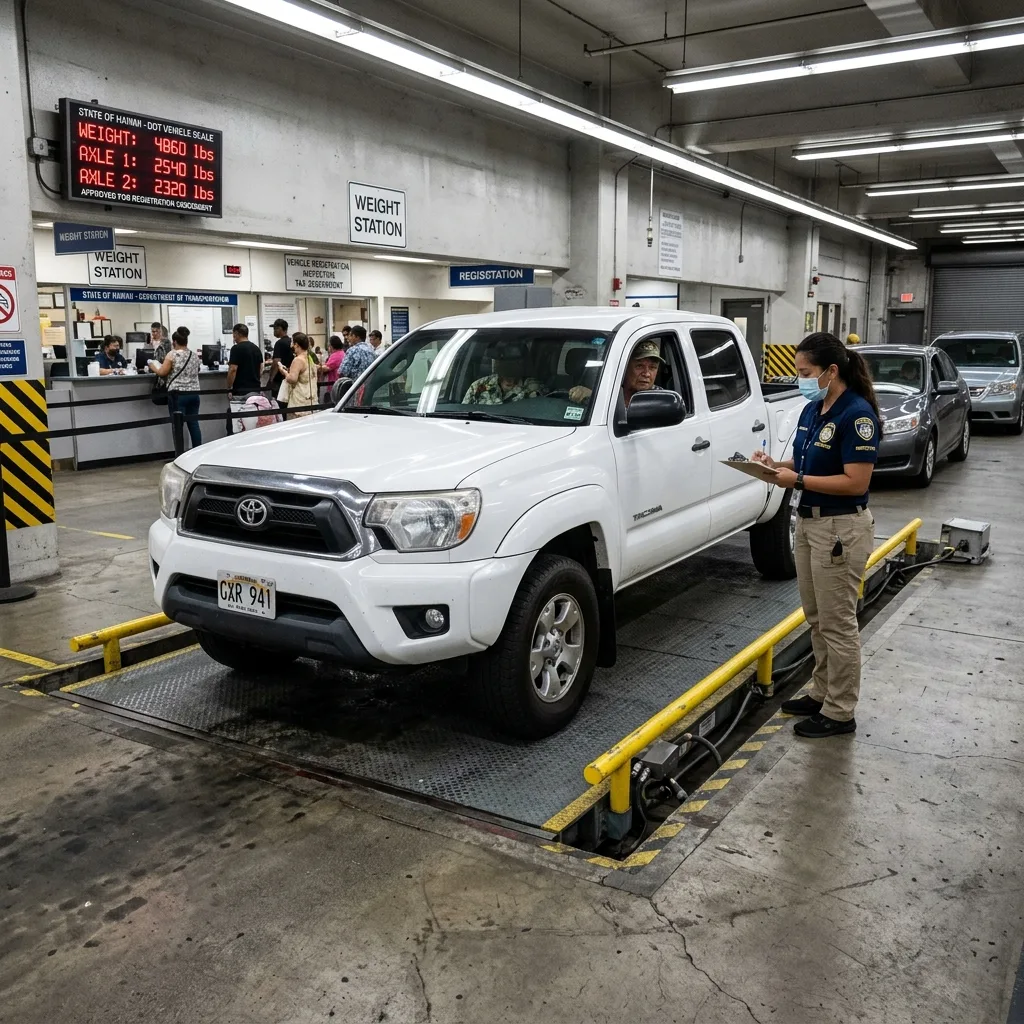
If the GET is the upfront punch, the annual weight tax is the slow body blow that lands every single year you own the vehicle. Under Hawaii Revised Statutes Chapter 249, every passenger vehicle in Hawaii is subject to a weight tax that varies dramatically by county. The tax is calculated by multiplying the vehicle’s net weight (up to a 10,000 lb maximum, with most passenger vehicles capped at 8,000 lb) by a per-pound rate set at the county level.
The County-by-County Weight Tax Comparison
This is where Hawaii vehicle tax becomes genuinely strange. The weight tax rate varies wildly depending on which island you live on. A Hawaii County (Big Island) resident with a 6,000 lb truck pays $75 per year. A Honolulu resident with the same truck pays $420 per year. Same state. Same vehicle. Five-and-a-half times the tax. The geography of where you happen to live in paradise has more impact on your annual vehicle tax than the make and model of the vehicle itself.
How the Weight Tax Compounds
The weight tax is paid every year, not just once. A Honolulu resident who purchases a 5,500 lb Range Rover Sport and keeps it for five years will pay $1,925 in weight tax alone — on top of the GET, on top of the registration fees, on top of the safety inspection. That’s nearly $2,000 in pure annual recurring vehicle tax that mainland owners never face.
For owners of larger vehicles, the math gets brutal. A 6,200 lb Land Rover Defender in Honolulu generates a $434 annual weight tax. A 5,800 lb Toyota Land Cruiser racks up $406 per year. A Class A motorhome that weighs 32,000 lbs is statutorily capped at 8,000 lb for weight tax purposes — a small mercy that still produces a $560 annual bill in Honolulu, or $2,800 over five years.
Important note: The Honolulu, Maui, and Kauai weight tax of 7.0 cents per pound is one of the highest per-pound vehicle taxes in the United States. Most states base recurring vehicle taxes on value (like Virginia’s personal property tax) or simply charge a flat registration fee. Hawaii’s three high-tax counties charge based on weight, which disproportionately punishes owners of trucks, SUVs, and motorhomes — exactly the kind of vehicles many island residents need or want.
The recurring nature of the weight tax is what makes Hawaii vehicle tax so different from mainland sales tax. In Texas or Florida, you pay sales tax once and you’re done. In Honolulu, you pay GET upfront AND you pay weight tax forever. There’s no exit ramp from the annual weight tax — unless you register in Montana.
The Shipping Cost Trap: Taxed for Living on an Island

There is no domestic auto manufacturing in Hawaii. Every single vehicle on the islands had to be shipped there at some point, and that shipping cost is anything but trivial. A standard sedan shipped from Los Angeles or Oakland to Honolulu typically costs between $1,200 and $2,000. An SUV or pickup runs $1,800 to $2,800. An RV or motorhome can easily exceed $5,000 to $9,000 depending on length and routing. And here’s the kicker that most buyers don’t realize until it’s too late: under Hawaii’s GET rules, when shipping is part of the dealer transaction, that shipping cost is added to the taxable base.
How the Shipping Tax Stack Works
When a Hawaii dealer sells you a vehicle, the price they quote often includes the cost of shipping the vehicle to the islands. The GET applies to the entire selling price — including the embedded shipping cost. That means you are paying GET on the cost of putting your vehicle on a boat. On a $180,000 luxury SUV with $2,500 in shipping, the embedded shipping triggers approximately $118 in extra GET (at the 4.712 percent Honolulu effective rate). It’s a small slice of the total bill, but it’s the perfect symbol of how the GET extracts revenue from every link in the supply chain.
For private buyers who arrange their own shipping, the math is slightly different — you pay for the shipping directly to the carrier, but the GET on the vehicle purchase still applies if the transaction was structured through a Hawaii dealer or broker. Either way, the cost of getting a vehicle to paradise is built into the tax base.
The Inter-Island Shipping Penalty
If you live on Maui, Kauai, or the Big Island and you buy a vehicle from a Honolulu dealer, you typically pay an additional $200 to $400 inter-island shipping fee. That fee is also part of the taxable base. And if you ever move from Oahu to a neighbor island and bring your vehicle with you, you’ll pay shipping again — and you’ll re-register the vehicle in your new county at the new county’s weight tax rate.
The hidden cost: Hawaii residents who buy luxury vehicles from mainland dealers and ship them across often discover the GET still applies in full, because the use tax (a sister tax to GET) catches imported vehicles. The combined shipping cost plus full taxation makes “buying it cheaper on the mainland and shipping it” a far less attractive strategy than most expect.
This is one of the structural reasons why a properly formed Montana LLC is so attractive to Hawaii residents. When the LLC owns the vehicle and the vehicle is registered in Montana, the upfront GET on the purchase can often be avoided entirely (subject to legal structure and use patterns), and the recurring weight tax disappears completely. The shipping cost still exists — physics is physics — but the tax stack on top of the shipping cost evaporates.
The 2025 EV Surcharge Surprise

Just when Hawaii vehicle tax couldn’t seem to get any more aggressive, the legislature added one more layer in 2025. Effective July 1, 2025, every electric vehicle and plug-in hybrid registered in Hawaii is subject to a new EV Road Usage Charge. The stated purpose of the charge is to recover the gas tax revenue that EV drivers don’t pay at the pump. The reality is that it’s another recurring annual fee stacked on top of an already brutal tax structure.
How the EV Charge Works
EV owners can choose between two options. Option one is a per-mile charge of $8 per 1,000 miles driven, capped at $50 per year for the 2025-2028 transition period. Option two is a flat annual fee of $50. Most drivers will simply choose the flat fee since the per-mile cap and the flat fee are identical. The interesting wrinkle is that starting July 1, 2028, the per-mile tracking becomes mandatory and the cap may be lifted, which means high-mileage EV drivers in Hawaii could see their road usage charge climb significantly.
The EV charge applies on top of the weight tax, on top of the registration fee, on top of the GET that was already paid at purchase. Hawaii EV owners are now paying the highest combined tax stack in the United States for the privilege of driving electric on the islands.
How Montana Handles EVs
Montana also charges EV fees — but the structure is dramatically more favorable. Montana imposes a flat $130 per year fee for battery electric vehicles under 6,000 pounds and a flat $70 per year fee for plug-in hybrid electric vehicles. There is no per-mile tracking. There is no cap that lifts in 2028. There is no weight tax stacked on top. For a Hawaii EV owner who registers a Tesla Model Y or a Rivian R1S in Montana, the annual recurring tax burden drops from potentially $700 or $800 per year (Honolulu weight tax + EV charge + registration) to $130 plus standard Montana registration fees.
5-Year Cost Comparison: Hawaii vs Montana

Put Hawaii vehicle tax side-by-side with Montana LLC registration and the math becomes very hard to argue with. Below are 5-year all-in cost comparisons for representative vehicle types in Hawaii’s most populated county (Honolulu).
Honolulu County: 5-Year Cost by Vehicle Type
5-Year Cost by Hawaii County (Same $185K Vehicle)
Real Hawaii Vehicle Tax Case Studies

Numbers in tables are useful, but real-world case studies make the Hawaii vehicle tax problem unmistakable. Four scenarios, drawn from actual Hawaii vehicle owners (names changed).
Case Study 1: Dr. Sarah K., Honolulu Physician
Dr. Sarah K. is a successful cardiologist practicing in Kakaako. She purchased a $185,000 Porsche Cayenne Turbo, weight 5,400 lbs. The math hit hard: $8,711 in upfront GET at Honolulu’s 4.712 percent effective rate. Annual weight tax of $378. Annual registration and inspection fees of approximately $100. Over five years, her total Hawaii cost reached $11,461.
Through a Montana LLC, Dr. K. paid Year 1 costs of $1,724 (the over-$150k vehicle tier) and approximately $270 per year in renewals. Five-year Montana total: $2,804. Net savings over five years: $8,657. That’s enough to fund a private wine cellar, a year of her daughter’s tuition at Punahou, or a serious investment in her practice.
Case Study 2: Marcus and Linda T., Maui Retirees

Marcus and Linda T. retired to Maui after 35 years on the mainland. They purchased a $92,000 Toyota Land Cruiser, weight 5,800 lbs, primarily for trips up to Haleakala and along the Hana Highway. Their Hawaii vehicle tax math: $3,832 in upfront GET (Maui’s 4.166 percent effective rate at the time of analysis), $406 annual weight tax, plus registration and inspection. Five-year Hawaii total: approximately $5,862.
Because their Land Cruiser fell under the $150k threshold, the Montana LLC structure cost them $899 in Year 1 and $270 per year thereafter. Five-year Montana total: $1,979. Net savings: $3,883. For retirees on a fixed income, that’s nearly four years of their property tax bill on their Kihei condo.
Case Study 3: Jake R., Big Island Contractor
Jake R. runs a residential framing crew in Hilo. He purchased a $68,000 Ram 2500, weight 6,400 lbs. Hawaii County’s weight tax of 1.25 cents per pound makes Jake’s annual weight tax just $80. Combined with his GET of approximately $2,833 (4.166 percent effective rate) and registration fees, his five-year Hawaii cost lands at roughly $3,600.
Through Montana, Jake’s five-year total would be $1,979 — saving him about $1,621. The savings are real, but they’re a fraction of what his Honolulu cousin would save on the same truck. Jake’s situation is a useful reminder: Big Island residents with utility vehicles see modest savings. The Montana LLC is most powerful for high-value vehicles in high-tax counties. For a working contractor on the Big Island, the savings are real but the case is less compelling than for a Honolulu luxury SUV owner.
Case Study 4: The Nakamura Family, Honolulu Class A Motorhome

The Nakamura family purchased a $1.2 million Prevost Marathon Class A motorhome with 32,000 lbs of actual weight. Under Hawaii’s weight tax cap of 8,000 lbs, their annual weight tax in Honolulu is $560. Their upfront GET at 4.712 percent is a staggering $56,534. Add five years of weight tax ($2,800) plus registration, inspection, and insurance compliance fees, and the five-year Hawaii cost exceeds $60,000.
Through Montana, the Nakamuras paid $1,699 in Year 1 (the RV tier for vehicles over $150k) and approximately $270 per year in renewals. Five-year Montana total: $2,779. Net savings: over $57,000. The Montana strategy paid for the family’s entire trip back to the mainland to drive the Prevost during the off-season — twice over.
The Montana LLC Solution: How It Actually Works
Montana is the only state in the country with no general sales tax, and it offers a uniquely friendly registration framework for limited liability companies that own vehicles. When you form a Montana LLC and purchase a vehicle through that LLC, the vehicle is owned by the LLC — a Montana entity — and is registered in Montana under that ownership. There is no Montana sales tax. There is no Montana excise tax on the purchase. The annual registration fees are modest and predictable. And there is no recurring property tax or weight tax that compounds year after year.
The Mechanics in Plain English
First, we form a Montana LLC for you. The LLC has a Montana address (we provide a registered agent and physical address that satisfy state requirements). The LLC is the legal owner of the vehicle. The vehicle is titled and registered in Montana, with Montana plates. Montana issues a permanent vehicle registration for many qualifying vehicles, and standard registration is renewed annually for a small fee.
You drive the vehicle. You insure it appropriately. You enjoy it. The LLC is the owner of record. You are the manager and member of the LLC. Exotic car collectors, motorhome owners, family offices, and institutional investors use the same structure across all 50 states.
Why Hawaii Residents Specifically Benefit
Hawaii’s tax structure is uniquely punishing for high-value and heavy vehicles. The combination of upfront GET (which has no trade-in credit), annual weight tax (which compounds for life), shipping cost taxation, and the new EV surcharge creates a tax environment where the Montana LLC alternative produces some of the largest dollar savings of any state in the country. A $250,000 vehicle in Honolulu generates over $12,000 in 5-year savings versus Montana. A $1 million-plus motorhome generates over $50,000 in savings. These are not edge cases — they are the typical math for any high-value vehicle on Oahu, Maui, or Kauai.
Is the Montana LLC Strategy Legal?
Yes. Montana law explicitly permits LLCs to own and register vehicles. The Montana Department of Justice and the Montana Motor Vehicle Division have established the registration process, and tens of thousands of LLCs across the country use it every year. The LLC structure itself is well-established in all 50 states under Uniform Limited Liability Company Act principles.
Under the U.S. Constitution’s Commerce Clause and Full Faith and Credit Clause, states cannot block legitimate out-of-state entity vehicle registrations. The vehicle is owned by the Montana LLC — a Montana entity — not by the Hawaii resident personally. Hawaii’s vehicle registration and tax requirements apply to vehicles owned by Hawaii residents; the Montana LLC is not one. Montana has the authority to register vehicles owned by Montana entities, a right backed by decades of federal court precedent.
The legal foundation: Montana LLC vehicle registration is not a gap in the law — it is how Montana’s registration and LLC system is designed to function. Federal constitutional protections ensure that Montana’s right to register vehicles owned by Montana entities cannot be overridden by another state’s tax preferences. Zero Tax Tags forms genuine, properly maintained Montana LLCs with real registered agents and correct documentation — exactly the kind of structure federal law protects.
The Montana LLC structure is the same one used by sophisticated investors, family offices, and exotic car collectors nationwide. It is durable, well-established, and fully supported by federal law.
Who Benefits Most from Montana Registration
The Montana LLC strategy produces the largest savings for specific Hawaii vehicle owner profiles. If you fit one or more of these categories, the math almost always works in your favor.
Honolulu, Maui, and Kauai Residents with Heavy Vehicles
The 7-cent-per-pound weight tax is brutal on anything heavier than a compact sedan. SUV owners, truck owners, large luxury vehicle owners, and motorhome owners on Oahu, Maui, and Kauai see the largest annual savings. A 6,000 lb vehicle in Honolulu generates $420 in annual weight tax — gone with Montana.
Buyers of High-Value Vehicles ($150k and Up)
The Hawaii GET on a $200,000 vehicle is approximately $9,400. The Hawaii GET on a $500,000 vehicle is approximately $23,560. The Hawaii GET on a $1 million vehicle is approximately $47,120. None of these costs apply through a Montana LLC. The savings on any single high-value vehicle purchase often pay for the Montana service many times over.
RV and Motorhome Owners
Class A and Class B motorhomes are particularly punished by the Hawaii GET because they are expensive, large, and often shipped to Hawaii at significant cost. The shipping itself adds to the GET base. Montana registration eliminates GET entirely and provides the kind of permanent, predictable registration that motorhome owners actually want.
Snowbirds and Multi-State Residents
If you split time between Hawaii and a mainland location, the Montana LLC structure is even more compelling. The vehicle’s actual usage pattern often gives you a stronger nexus to Montana than to Hawaii during meaningful portions of the year.
Exotic and Collector Car Owners
Hawaii’s collector car community is small but passionate. Owners of Ferraris, Lamborghinis, Porsches, McLarens, Bentleys, and other exotics face the highest absolute dollar savings under Montana registration. A single $300,000 exotic generates over $14,000 in upfront GET savings alone.
Our 10-Day Process Timeline
Zero Tax Tags handles every step of the Montana LLC formation and vehicle registration process. Our typical timeline runs ten business days from initial consultation to license plates in your hands.
| Day 1: | Submit your MCO and supporting paperwork through our secure portal. We review for completeness and file your Montana LLC the same day. |
| Days 1–2: | Montana LLC formation complete — same business day in most cases, second business day at the latest. |
| Days 2–4: | Title transferred into the LLC name at the Montana county treasurer. |
| Days 4–7: | Permanent Montana plates shipped directly to your door within 3–5 business days of title completion. |
The process is turnkey. You don’t have to fly to Montana. You don’t have to deal with state offices. You don’t have to interpret confusing forms. We handle every step, and we maintain the LLC for you year after year with annual filings, registered agent service, and renewal reminders.
Who This Is Built For
The Montana LLC is built for Hawaii vehicle owners facing one of the most expensive vehicle ownership environments in the country — General Excise Tax at 4.712% with no trade-in credit, annual weight-based registration fees that never decline, county surcharges, and shipping costs taxed on top of everything else. The savings are most powerful for the following profiles.
Anyone purchasing a vehicle worth $25,000 or more. At $50,000, Hawaii’s GET is $2,356 at closing — with no offset for your trade-in. At $120,000, the GET alone is $5,654. Add years of weight-based registration and the five-year cost of ownership is substantial. Montana eliminates the upfront tax and replaces the weight fee with a flat renewal.
Honolulu, Kailua, and North Shore professionals. Tech professionals, physicians, attorneys, and real estate developers who purchase $65,000 to $200,000 vehicles are paying thousands in GET with no relief mechanism. Our Hawaii clients in this demographic typically recover the ZTT setup cost within the first twelve months.
RV and motorhome owners. A $250,000 motorhome generates over $11,780 in Hawaii GET alone, before shipping costs are also taxed. Montana registration through Zero Tax Tags is $1,699 in Year 1 for RVs over $150,000 — a first-year net saving that often approaches $10,000 or more.
Business owners with multiple vehicles. One LLC holds every vehicle in your operation. The $200 LLC formation fee is paid once. Additional vehicles on the same LLC pay only the service portion of the setup fee, making fleet registration far more economical than repeating the GET on each purchase.
Collectors and multi-vehicle households. Hawaii’s geographic isolation means every vehicle purchase involves shipping costs on top of GET. Multi-vehicle households compound those savings across every acquisition and every annual renewal cycle.
For vehicles under $20,000, call us before assuming the numbers don’t work. We run the calculation free. For anyone buying above that threshold, they almost always do.
Hawaii Vehicle Tax FAQs
Q1: Is a Montana LLC legally protected in Hawaii?
Yes. The vehicle is owned by the Montana LLC — a Montana entity — not by the Hawaii resident personally. Hawaii’s vehicle registration requirements apply to vehicles owned by Hawaii residents; the Montana LLC is not one. Federal constitutional protections under the Commerce Clause and Full Faith and Credit Clause ensure Montana’s right to register vehicles owned by Montana entities. Properly formed Montana registrations are fully legal under federal law and have been used by tens of thousands of vehicle owners for decades.
Q2: Do I have to drive my vehicle in Montana?
No. There is no requirement to drive the vehicle in Montana. Many of our clients travel to Montana for vacations or business during the year, but it is never required for the structure to function.
Q3: How does insurance work with a Montana LLC?
Your insurance is written for the LLC as the named insured, with you as a permitted driver. We work with insurance brokers experienced with Montana LLC structures who provide nationwide coverage that meets all state requirements wherever you drive.
Q4: Will my vehicle still be inspected for safety?
Montana requires safety inspections for vehicles in certain situations but generally does not require an annual safety inspection in the way Hawaii does. The mandatory annual $25.75 Hawaii safety inspection goes away when you register in Montana.
Q5: What about EV vehicles? Doesn’t Montana also charge EV fees?
Yes. Montana charges a flat $130 per year for battery electric vehicles under 6,000 pounds and $70 per year for plug-in hybrids. This is dramatically less than Hawaii’s combined EV stack (weight tax plus the new EV Road Usage Charge plus registration), and Montana’s structure is flat and predictable rather than escalating.
Q6: Can I still get my vehicle financed?
Yes. Many lenders work with Montana LLC structures. We help coordinate with lenders during the title transfer process. The vehicle is owned by the LLC, with the loan secured against the LLC and personally guaranteed by you in most cases.
Q7: How much does the service cost?
For vehicles under $150,000, Year 1 cost is $899 (including $699 service plus $200 LLC formation). For vehicles over $150,000, Year 1 is $1,724 for cars and SUVs and $1,699 for RVs and motorhomes. Annual renewals (years 2 and beyond) are approximately $270 per year, covering registration plus annual filing.
Q8: What happens if I move from Hawaii to the mainland?
Your Montana LLC stays exactly where it is. Your vehicle stays registered in Montana. Nothing changes. This is one of the great advantages of the structure for Hawaii residents who anticipate ever moving back to the mainland — your registration is portable and stable.
Q9: Can I use this for multiple vehicles?
Yes. A single Montana LLC can hold multiple vehicles, which dramatically improves the economics for clients with two or more high-value vehicles, RVs, or collector cars.
Q10: Is the GET savings the only benefit?
No. You also save the annual weight tax (which never ends in Hawaii), the annual safety inspection fee, the new EV Road Usage Charge if applicable, and the various dealer documentation fees that compound under the GET. The total savings stack is much larger than the GET alone.
Stop Overpaying Hawaii Vehicle Tax
Hawaii’s combination of GET, weight tax, shipping cost taxation, and the new EV Road Usage Charge creates one of the most expensive vehicle tax environments in the United States. For high-value vehicles, the annual recurring costs alone can exceed what mainland owners pay in a decade. The Montana LLC alternative is legal, established, turnkey through Zero Tax Tags, and produces savings that often range from a few thousand to over fifty thousand dollars per vehicle over five years.
You did not move to paradise to overpay. You did not work hard your entire career to hand a percentage of every vehicle purchase to the state, and then keep paying weight tax forever. The Montana LLC structure exists, it works, and Hawaii residents are using it every single day to keep more of what they’ve earned.
See how Montana LLC registration helps owners in other high-tax states:
- California Vehicle Tax: The DMV Wealth Extraction Machine
- Massachusetts Excise Tax: The Motorist’s Tax Trap
- Arizona VLT: How to Stop Paying $1,000 Every Year
Ready to Stop Overpaying Hawaii Taxes?
Hawaii vehicle owners have saved millions with Montana LLC registration. You’re next.