22 min read

Arizona vehicle license tax is the kind of bill that ruins a perfectly good Tuesday. You walk to the mailbox, you flip through the junk, and there it is. A renewal notice from ADOT with a number on it that has no business being attached to a car you already paid for. And the worst part? You’re going to pay a similar number next year. And the year after that. And the year after that. For as long as you own the vehicle.
Welcome to one of the most aggressive recurring vehicle taxes in the country, dressed up in the friendly language of a “registration fee.” It isn’t a registration fee. The actual registration is eight bucks. The thing that costs hundreds or thousands of dollars every year is the Arizona vehicle license tax, and once you understand how it’s calculated, you’ll understand why so many Arizona drivers, snowbirds, and RV owners are quietly switching their plates to Montana.
This article walks through exactly how the Arizona VLT works, what it costs over five years for vehicles at every price point, who gets hit hardest, and the legal Montana LLC strategy that ends the bleeding. Real numbers, real case studies, no fluff.
On this page
- + What is Arizona vehicle license tax
- + The VLT formula: how it destroys your budget
- + The double hit: sales tax at purchase
- + The real five-year cost
- + Who gets hit hardest
- + Three real case studies
- + The Montana solution
- + Is this legal
- + Who benefits most
- + Our process
- + Who This Is Built For
- + Frequently asked questions
What is Arizona vehicle license tax
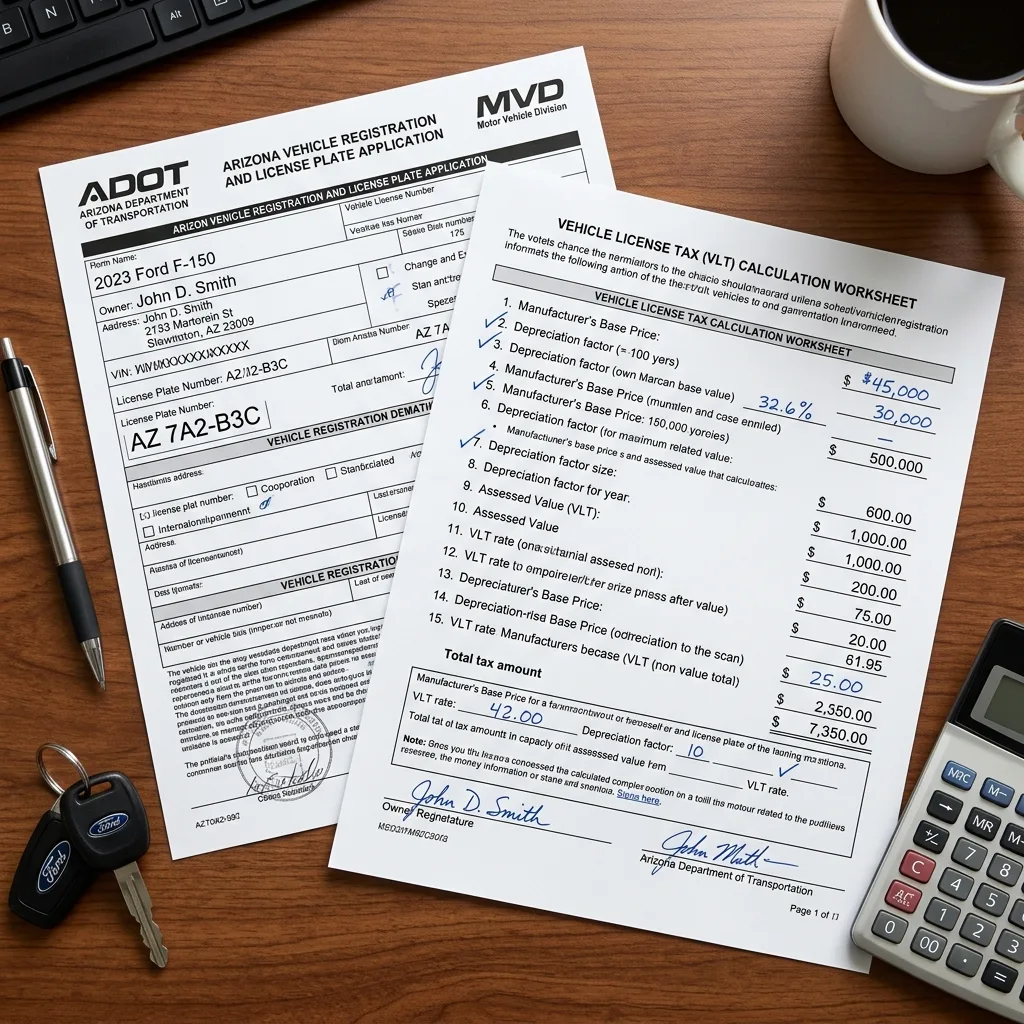
The Arizona vehicle license tax, or VLT, is the dollar amount Arizona charges you every single year just for the privilege of having a registered vehicle in the state. It is calculated, billed, and collected by the Arizona Department of Transportation (ADOT) through the Motor Vehicle Division. It shows up bundled into your registration renewal, which is why most people don’t realize the tax is the registration. The eight-dollar registration fee is a rounding error. The VLT is the actual price tag.
Here’s the formula, in plain English. ADOT takes the manufacturer’s suggested retail price of your vehicle when it was new. Not what you paid for it. Not what it’s worth today. The original sticker price. Then it sets the assessed value at 60 percent of that MSRP. So a $50,000 truck has an assessed value of $30,000. That assessed value is what they charge the tax against, at a rate of $2.80 per $100 of assessed value for new vehicles, and $2.89 per $100 for renewals.
Then, every year, the assessed value depreciates by 16.25 percent. That sounds like a tax break until you realize the original assessed value was already 60 percent of a sticker price most people never actually paid. So the depreciation curve is starting from a number that’s already inflated relative to your real-world purchase price, and the depreciation only flattens the bill, it doesn’t end it. There is a $10 floor. The VLT never goes to zero. You pay until you sell, you scrap, or you move the title out of state.
That’s it. That’s the whole machine. A flat percentage of an inflated assessed value, hitting you every twelve months, in addition to the sales tax you already paid at purchase, in addition to the emissions test if you live in Maricopa or Pima County, in addition to the registration fee, the title fee, the air quality fee, and, if you drive an EV, the brand new $147 annual electric vehicle surcharge. Welcome to Arizona.
The VLT formula: how it destroys your budget

Take a 2025 BMW X5 xDrive40i, $65,000 MSRP. Mid-tier luxury SUV, the kind you see in every Scottsdale parking lot and every Paradise Valley driveway. The five-year Arizona vehicle license tax bill on this vehicle:
Four thousand and forty dollars over five years, just in Arizona VLT, on a single vehicle, after you already paid for it. And remember, the depreciation never zeroes out the bill. By year ten, you’re still paying a couple hundred dollars annually. By year fifteen, you’re still paying. The tax outlasts the warranty. It outlasts most loans. For vehicles kept long-term, it just keeps going.
Here’s the cruel design feature. Notice how Year 1 uses the new-vehicle rate of $2.80 per $100, but every renewal year uses $2.89 per $100. That’s a 3.2 percent rate bump the moment your car stops being new. So even as the assessed value depreciates, the rate climbs. The state is essentially saying, congratulations on your one-year-old car, that’ll cost a little extra now.
And the 16.25 percent depreciation isn’t a refund. It’s a slowdown. Your assessed value drops from $39,000 to $19,187 over five years, but you’ve still handed Arizona over four grand for the privilege of parking your own SUV in your own driveway. Multiply that across two cars in a household and you’re at $8,000+ in five years. That’s a kitchen remodel. That’s a cruise. That’s a year of community college tuition. Gone. To VLT.
Reality check. The VLT is calculated on MSRP, not the price you actually paid. So if you bought used, or you negotiated hard, or you got a year-end discount, none of that helps you. The state taxes you on the original window sticker, forever.
The double hit: sales tax at purchase

Before you ever pay a single dollar of Arizona vehicle license tax, you’ve already been hammered by sales tax at the dealer. Arizona calls it the Transaction Privilege Tax, but it walks like a sales tax, talks like a sales tax, and bleeds your wallet like a sales tax. It’s a sales tax.
The state base rate is 5.6 percent. Then your county adds its piece. Then your city adds its piece. By the time the total prints out on the contract, you’re staring at numbers like these.
So our $65K BMW X5 buyer in Scottsdale writes a check for $5,720 in sales tax on day one. Before they leave the lot. Before any registration paperwork. Before VLT even enters the conversation. That’s nearly six grand vaporized at the dealer’s finance desk.
Then, twelve months later, the first VLT bill arrives. $1,092. Then another. Then another. And it never stops.
Here’s the math nobody wants to do out loud. The Scottsdale buyer of that BMW X5 will spend $5,720 in sales tax plus $4,040 in five years of VLT. That’s $9,760 in total Arizona vehicle taxation on a single $65,000 vehicle over five years. Fifteen percent of the purchase price, paid in taxes, just to keep the same car legal. The state of Arizona is essentially renting your car back to you for fifteen cents on the dollar every five years.
Trade-in credits do reduce the taxable amount, which is the one mercy in the system. But for cash buyers, fleet vehicles, second cars, RVs purchased without a trade, and out-of-state purchases, the full hit lands.
The real five-year cost

One BMW tells a story. The five-year picture across price points shows how the system really works. The numbers below show Arizona vehicle license tax only over five years, plus the sales tax shock at purchase (using Scottsdale’s 8.8 percent combined rate), compared against what the same vehicle would cost under a Montana LLC.
Look at the $100,000 row. Fifteen thousand dollars. Over five years. On one vehicle. To Arizona. For the right to drive on roads you also pay gas tax to use. And the savings column on the right is what’s left in your bank account if you simply choose a different state to register in.
Even on the modest $30,000 economy car, you’re looking at almost two thousand dollars saved in five years. And the savings scale almost linearly with vehicle price. The more car you have, the more aggressively the Arizona VLT punishes you for owning it.
Pricing note. Montana 5-year totals shown are: $899 Year 1 + ($368 × 4 renewals) = $2,371 for vehicles under $150K MSRP. Vehicles over $150K MSRP: $1,724 Year 1 + ($368 × 4 renewals) = $3,196.
Who gets hit hardest
The Arizona vehicle license tax is regressive in a quiet, technical way. The percentage rate is the same for everyone, but the dollar amounts hit certain groups disproportionately. Here are the people writing the biggest checks.
Luxury and exotic vehicle owners. Anyone with a Range Rover, an Escalade, a Porsche Cayenne, an X7, a G-Wagen, or a Lamborghini is looking at four-figure VLT bills annually for years on end. A $250K vehicle has a Year 1 VLT around $4,200 and total five-year VLT around $15,500. That’s before sales tax. With sales tax at 8.8 percent in Scottsdale, you’re at $37,500 in vehicle taxation in five years. On one car.
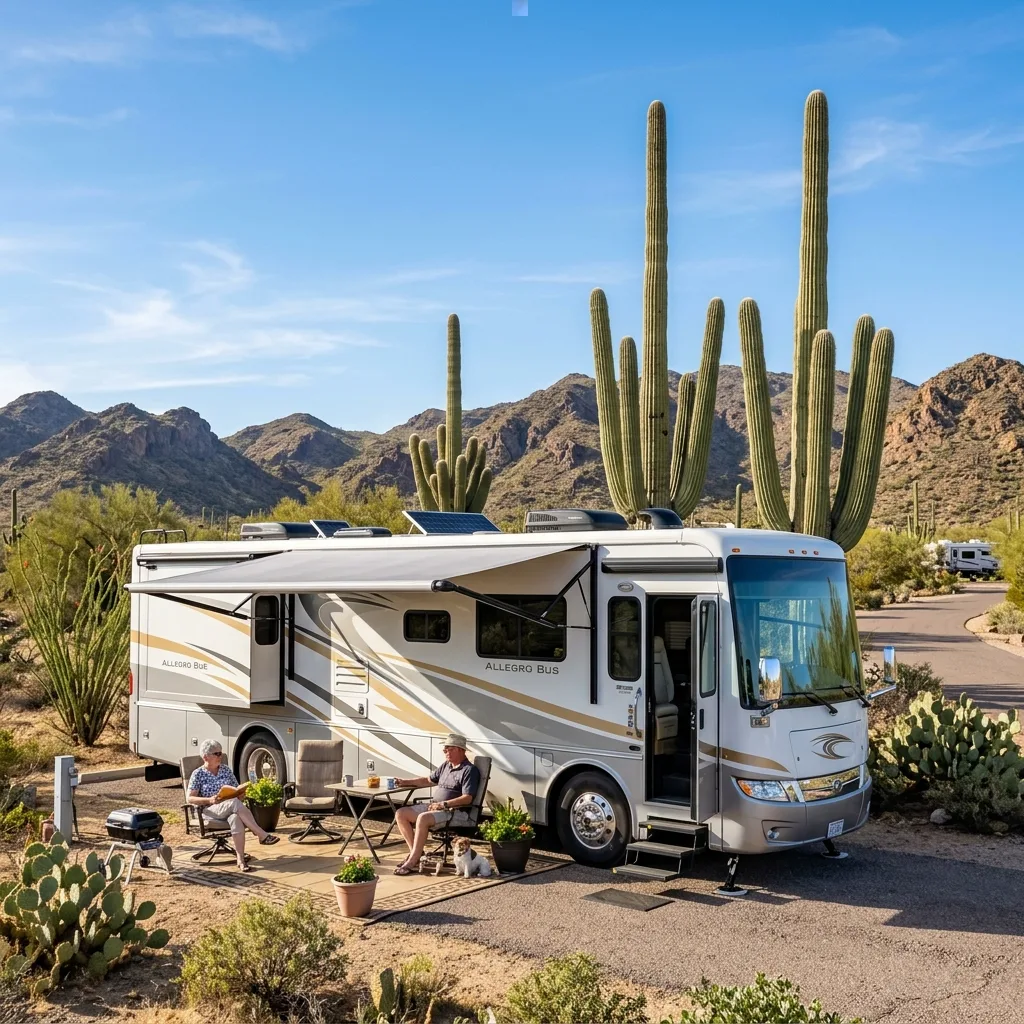
RV and motorhome snowbirds. Class A motorhomes routinely retail for $200K to $500K. The VLT on a $300,000 Class A is approximately $5,040 in Year 1, with five-year totals north of $18,000. RV owners who only spend half the year in Arizona are paying full freight VLT for a vehicle that sits in storage six months. The RV demographic is one of the heaviest casualties of the system.
Classic and collector car enthusiasts. The VLT formula uses original MSRP. So a 1990 Ferrari Testarossa, originally $181,000 in 1990 dollars, gets assessed at 60 percent of that, then depreciated over 35 years. By now it’s near the floor. But anything titled and registered new in the last decade still has serious VLT attached. And collector vehicles often sit in climate-controlled storage 50 weeks a year. You’re paying VLT on a museum piece.
Electric vehicle owners. Arizona piled on a $147 annual EV surcharge to compensate for lost gas tax revenue. So if you bought a Tesla Model X or a Rivian R1S thinking you were saving money on fuel, congratulations, the state already invented a fee to claw it back. EV owners pay the standard VLT plus the surcharge plus sales tax on a vehicle that’s typically priced higher than its gas equivalent.
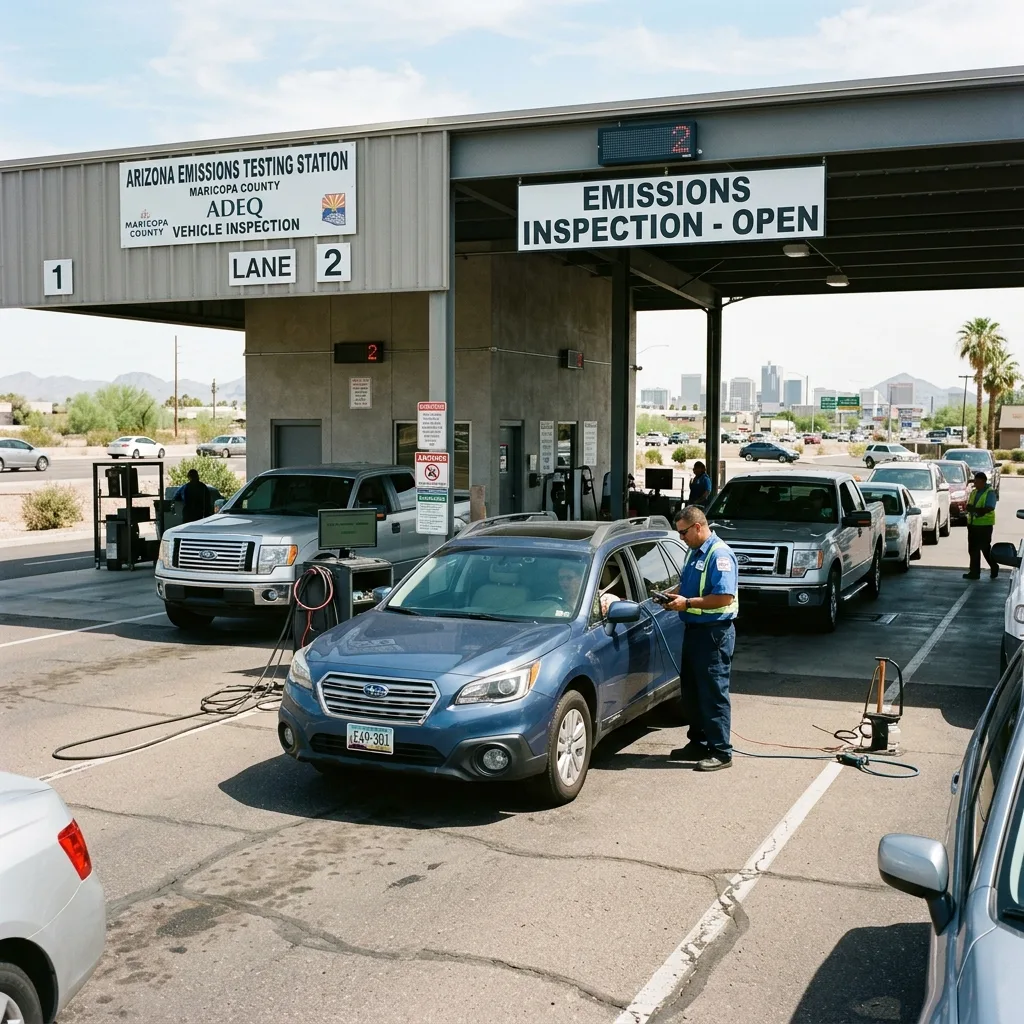
Maricopa and Pima County residents. The two big metro counties also require emissions testing every two years for vehicles model year 1981 and newer (1996 and newer in Pima). Sixteen and a half dollars per test, plus the time, plus the inconvenience. EVs are exempt from emissions, which is one small mercy. Everyone else, get in line at the testing station.
Alternative fuel vehicle owners who registered late. Here’s a brutal one. Arizona used to give massive AFV discounts. Vehicles registered as AFVs before January 1, 2023 were assessed at only 1 percent of MSRP. That’s a near-total exemption. Vehicles registered as AFVs in calendar 2022 got 20 percent assessment. Anyone who registered an AFV from January 1, 2023 onward gets the full standard 60 percent treatment. So if you bought your EV in late 2022 and didn’t register quickly, you’re now paying ten to twenty times what your neighbor pays for a similar vehicle. That’s not a tax policy. That’s a lottery.
Three real case studies
Case study 1: The Scottsdale attorney with the Range Rover
Meet our hypothetical Scottsdale attorney. She makes good money, drives a 2025 Range Rover Autobiography, $120,000 MSRP. She lives off Hayden Road, registers in Scottsdale at the 8.8 percent combined rate. The Arizona bill:
- Sales tax at purchase: $120,000 × 8.8% = $10,560 (this is the big one she didn’t budget for)
- Year 1 VLT: $120,000 × 60% = $72,000 assessed × $2.80/$100 = $2,016
- Five-year VLT total: approximately $7,460
- Five-year Arizona total: $10,560 sales tax + $7,460 VLT = $18,020
Now compare to Montana. Vehicle is under $150K MSRP, so she’s in the standard tier.
- Year 1 (LLC formation + Montana registration): $899
- Years 2 through 5 (annual renewal + filing): $368 × 4 = $1,472
- Five-year Montana total: $2,371
- Total five-year savings: $18,020 – $2,371 = $15,649
$15,649. That’s a luxury vacation, or six months of private school tuition, or a healthy down payment on the next car. Recovered legally, simply by titling the Range Rover through a Montana LLC instead of registering it in Scottsdale.
Case study 2: The Phoenix couple’s Toyota Tundra
Working family in Phoenix. They buy a 2024 Toyota Tundra TRD Pro, $62,000 MSRP. Phoenix combined sales tax is 8.6 percent.
- Sales tax at purchase: $62,000 × 8.6% = $5,332
- Year 1 VLT: $62,000 × 60% = $37,200 assessed × $2.80/$100 = $1,041.60
- Five-year VLT total: approximately $3,853
- Five-year Arizona total: $5,332 + $3,853 = $9,185
Montana option:
- Five-year Montana total: $899 + ($368 × 4) = $2,371
- Total five-year savings: $9,185 – $2,371 = $6,814
This isn’t a luxury problem. This is a working family with a daily-driver pickup, and Arizona is still extracting nearly seven thousand dollars over five years that could be staying in their household budget.
Case study 3: The Mesa retiree’s Class A RV
This one’s the big one. Retired couple in Mesa, just bought a brand-new Tiffin Allegro Bus, Class A diesel pusher, $280,000 MSRP. They use it three months a year for road trips. The rest of the time it sits in covered storage off Power Road.
- Sales tax at purchase: $280,000 × 8.8% = $24,640 (yes, twenty-four thousand six hundred forty dollars at the dealer)
- Year 1 VLT: $280,000 × 60% = $168,000 assessed × $2.80/$100 = $4,704
- Five-year VLT total: approximately $17,400
- Five-year Arizona total: $24,640 + $17,400 = $42,040
Forty-two thousand dollars. To Arizona. On a vehicle that gets driven three months a year. The retirees are paying full-time tax on a part-time vehicle.
Montana option (over $150K MSRP):
- Year 1: $1,724
- Years 2 through 5: $368 × 4 = $1,472
- Five-year Montana total: $3,196
- Total five-year savings: $42,040 – $3,196 = $38,844
Almost forty thousand dollars in savings on a single RV over five years. That’s not a coupon. That’s a meaningful chunk of retirement income. And it’s the difference between feeling free on the road and feeling resentful every time the renewal arrives.
Worth noting: across all three examples, the Montana LLC costs 8 to 14 percent of what Arizona charges. The math holds up at every price tier. I’d say the system isn’t designed to be affordable, but I think it’s more accurate to say nobody who designed it was thinking about the people writing the checks.
The Montana solution

The mechanism is simpler than most people expect. A Montana limited liability company, a real legal business entity formed and maintained in Montana, holds title to your vehicle and registers it there. A real legal business entity, formed and maintained in the state of Montana, that holds title to your vehicle and registers it in Montana.
Montana doesn’t charge sales tax on vehicle purchases. Period. Zero percent. There is no “transaction privilege tax.” There is no Arizona vehicle license tax equivalent. Montana has flat, predictable registration fees and that’s it. When your LLC, which is a Montana legal resident, owns the vehicle and registers it in Montana, the vehicle gets Montana plates and Montana’s tax treatment.
Four steps, in order:
- Form a Montana LLC. Real entity, real registered agent in Montana, real annual filings. We handle all of it.
- Title the vehicle in the LLC’s name. Not yours. The LLC is the legal owner.
- Register the vehicle in Montana. Montana plates, Montana title, Montana state of registration.
- Drive your vehicle. The LLC keeps owning it. You keep using it. The renewal each year is a fraction of what Arizona was charging.
Pricing through Zero Tax Tags:
Notice the bottom row. ATVs, UTVs, motorcycles, trailers, and boats get permanent Montana plates. One payment. Done forever. Compare that to Arizona’s recurring fees on a $40,000 utility trailer or a $25,000 motorcycle. Year after year, in perpetuity.
Is this legal

Yes, with conditions. Both parts of that sentence matter.
Forming a Montana LLC is legal. Anyone can do it. Montana, like every state, allows non-residents to form business entities there. That’s standard interstate commerce. Lawyers, accountants, startups, real estate investors, and holding companies form out-of-state LLCs every day. The IRS recognizes it. The courts recognize it. There is nothing illegal about a Montana LLC owning a vehicle.
The key word is “owning.” The LLC must actually own the vehicle. The title must be in the LLC’s name. The registration must be in the LLC’s name. The insurance is generally written naming the LLC as the owner with you as the named driver. If the LLC isn’t a real entity that genuinely owns the asset, you’ve created a paper fiction and that’s where people get into trouble. We don’t do paper fictions. Every LLC we form is a real Montana entity with a real registered agent and real filings.
The other piece is residency. Arizona has clear residency triggers. If any of these apply to you, Arizona considers you a resident and expects you to register your vehicle in Arizona regardless of how the title is held.
- You stay in Arizona seven or more months in a calendar year
- You work in Arizona
- You register to vote in Arizona
- You enroll children in Arizona public schools
If you fall under any of those, you’re an Arizona resident and you have an Arizona registration obligation. The Montana LLC strategy works cleanly for snowbirds who split time, for second-home owners, for businesspeople who travel, for vehicles that are stored or used outside Arizona, and for legitimate part-year residents. It is not a magic shield against being an Arizona resident.
The line in the law is between tax avoidance, which is legally arranging your affairs to minimize tax (legal, encouraged even), and tax evasion, which is hiding facts or fabricating them to avoid tax you actually owe (illegal). A Montana LLC that genuinely owns the vehicle, where you genuinely fall outside Arizona’s residency triggers, is tax avoidance. The IRS, the AZ Department of Revenue, and the courts all draw the line in the same place. We help you stay clearly on the right side of it.
One caveat about late registration. If you do owe Arizona registration and you let it lapse, the late penalty is $8 for the first month, $4 for each additional month, capped at $100. The fees are small but the legal exposure isn’t. Don’t let registration drift if Arizona is genuinely your state of residence. Either register properly in AZ, or restructure cleanly through Montana.
Who benefits most

Not everyone needs this. Plenty of Arizona drivers will keep registering with ADOT and writing the VLT check. For some of them, that’s the right call. For others, the savings are large enough that ignoring Montana is genuinely leaving money on the table.
- Luxury vehicle owners driving anything over $50,000 MSRP. The savings start to dominate the math at this tier.
- RV and motorhome owners, particularly snowbirds who split time between Arizona and another state.
- Classic and collector car enthusiasts who store vehicles and rarely drive them.
- EV owners tired of the $147 annual surcharge on top of standard VLT.
- Part-year Arizona residents who fall under the seven-month threshold.
- People moving to Arizona who want to keep an out-of-state vehicle registration legally.
- Owners of multiple vehicles where the savings compound across the household.
- Trailer, boat, ATV, UTV, and motorcycle owners who can use the permanent Montana plate option.
If you fit any of those, the math almost always works in your favor. Often dramatically.
Our process
When you work with Zero Tax Tags, this is how it goes. No mystery, no six-week waits, no surprise paperwork dumped on you at the end.
| Day 1: | Submit your MCO and supporting paperwork through our secure portal. We review for completeness and file your Montana LLC the same day. |
| Days 1–2: | Montana LLC formation complete — same business day in most cases, second business day at the latest. |
| Days 2–4: | Title transferred into the LLC name at the Montana county treasurer. |
| Days 4–7: | Permanent Montana plates shipped directly to your door within 3–5 business days of title completion. |
Who This Is Built For
The Montana LLC is engineered for Arizona vehicle owners who are tired of the double hit: 5.6% sales tax on Day One, then the Vehicle License Tax every year after that. The savings are most powerful for the following profiles.
Anyone purchasing a vehicle worth $25,000 or more. At $45,000, your Arizona sales tax alone tops $2,500. Add three to five years of VLT and you are well past $5,000 on a vehicle that loses value every month. The Montana structure breaks even before your second oil change.
Scottsdale, Paradise Valley, and Chandler professionals. If your typical vehicle sits in the $60,000 to $150,000 range, you are paying between $3,360 and $8,400 in Arizona sales tax at closing, then another $1,500 to $5,000 in VLT over the first five years. Montana eliminates both.
RV owners and snowbirds. Arizona is the second home for millions of part-year residents who own motorcoaches, fifth wheels, and toy haulers. A $200,000 motorhome generates over $11,200 in Arizona sales tax alone. Montana registration through Zero Tax Tags: $1,699 in Year 1, permanent plates for trailers and boats.
Business owners and contractors with fleets. One LLC holds every vehicle you own. The $200 LLC formation fee is paid once. Add a second truck, a third trailer, a fourth piece of equipment — each pays only the service fee, not the full setup cost again.
Collectors with multiple high-value vehicles. A five-car garage of $80,000 vehicles in Maricopa County generates $22,400 in sales tax and years of compounding VLT. Through one Montana LLC, that becomes one annual renewal per vehicle and zero Arizona property tax.
For vehicles under $20,000, call us before assuming the numbers don’t work. We run the calculation free of charge. For anyone buying above that threshold, they almost always do.
Frequently asked questions
What’s the difference between Arizona vehicle license tax and Arizona sales tax?
Sales tax is one-time, paid at purchase, calculated on the full purchase price at your local combined rate (5.6% state plus county and city). VLT is annual, paid every year for as long as you own the vehicle, calculated on 60% of MSRP at $2.80 or $2.89 per $100 of assessed value. Sales tax is a punch. VLT is the slow drip that never stops.
When is VLT due?
VLT is due at the same time as your annual registration renewal, on or before the last day of your registration month. ADOT mails a renewal notice roughly 45 to 60 days in advance. If you let it lapse, the late penalty is $8 for the first month and $4 for each additional month, capped at $100.
How does the 16.25% depreciation actually work?
Each year, the prior year’s assessed value is multiplied by 83.75% (which is 100% minus 16.25%). So if Year 1 assessed value is $39,000, Year 2 is $39,000 × 0.8375 = $32,663. Year 3 is $32,663 × 0.8375 = $27,355. And so on. The bill never zeros out because of the $10 statutory floor.
What happens to my VLT if I sell the vehicle mid-year?
VLT is not pro-rated as a refund to you. Once you’ve paid for the registration year, that money is gone. The new buyer starts fresh with their own registration when they title the vehicle. So selling in month 11 means you got a great deal on the last 30 days. Selling in month 2 means you essentially paid for a full year of registration on a vehicle you no longer own.
Why does Arizona charge an EV surcharge on top of VLT?
The state argues that gasoline vehicles fund road maintenance through gas tax, and EVs use the roads without contributing to that pool. The $147 annual EV surcharge is meant to replace the gas tax revenue. It’s added on top of regular VLT. So an EV owner pays a fee to compensate for not buying gas, plus VLT on the original MSRP, plus sales tax at purchase. The EV math in Arizona is harsh.
Are EVs exempt from emissions testing?
Yes. Electric vehicles, hydrogen fuel cell vehicles, and golf cart-class electric vehicles are exempt from emissions testing in both Maricopa and Pima counties. Hybrids are not exempt, they still test. Diesel pickups have their own testing rules.
Does a Montana LLC affect my insurance?
It changes how the policy is written, but it doesn’t make insurance harder to obtain or dramatically more expensive. The policy lists the LLC as the named insured (the legal owner of the vehicle) and you as the principal driver. Most major carriers handle this routinely. We provide guidance on which carriers are most experienced with Montana LLC-owned vehicles.
How long until I have Montana plates in my hand?
Typically 21 to 30 days from the day we have all your paperwork. The LLC formation takes 3 to 5 days, the title and registration runs 7 to 14 days, and shipping the plates to your address adds the final week. If anything stalls (lender questions, missing documents, holiday delays), we keep you informed in real time.
What if I move out of Arizona later?
The Montana LLC and the registration travel with you. The vehicle stays titled in the LLC. Your physical address can change without touching the registration arrangement. Many of our clients move between states multiple times during the life of a vehicle and never need to change anything on the Montana side.
See how Montana LLC registration helps owners in other high-tax states:
- Virginia Car Tax: Stop Paying the Highest Vehicle Tax in America
- Nevada’s 8.25% Car Tax: The Hidden Cost Nobody Tells You About
- North Carolina Vehicle Tax: The Tag Tax Trap
Ready to stop paying Arizona vehicle license tax?
Arizona vehicle owners have saved millions with Montana LLC registration. From Scottsdale luxury cars to Phoenix RVs, the math works. You’re next.