
11 min read
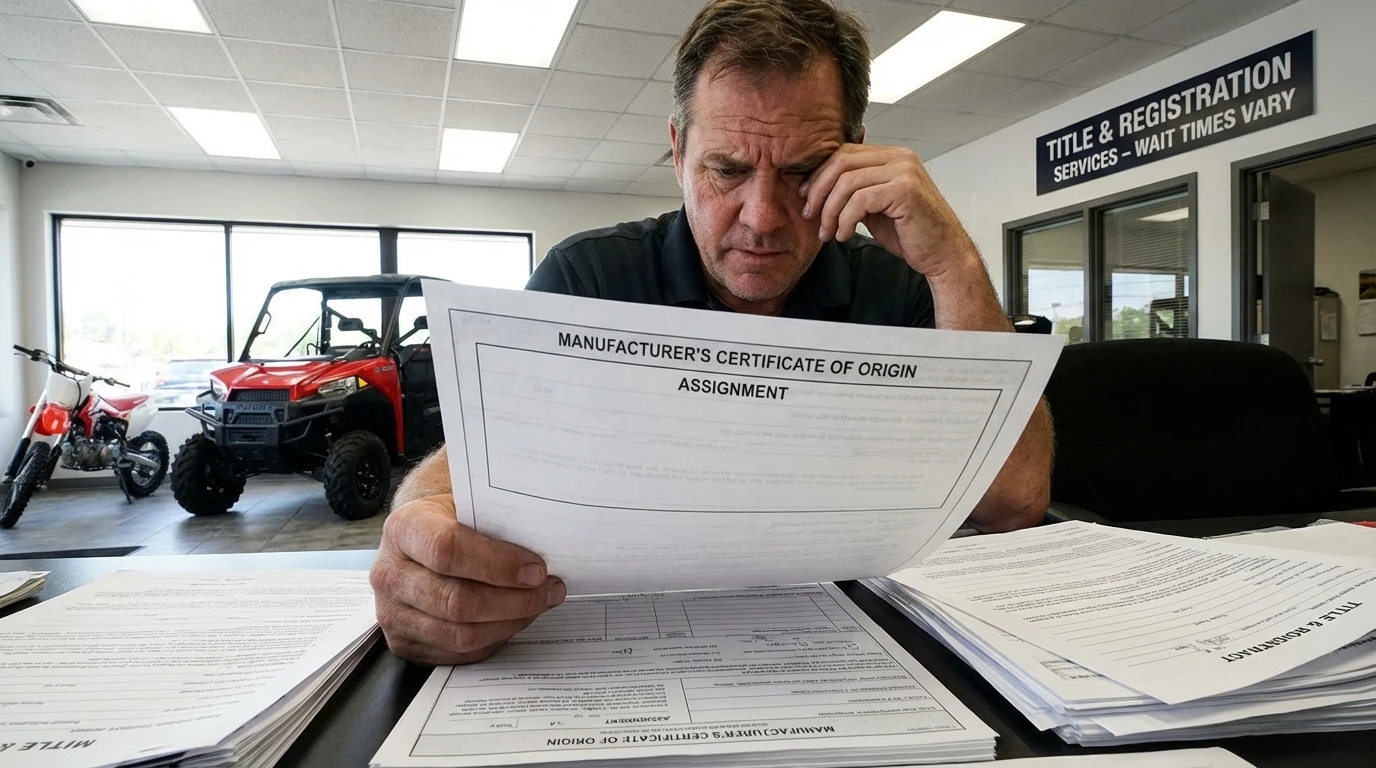
You just bought a brand-new UTV, dirt bike, or trailer. The machine is pristine, the engine purrs, and you are ready to hit the trails. The dealer hands you a crisp piece of paper with fancy borders: the Manufacturer’s Certificate of Origin (MCO), sometimes called the Manufacturer’s Statement of Origin (MSO).
You toss it in a folder and forget about it. Fast forward a few weeks (or years), and you decide it’s time to get that machine street legal or sell it. You pull out the MCO, flip it over to the back, and… it’s blank.
Or maybe it’s not blank. Maybe the dealer signed it but didn’t fill in your name. Maybe they forgot the odometer reading. Maybe you bought it from a private seller who handed you an MCO that was issued to them ten years ago but never titled.
Welcome to the gray area of vehicle bureaucracy. While an MCO looks like a title, it isn’t one yet—it’s the vehicle’s birth certificate. And if the back of that document isn’t filled out correctly, the DMV is going to treat you like a criminal.
At Zero Tax Tags, we deal with botched paperwork every single day. We know the panic of holding a useless piece of paper for a $30,000 toy. Here is the definitive guide on handling blank MCO certificates, incomplete assignments, or messed-up MCOs without losing your mind.
On this page
- + The “Blank Check” Myth: Why a Blank MCO Is a Liability
- + Anatomy of a Screw-Up: Common MCO Deficiencies
- + The Private Seller Trap: “I Never Titled It”
- + How to Fix an Incomplete MCO (Without Going to Jail)
- + When You Need a Duplicate MCO
- + The Montana LLC Solution: Handling MCOs the Smart Way
- + Summary: The Checklist for a Healthy MCO
The “Blank Check” Myth: Why a Blank MCO Is a Liability
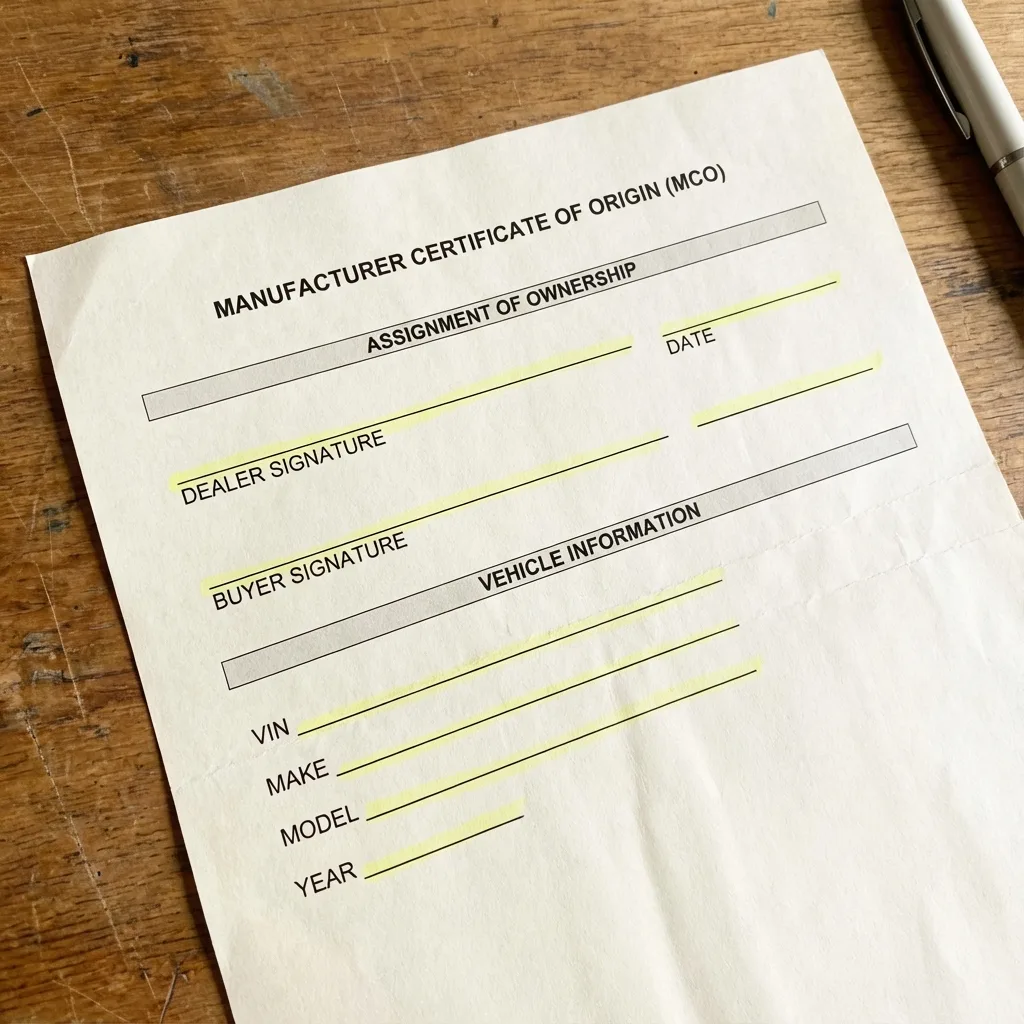
There is a common misconception in the powersports world that a blank MCO is like a “blank check” or an “open title.” People think, “Great! I can just write in whoever’s name I want later!”
Stop right there.
Legally, if the back of the MCO (the assignment section) is blank, ownership has not been transferred from the dealership to you. In the eyes of the law, that vehicle still belongs to the dealer who ordered it from the factory.
Scenario 1: The Buyer Took a Blank MCO Home
This happens constantly. You pick up your RZR on a busy Saturday. The finance guy is swamped. He hands you the MCO folder and says, “Here you go, have fun.” You get home, and the “First Assignment” section on the back is empty.
If you try to walk into a DMV with that, they will kick you out. Why? Because there is no proof the dealer actually released interest in the vehicle. You possess the document, but the chain of ownership is broken.
The Chain of Ownership
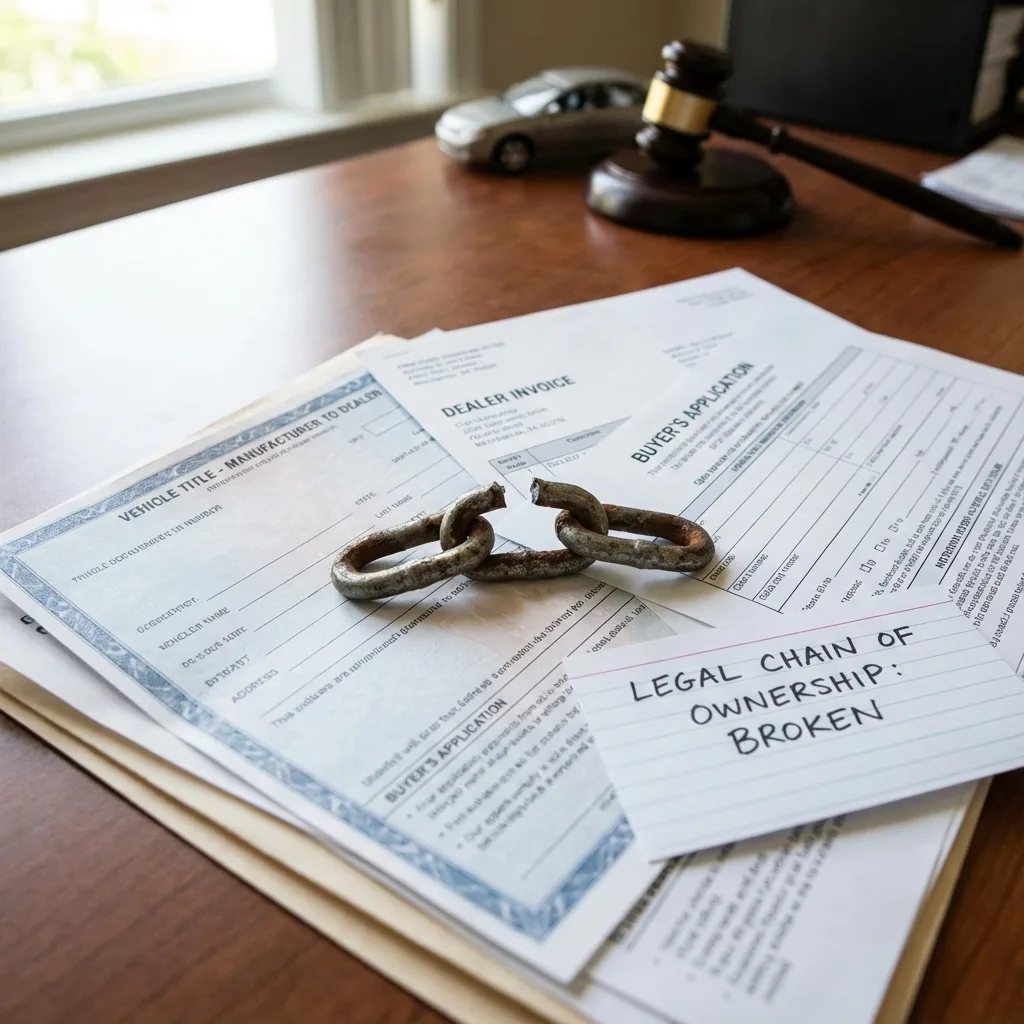
The DMV cares about one thing: The Chain.
- Manufacturer creates the vehicle → Issues MCO to Dealer.
- Dealer sells to You → Signs back of MCO to transfer ownership.
- You take MCO to DMV → DMV keeps MCO and issues a Title.
If Step 2 is blank, the chain snaps. You cannot skip links in the chain.
Anatomy of a Screw-Up: Common MCO Deficiencies
It’s not always completely blank. Sometimes it’s just… wrong. Here are the specific deficiencies that will cause a DMV clerk to reject your paperwork faster than you can say “bureaucracy.”
1. Missing Dealer Signature
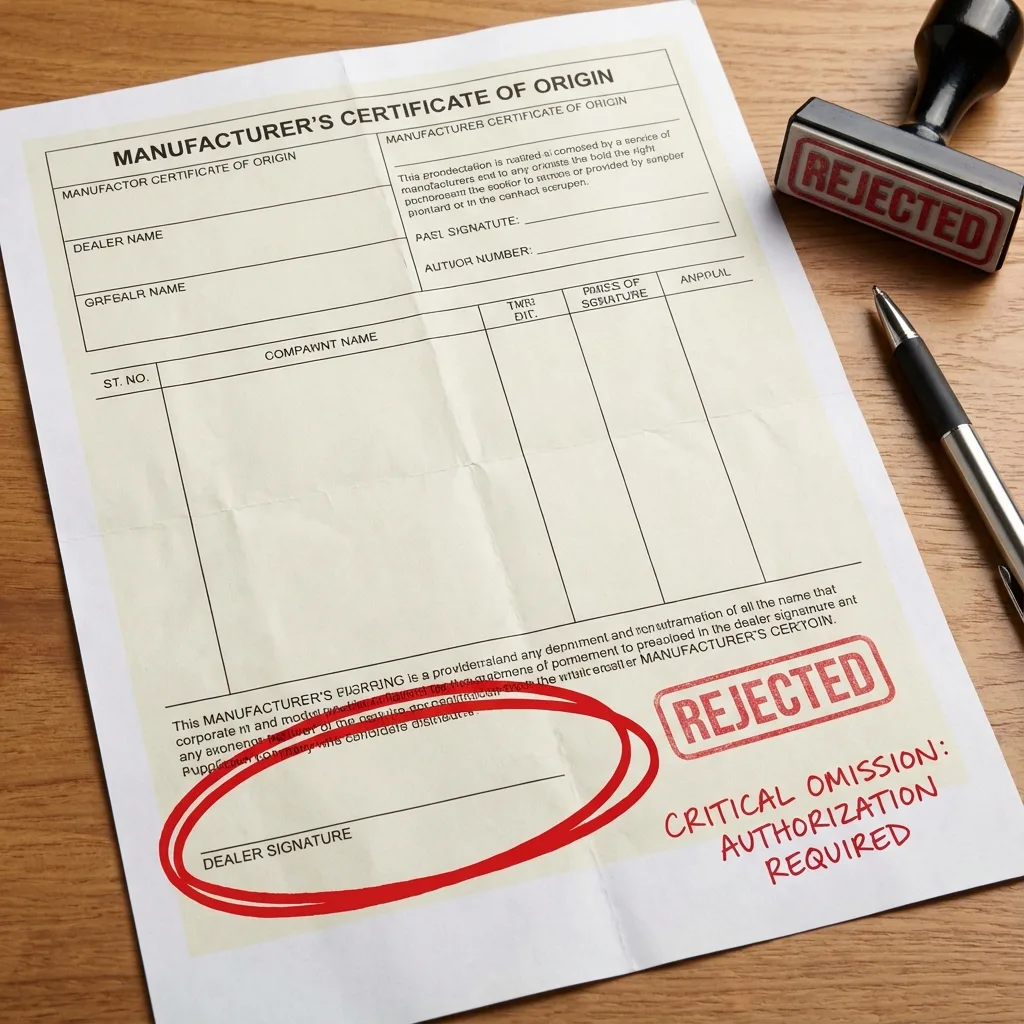
This is the most critical omission. The “First Assignment” or “Transfer to First Owner” section must be signed by an authorized representative of the dealership. Without this signature, the MCO is just a piece of paper. It is not a legal transfer document.
2. Incomplete Buyer Information
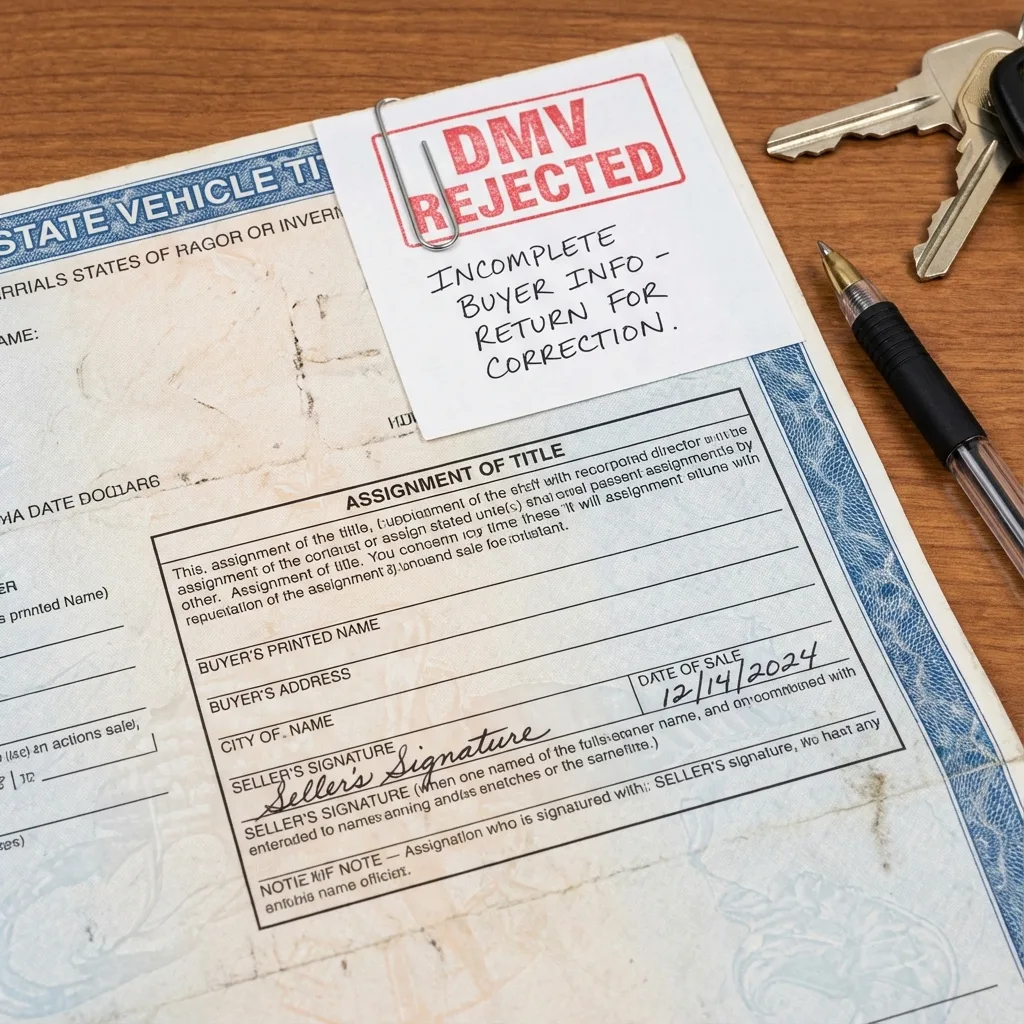
Sometimes the dealer signs it but leaves the buyer’s name blank. They might do this to be “nice” so you can resell it easily (more on why that’s a bad idea later). However, if you are registering this vehicle, your name (or your LLC’s name) needs to be there.
3. The Odometer Disclosure (The Federal Violation)
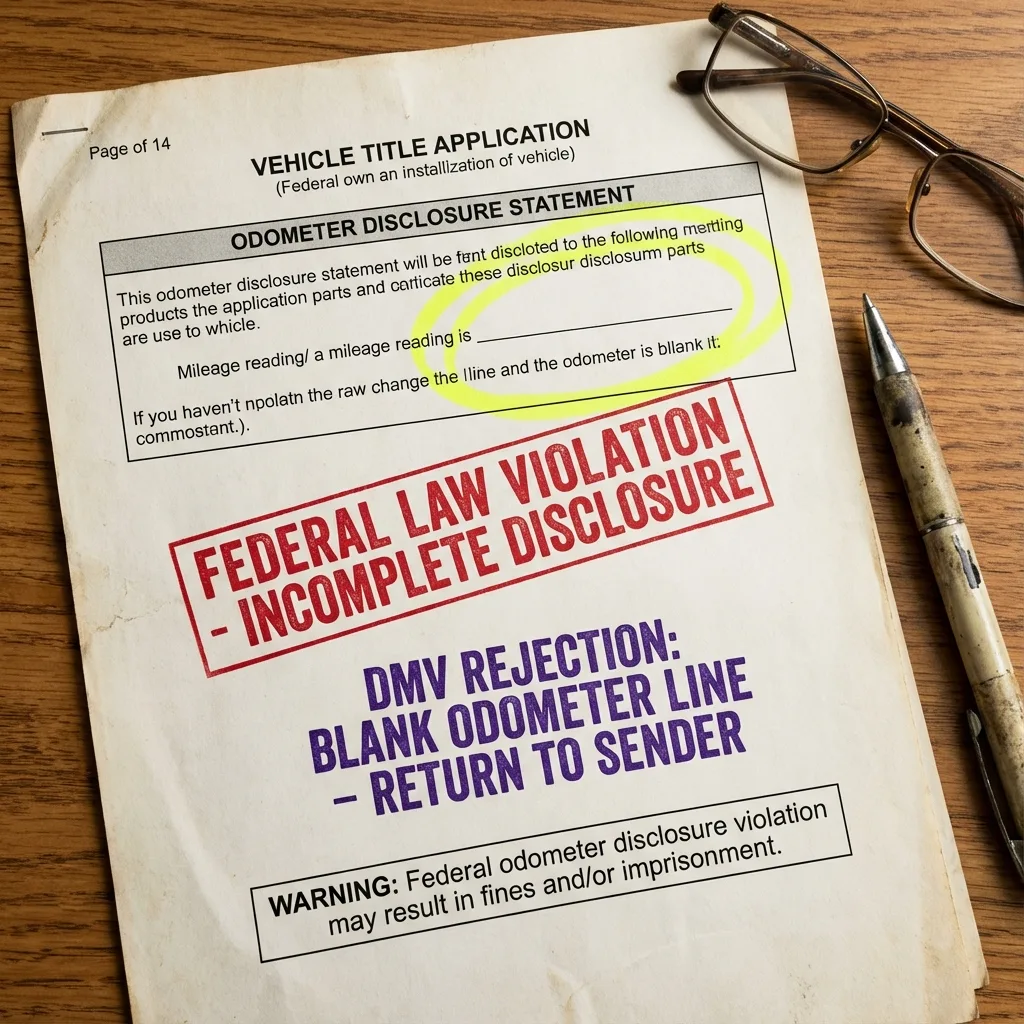
This is the big one. Under federal law, the odometer reading must be disclosed upon transfer of ownership for vehicles under a certain age (usually 10 or 20 years depending on the state, though rules tightened recently).
Real Scenario: A UTV dealer sells a brand new unit. It has 1 mile on it. They leave the odometer line blank because “it’s new.”
The Result: The DMV rejects it. It doesn’t matter if it’s zero miles. It must be written down. A missing odometer disclosure is technically a federal odometer fraud violation if not corrected properly.
The Private Seller Trap: “I Never Titled It”
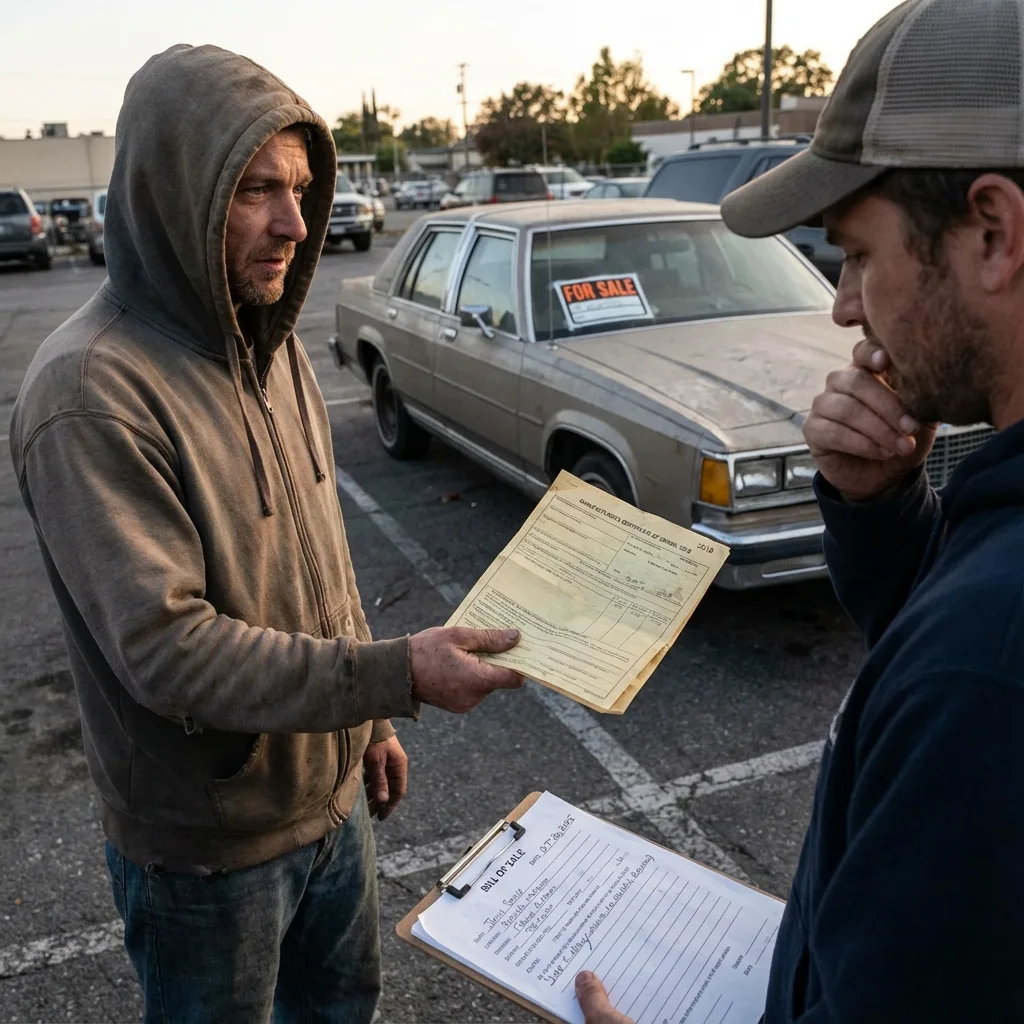
This is Scenario 2, and it is the bane of the used market.
You find a guy on Craigslist selling a 2018 KTM. He says, “I have the title in hand!” You get there, and he hands you the original MCO from 2018.
Here is the problem:
- Case A: The MCO is signed by the original dealer to the seller. The seller never went to the DMV to get a real title. Now, he wants to sell it to you. He cannot sign the back of the MCO again. The MCO usually only has one reassignment line on the back (from Dealer to First Buyer). Once that line is full, the document is “dead” until it is converted to a title.
- Case B: The MCO is blank. The seller claims, “Just write your name in!” But if you look at the original Bill of Sale (if he has it), the dates won’t match. If the dealer reported the sale to the manufacturer in 2018, and you try to register it as a “new” sale in 2025, the DMV system might flag it.
The Fix for Case A: The seller needs to go to the DMV, pay the taxes he skipped in 2018, get a title in his name, and then sign that title over to you. Good luck convincing a Craigslist seller to do that.
The Fix for Case B: You are essentially jumping title. While common in the dirt bike world, it carries risks regarding tax liability and theft recovery.
Related Reading: If you’re dealing with dealer MCO problems, check out our guide on What to Do When the Dealer Won’t Release Your MCO for complete instructions.
How to Fix an Incomplete MCO (Without Going to Jail)
So, you are staring at an MCO that is missing a signature, a date, or an odometer reading. What do you do?
Option 1: The “Go Back” Method (Best Case)
If the dealership is local and still in business, take the MCO back to them.
- Missing Signature: Have the finance manager sign it.
- Missing Odometer: Have them fill it in based on their records of the sale.
- Blank Buyer Name: Have them fill it in.
Warning: Do NOT fill in the dealer’s section yourself. That is forgery. It doesn’t matter if “they meant to sign it.” If you sign a dealer rep’s name, you are committing a crime.
Option 2: The Statement of Facts (The Band-Aid)
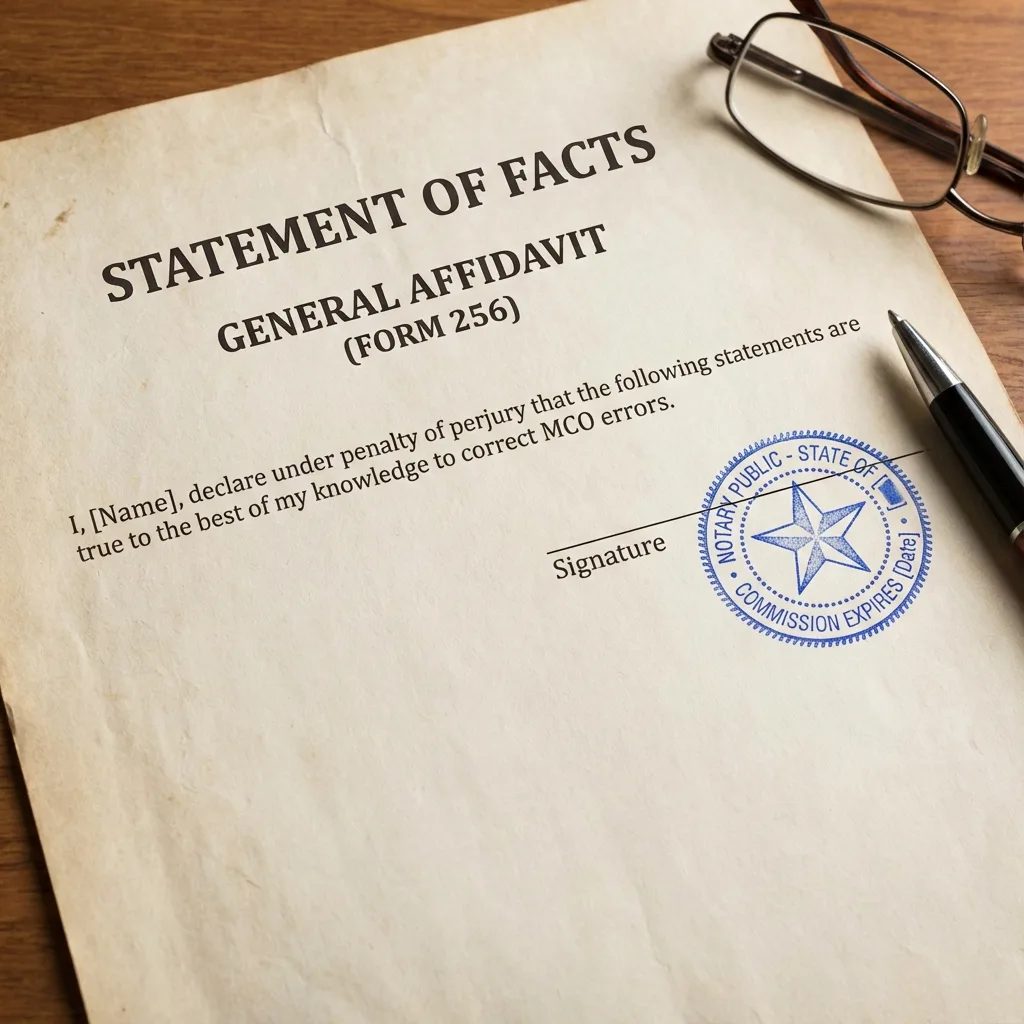
If the dealer is far away, out of business, or uncooperative, you may be able to use a Statement of Facts (often called a General Affidavit or Form 256 in some states).
This is a legal document where you swear under penalty of perjury that:
- You bought the vehicle legally.
- The MCO was left blank/incomplete by error.
- You are the rightful owner.
You attach this to the MCO when applying for a title. Many DMVs will accept a Statement of Facts to correct a missing odometer reading or a minor clerical error, provided you have a Bill of Sale from the dealer proving you bought it.
Note: A Statement of Facts usually cannot cure a missing dealer signature. You almost always need the dealer to sign off on the transfer.
When You Need a Duplicate MCO
Sometimes, the MCO is beyond saving.
- Scenario: You tried to fix a typo with White-Out (Correction Fluid).
- The Rule: Mistakes on a title (or MCO) cannot be crossed out or white-outed. If you use White-Out, the document is void. Immediately.
- Scenario: The dog ate the corner with the VIN.
- Scenario: The dealer filled it out to “John Smtih” instead of “John Smith.”
In these cases, you cannot fix the document. You must request a Duplicate MCO from the dealership. The dealer has to contact the manufacturer (Polaris, Can-Am, Honda, etc.) to issue a reprint. This costs money and takes time. The dealer will likely charge you for this administrative headache.
The Montana LLC Solution: Handling MCOs the Smart Way
This is where Zero Tax Tags shines. If you are using our service to register your vehicle in Montana under an LLC (to save on sales tax and get street legal tags), the MCO process is specific.
1. Don’t Fill It Out Yet!
If you have a blank or partially filled MCO and you plan to use our Montana LLC service, do not fill out the buyer section yet.
Why? Because the vehicle needs to be owned by your LLC, not you personally.
- If you write your personal name on the MCO, we have to do extra paperwork to transfer it from You to Your LLC.
- If you leave it blank (or if the dealer hasn’t filled it in yet), we can instruct you on how to assign it directly to the LLC, saving a step in the chain.
2. We Handle the Reassignment
If the title/MCO is in your personal name, leave it as-is. We will handle the transfer to the LLC to prevent mistakes.
If the MCO is blank, we can provide the specific verbiage and Power of Attorney forms to ensure the dealer (or you, acting as agent) fills it out exactly right for the Montana DMV.
3. What if the Dealer Assigned it to My Name Already?
That’s okay! It just means one extra step. We will generate a Bill of Sale from You to Your Montana LLC. The MCO shows the transfer to you; the Bill of Sale shows the transfer to the LLC. The chain remains unbroken.
More MCO Guides: For step-by-step MCO transfer instructions, see our comprehensive guide on How to Transfer a Certificate of Origin and Out-of-State MCO Requirements.
Summary: The Checklist for a Healthy MCO
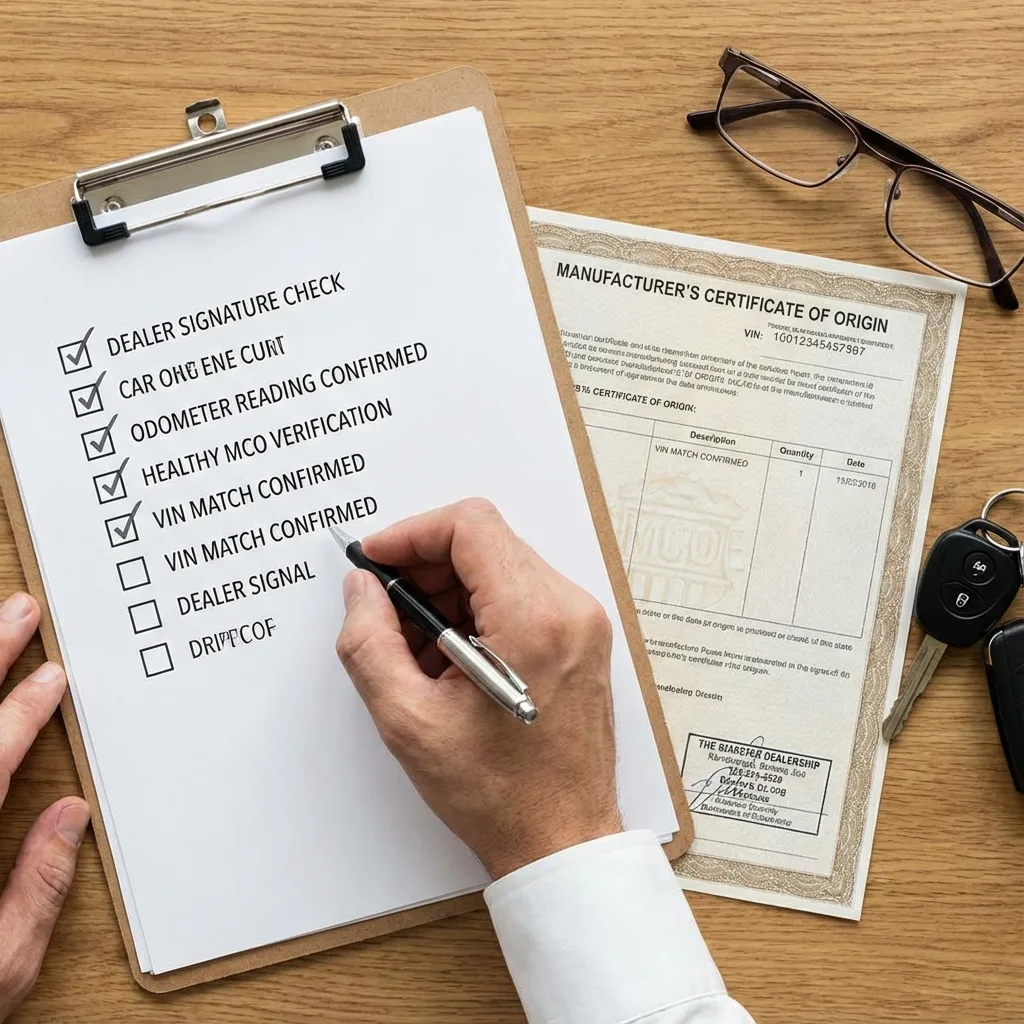
Before you leave the dealership (or the seller’s driveway), check these four things on the back of the MCO:
- VIN Match: Does the VIN on the paper match the VIN on the frame? (Check it physically!)
- Dealer Signature: Is there a scribble in the dealer/seller signature block?
- Odometer: Is there a number in the odometer space? (Even “0” or “1”).
- Notarization: Some states require the MCO assignment to be notarized. Check if there is a notary stamp block. If there is, and it’s empty, you have a problem.
We Fix the Bureaucracy
If you are staring at a messed-up MCO, a blank assignment, or a stubborn dealer who won’t help, don’t panic. You don’t have to navigate the DMV’s maze of rejection alone.
Whether it’s obtaining a bonded title because the MCO is lost, or simply managing the transfer of a messy MCO into a tax-free Montana LLC, Zero Tax Tags has the experience to handle it. We deal with the red tape so you can focus on the redline.
Don’t let a piece of paper turn your machine into a lawn ornament.
Ready to Fix Your Blank MCO?
Incomplete MCO? Missing dealer signature? Odometer disclosure violation? Zero Tax Tags fixes botched paperwork and converts your MCO to a tax-free Montana LLC registration. We’ve handled thousands of blank certificates—yours is next.