24 min read

On this page
- + Florida Vehicle Tax: The 6% Hammer With a $50 Twist
- + County-by-County Florida Vehicle Tax Rates (2026)
- + The Real Cost of Florida Vehicle Tax: A 5-Year View
- + The Florida Vehicle Tax Traps Nobody Warns You About
- + Who Florida Vehicle Tax Hits Hardest
- + Three Florida Vehicle Owners Who Found the Exit
- + The Montana Solution
- + Is Montana LLC Vehicle Registration Legal?
- + Who Benefits Most from Montana LLC Registration
- + How Zero Tax Tags Gets You Registered in Montana
- + Who This Is Built For
- + Frequently Asked Questions
Florida vehicle tax is the kind of expense that hides in plain sight. You see the sticker. You shake on the deal. You think you know what the car costs. Then the finance manager slides a single sheet of paper across the desk, and your stomach does something it hasn’t done since college finals.
Michael Tanaka is 52. He’s an orthopedic surgeon in Fort Lauderdale, and on a humid Tuesday in March he walks into a Porsche dealership on Federal Highway to take delivery of a 2026 Cayenne Turbo S. Sticker price: $185,000. He’s already written the check. The car is detailed. The keys are on the desk. He sits down across from the finance manager, who is wearing a tie that costs more than most people’s car payments.
The finance manager slides the worksheet across. Most of the lines are familiar. Vehicle price. Initial registration. Title transfer. Then there’s a line that stops him cold.
Florida sales tax: $11,150.
Not a down payment. Not an extended warranty. Not a service plan. A mandatory transfer of $11,150 from his checking account to the Florida Department of Revenue, due at signing, before he touches the steering wheel. He stares at the number. He runs the math in his head. Six percent of $185,000. The math is correct. There’s another line just underneath it, a county surtax of $50, and that one almost makes him laugh, because it has nothing to do with the eleven thousand dollars stacked on top of it. The $50 is a rounding error. The $11,150 is a wound.
He thinks about what $11,150 buys. A family vacation. His daughter’s tuition at a private school for a year. A used Honda Pilot. It won’t appear as a deduction, won’t build any road, won’t produce any service. It’s just gone.
What if that $11,150 stayed in your pocket?
Florida Vehicle Tax: The 6% Hammer With a $50 Twist
Florida vehicle tax is administered by the Florida Department of Revenue under Chapter 212 of the Florida Statutes. The mechanics are simple to describe and brutal to experience. The state collects 6% sales tax on the full purchase price of any motor vehicle. There is no cap. There is no exemption for high-value vehicles. There is no graduated rate. Whether the car costs $14,000 or $400,000, the state takes 6 cents of every dollar at the moment of sale.
Then there’s the county discretionary surtax. Each county sets its own rate, somewhere between 0.5% and 2.5%, on top of the state’s 6%. Florida law does something quietly generous to wealthy buyers here, and quietly punishing to everyone else. The county surtax applies only to the first $5,000 of the taxable value. Everything above $5,000 escapes the county tax entirely. The maximum any county can ever charge on a single vehicle, regardless of price, is $125 — and that’s only at the rare 2.5% rate.
That means a $200,000 Ferrari and a $30,000 Honda Civic registered on the same street in Miami pay the exact same county surtax: $50 each. The county surtax was designed for ordinary purchases — appliances, furniture, low-priced cars. For luxury vehicles, it’s basically symbolic. The state tax does all the heavy lifting.
This structure has a perverse consequence. On expensive vehicles, the headline combined rate is misleading. A finance manager will tell you the Miami-Dade rate is 7%, and you’ll picture 7% of your purchase price. But on a $185,000 Porsche, the actual effective rate is 6.027%. The 1% county surtax that sounds significant is statistically invisible. Your real enemy is always the flat 6% state rate, and that rate has no ceiling.
The Florida Vehicle Tax Formula:
(Purchase price × 6%) + (First $5,000 × county surtax rate) = Total taxExample: $100,000 SUV in Miami-Dade (7% combined headline rate)
$100,000 × 6% = $6,000 state tax
$5,000 × 1.0% = $50 county surtax
Total: $6,050 — not the $7,000 you’d expect from a “7% rate”
The good news, if you can call it that, is that Florida charges this tax once. Unlike Virginia, which collects a personal property tax every year you own the vehicle, Florida hits you at purchase and walks away. The bad news is that “once” can mean every two or three years for buyers who upgrade frequently, and the dollar amount is usually larger than five years of property tax in most other states combined.

County-by-County Florida Vehicle Tax Rates (2026)
Florida has 67 counties, and each one sets its own discretionary surtax rate. The state portion is fixed at 6% everywhere. The variation is entirely in the county piece, and 2026 brought meaningful changes that vehicle buyers should know about before they sign anything.
Palm Beach County dropped its combined rate from 7.0% to 6.5% effective January 1, 2026. The county commission repealed the 1% local government infrastructure surtax and replaced it with a smaller 0.5% school capital outlay surtax. The practical impact on a $185,000 vehicle is modest — you’d save $25 — but for ordinary buyers, the change is welcome.
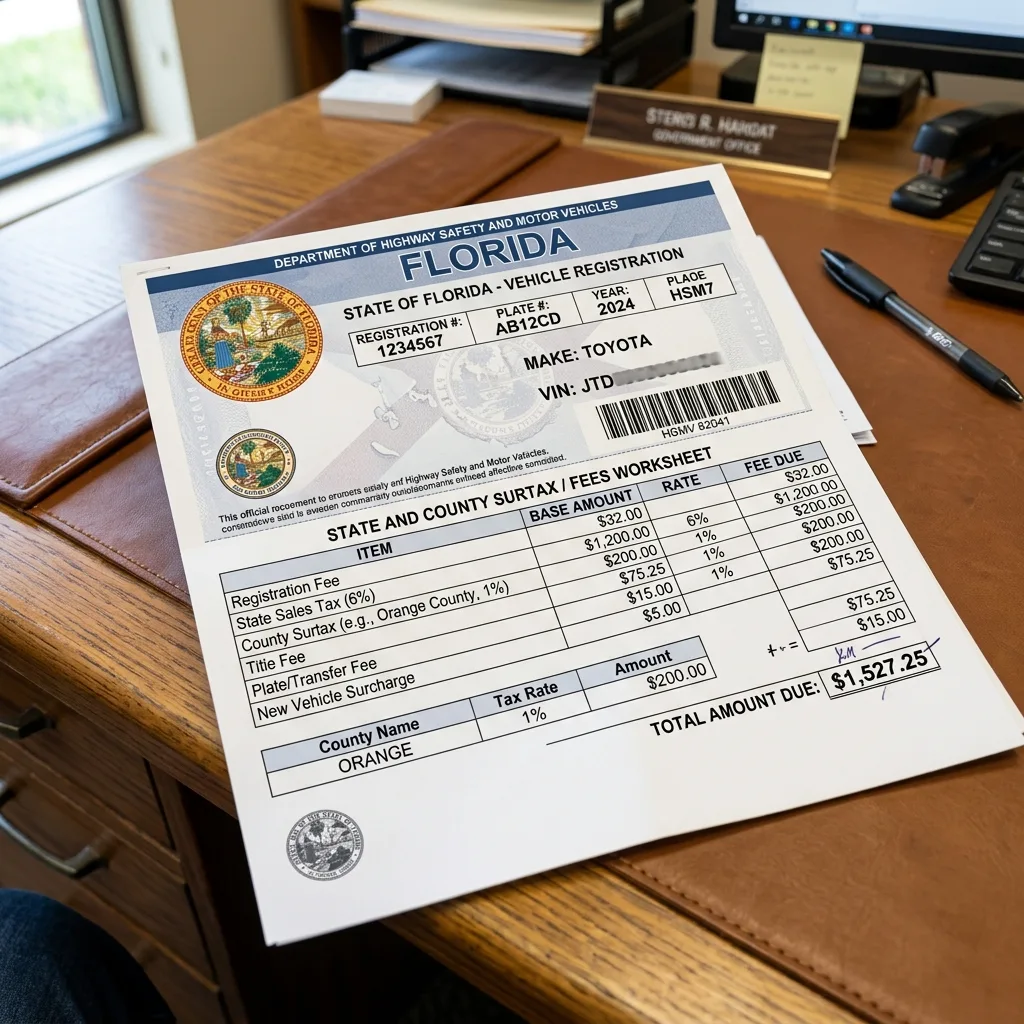
Hillsborough County (Tampa) had a more complicated year. The county temporarily reduced its surtax for several months in early 2025 while litigation worked through the courts. As of June 2025, the full 1.5% surtax was reinstated, and a 2026 ordinance extended the 0.5% transportation infrastructure surtax through 2041. So Tampa is back to a 7.5% combined rate, the highest in Florida among major metros, and likely to stay there for the next 15 years.
*Palm Beach dropped from 7.0% to 6.5% on January 1, 2026. **Hillsborough’s surtax was temporarily reduced in early 2025 and reinstated June 1, 2025; the 0.5% transportation surtax is now extended through 2041.
Most Florida buyers miss what this table actually shows. On a $185,000 vehicle, the difference between Hillsborough’s 7.5% headline rate and Orange County’s 6.5% headline rate is exactly $50. That’s it. The county surtax is $25 in Orlando and $75 in Tampa, and the state portion is identical at $11,100 in both. The 1% gap that would matter on a $5,000 used motorcycle is invisible on anything north of $50,000.
Verify before you sign. Hillsborough County temporarily dropped its surtax in early 2025 due to court action, then reinstated it on June 1, 2025. Counties can change rates at the start of any calendar year, and 2026 brought several changes. Always confirm your county’s current rate with the Florida Department of Revenue before closing on a vehicle.
If you live in any major Florida metro and you’re buying a vehicle worth more than $50,000, you are paying state tax. Full stop. The county lines on the worksheet are decoration. The 6% rate is the thing doing the actual work.

The Real Cost of Florida Vehicle Tax: A 5-Year View
Florida is, technically, a one-time sales tax state. You buy the car, you pay the tax, you drive away. Compared to Virginia, where you write a property tax check every year for as long as you own the vehicle, Florida looks downright reasonable on paper. Pay once, never again.
That framing ignores how people with money actually use cars. Doctors, attorneys, contractors — they don’t drive a car into the ground. They buy something new every three to five years, sometimes every 24 months. Trade up. Lease and re-lease. Every one of those transitions is another full Florida sales tax bill. The “one-time” tax becomes a recurring expense, just with gaps between hits.
The trade-in credit helps: Florida lets you subtract the dealer-allowed trade-in value from the taxable amount. But if you trade a $80,000 SUV for a $110,000 SUV, you still owe $1,800 on the $30,000 difference. Every cycle.
And the sales tax isn’t the only hit. Florida tacks on a $225 initial registration fee — one-time, non-refundable — on top of the annual registration. Title transfer is another $77 to $85. Annual weight-based registration runs $14.50 to $32.50 for cars, but Class A motorhomes can run $1,322 per year at the heavy end.
Florida’s tax hits once — but it hits hard. A $180,000 motorhome costs you $10,850 before you sleep in it for the first night. That’s not a service fee or a road tax. It’s a transfer of capital from your retirement account to the state of Florida, in exchange for nothing the state wasn’t already going to provide.
A Coral Gables physician buying a new $90,000 SUV every three years pays roughly $5,425 per vehicle in Florida sales tax. Over 15 years, that’s five vehicles and $27,000 paid to Tallahassee — roughly a year of college tuition, spread across seven-figure transactions and never appearing on a single statement.
The Florida Vehicle Tax Traps Nobody Warns You About
The headline rate is the easy part. What makes Florida vehicle tax dangerous is what surrounds it — the rules nobody mentions until you’ve already triggered them. Three traps catch the same buyers every year, usually the ones with the most to lose.
Trap one: the snowbird 90-day rule. Florida considers you a resident for vehicle registration purposes if you spend more than 90 cumulative days in the state during a calendar year. Not consecutive — cumulative. A retiree from Cleveland who arrives November 2 and leaves March 15 has been in Florida for 134 days, and Florida considers them a resident under the registration statute regardless of where they vote or pay income tax. The same applies to anyone whose child enrolls in a Florida school, anyone who accepts Florida employment, or anyone who rents a Florida apartment for more than 30 days. Once that line is crossed, your home-state plates are no longer legal, and the state can assess use tax on the vehicle as if you’d bought it the day you moved in.
The use tax credit doesn’t fully save you. Florida will credit any state sales tax you already paid in your home state, but only up to its own 6% rate, and the county discretionary surtax is never creditable. So if you bought a $90,000 SUV in Ohio and paid Ohio’s 5.75% tax, Florida will demand the missing 0.25% — plus penalties and interest if you didn’t file proactively.
You kept your Michigan plates all winter. You were in Naples from November 2 to March 15 — that’s 134 days. Florida just decided you owe use tax, a 10% penalty (minimum $50), and interest. The notice is real. The math is final. Your snowbird routine just became a tax assessment.
Trap two: the boat cap surprise. Florida famously caps boat sales tax at $18,000. This is celebrated in yacht-buying circles as a generous concession. What it actually means is that on a $300,000 boat, you pay 6% — which works out to exactly $18,000 — and on a $1.2 million boat, you also pay $18,000. The cap is real. But $18,000 is also real, and it’s due in full at the moment of purchase. Out-of-state boat buyers can sometimes qualify for a nonresident exemption (Form GT800006) if they remove the boat from Florida within 10 to 90 days, but that exemption is narrow, paperwork-intensive, and lost the moment you decide to keep the boat in a Florida slip.
Trap three: the dealer doc fee inflation. Florida dealer documentary fees averaged $898 in 2026, the highest in the country. There is no statutory cap. Some dealers add it to the taxable amount, which means you pay 6% sales tax on the doc fee itself. On a $90,000 transaction, an $898 doc fee that’s rolled into the taxable base costs you another $54 in tax. It sounds small until you realize it’s pure dealer revenue you’re paying tax on. Always ask for the doc fee to be itemized separately and excluded from the tax base.

Who Florida Vehicle Tax Hits Hardest
The flat 6% state rate is uniformly applied. The pain it causes is not. Some buyer profiles take a much harder hit than others.
Luxury vehicle buyers carry the heaviest absolute load. If you’re shopping in the $90,000-to-$300,000 range — Porsche Cayenne and 911, Range Rover, Mercedes G-Wagon, Bentley Bentayga, Rolls-Royce Cullinan, Lamborghini Urus, Ferrari Roma — your sales tax bill ranges from $5,400 to $18,000 per purchase. A garage with three of these vehicles represents $20,000 to $50,000 in state tax. The county surtax across all three is irrelevant, totaling under $200. The state portion is the entire problem.
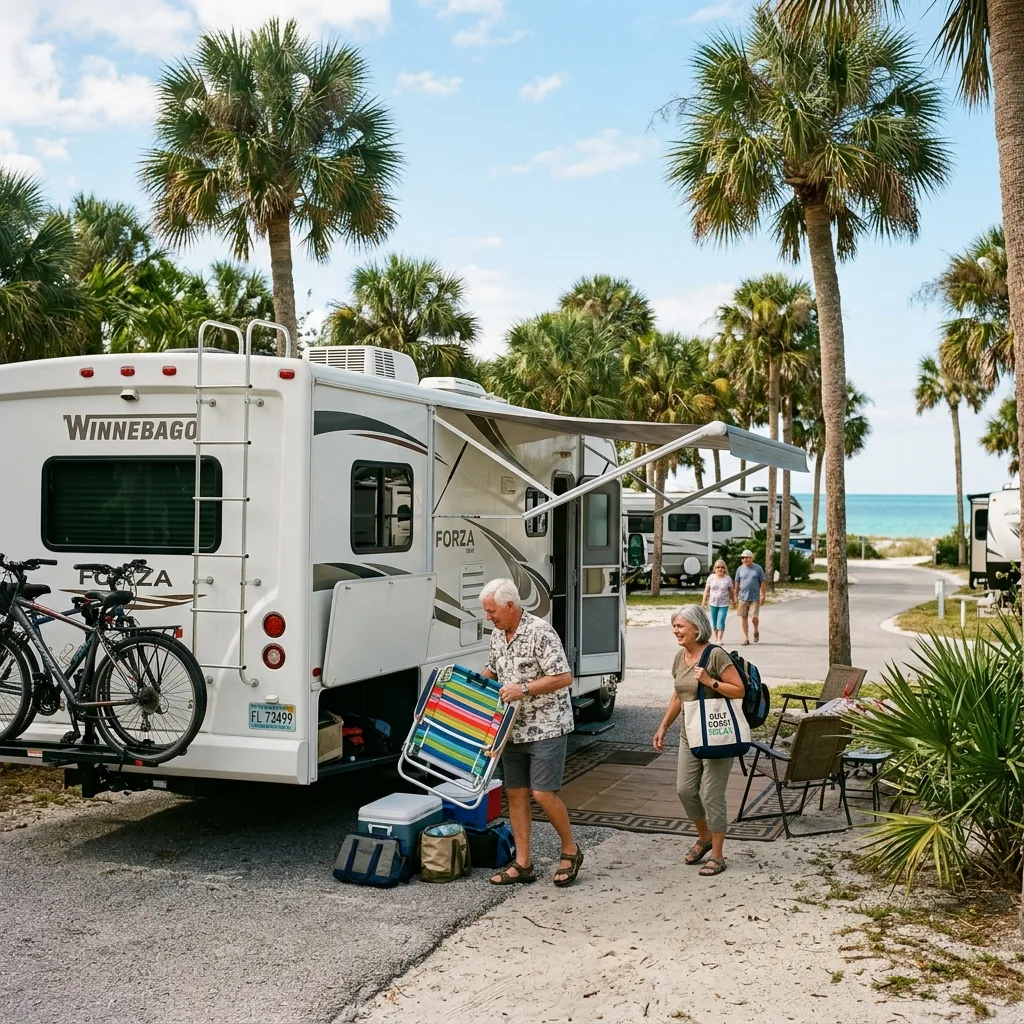
RV snowbirds are the second most exposed group. Class A motorhomes routinely run $200,000 to $500,000. The sales tax on a $300,000 Tiffin Allegro Bus is $18,050 — almost the price of a new Honda Civic, paid as tax on a vehicle you’ll use four months a year. RV owners also face the 90-day residency trap because they tend to be in Florida exactly long enough to trigger it.
Boat buyers in the $250,000-and-up segment effectively pay the maximum every time. The $18,000 cap is generous on a $1.5 million sportfisher and irrelevant on a $250,000 cruiser, where 6% would be $15,000 anyway. Either way, you’re writing a five-figure check at closing.
Frequent upgraders pay a structural penalty. If you replace your primary vehicle every 24 to 36 months — common among physicians, attorneys, and finance professionals — you’re paying full Florida sales tax three to five times more often than a typical owner. A 15-year cycle of seven $90,000 SUVs runs roughly $38,000 in cumulative state tax. It’s spread across separate transactions so it never shows up on any single statement. You only see it when you add it up.
Business fleets compound it further. A construction firm replacing six pickups over five years pays full sales tax on every swap. There’s no fleet discount in Florida’s tax code.
Three Florida Vehicle Owners Who Found the Exit
Three Florida vehicle owners — names changed, situations real — who hit the edge of the Florida tax system and stepped around it.
Case Study 1: The Fort Lauderdale Surgeon
Michael, 52, is an orthopedic surgeon practicing at a hospital system on Florida’s Gold Coast. He’d already signed for a 2026 Porsche Cayenne Turbo S, a $185,000 vehicle, when his finance manager handed him the worksheet. Florida sales tax: $11,150. He hadn’t budgeted for it as a separate line item; he’d assumed it was somehow rolled into financing or absorbed by the dealer’s incentives. It wasn’t. It was a fresh five-figure obligation due at signing.
He stepped outside, called his accountant, and asked the obvious question: “Is there any way around this?” His accountant, who’d just finished the same conversation with another client a month earlier, gave him a name and a phone number. Michael called Zero Tax Tags from the dealership parking lot. Nineteen days later, the Cayenne was titled to a Montana LLC, plated in Montana, and insured in Florida under a commercial vehicle policy. Total cost of the Montana setup: $899 in year one, with $368 per year in renewals. Net savings versus the Florida sales tax bill: $10,251 in the first year alone.
“I called my accountant after I saw the worksheet,” Michael said. “He told me about Montana. I was registered in 19 days. The most expensive part of the whole process was the FedEx envelope I sent the title in.”
Case Study 2: The Naples Snowbird
Carol and Dennis are retired educators from Cleveland, Ohio. They winter in Naples, summer in Lake County, Ohio, and own a 2024 Tiffin Allegro Bus — a $285,000 Class A motorhome — that they purchased in Ohio and registered in Ohio. For three years, they assumed their Ohio plates were sufficient, because they were “Ohio residents” in every sense that mattered to them: voter registration, primary care physician, mailing address, federal tax filing.
The 90-day rule got them. In 2024, they arrived in Naples on November 4 and left for Ohio on April 11. That’s 159 days. Florida’s automated tracking — driven by license plate readers, insurance filings, and the simple fact that their Florida community required vehicle stickers — flagged them. They received a use tax assessment in August 2025: $17,100 in tax (6% of $285,000), a 10% penalty ($1,710), and accrued interest. Total bill: just under $19,500.
They paid it. The Ohio plate was legally insufficient, and the credit for Ohio’s lower tax rate didn’t absorb the penalties. A Montana LLC set up at the time of purchase would have cost $1,699 in setup plus $368 per year — under $3,000 total instead of $19,500.
“Nobody told us about the 90-day rule,” Carol said. “We thought Ohio plates were fine. We thought we were doing things right.”

Case Study 3: The Miami Car Collector
Roberto, 47, is a real estate developer in Coral Gables. His pattern is consistent: he buys a new flagship vehicle every two to three years, drives it hard, sells it private-party at the 30,000-mile mark, and replaces it. Over the past seven years, his garage has cycled through a 2019 BMW M8 ($142,000, sales tax $8,570), a 2022 Mercedes-AMG GT 63 ($165,000, sales tax $9,950), and a 2024 Lamborghini Urus ($195,000, sales tax $11,750). Total Florida vehicle sales tax over the seven-year window: $30,270.
His CPA ran the alternative. A Montana LLC from the BMW purchase forward, with each subsequent vehicle retitled under the same LLC: $899 setup, $368 per year, $3,107 total over seven years. Net savings versus what he actually paid: $27,163.
Roberto switched the Lamborghini to Montana mid-year and is planning his next vehicle, a Bentley Continental GT Speed, the same way. “Twenty-seven thousand dollars is a wine cellar,” he said. “It’s a year of private school. It’s not a number I want to keep handing over.”
The Montana Solution: How to Legally Skip Florida Vehicle Tax
Montana is one of five states with no general sales tax. Not on cars, boats, RVs, or anything else. No annual vehicle property tax for LLC-owned vehicles. No emissions inspection. The state chose decades ago to fund itself without a sales tax and hasn’t changed course.

The mechanics are simple. You form a Montana limited liability company. The LLC, not you personally, takes title to the vehicle. The LLC registers the vehicle in Montana. The vehicle wears Montana plates. The vehicle can be physically located in Florida, garaged in Florida, driven in Florida — all of that is legal — but for tax and registration purposes, it’s a Montana asset owned by a Montana entity.
Florida’s sales tax statute applies to “every person” who purchases a vehicle “in this state.” When the buyer is a Montana LLC, Florida’s handle is gone. Most luxury and RV dealers will deliver out-of-state, and private-party transactions between a Montana entity and a seller trigger no Florida tax.
Montana has no state vehicle sales tax because the state never adopted one. It also has no annual personal property tax on vehicles owned by LLCs, no emissions inspection, and no county discretionary surtax. The same vehicle that costs $11,150 in Florida tax costs $0 in Montana sales tax — a difference that is not a loophole, not a deduction, and not a temporary policy. It’s the state’s tax code.
The savings widen dramatically as the vehicle price climbs. On a $185,000 vehicle, the 10-year delta exceeds $7,000. On a $300,000 RV or boat, it exceeds $14,000. On a serial buyer’s pattern of three vehicles in 10 years, the cumulative gap can clear $25,000.

Is Montana LLC Vehicle Registration Legal?
Yes. Montana law explicitly permits LLCs to title and register vehicles, and tens of thousands of vehicles are already registered this way — owned on paper in Montana, physically sitting in driveways across California, Texas, Florida, and everywhere else. The plates are valid for highway use in every state.
What matters legally is that the LLC must be real: a registered agent maintaining a Montana address, articles filed with the Secretary of State, an annual report on file, and a federal EIN. The LLC takes title. The LLC registers the vehicle. The LLC owns the asset. Built correctly, there is nothing for any state to challenge.
What gets owners into trouble is half-doing it — forming the LLC and then titling the vehicle in their personal name, or letting the annual report lapse until the entity dissolves. The structure works because Montana law works. It fails when it’s not maintained.
This strategy is for vehicle owners who travel. Multi-state owners, snowbirds, RV travelers, and business owners with vehicles crossing state lines are the natural fit. If your vehicle never leaves Florida and it’s your only car, call us before spending anything — we’d rather tell you it doesn’t fit than have you find out later.
Who Benefits Most from Montana LLC Registration
1. Luxury vehicle buyers ($75,000+). On a $90,000 vehicle, you save roughly $5,000 on a $899 Montana setup. The Montana fee is flat, so every additional dollar of purchase price is pure savings. A $300,000 vehicle avoids $18,000 in tax on the same $899 setup.
2. Snowbirds and multi-state owners. Montana plates eliminate Florida’s 90-day residency trap. The LLC owns the vehicle; there’s no individual Florida “resident” to register. Splits between Florida and Ohio, Michigan, or New York work cleanly.
3. Class A and Class C RV owners. Florida RV registration scales aggressively by weight — a 30,000-pound Class A can run $400+ per year in registration alone, stacked on top of $10,000+ in sales tax at purchase. Montana flattens both costs.
4. Boat owners over $200,000. The Florida boat tax cap is $18,000 — real money, due in full at closing. Montana avoids it entirely. Saving $18,000 on a $1,699 setup is the cleanest math in this strategy.
5. Frequent vehicle upgraders. Every 24-to-36-month upgrade cycle triggers a full Florida sales tax bill. Over a decade of trading up through $90,000 vehicles, the savings gap often exceeds $20,000.
6. Business fleet owners. Multiple vehicles register under one Montana LLC. The annual $368 covers the LLC regardless of how many vehicles are on it, so the cost per vehicle drops as the fleet grows.
7. Collector car owners. You buy a vintage Porsche at $250,000, sell it at $400,000, and Florida sees none of it. Montana plates protect both sides of the appreciation curve.

How Zero Tax Tags Gets You Registered in Montana
We handle every step. The whole process runs by mail and email — no Montana trip, no court appearances, nothing beyond a local notary signature.
Your timeline, day by day:
| Day 1: | Submit your MCO and supporting paperwork through our secure portal. We review for completeness and file your Montana LLC the same day. |
| Days 1–2: | Montana LLC formation complete — same business day in most cases, second business day at the latest. |
| Days 2–4: | Title transferred into the LLC name at the Montana county treasurer. |
| Days 4–7: | Permanent Montana plates shipped directly to your door within 3–5 business days of title completion. |
Who This Is Built For
The Montana LLC is built for Florida vehicle owners who are done paying 6% to 7.5% in combined sales tax at the dealership — a flat bill due the day you sign, with no cap and no credit for being a good customer. The savings are most powerful for the following profiles.
Anyone purchasing a vehicle worth $25,000 or more. At $50,000, Miami-Dade buyers pay $3,500 in sales tax at closing. At $130,000, that becomes $9,100. Montana eliminates it entirely, and the ZTT setup pays for itself before your second registration renewal.
Miami, Naples, and Palm Beach professionals. Finance executives, attorneys, physicians, and real estate developers who purchase $80,000 to $250,000 vehicles are handing Florida between $5,600 and $17,500 in sales tax per transaction. Our Florida clients in this demographic often save five figures in Year 1 alone.
RV owners and seasonal residents. Florida is home to one of the largest RV ownership bases in the country. A $200,000 motorhome generates $14,000 in Florida sales tax. Many RV owners travel through multiple states seasonally, making Montana registration a natural fit.
Business owners and fleet operators. One LLC holds every vehicle in your operation. A contractor running four $72,000 trucks saves over $17,000 in Florida sales tax across that fleet — then keeps one annual renewal cadence instead of juggling separate Florida tags.
Collectors and enthusiasts. South Florida and the Gulf Coast have a large concentration of exotic car and classic vehicle collectors. Every purchase at six figures or above generates avoidable Florida sales tax that Montana eliminates.
For vehicles under $20,000, call us before assuming the numbers don’t work. We run the calculation free. For anyone buying above that threshold, they almost always do.
Frequently Asked Questions About Florida Vehicle Tax and Montana LLC
1. Will Florida audit my Montana plates?
Florida has no dedicated “Montana plate audit” program. The state targets residents who fail to register at all, not residents using legitimate out-of-state corporate registration. If you’re a single-vehicle owner with no business reason for the structure and the car never leaves your Florida driveway, your fact pattern is weaker. Build the structure correctly, maintain the LLC, and the audit risk is low.
2. Do I need to visit Montana?
No. Everything is handled remotely. We file all paperwork, secure your registered agent, manage your address of record, and process your annual renewals. You will never need to set foot in Montana.
3. What happens when I sell the vehicle?
You sell the vehicle the same way you’d sell any vehicle. The seller of record is your Montana LLC. We handle the title transfer on the Montana side; you sign as the LLC’s authorized representative. If the buyer is in Florida, they pay Florida use tax — that’s their obligation. Some clients retire the LLC after a sale; others keep it active for the next vehicle.
4. Can I insure a Montana-plated vehicle in Florida?
Yes. Most major carriers — Progressive, GEICO, State Farm, Allstate, USAA — write policies on Montana-plated vehicles garaged in Florida. The policy is structured as a commercial vehicle policy with the LLC as the named insured and you as the authorized driver. Premiums are usually similar to a comparable personal auto policy, sometimes slightly higher, sometimes lower.
5. Does this work for boats?
Yes, with one practical caveat. Montana doesn’t have an ocean, so boat registrations through Montana LLCs make the most sense when paired with U.S. Coast Guard documentation for vessels of 5 net tons or larger. For smaller boats, the savings are still real — avoiding Florida’s $18,000 cap on a $300,000 boat is a clean win — but the registration logistics are more complex. We handle both routes for clients who own watercraft.
6. How much does Zero Tax Tags charge?
Year one is $899 for cars under $150,000, $1,724 for cars over $150,000, and $1,699 for RVs over $150,000. This includes Montana LLC formation, registered agent service, EIN application, title transfer, registration filing, and plate delivery to your door. Annual renewals are $368 per year, which covers continued registered agent service, annual report filing with the Montana Secretary of State, and registration renewal. Motorcycles, ATVs, UTVs, trailers, and boats use a permanent plate structure: $749 one-time, $0 annual renewal.
7. Can I register multiple vehicles?
Yes. Once your Montana LLC exists, each additional vehicle costs registration fees only — typically $200 to $400 for cars under $150,000, plus the $368 annual renewal that covers the LLC regardless of how many vehicles are on it. The overhead amortizes across the entire fleet.
8. What if Florida changes the law?
Florida cannot unilaterally invalidate Montana’s vehicle registration system — full faith and credit and state plate reciprocity rules prevent it. What Florida could do is tighten residency triggers: shorten the 90-day rule, expand the definition of a “Florida-based” vehicle. We monitor Florida legislative activity and notify clients of any changes. Montana LLC registration has been a recognized practice for 20-plus years, and no state has eliminated it.
See how Montana LLC registration helps owners in other high-tax states:
- Arizona VLT: How to Stop Paying $1,000 Every Single Year
- Virginia Car Tax: Stop Paying the Highest Vehicle Tax in America
- Georgia Vehicle Tax: The TAVT Trap
- Texas Vehicle Tax: The 6.25% MVST Trap
Ready to Stop Overpaying Florida Vehicle Tax?
Florida vehicle owners have saved millions with Montana LLC registration. The 6% state tax is a choice, not a requirement. You’re next.
More Florida Vehicle Tax Solutions
Florida Vehicle Tax 2026
The 6% Sales Tax That Hits You Before You Drive…
Florida UTV Street Legal 2026
The Registration Maze and Montana Plate Solution
Florida Super Speeder Law 2026
The Performance Driver’s Complete Legal G…
Florida License Plate Law 2026
How Montana Plates Deliver Full Compliance