26 min read
Certificate of origin transfer is the most critical step in registering a brand-new vehicle. You just bought a brand-new vehicle, trailer, or UTV. You expect a title, but instead, the dealer hands you a fancy piece of paper that looks like a stock certificate. It says “Manufacturer’s Certificate of Origin” or “Manufacturer’s Statement of Origin” (MSO).
Now you’re standing there thinking, “What am I supposed to do with this? Can I put a license plate on a piece of paper?”
The short answer is no. The long answer is that you are holding your vehicle’s birth certificate, and until you “transfer” it, that vehicle doesn’t legally exist in the eyes of the Montana MVD.
On this page
- + What MCO transfer actually means
- + Step 1: Verify you have the right document
- + Field-by-field: reading the back of an MCO
- + Step 2: Complete the assignment section
- + Step 3: Gather supporting documents
- + Step 4: State-specific requirements
- + State-by-state rules comparison
- + Correction rules: how to fix a slip without voiding the document
- + Step 5: Submit to the DMV
- + The Montana LLC direct MCO shortcut
- + When your MCO is lost or damaged: the duplicate process
- + Common mistakes that cause rejections
- + Two real case studies: one painful, one painless
- + What happens after submission?
If you are registering a vehicle through a Montana LLC to save on sales tax, or if you are just a DIYer trying to handle your local DMV without a dealer’s help, mishandling the MCO is the fastest way to get your registration denied. One typo, one wrong signature, or one missing odometer reading, and you are looking at months of delays and requests for duplicate documents.
At Zero Tax Tags, we process thousands of these documents. We know exactly what the DMV looks for and exactly what makes them stamp “REJECTED” on your application.
What MCO transfer actually means
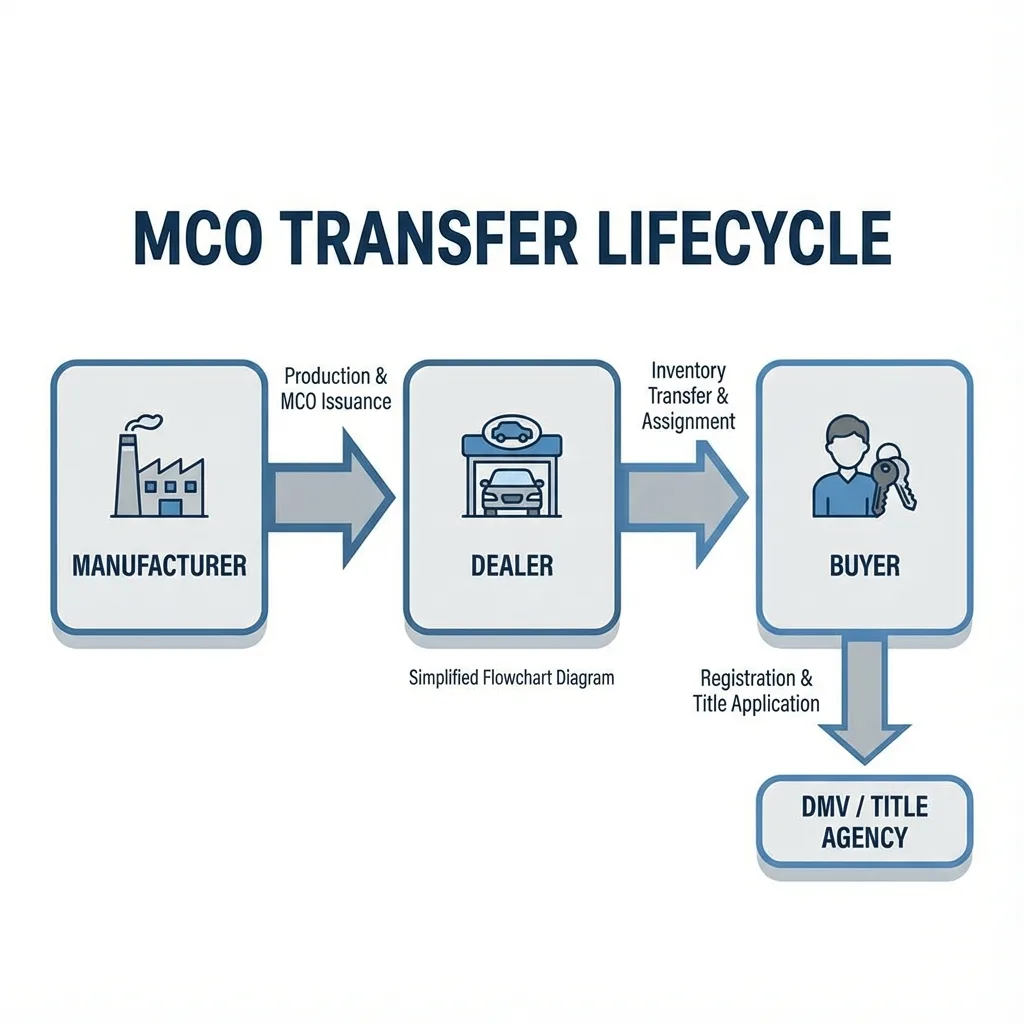
Before you pick up a pen, understand the lifecycle of this document.
The Manufacturer’s Certificate of Origin (MCO) is the proof that a vehicle was built. It transfers ownership from the Manufacturer to the Dealer to You.
Here’s the catch: The MCO is a “die-on-use” document.
You cannot keep an MCO forever. You cannot “transfer” an MCO to a second buyer. The moment you want to put a license plate on the vehicle, the MCO must be surrendered to a DMV (or a processing service like ours). The DMV takes the MCO, files it away permanently, and issues a State Certificate of Title in its place.
Think of it like cashing a check. Once the bank takes the check, they give you cash (the Title). You don’t get the check back.
That one-shot quality is why dealers and DMV clerks treat the MCO with so much respect. There is no Ctrl+Z. Re-creating the chain after a mistake means going back to the manufacturer for a duplicate and waiting one to three weeks for it to arrive. During that wait you cannot legally drive the vehicle on public roads.
The Golden Rule: The MCO must be assigned to the exact entity that will hold the title. If you assign it to “John Doe,” the title will be issued to “John Doe.” If you want the title in your Montana LLC name, the MCO must be assigned to the LLC.
Step 1: Verify you have the right document

Dealers are human. They make mistakes. Before you leave the dealership or accept delivery of the paperwork, you need to audit the document. Once you write on an MCO, correcting it is a nightmare that often requires the dealer to order a duplicate from the factory (which can take weeks).
Check the security features:
A real MCO feels like money. It has intaglio borders, watermarks, and visible fibers. If it looks like a photocopy on standard printer paper, question it immediately. Hold it to the light: you should see a watermark embedded in the paper, not printed on top of it.
Verify the VIN:
Walk over to the vehicle. Look at the VIN plate on the dashboard or the stamped VIN on the frame (for trailers/UTVs). Read the VIN on the MCO character by character. The 17-character VIN never contains the letters I, O, or Q, so any of those on your MCO is a clerical error to fix before signatures land.
Real-World Scenario: We had a client buy a $40,000 UTV. The dealer swapped two digits on the MCO. The client mailed it to us, and we had to send it back. The client couldn’t ride for 6 weeks while the dealer scrambled to get a corrected document from Polaris.
Check the dealer assignment:
On the back of the MCO, there is a section called “First Assignment.” The dealer must sign this. If the dealer hasn’t signed it, the chain of ownership is broken. You cannot sign for the dealer. The signing party must be an authorized agent of the dealership, with their printed name, title, and dealer license number filled in. A scrawled signature alone is not enough in Florida or Texas.
Confirm year, make, model, body style:
The data block at the top of the MCO has fields for model year, make, model, body type, weight, and fuel type. Any one of these transcribed wrong creates a downstream rejection because the DMV cross-references everything against NHTSA databases.
Field-by-field: reading the back of an MCO
Flip the MCO over. The reverse side is a structured legal form, not free space. Every blank exists for a reason and missing a single one of them gives the title clerk a clean excuse to reject the package.
The reassignment block (dealer to dealer)
You will see one to four numbered “Reassignment by Dealer” sections. Each one contains:
- Selling dealer name and address, printed in full with dealer license number where required.
- Buying dealer name and address, documenting the bridge when a unit moves through a wholesale auction or sister store.
- Purchase date: the wholesale transfer date, not the retail sale date.
- Purchase price: the dealer-to-dealer price, not used for your sales tax calculation.
If your unit went through three wholesale stops, three reassignment blocks must be completed in order. The chain has to be uninterrupted.
The odometer disclosure section
The federal Truth in Mileage Act (49 U.S.C. § 32705) requires odometer disclosure on the MCO for any motor vehicle fewer than 10 model years old. The block includes:
- Actual mileage reading: whole miles, no decimals or fractions.
- Reading status box: three checkboxes for “Actual Mileage,” “Exceeds Mechanical Limits,” and “Not Actual Mileage.” For a new vehicle, only “Actual Mileage” is correct.
- Transfer date: same date as the assignment to you.
- Certification statement: fixed-text block declaring the disclosure true under penalty of federal fines or imprisonment.
Illinois explicitly bans decimals. Write 14, never 14.0. Write 6, never six.
The lienholder section
If you financed the vehicle, this block is mandatory:
- Lender name: the legal name of the bank or finance company.
- Lender address: the title-perfection mailing address, often a dedicated lien department address rather than the consumer-facing branch.
- Lien date: the loan funding date.
Leaving any field blank prevents title issuance in most states because the DMV cannot mail the title to the lienholder without a complete address. Cash buyers leave the entire block blank or write “NONE.”
The notary block
Some MCO forms include a pre-printed notary acknowledgment. Eight states require this block to be completed for title transfer: Pennsylvania, Oklahoma, Ohio, North Carolina, Montana, Louisiana, Kentucky, and Arizona. Ohio is the strictest of the eight: both the seller and the buyer must each provide notarized signatures, on the same form, with the notary having physically observed both parties sign. We cover notarization in detail below.
California and Florida do not require notarization on the MCO even if the form has a notary block printed on it. You can leave the block blank in those states without consequence.
Step 2: Complete the assignment section
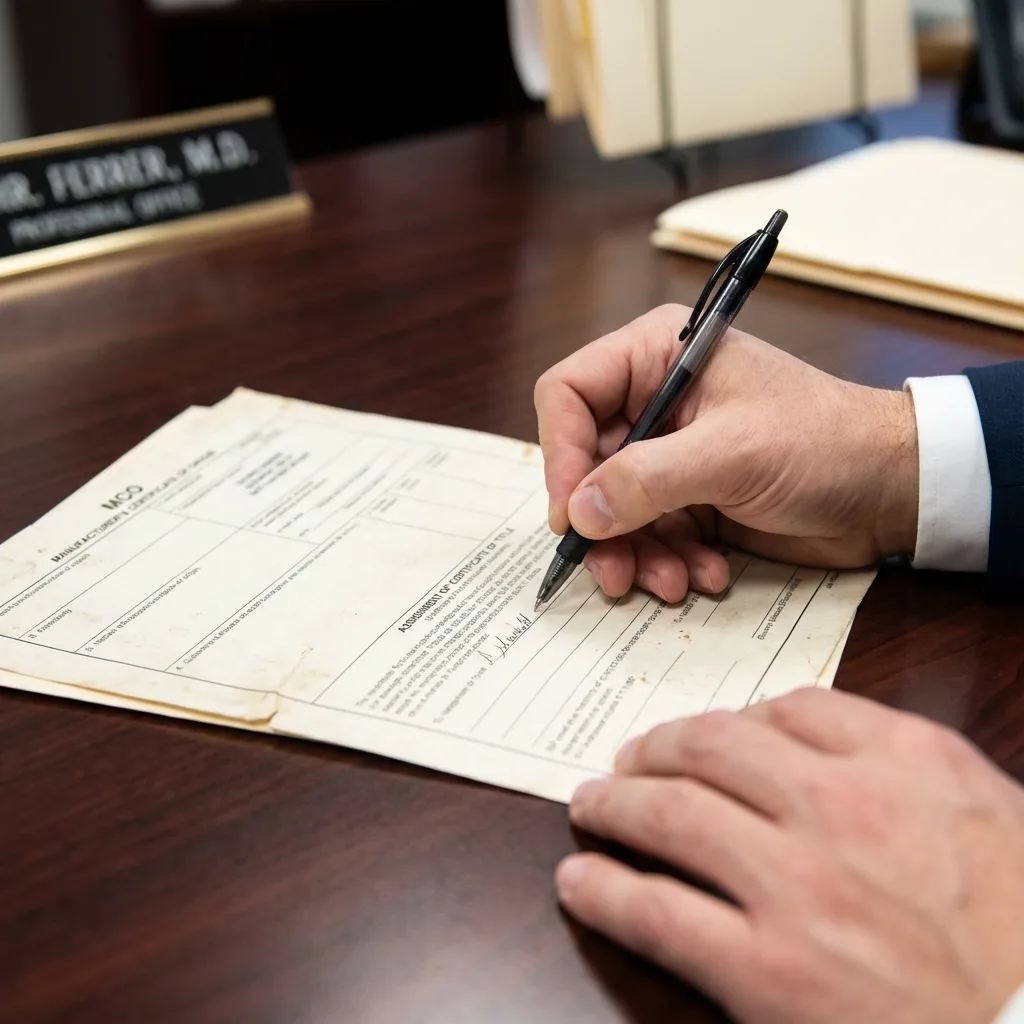
This is the “make or break” step. Flip the MCO over. You will see a section labeled “Assignment of Manufacturer’s Certificate of Origin” or “First Assignment.”
1. Buyer information:
This must match your ID or your LLC documents exactly.
- If personal: write your full legal name as it appears on your driver’s license.
- If Montana LLC: write the full name of the LLC. Do not write your personal name here. If you write your name, you will have to pay sales tax in your home state to title it to yourself, then transfer it to the LLC later (paying fees twice).
2. Odometer disclosure:
Federal law requires mileage disclosure on the MCO for all motor vehicles. The reading must be accurate at the time of sale — “new” doesn’t mean zero. Most vehicles have 5, 12, or 50 test miles on them. Leave the field blank and the DMV rejects it. Whole miles only: Illinois rejects decimals on sight, and most other states follow the same rule informally.
3. Purchase price:
Some states require this on the back of the MCO; others rely on the Bill of Sale. If there is a blank for it, fill it in. This figure is what the DMV uses to calculate sales tax (unless you are using a Montana LLC, in which case the tax is $0, but the value is still required for registration fees).
4. Signatures:
- Buyer signature: you sign here.
- Printed name: print your name clearly.
- Capacity: if signing for an LLC, indicate why you have the right to sign — for example, “John Doe, Member” or “John Doe, Manager.”
5. Ink color:
Use a black ballpoint pen unless your destination state allows blue. Georgia explicitly limits ink color to black or blue and will reject pencil, gel, felt-tip, or any other color. Texas accepts blue or black. Florida accepts blue or black. When in doubt, black ink keeps every state happy.
Step 3: Gather supporting documents

You cannot just mail an MCO to the DMV and hope for the best. It must be accompanied by a “registration package.”
1. Bill of sale:
The MCO proves the vehicle exists; the Bill of Sale proves you paid for it.
Pro Tip: Get the Bill of Sale notarized. While not every state requires this, Montana and several others strictly enforce it. It prevents fraud and speeds up processing.
2. Proof of insurance:
You cannot register a vehicle without active insurance. The insurance card must match the name on the MCO. If the MCO is assigned to “Smith Logistics LLC,” the insurance policy must list “Smith Logistics LLC” as the insured.
3. Identification:
- Personal: copy of your driver’s license.
- LLC: Articles of Organization and an EIN letter (if required by the state).
4. Sales tax proof:
If you are registering in your home state, you need a check for the sales tax (often 6-10% of the purchase price). If you are registering via a Montana LLC through Zero Tax Tags, you do not pay sales tax, but you will pay the flat Montana registration fees.
5. Manufacturer’s Statement of Compliance (MSO Annex):
Some manufacturers ship a separate compliance certificate alongside the MCO confirming federal safety, emissions, and lighting standards. RV builders, custom trailer makers, and low-volume motorcycle assemblers commonly issue these. If your unit shipped with one, include it. The DMV may not ask for it explicitly, but its absence triggers an inspection in Florida and a fitment review in California.
See how Montana LLC registration helps owners avoid other vehicle ownership headaches:
- Unsigned MCO: What to Do (and What NOT to Do)
- Certificate of Origin vs Title: The Definitive Legal Guide
Step 4: State-specific requirements
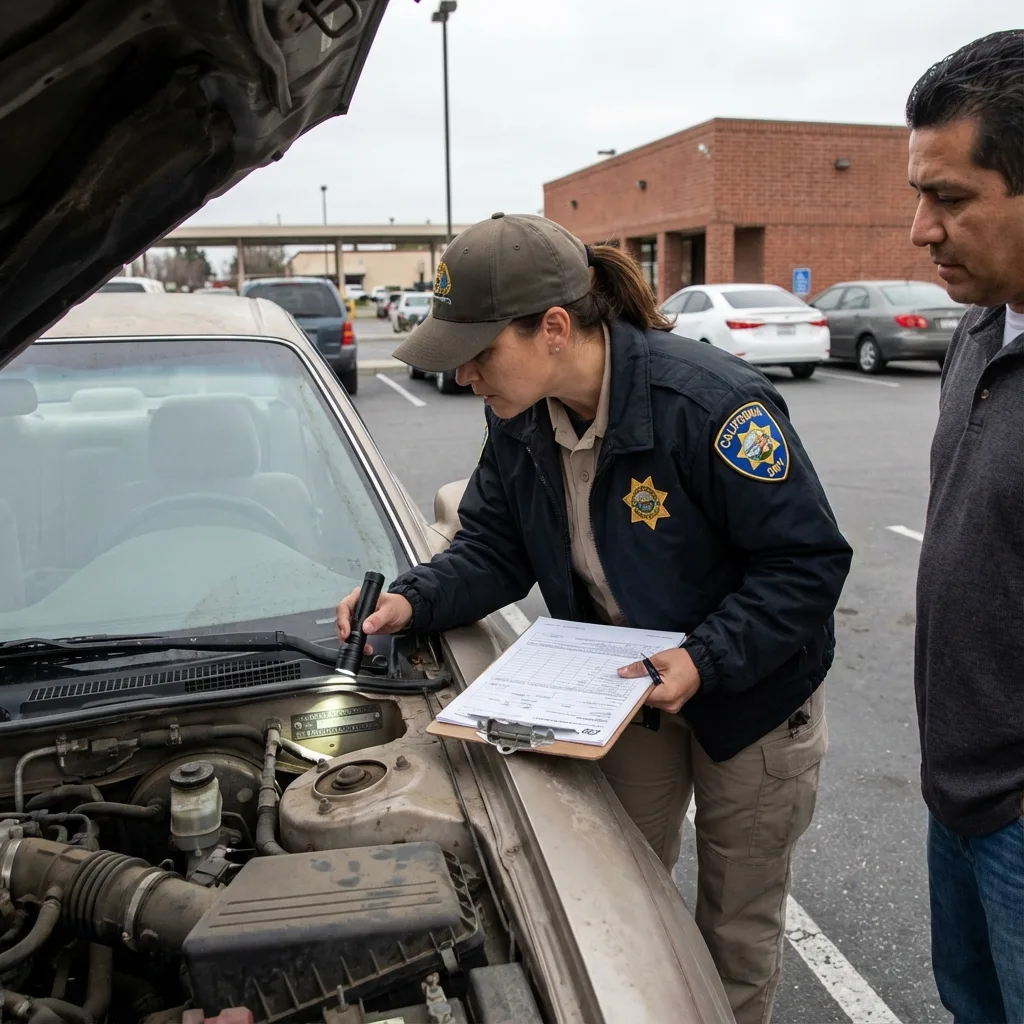
Every state DMV operates like its own little fiefdom. The requirements in California are vastly different from the requirements in Montana or Florida.
VIN inspections:
Many states (like California, Florida, and Colorado) require a physical VIN inspection (or VIN verification) for out-of-state vehicles or first-time titles. This usually involves a police officer or DMV official looking at your VIN plate and signing a form (like the MV20 form in Montana). When the DMV finds a VIN discrepancy on the MCO, Florida and Ohio escalate to law enforcement verification, which adds four to eight weeks to the process.
Note: If you are buying a vehicle remotely and registering it in Montana through us, we can often handle the paperwork without the vehicle needing to be physically in Montana, provided the paperwork is perfect.
Emission standards:
If you are in a CARB (California Air Resources Board) state, verify the MCO states “50-State Emissions Legal.” If it says “49-State” or “Federal Emissions Only,” you may be barred from titling that vehicle in California or New York.
Weight certificates:
For trucks, trailers, and commercial vehicles, the DMV needs to know the empty weight (tare weight) and the Gross Vehicle Weight Rating (GVWR). If this isn’t printed on the MCO, you will need to go to a certified scale, weigh the vehicle, and provide a weight slip.
Reassignment limits:
Indiana caps a single MCO at three dealer-to-dealer reassignments. After the third reassignment, the next dealer in the chain must use a continuation form. Florida uses Form HSMV 82994 for MCO continuations. California requires that any continuation document clearly state the word “Continuation” and carry the same security features as the original. A continuation cannot stand alone in California; it must be physically attached to the parent MCO.
State-by-state rules comparison
This is the cheat sheet you wish the dealership had handed you. Ten of the most common destination states, four of the most common rejection triggers. Use it before the pen touches the paper, not after.
Two patterns jump out of that table. The eight notarization states (Pennsylvania, Oklahoma, Ohio, North Carolina, Montana, Louisiana, Kentucky, Arizona) cover roughly half the country by population, but the white-out rule is universal: no state quietly accepts correction fluid. If you see a white smear on the document, treat it as voided.
Correction rules: how to fix a slip without voiding the document
You misspelled “Corporation” as “Corparation.” You wrote 12 instead of 21 in the odometer field. You forgot to include “LLC” at the end of the entity name. The instinct is to scratch it out, dab some white-out, or tear up the page. Each of those moves makes the problem worse.
The only universally accepted correction method:
- Draw one single straight line through the incorrect text. The original must remain legible after the line is drawn.
- Write the correct information immediately adjacent to the strike-through, in the same ink color you used for the rest of the form.
- Initial the correction. Both the seller and buyer should initial when both signed the section.
- Date the correction with the same date as the assignment.
That method works in Texas, Florida, California, Georgia, and most other states for routine field corrections. Texas formalizes it with Form VTR-18 for specific error categories. Louisiana goes further: any alteration beyond a minor name correction requires a notarized affidavit.
What never works:
- Correction fluid of any color.
- Correction tape.
- Pencil at all (grounds for rejection on its own).
- Multiple cross-outs in the same field.
- A second ink color (Georgia treats this as defacement).
- Heavy ink scribble obliterating the original text.
Notarization errors are worse than field errors: If your MCO required a notary and the notary block is defective, the entire affidavit is void and you must re-execute from scratch. Defects include missing notary language (“Subscribed and sworn before me”), the wrong county listed, a missing notary commission number or expiration date, the notary signing on a different page than the statement, or a notary stamping a document outside their state of commission. None of these can be fixed with a strike-through. The fix is a fresh signing in front of a fresh notary.
Step 5: Submit to the DMV
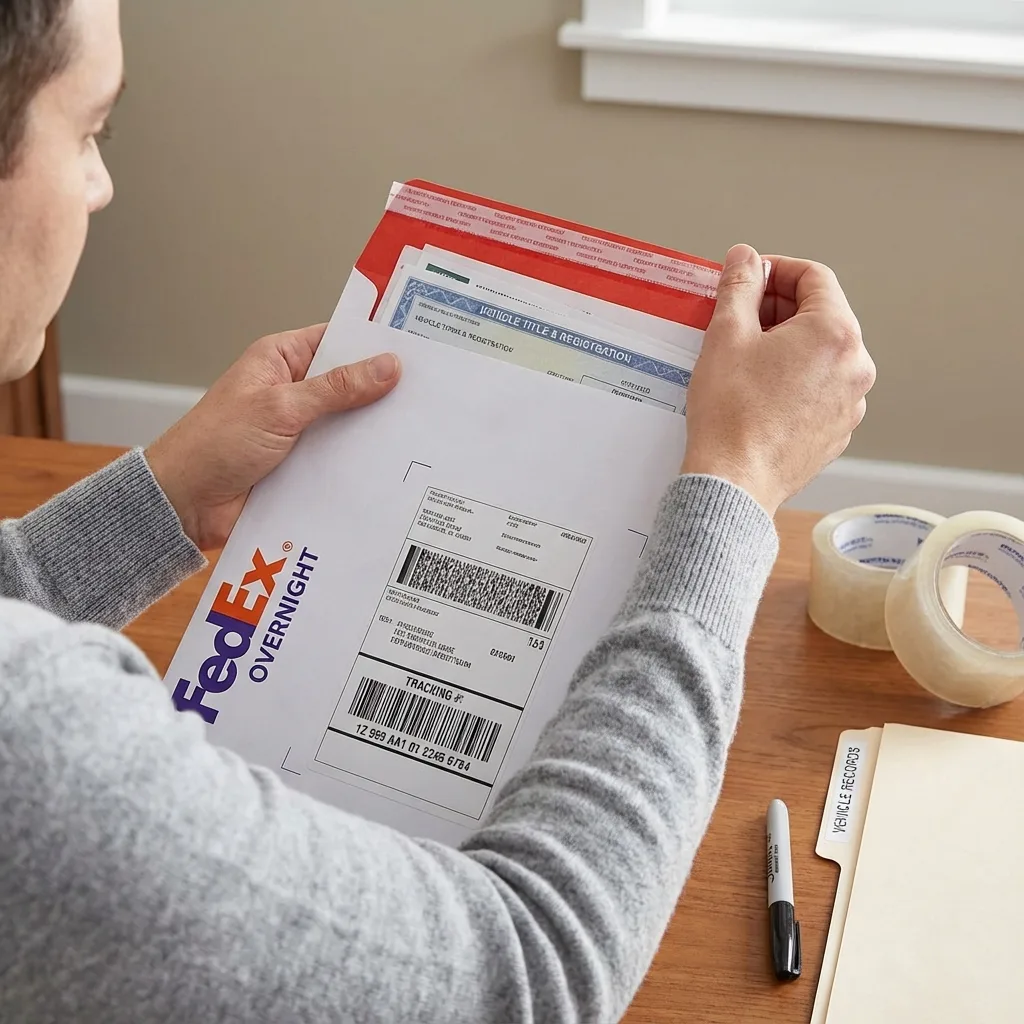
Once the MCO is assigned and the packet is built, you have to submit it.
The in-person route:
If you are doing this locally, prepare for a wait. Bring your checkbook (DMVs often charge credit card fees), a black pen, and patience. If you make a mistake on the forms in front of the clerk, they may make you go to the back of the line or get a new notarized document.
The mail-in route:
If you are mailing your MCO (which you will do if using Zero Tax Tags), never use standard mail.
The MCO is the only proof of ownership you have. If the post office loses it, you are in a world of hurt. Always use FedEx, UPS, or USPS Priority/Express with tracking.
Processing timeframes:
- Local DMV: you might walk out with plates, but the title will be mailed in 2-4 weeks.
- Montana LLC service: we typically turn around registration and plates quickly, with the physical title following the state’s processing timeline (roughly 4-8 weeks depending on MVD volume).
The Montana LLC direct MCO shortcut
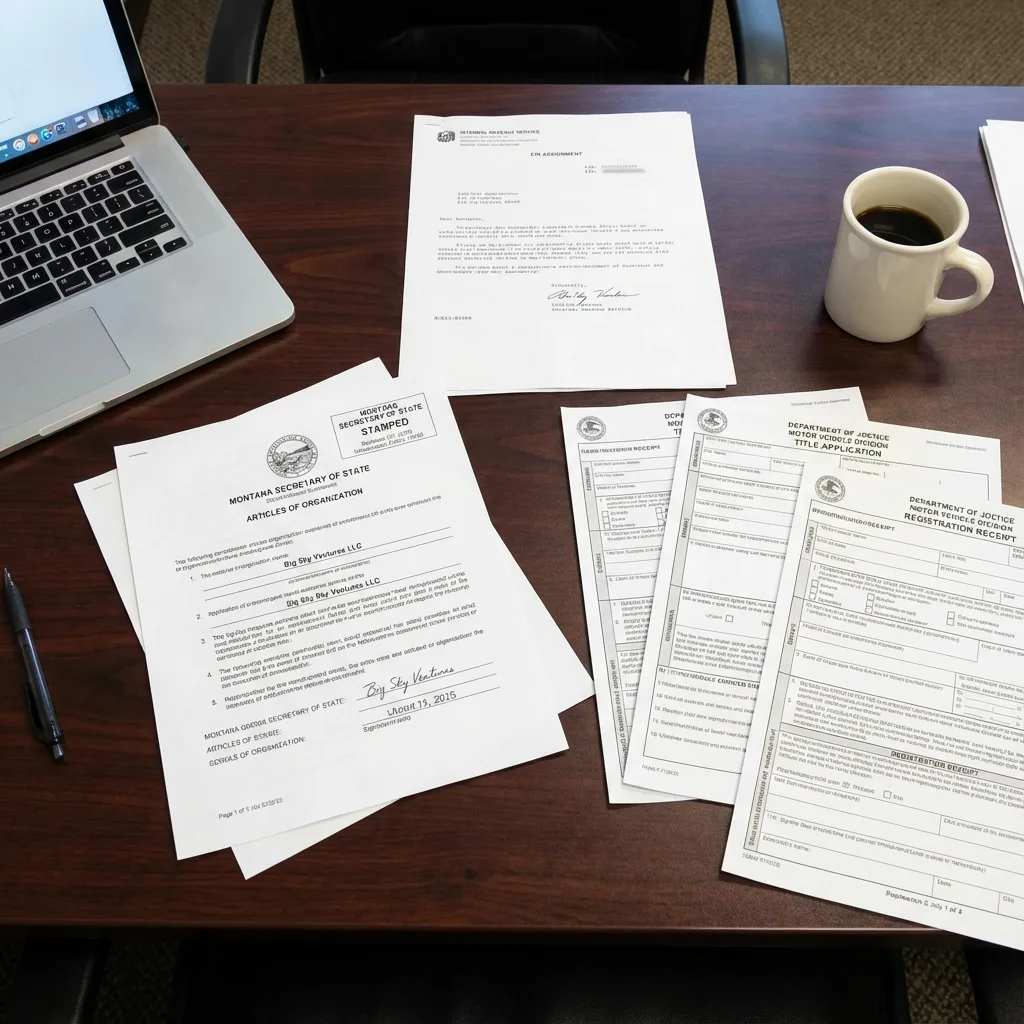
If you are using Zero Tax Tags to register your vehicle in Montana (to legally avoid sales tax on your RV, exotic car, or UTV), the MCO transfer process is slightly different but much easier for you. Montana is also the only state in the country that lets you skip the most painful step entirely: the prior-state title conversion.
Why Montana accepts the MCO directly
Montana Code Annotated § 61-3-201 explicitly allows non-resident LLCs to register vehicles using the MCO directly. There is no requirement to first title the vehicle in your home state, then transfer it to Montana. The MCO goes straight from the dealer to the Montana MVD with the LLC as the named buyer, and the state issues plates and a title on the strength of the original document.
Practical effect: you skip a four-to-six week round trip through your home state’s DMV, avoid paying that state’s sales tax on the way through, and never have to handle a duplicate title transfer. The original MCO becomes the foundation document for the Montana title, exactly as the manufacturer intended.
Statutory requirements for the direct route
- A valid Montana LLC with a registered agent in Montana (physical street address, not a PO box).
- The MCO and bill of sale showing the LLC as the buyer, not your personal name.
- A penalty bond of $100,000 for nonresident applicants registering high-value vehicles, which is standard and built into the service fee.
- EIN/FEIN for the LLC, since the owner is a business entity.
1. The assignment:
The dealer must assign the MCO to your Montana LLC.
- Correct: “Mountain View Holdings LLC”
- Incorrect: “John Smith”
- Fatal error: “John Smith AND Mountain View Holdings LLC”
2. Power of attorney:
We will provide you with a Limited Power of Attorney form. This allows our agents in Montana to sign the title application and registration documents on behalf of your LLC. This saves you from flying to Montana to sign paperwork.
3. We catch the errors:
When you send your MCO to Zero Tax Tags, our experts audit it before it goes to the state. If the dealer missed a signature or the odometer reading is blank, we catch it. We work with you (and the dealer) to fix it before it enters the DMV black hole.
4. EIN requirement:
Since the owner is a business (your LLC), the DMV requires the Federal Employer Identification Number (FEIN/EIN). Ensure you have this number handy when filling out our intake forms.
5. Processing timeline (direct MCO route)
License plates are issued in 2 to 5 business days after the Montana MVD receives a clean package. The physical Montana title follows in 2 to 5 weeks. That is materially faster than any other state’s first-time titling process for an out-of-state buyer, because every other state requires you to first transit through your home state’s DMV.
6. Missing or damaged VIN? Montana still works
Vintage builds, frame-up restorations, and certain salvage vehicles arrive without a readable VIN. Most states refuse to title these without a court order. Montana issues a bonded title and assigns its own VIN through the MVD. The MCO (or what’s left of it) is still the anchor document; Montana fills the gaps with a bond and an assigned identifier.
See how others have successfully registered through Montana LLCs:
When your MCO is lost or damaged: the duplicate process
Maybe FedEx lost the envelope. Maybe a basement flood took out the file cabinet. The MCO is gone or unreadable. You can still recover, but the process is slow and varies by manufacturer.
The most important rule: only the registered owner of record can request a duplicate by mail. If the MCO never made it onto your name (because you never signed it or the dealer never reassigned it), the manufacturer treats the dealer as the only party allowed to request a duplicate. You will need to bring your selling dealer back into the conversation.
Polaris (RZR, Ranger, General, Sportsman, Slingshot)
- Phone: 1-800-765-2747
- Timeline: 7 to 10 business days mailed to the registered owner address.
- Cost: free for the registered owner of record.
- Required: VIN, original purchase date, registered owner name and address.
Indian Motorcycle
- Phone: 1-877-204-3697
- Timeline: 7 to 10 business days.
- Cost: $25 processing fee.
- Required: VIN, dealer of original sale, registered owner ID.
Ford
Ford routes all duplicate MCO requests through the original selling dealer. If that dealer is out of business, Ford will refer you to your state DMV for a “lost MCO affidavit” pathway, which typically requires a bonded title application as the substitute.
If you are not the registered owner
You will need to visit the dealer in person with proof of ownership (bill of sale and government ID). The dealer files the duplicate request, the document mails to the dealer’s address, and the dealer hands it to you. Build in an extra week for that hand-off.
While you wait
The vehicle cannot be legally driven, registered, insured under most policies, or sold. If you have a pending Montana LLC registration in flight, the clock pauses until the duplicate arrives. Plan around a three-to-four week total delay from the moment you discover the loss.
Common mistakes that cause rejections
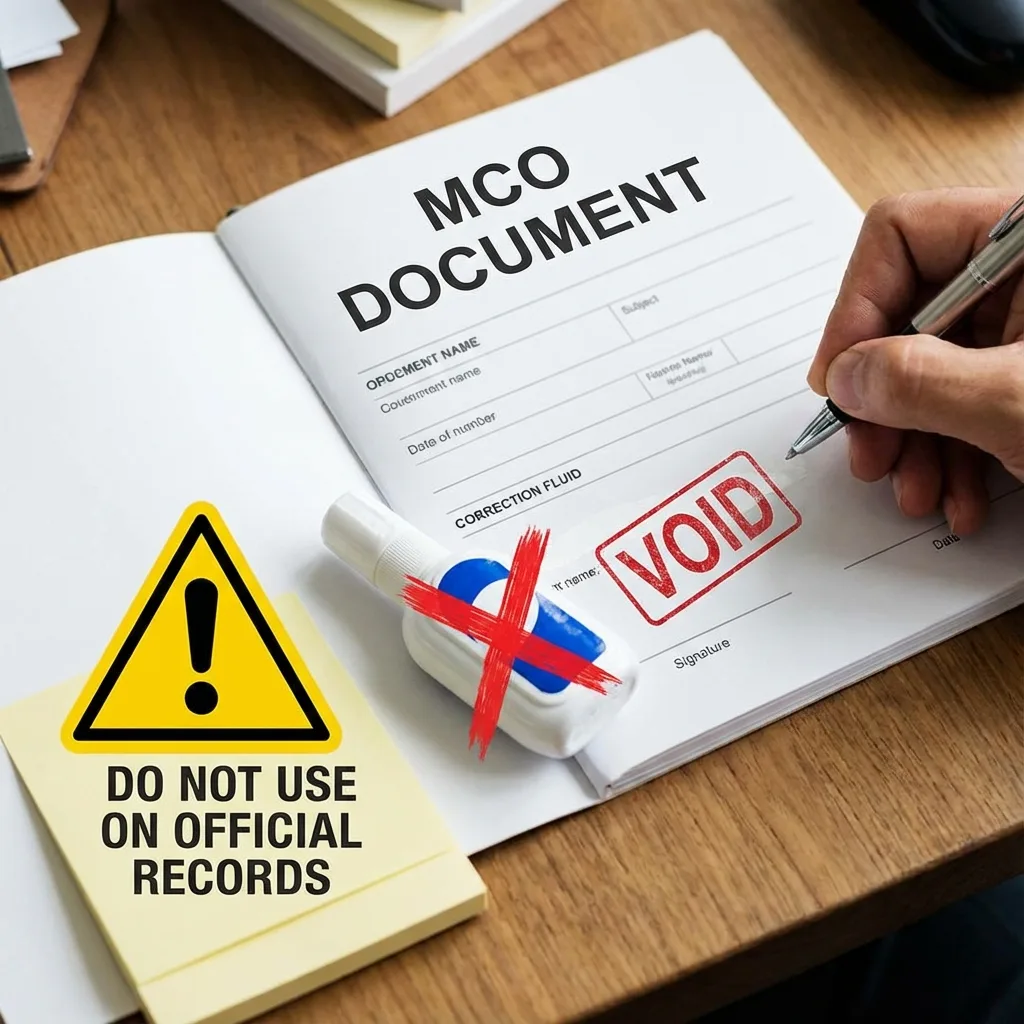
We see hundreds of MCOs a month. Here are the most common reasons they get rejected and how long each one delays your registration.
1. The “white-out” disaster
Never, ever use correction fluid (White-Out) on an MCO.
If you write the wrong name or date, do not scratch it out. Do not paint over it. A defaced MCO is void in Florida, Texas, Louisiana, and California, with most other states following the same rule by practice. You will have to go back to the manufacturer for a duplicate, which is the 7 to 10 business day delay covered in the duplicate section above.
Solution: If you make a mistake, stop. Call us. There are specific affidavits (Statement of Fact) that can sometimes correct a minor error, but let the experts handle it.
2. VIN discrepancies
This is the single most common rejection trigger we see. The dealer transposed two characters, or the MCO came from the manufacturer with a printing error. When the DMV catches it, Florida and Ohio escalate to law enforcement VIN verification, which adds 4 to 8 weeks. Even when the inspector confirms the vehicle’s VIN matches the physical plate, the MCO itself still needs an amended document or a manufacturer affidavit before the title can issue.
3. Name mismatch
- Scenario: your driver’s license says “Robert J. Downey” but you write “Bob Downey” on the MCO.
- Result: rejection. The names must match the ID or LLC documents character-for-character.
- Fix timeline: a notarized name affidavit can patch the gap, but it adds 3 to 4 weeks of round-trip processing with the DMV.
4. The “skipped” dealer (broken reassignment chain)
Sometimes a dealer trades a vehicle to another dealer before selling it to you.
- Dealer A transfers to Dealer B.
- Dealer B sells to You.
- The error: Dealer A assigns the MCO directly to you, skipping Dealer B. Or the chain of assignments on the back is incomplete.
- The fix: all transfers must be documented. Florida and California reject incomplete chains on first review and demand the missing dealer come back to fill the gap.
5. Missing odometer disclosure
If the odometer section is blank, the MVD assumes the vehicle has an unknown history or a broken odometer. This can lead to a “Not Actual Mileage” brand on your title, killing your resale value. Federal law requires the disclosure for any vehicle fewer than 10 model years old. Brand-new vehicles are not exempt; they need a real reading, even if it’s a single digit.
6. Decimal mileage
Illinois explicitly bans decimals. Whole miles only. Writing “14.0” instead of “14” triggers an automatic rejection and a corrected resubmission. Most other states follow the same rule informally.
7. Missing signatures at any tier
Manufacturer agent signature, dealer assignment signature, buyer signature: all three (or more if there are reassignments) must be present. Florida treats a missing signature at any tier as disqualifying on first review.
8. Incomplete lienholder information
Partial lender details prevent title issuance because the DMV cannot mail the title to a partial address. Get the complete lien-perfection address from your finance manager, not the consumer-facing branch address.
Two real case studies: one painful, one painless
Case study #1: the white-out catastrophe
A client in Sarasota bought a $58,000 Polaris RZR Pro R Ultimate at a dealer in Tampa. The finance manager misspelled the buyer’s middle name on the MCO and dabbed a small smear of white-out to fix it before handing the document over. The buyer didn’t notice. He drove home, photographed the documents, emailed them to us for processing.
We caught the white-out smear within an hour of receipt and told him the MCO was void in Florida. He called the Tampa dealer, who refused to absorb the cost. Polaris would issue a free duplicate, but only to the registered owner of record (the dealer, since the MCO had not yet been reassigned to the buyer).
Total elapsed time: 3 weeks from discovery to replacement MCO.
Lost riding days: 21.
Out-of-pocket cost: $40 in expedited shipping.
Lesson: Inspect the MCO at the dealership counter before accepting delivery. Look for any opacity over text; white-out catches light differently than the surrounding paper.
Case study #2: the Montana LLC direct route
A buyer in Austin purchased a $180,000 Class A motorhome from a dealer in Phoenix. He had set up his Montana LLC two months earlier in anticipation of the purchase. The dealer assigned the MCO directly to “Big Bend Holdings LLC” with a Montana registered agent address as the buyer.
The dealer overnighted the MCO and bill of sale to our office on a Tuesday. We audited it Wednesday: VIN match, signature presence, odometer reading, assignment accuracy. Everything clean. We submitted to the Montana MVD on Thursday morning. License plates were issued the following Monday and shipped to the buyer’s Texas residence.
Total elapsed time: 4 business days from dealer overnight to plates in hand.
Sales tax avoided: $14,850 (Texas 6.25% on $180,000 purchase, before any local add-on).
Out-of-pocket cost: Service fee plus Montana registration; no home-state DMV interaction at any point.
Lesson: The direct MCO acceptance under Montana Code Annotated § 61-3-201 is the fastest legal path from dealer to plates for an out-of-state buyer. Skipping the home-state DMV is the entire game.
What happens after submission?
Once the MVD accepts the MCO, the magic happens.
- Surrender: The MVD keeps the MCO. It is archived and effectively “destroyed” as an active ownership document.
- Title issuance: The state prints a Certificate of Title. This is your new “Pink Slip.” It will list your LLC as the owner.
- Registration: You receive your license plates and registration card.
If you financed the vehicle, the Title will be mailed directly to your lender (the lienholder). You will receive the registration and plates, but you won’t see the title until the loan is paid off.
From that moment forward, the MCO is a closed chapter. Every future transaction (selling the vehicle, refinancing, transferring between trusts or LLCs) runs against the state Certificate of Title. The MCO has done its job.
Ready to Transfer Your Certificate of Origin Correctly?
Vehicle owners have saved thousands with Montana LLC registration. Skip the DMV nightmares and let our experts handle your MCO transfer — right the first time.
Conclusion
Transferring a certificate of origin isn’t rocket science, but it is strict legal bureaucracy. It requires precision. You are converting a manufacturer’s promise into a government-recognized legal asset.
If you are buying a high-value vehicle, an RV, or a trailer, doing this process through a Montana LLC can save you thousands in taxes and headaches. But it only works if the paperwork is perfect. The good news is that Montana’s direct MCO acceptance under § 61-3-201 makes the path shorter than any other state in the country, provided you assign the document to the LLC at the dealer counter and not to yourself.
Don’t guess. Don’t use white-out. And definitely don’t let a sloppy dealer assignment cost you weeks of riding time.
Ready to register your new vehicle tax-free? Zero Tax Tags handles the entire MCO-to-Title process for you. We catch the errors, handle the DMV, and get your plates delivered to your door.