26 min read
On this page
- + Executive summary
- + The Manufacturer’s Certificate of Origin
- • Characteristics & chain of assignment
- + The certificate of title
- • Legal function & ownership proof
- + Key differences: MCO vs. title
- + The legal exchange mechanism
- • Surrender principle & fraud prevention
- + What happens when you lose each document
- + Step-by-step MCO transfer walkthrough
- + State-by-state requirements comparison
- + The Montana LLC connection
- • MCA § 61-3-201 and direct MCO acceptance
- + Common legal mistakes and pitfalls
- + Real consequences: two case studies
- + Real-world scenarios
- + Decision matrix
- + Conclusion
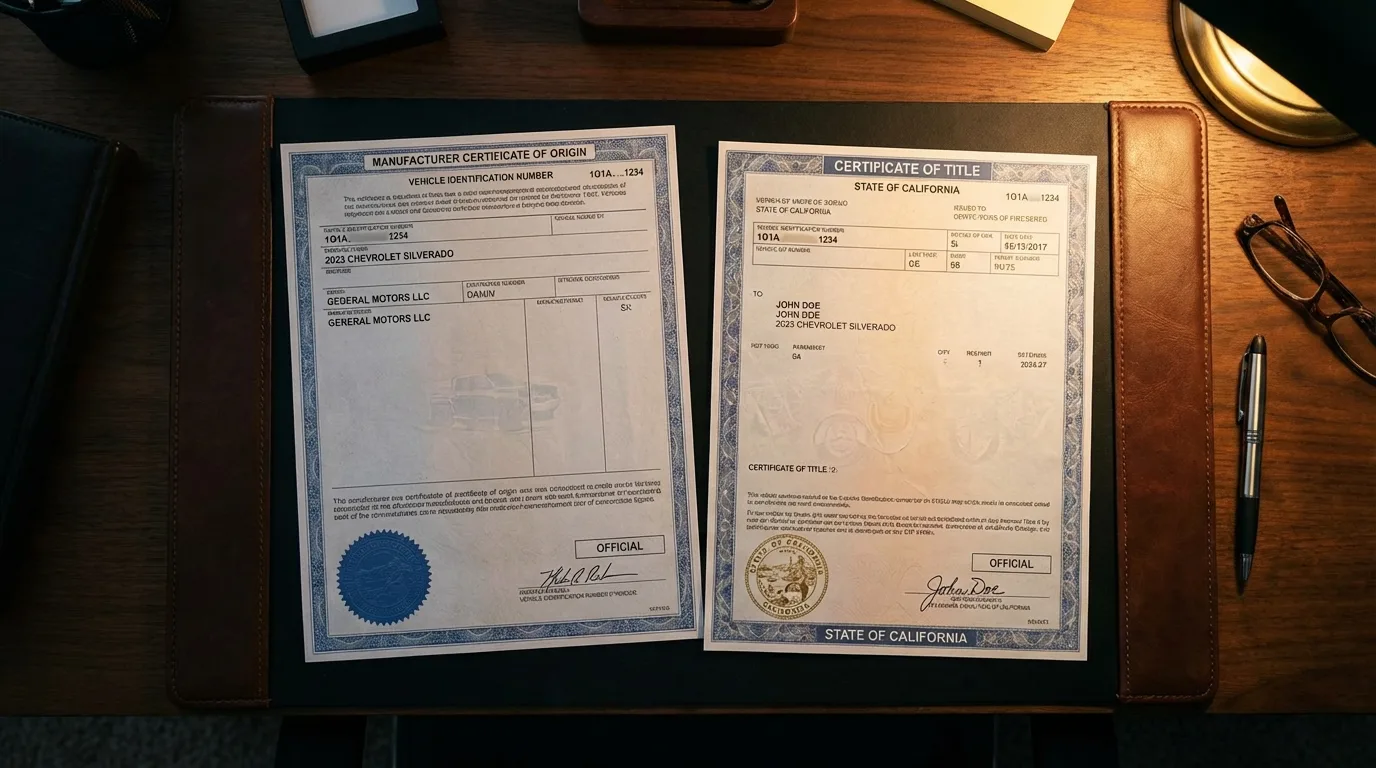
Few concepts in vehicle acquisition cause as much confusion as the distinction between a certificate of origin vs title. Both documents establish ownership. They do so at different stages of a vehicle’s life, under different legal authorities, and with very different consequences when something goes wrong.
You may treat the two as interchangeable. The state will not. A Manufacturer’s Certificate of Origin (MCO) proves a vehicle exists and has been released from the factory. The Title proves who owns it under the laws of a specific state. Confusing the two costs people thousands in delayed registrations, double taxation, and rejected applications every year.
This guide walks through the legal mechanics of both documents, the exchange process that converts one into the other, the dollar costs of losing each, and how Zero Tax Tags uses Montana’s MCA § 61-3-201 statute to register new vehicles directly through an LLC without passing through your home state’s tax system.
Executive summary: the “birth certificate” vs. the “state ID”
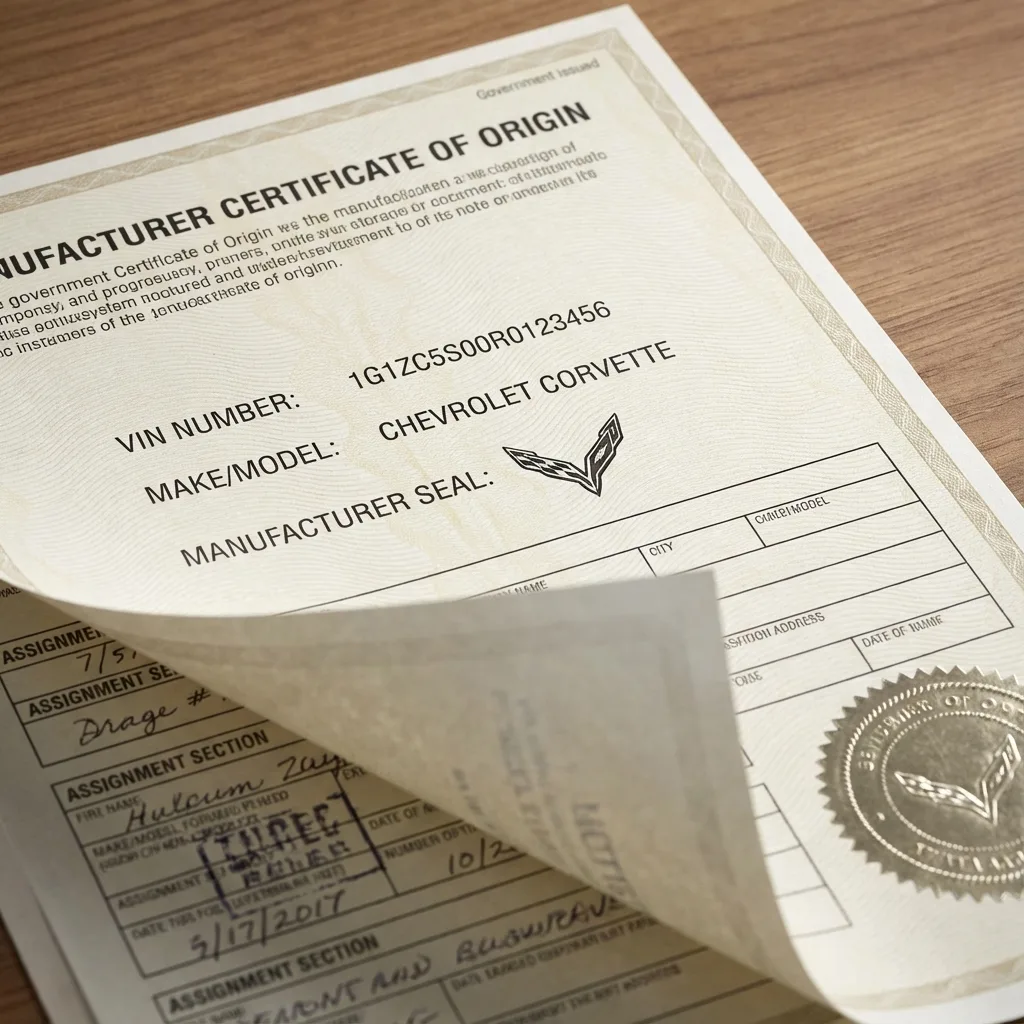
A Manufacturer’s Certificate of Origin (MCO), also called a Manufacturer’s Statement of Origin (MSO) or Certificate of Origin (CO), is the initial proof that a motor vehicle exists. The factory issues it. It certifies a specific VIN has been produced and shipped to a licensed dealer. It is printed on watermarked, security-feature paper similar to a stock certificate, often with embossed seals and color-shifting ink.
A Certificate of Title is a state-issued legal document that establishes the current owner of the vehicle within a specific jurisdiction. It is the controlling ownership document for the entire remaining life of the vehicle.
The relationship between the two is linear. The MCO is surrendered to a state Department of Motor Vehicles (DMV) or Motor Vehicle Division (MVD) to generate the first Certificate of Title. You cannot hold a valid MCO and a Title for the same vehicle simultaneously. The issuance of the Title legally voids the MCO. From that moment forward, the MCO never reappears in the chain of ownership.
If you are buying a brand-new vehicle that has never been registered anywhere, you will receive an MCO from the dealer. If you are buying anything else, you will receive a Title from the seller. Treating these documents as the same thing is the single most common reason registration applications get bounced back.
1. The Manufacturer’s Certificate of Origin (MCO/MSO) defined

The MCO is the source document for every piece of paperwork that follows. State statutes, including Montana’s, define a “new motor vehicle” as one whose legal title has never been transferred to a person for purposes other than resale. The MCO substantiates this status. It is the first link in the chain of title.
Characteristics of the MCO
The MCO contains data fixed at the moment of manufacture:
- Vehicle Identification Number (VIN): The unique 17-character serial number.
- Year, Make, and Model.
- Engine specifications and Horsepower.
- Gross Vehicle Weight (GVW) or shipping weight.
- Body type and color.
- Manufacturer’s signature block certifying the vehicle was built to specification.
The chain of assignment
The back of an MCO contains assignment spaces, also called reassignment blocks. When a manufacturer sells a vehicle to a dealer, it assigns the MCO to that dealer. If that dealer trades the vehicle to another dealer, the MCO is reassigned in the next block. Indiana caps dealer-to-dealer reassignments at three on a single MCO. Once the limit is reached, dealers must use a continuation form. Florida uses Form HSMV 82994 for that purpose.
When the vehicle is sold to the first retail purchaser, whether an individual or a Montana LLC, the dealer assigns the MCO to that purchaser. This assignment is the legal trigger that changes the vehicle’s status from “inventory” to “property.”
Per Montana MVD regulations, a new vehicle cannot be titled without submission of this document. The MCO is the proof of ownership required to apply for the initial Montana Certificate of Title.
Why the MCO looks the way it does
Manufacturers print MCOs on security paper because the document is a bearer instrument until it is assigned. Whoever physically possesses an unassigned MCO with a clean back can theoretically claim ownership. That is why dealers store them in safes, why title companies require originals only, and why eight states demand notarization on the assignment.
2. The certificate of title defined
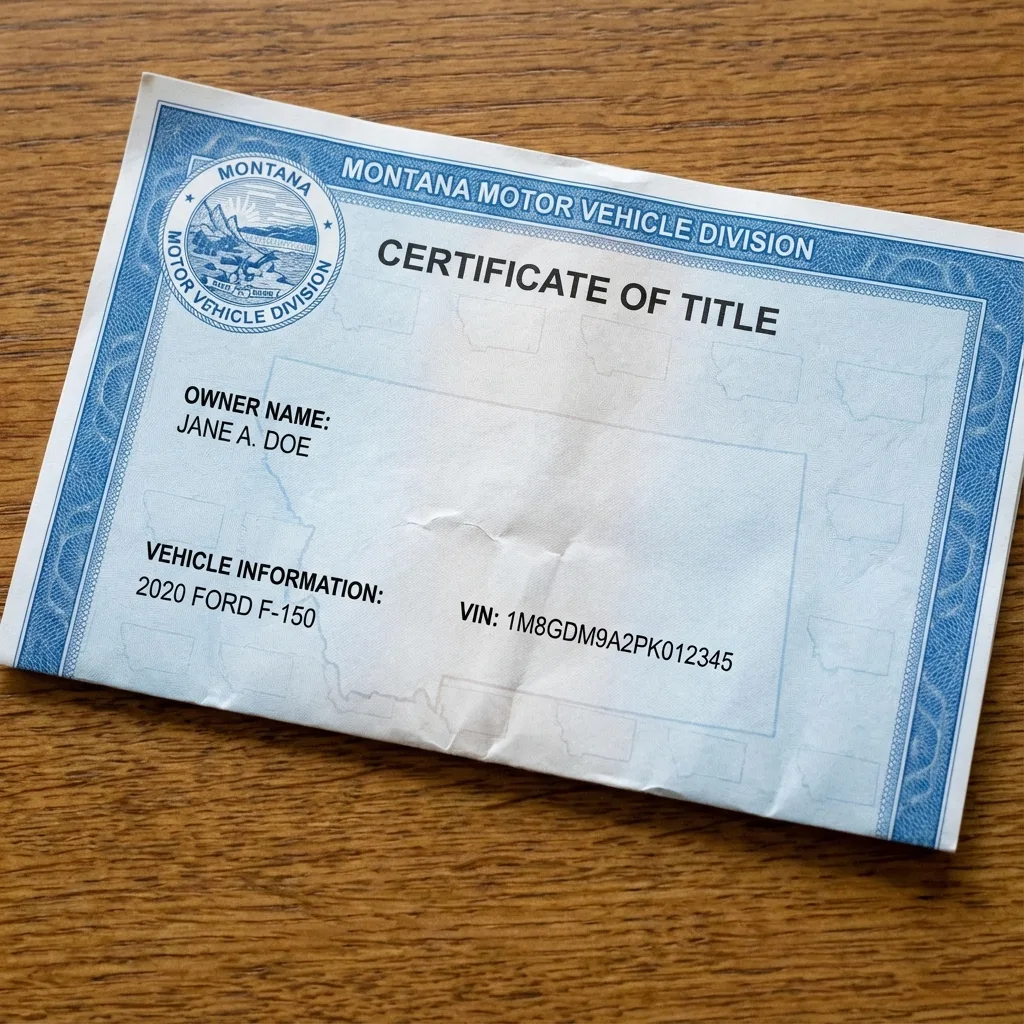
The Certificate of Title is the definitive proof of ownership recognized by the state. Unlike the MCO, which is a manufacturer’s document, the Title is a government-issued document. It is backed by the full faith and credit of the issuing state’s records system. Montana’s centralized electronic title registry, authorized under MCA § 61-3-101, preserves chain-of-title information for all Montana-registered vehicles.
The legal function of a title
A Title serves three primary legal purposes:
- Establishes Ownership: It names the specific individual or entity (such as a Montana LLC) that owns the asset.
- Records Liens: It is the public record for any security interests. If a vehicle is financed, the lender’s interest is perfected by being recorded on the face of the Title.
- Tracks History: Through “branding,” a Title discloses if a vehicle has been salvaged, rebuilt, flood-damaged, or designated as a manufacturer buyback (lemon).
Once a Title is issued, the vehicle is no longer considered “new” in the eyes of registration law, regardless of mileage. A dealer demonstrator with 200 miles on the odometer that was titled to the dealership is, legally, a used vehicle. It is now a titled asset. Future transfers must be conducted by assigning the Title, not an MCO. The MCO is gone forever.
Title vs. registration: two different things
People conflate “title” and “registration.” They are separate. The Title proves you own the vehicle. The Registration proves you have paid the annual fees required to operate it on public roads. You can hold a Title without an active registration. You cannot hold a registration without a Title. New York requires Form MV-82, proof of liability insurance, and proof of identity to issue a registration. Title processing there can take up to 90 days after the registration is issued.
3. Key differences: MCO vs. title
The table below compares both documents across their legal attributes.
4. The legal exchange mechanism
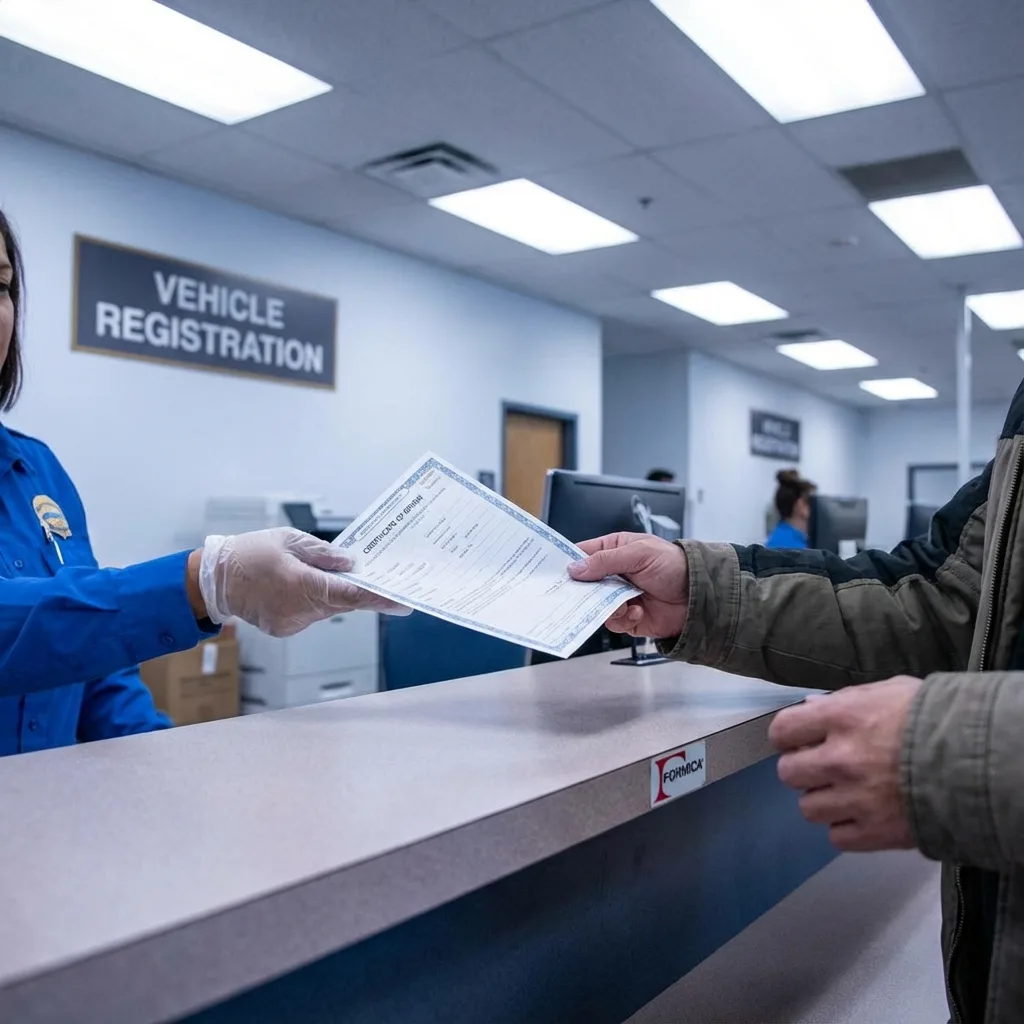
The transition from MCO to Title, called “titling,” creates the state record for the vehicle.
The surrender principle
You cannot maintain an active MCO and a Title simultaneously. To obtain a Title, the MCO must be physically surrendered to the state licensing agency. There are no exceptions, no workarounds, no situations where you keep both. The MCO is consumed by the titling process.
In Montana, when Zero Tax Tags processes a registration for a client, we submit the original MCO to the Montana Motor Vehicle Division. The state reviews the assignment on the back of the MCO to confirm the chain of ownership flows correctly from the dealer to the Montana LLC. Once verified, the state archives or destroys the MCO and issues a Montana Certificate of Title. That new Title is the legal proof your LLC owns the vehicle. Nebraska follows a similar protocol: the MSO must be assigned and submitted to the county treasurer alongside the Application for Certificate of Title.
Why you cannot keep the MCO
Clients sometimes ask if they can keep the MCO as a souvenir or for their records. The answer is legally no. The state requires the MCO as evidence to prevent fraud and theft. If a state issued a Title without collecting the MCO, a fraudster could theoretically use the MCO to title the same vehicle in a different state. That creates conflicting ownership records, a practice known as “title washing” or “cloning.” States destroy or archive the MCO precisely to make this impossible.
The one exception: vehicle export
U.S. Customs and Border Protection accepts the original MCO plus two copies as proof of ownership for export under 19 CFR. This applies only when the vehicle has never been titled in any state. Once a Montana Title exists, CBP requires that document instead.
5. What happens when you lose each document
This is where the legal asymmetry between an MCO and a Title becomes a real-world financial problem. The two documents look similar. Losing them produces wildly different outcomes.
Losing a title (after registration): mostly administrative
If you lose your Certificate of Title after the vehicle has been registered, you have nothing to panic about. The state already has your ownership recorded electronically. You apply for a duplicate, pay a small fee, and wait.
You walk into the DMV with valid identification. They look up your VIN. They print a duplicate. The original lost Title is now void in the system. Annoying, not catastrophic.
Losing an MCO (before registration): a genuine problem
Losing an MCO before titling is a different category of headache. The state never issued it. The state has no record of it. The state cannot issue a duplicate. You must go upstream to the manufacturer.
Most manufacturers will not deal directly with end consumers. They communicate only with their authorized dealer network. The process:
- Contact the selling dealer.
- The dealer files an affidavit of lost MCO with the manufacturer.
- The manufacturer prints a replacement MCO marked “DUPLICATE.”
- The replacement is shipped to the dealer (typically 7 to 10 business days).
- The dealer reassigns it to you.
Some powersports brands allow direct consumer contact. Polaris will issue a free duplicate MCO if you call 1-800-765-2747. Indian Motorcycle charges $25 for a replacement at 1-877-204-3697. For most automotive brands, you are entirely dependent on dealer cooperation.
Warning: If the selling dealer has gone out of business, recovering a lost MCO becomes extraordinarily difficult. You may need to contact the state dealer board, file affidavits with the manufacturer’s regional office, and potentially pursue a bonded title in some states. Expect months, not weeks.
Side-by-side: what each loss actually costs you
Treat your MCO like cash. Treat your Title like a passport. Both matter. One is far easier to replace.
6. Step-by-step MCO transfer walkthrough
Most buyers never look at the back of an MCO. They sign whatever the dealer puts in front of them. That is a mistake. The back of an MCO is where every error happens, and every error costs you time and money.
The anatomy of an MCO back page
The reverse side of an MCO contains four functional zones:
- Dealer-to-Dealer Reassignment Blocks: Numbered sections for wholesale transfers between licensed dealers. Each block contains seller and buyer dealer names and addresses, the date, and signature lines.
- Dealer-to-Retail-Buyer Assignment Block: The final assignment that transfers ownership from the dealer to you or your Montana LLC. The legal entity name must appear exactly as it will on the title.
- Odometer Disclosure Section: Required by the federal Truth in Mileage Act for any vehicle fewer than 10 model years old. Actual mileage in whole miles. No decimals. No fractions.
- Lienholder Section: If financed, the lender’s name, address, and lien date appear here. For a cash or LLC purchase, this section stays blank.
The correct sequence for an LLC transfer
If you are buying a new vehicle through your Montana LLC, the assignment must follow this exact sequence:
| Step 1: | Confirm the dealership has your Montana LLC name spelled correctly on the buyer’s order, the bill of sale, and the MCO assignment block. A single typo can void the assignment. |
| Step 2: | The dealer’s authorized representative completes the dealer-to-buyer assignment in blue or black ink only. Georgia rejects any other color outright. Pencil is universally rejected. |
| Step 3: | The odometer reading is recorded in whole miles. The dealer signs and dates the disclosure. You (as the LLC’s authorized member) acknowledge the reading. |
| Step 4: | If the transaction is occurring in one of the eight notarization states (Pennsylvania, Oklahoma, Ohio, North Carolina, Montana, Louisiana, Kentucky, Arizona), a notary public witnesses the signatures. Ohio is unique: it requires both seller and buyer signatures to be notarized. |
| Step 5: | The dealer ships the original assigned MCO to Zero Tax Tags via tracked overnight courier. We do not accept copies. We do not accept scans. The original document is what Montana requires. |
| Step 6: | Zero Tax Tags submits the MCO, the bill of sale, the LLC formation documents, and the Application for Certificate of Title to the appropriate Montana county treasurer. |
| Step 7: | License plates are issued in 2 to 5 business days. The Montana Title is mailed in 2 to 5 weeks. You are now legally registered. |
How to correct mistakes on an MCO
Typos happen. Here is how to fix one without voiding the document:
- Draw a single horizontal line through the incorrect text. Original text must remain legible.
- Write correct text directly adjacent (not over) the lined-out text.
- The correcting party must initial and date the change.
- No white-out, correction tape, or stickers. Texas, Georgia, Florida, and California reject these on sight.
- Louisiana requires a notarized affidavit for any alteration beyond a minor name correction.
Pro tip: If a dealer’s representative asks you to “just initial here while we fix this later,” refuse. Once the document is signed, you have legally accepted the assignment. Any subsequent alteration without your involvement is improper and may be challenged by the state.
7. State-by-state requirements comparison
State title statutes are not uniform. The same MCO that sails through registration in one state will be rejected in another for failing a procedural rule that does not exist in your home jurisdiction. The table below summarizes the rules that trip up the most buyers.
Eight of the fourteen states above require notarization. If you are completing the MCO assignment in any of them, the notary must be present at the moment of signing. You cannot sign first and notarize later. The notary’s seal certifies the signature was executed in the notary’s presence on the stated date.
8. The Montana LLC connection

For Zero Tax Tags clients, the MCO is the document that makes new vehicle tax savings possible. Most states force you to title your new vehicle in your home state first, paying full sales tax, before any subsequent transfer to a Montana LLC can occur. Montana is different.
The statutory foundation: MCA § 61-3-201
Montana Code Annotated § 61-3-201 expressly authorizes a non-resident LLC to register a vehicle in Montana using the original MCO. There is no requirement that the vehicle first be titled elsewhere. The MCO is assigned directly from the dealer to the Montana LLC, and Montana issues its own Title in the LLC’s name.
This single statutory provision is what makes the entire Montana LLC vehicle registration model possible. Without direct MCO acceptance, you would be forced through your home state’s tax system before reaching Montana.
What Montana requires
To register a vehicle through a Montana LLC under MCA § 61-3-201, you need:
- A properly formed Montana LLC with a Montana registered agent at a physical street address. Post office boxes are not accepted.
- The original MCO assigned by the dealer to the LLC.
- A bill of sale showing the LLC as the purchaser.
- For nonresident applicants, a penalty bond of $100,000 to secure the proper application.
- Application for Certificate of Title submitted to the county treasurer.
The process for new vehicles
When you purchase a new vehicle through a Montana LLC to legally avoid sales tax, the dealership must assign the MCO directly to your LLC, not to you personally.
- Purchase: You buy the vehicle. The “Purchaser” listed on the MCO must be the name of your Montana LLC, exactly matching the formation documents.
- Submission: The original MCO is shipped to Zero Tax Tags via overnight courier with tracking.
- Exchange: Zero Tax Tags submits the MCO, along with the Application for Certificate of Title and supporting LLC documents, to the county treasurer or MVD.
- Issuance: Montana issues a Title in the name of the LLC and provides the license plates. Plates arrive in 2 to 5 business days. The Title arrives in 2 to 5 weeks.
Compare that to the alternative. In a typical home-state title conversion, you would first title the vehicle in your name, pay state sales tax (often 6% to 10%), pay registration fees, then transfer the title to your LLC. Montana’s direct MCO acceptance bypasses every one of those steps.
Why the MCO matters for the LLC
If the dealer assigns the MCO to you personally, you have technically taken ownership as an individual. Transferring it subsequently to the LLC may trigger tax liabilities in your home state. The MCO assignment must be executed correctly at the point of sale, naming the LLC as the buyer from the start.
Zero Tax Tags acts as your authorized agent. We pre-coordinate with the dealer’s title clerk to confirm the LLC name will appear correctly. We provide the dealer with a written instruction packet so the assignment is unambiguous. Then we handle the surrender of the MCO and issuance of the Montana Title in strict accordance with Montana MVD regulations.
9. Common legal mistakes and pitfalls
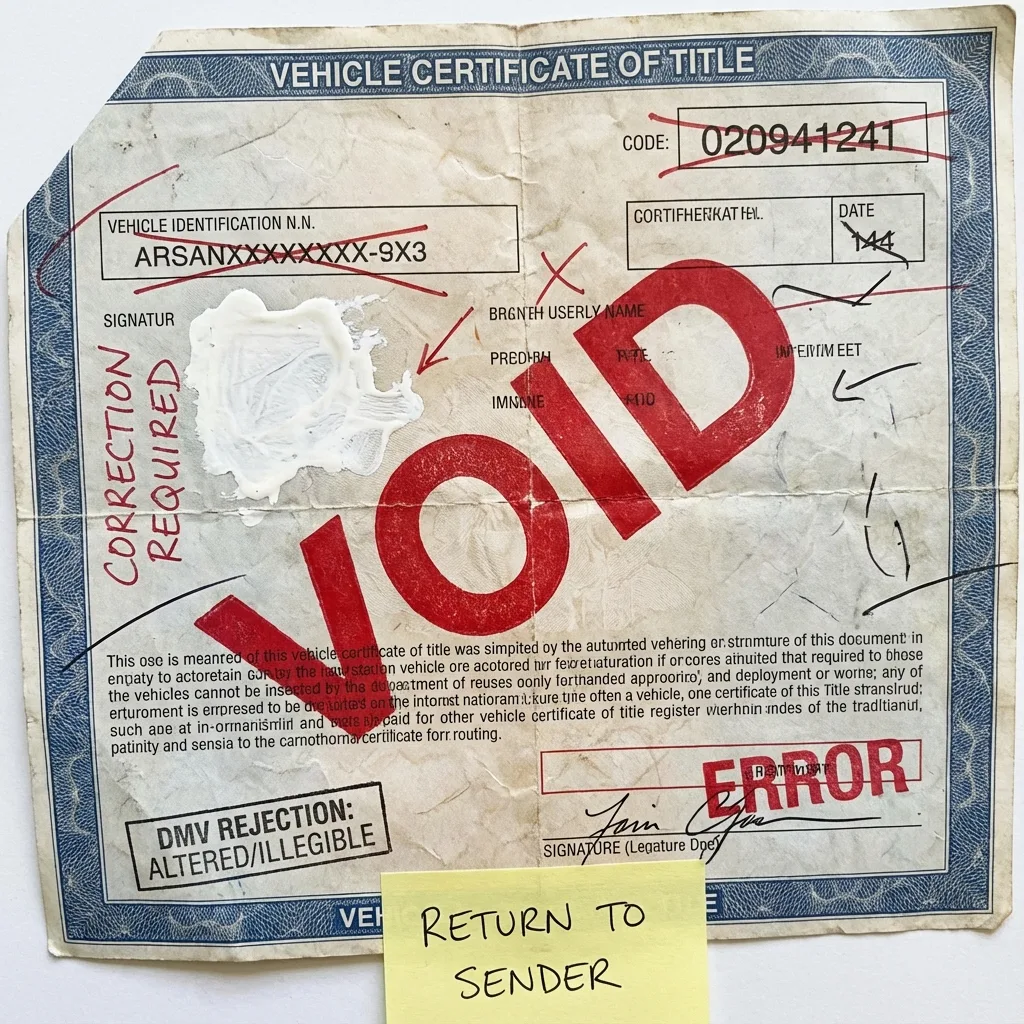
The documentation process is unforgiving. Small errors on an MCO or title get applications bounced back by the state, sometimes creating tax exposure you didn’t anticipate.
Mistake 1: breaking the chain of ownership
The “Chain of Ownership” must be unbroken.
- Correct: Manufacturer → Dealer → Your LLC.
- Incorrect: Manufacturer → Dealer → You (Personal Name) → Your LLC.
If the MCO is assigned to you personally, you generally must title it in your name first (paying applicable taxes) before you can transfer it to the LLC. Zero Tax Tags advises clients on how to instruct dealers to avoid this costly error.
Mistake 2: losing the MCO
Because the MCO is a bearer instrument of sorts, losing it is a significant legal hurdle. You cannot apply for a “duplicate” at the DMV because the DMV never issued it. You must go back to the selling dealer, who must petition the manufacturer for a replacement. Recovery takes 7 to 10 business days under good conditions and months if the dealer has gone out of business.
Mistake 3: alterations and erasures
State agencies, including the Montana MVD, have a zero-tolerance policy for alterations on title documents. If a name is written on the MCO assignment line and then crossed out or covered with white-out, the document is typically voided. White-out and erasures are universally rejected in Texas, Georgia, Florida, and California. Correction requires a single line through the incorrect text with the correct text written adjacent. The original must remain legible. Texas mandates that the correcting party initial and date the change. Louisiana requires a notarized affidavit for any alteration beyond a minor name correction.
Mistake 4: confusing the documents
Attempting to register a vehicle with an MCO that has already been titled, or attempting to export a vehicle using a Title when an MCO is required (or vice versa), leads to immediate rejection.
Mistake 5: wrong ink color
Georgia mandates blue or black ink only. Other colors or pencil cause immediate rejection. Red ink, in particular, is treated by most states as an alteration indicator and triggers additional scrutiny even where it is not formally prohibited.
Mistake 6: odometer disclosure errors
The federal Truth in Mileage Act applies to any vehicle fewer than 10 model years old. The disclosure must show actual mileage in whole miles. Decimals, fractions, or “approximately” notations void the disclosure. Failing to complete the odometer section on a new vehicle MCO (where the reading should be the delivery mileage, often under 50 miles) is a common dealer mistake that bounces the entire application.
Warning: Never alter, erase, or white-out information on an MCO or Title. The document will be voided and rejected by the state.
Explore related guides:
10. Real consequences: two case studies
Theory is one thing. The cost of a mishandled document is another. The two scenarios below are composite cases drawn from the kinds of situations Zero Tax Tags resolves on a regular basis.
Case study A: the lost MCO on a $185,000 coach
A retired engineer in Scottsdale, Arizona, purchased a new Class A diesel motorcoach from a dealer in Indiana. He intended to register it through a Montana LLC to avoid Arizona’s combined sales tax and use tax burden, which would have exceeded $14,000 on the purchase. The dealer assigned the MCO correctly to the LLC and shipped the document via standard mail to the buyer’s home address.
The package never arrived.
Three weeks of tracking returned nothing. The MCO was lost in transit. The buyer contacted Zero Tax Tags. We initiated the recovery sequence: the selling dealer filed an affidavit of lost MCO with the manufacturer’s regional office. The manufacturer issued a duplicate marked “DUPLICATE” in red ink, shipped by tracked overnight courier. Total elapsed time from purchase to plates: 11 weeks. During those weeks, the coach sat in storage with active insurance but no registration.
The replacement MCO cost the manufacturer nothing to issue. The cost to the buyer was time. Eleven weeks of lost use, storage fees of roughly $400 per month, plus the anxiety of holding a $185,000 asset with no legal way to operate it. The lesson: ship the original MCO by tracked overnight courier, every time, no exceptions.
Case study B: the lost title on a vintage Ferrari
A collector in Naples, Florida, owned a 1985 Ferrari 308 GTS Quattrovalvole, originally registered in Florida and later transferred to a Montana LLC through Zero Tax Tags. Two years after the Montana title was issued, the collector decided to sell the car at a Mecum auction. He went to retrieve the Montana Title from his home safe. The title was not there.
This is the easy version of the story. The collector contacted Zero Tax Tags. We submitted a duplicate title application to the Montana MVD on his behalf. Montana looked up the VIN, confirmed the LLC’s ownership in the centralized electronic title registry under MCA § 61-3-101, and issued a duplicate Title within 9 business days. Cost: $10.30. The collector signed the duplicate Title, transferred it to the auction buyer, and walked away with a $145,000 sale price.
Compare the two outcomes. The lost MCO took 11 weeks and required coordination with a dealer and a manufacturer. The lost Title took 9 business days and a duplicate application. Same problem, wildly different consequences.
The pattern: Once your vehicle has been titled, you have a state safety net. Until then, you are entirely dependent on the manufacturer and the selling dealer to recover from any document loss. The faster you complete the MCO-to-Title exchange, the safer you are.
11. Real-world scenarios
The four scenarios below cover the most common certificate of origin vs title situations Zero Tax Tags handles.
Scenario A: buying a brand new RV from a dealer

You’re purchasing a $300,000 Class A motorhome. The dealer holds the Manufacturer’s Certificate of Origin. The MCO gets assigned to your Montana LLC, Zero Tax Tags takes physical possession and surrenders it to Montana to generate the first title. You get Montana plates and a title. The MCO is archived by the state.
Scenario B: buying a classic car from a private seller

You’re buying a 1969 Mustang from a private collector. The seller holds a Certificate of Title from their home state. The seller signs the back of the title as “Seller,” your Montana LLC goes in as “Buyer,” and Zero Tax Tags submits the title to Montana. Montana cancels the old state title and issues a new Montana title in your LLC’s name. No MCO involved, because this vehicle has been titled before.
Scenario C: the “title only” dealer transaction
A dealer sells you a used vehicle that was traded in. The dealer holds the previous owner’s Certificate of Title. The dealer uses a Dealer Reassignment form or the back of the title to transfer ownership to your LLC. You get a title, not an MCO, even though you’re buying from a dealer. Used is used.
Scenario D: the dealer demonstrator trap
You think you’re buying a brand new SUV, but it has 1,800 miles because it was used as a dealer demonstrator. The question that actually matters: was the demo titled to the dealership? If yes, the dealership holds a Certificate of Title, not an MCO. If no, the dealership still holds the MCO. Ask the dealer in writing. Don’t accept verbal assurances. If it was titled, the vehicle is legally used and the dealer reassigns the title. If not, the MCO assignment proceeds as with any new vehicle.
12. Decision matrix: when is each document required?

When preparing to register your vehicle through Zero Tax Tags, use this matrix to determine which document you must obtain from the seller.
When to require a Manufacturer’s Certificate of Origin (MCO):
- New vehicles that have never been titled in any state
- Kit vehicles where the chassis and body haven’t been assembled or titled as a road-legal vehicle yet
- Some direct imports (grey market vehicles with no US title yet, though these need additional Customs documentation)
When to require a Certificate of Title:
- Any vehicle that has been registered before
- Dealer demonstrators that have been titled to the dealership (if so, you need the title, not the MCO)
- Auction purchases, unless it’s a factory sale of new units
- Transfers from personal name to LLC if you already own the vehicle
Conclusion: professional handling of legal documentation
The distinction between a certificate of origin vs title is the legal foundation of your vehicle ownership. Mismanaging these documents leads to rejected registrations, double taxation, broken chains of legal ownership, and in the worst cases, multi-month delays during which your asset cannot be legally operated.
The MCO is the vehicle’s birth certificate: single-use, factory-issued, surrendered the first time the vehicle is titled. The Title is the vehicle’s permanent identity card: state-issued, electronically backed, transferable indefinitely. Lose a Title and you replace it for $10 to $75 in days. Lose an MCO and you may wait months while depending entirely on a dealer’s cooperation to recover.
Montana’s MCA § 61-3-201 makes the state uniquely valuable for new vehicle purchases. By accepting an MCO directly from a non-resident LLC, Montana lets you bypass your home state’s tax system. Plates arrive in 2 to 5 business days. The Title arrives in 2 to 5 weeks. The case for direct Montana registration writes itself.
At Zero Tax Tags, we specialize in the precise execution of these documents. Whether you are surrendering an MCO for a new luxury coach or transferring a Title for a classic Ferrari, our team handles the exchange in strict compliance with Montana MVD statutes. We coordinate with dealers, ship documents securely, prepare the LLC paperwork, and stand between you and every administrative pitfall described in this guide.
Ready to Navigate MCO to Title Conversion?
Whether you have a Manufacturer’s Certificate of Origin or a Certificate of Title, we handle Montana registration with legal precision.