25 min read
On this page
- + Legal liability of a blank MCO
- + Anatomy of a valid MCO
- + Six failure modes
- + Private seller trap
- + Fixes by failure mode
- + Manufacturer duplicate MCO
- + Bonded title fallback
- + No-bond states
- + Quiet title in court
- + Three case studies
- + Montana LLC solution
- + Dealer non-compliance rights
- + Is this legal?
- + Who benefits most
- + Our process
- + FAQs
You wrote the check. The dealer handed you a yellow envelope with a glossy cardstock document inside. Two weeks later you opened it to start the title work and noticed the document was almost entirely blank. The VIN was filled in. The model was filled in. The two lines that mattered, the dealer assignment block and your buyer information, were untouched. No signatures, no date, no odometer reading. You just spent twenty-eight thousand dollars on a side-by-side and the only thing you actually own is a piece of paper the DMV will laugh at.
A blank MCO is one of the most expensive paperwork disasters in the powersports world. Manufacturer’s Certificate of Origin documents, sometimes called MSOs, are the birth certificates of a brand-new vehicle. When that certificate is unsigned, missing fields, or carries a single transposed digit, the vehicle effectively does not exist in the eyes of any DMV. You cannot register it, insure it legally, or sell it. If a dealer goes out of business between purchase and discovery, your blank MCO can sit in a filing cabinet for years.
Montana LLC registration quietly solves more blank MCO problems than any other single strategy. The reasons become clear once you understand how federal odometer disclosure under 49 CFR Part 580, state bonded title rules, and the manufacturer duplicate process each work.
What makes a blank MCO a legal liability
A blank MCO is not just an inconvenience. It is a legal cliff. State title bureaus do not accept incomplete documents because the chain of ownership is the foundation of vehicle law. The MCO must travel from manufacturer to dealer to buyer in an unbroken sequence of signatures, dates, and notary acknowledgments.
The DMV clerk has no discretion. She cannot fill in the blanks for you, sign on the dealer’s behalf, or accept a verbal explanation. If the assignment block is empty, the vehicle is technically still owned by the dealer or the manufacturer. You possess property that legally belongs to someone else. Your insurance carrier may deny a comprehensive claim if you cannot produce a clean title within thirty to ninety days. Your lender may consider you in default of the title perfection clause.
It gets worse for high-value vehicles. A blank MCO on a Bentley, Mercedes-AMG, or Lincoln Navigator triggers extra scrutiny because counterfeit MCO fraud has exploded in luxury segments. Florida law enforcement now flags any luxury vehicle arriving at a registration counter with an irregular MCO. Detection markers include “was manufactured” replaced with “is manufactured,” missing photocopy-visible warning text, and the absence of a properly formatted “Sold To:” line. If you bought a luxury car from a private seller with irregularities on the MCO, you may be carrying stolen property.
Critical: Possession of a vehicle without a clean ownership document is not the same as ownership. A blank MCO gives you physical custody. It does not give you legal title. You can drive the vehicle on private property, but the moment you put it on a public road without registration, you are committing a misdemeanor in most states.
Anatomy of a valid MCO — what should be there
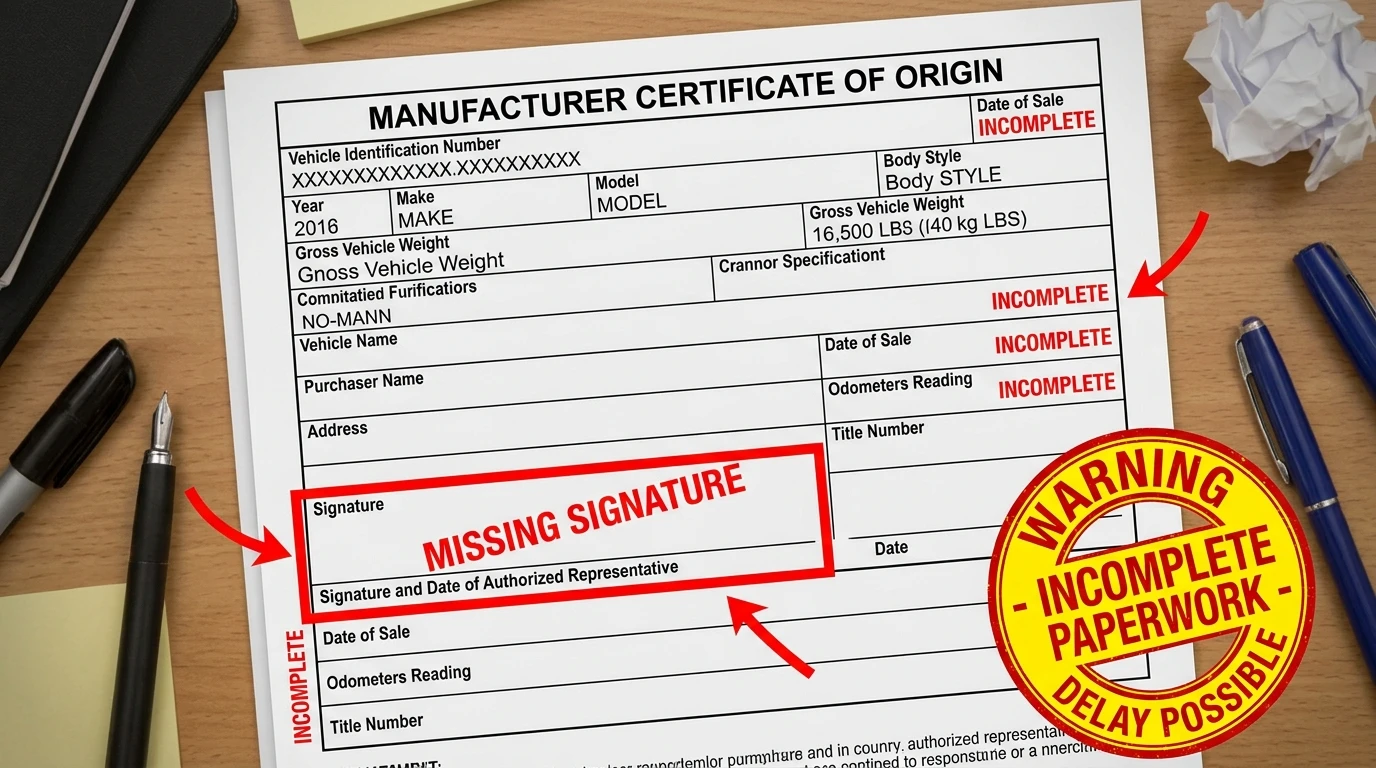
Before you can identify what is wrong with your blank MCO, you need to know what a complete one looks like. Genuine manufacturer certificates of origin share a strict set of features evolved over decades to combat fraud and standardize ownership transfer.

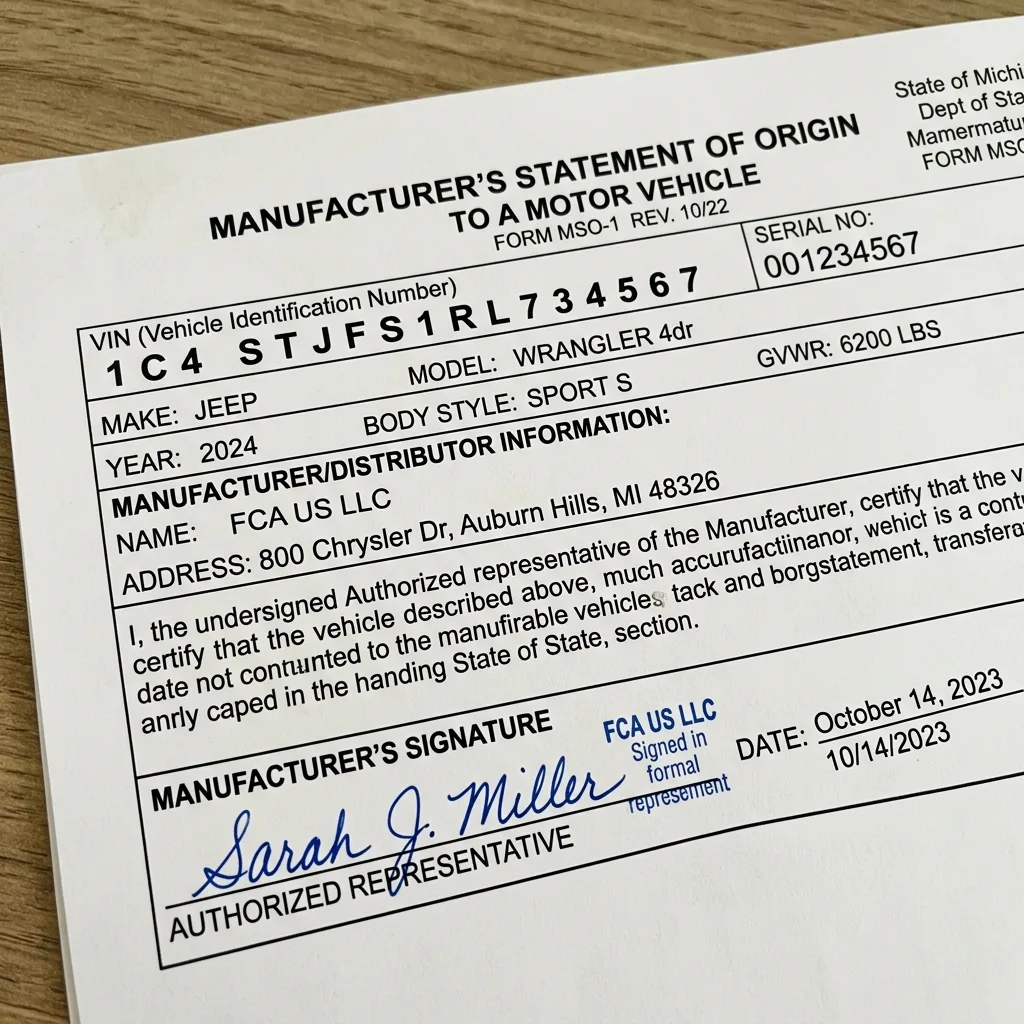
Every authentic MCO contains pre-printed manufacturer information at the top: full legal name, headquarters address, and a unique document number. The vehicle ID block lists the seventeen-character VIN, model year, make, model designation, body style, and any series or trim identifier.
The document carries multiple security features. Watermarks become visible when held to light or appear as VOID when photocopied. A security thread runs vertically through the paper. The manufacturer’s insignia is centered and embossed. NHTSA-mandated language appears in pre-printed form, including the federal odometer disclosure block required by 49 CFR Part 580.
The assignment section fails most often. It must include the dealer’s name, license number, authorized signature, transfer date, the buyer’s legal name as it will appear on title, complete physical address, odometer reading at transfer, and federal odometer certification. Many states also require notary acknowledgment.
Six MCO failure modes
MCOs fail in six distinct ways, each with a different fix, different timeline, and different cost. Knowing which one you are dealing with is half the battle — the wrong recovery path can waste weeks and hundreds of dollars.
1. Unsigned by dealer
This is by far the most common failure. The dealer prints the MCO, fills in the vehicle info, and forgets to sign the assignment block before handing it over. Sometimes the dealer signs but leaves buyer fields empty. UTV, ATV, and trailer dealers cause this problem at roughly four times the rate of full-size auto dealers because off-road dealers process less title paperwork daily and powersports buyers often trailer the unit home without a finance office walkthrough.
2. VIN mismatch
A single transposed digit in the VIN creates rejection at every DMV in the country. The system compares the MCO VIN, manufacturer reporting VIN, and the physical VIN plate. Any deviation triggers a hold. If the mismatch involves whiteout, scratched ink, or photocopied corrections, the DMV treats it as potential fraud and may refer the case to law enforcement.
3. Wrong buyer information
A typo in the buyer’s name or missing apartment number may seem trivial, but title bureaus are unforgiving. If the spelling on the MCO does not match your driver’s license, you will be rejected. Minor errors are fixable with a dealer corrected affidavit. Wrong name entirely requires a full reassignment process and sometimes a duplicate MCO.
4. Missing odometer disclosure
Federal law under 49 CFR Part 580 requires odometer disclosure on every motor vehicle transfer, even brand-new units. If the dealer left this field blank, you are missing a federal disclosure. Some states allow a supplemental federal odometer statement filed separately. Others require a duplicate MCO. Even small discrepancies, like the dealer writing 12 miles when the actual reading is 14, can require a federal warning notice attached to the title.
5. Water damage or illegible MCO
Coffee spills, basement flooding, garage roof leaks, and faded ink destroy legal validity. State title bureaus will not accept a document where any required field is unreadable. The fix is a duplicate from the manufacturer. If the manufacturer has already received the MCO through normal title processing, they cannot issue a duplicate and you are forced into the bonded title path.
6. Dealer withheld MCO
Some dealers refuse to release the MCO at sale. Common excuses include “manufacturer policy,” “we mail it after registration,” or “your finance company gets it directly.” All three are false. The MCO is the buyer’s property at sale completion in cash deals. In financed transactions, it goes to the lienholder, never to the dealer’s filing cabinet. Dealers who withhold MCOs violate state dealer licensing law.
The private seller trap
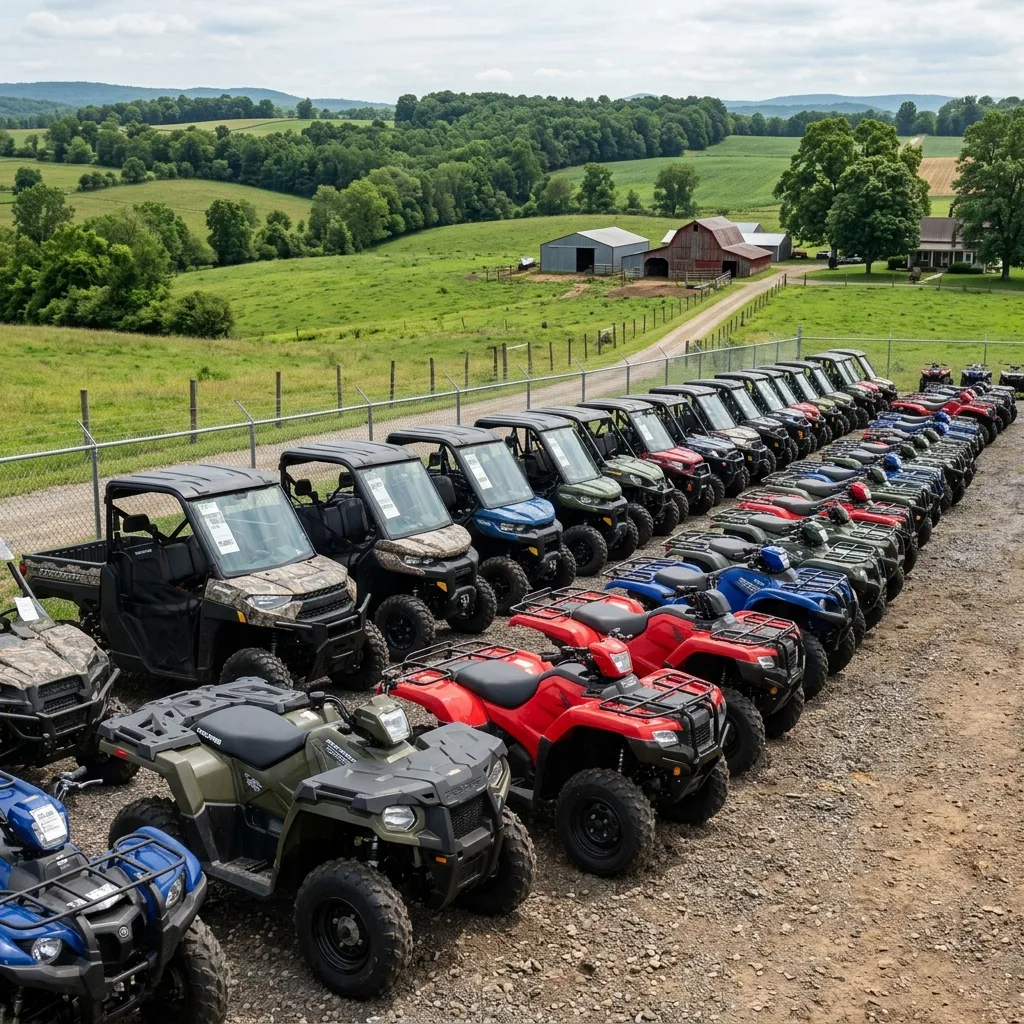
The most dangerous blank MCO situation does not start at a dealer. It starts on Facebook Marketplace, Craigslist, or a buddy-of-a-buddy deal. A private seller hands you an MCO never titled, swearing the unit is brand new and the paperwork is clean. The VIN matches. You hand over cash. Six weeks later the DMV says the document is unusable.
Here is what happens. The original buyer picked up the side-by-side from a dealer and threw the MCO in a drawer. They never assigned it, never registered the vehicle, never paid sales tax. Years later the unit changes hands two or three times in private deals. Each buyer assumes the MCO is a clean ownership document. None realize the assignment block still points to the original buyer who has long since lost interest.
If the seller’s name is not on the MCO and they did not properly assign it, you bought from someone who never legally owned the vehicle. Your only legal claim runs back to the original named buyer. Tracking that person down years later and getting them to sign a back-dated assignment is a multi-month ordeal at best.
The aging-out problem compounds this. Some states treat an MCO not submitted for titling within two to three years of issue date as expired. The state will not accept it as a primary ownership document. You are forced into bonded title even though you hold what looks like a clean MCO.
Buyer protection rule: If you are buying a powersports unit, trailer, or motor vehicle from a private seller and they hand you an MCO instead of a titled document, walk away unless they will sign a properly notarized assignment in front of you and provide a clean bill of sale with their full legal name, driver’s license number, and current address. If they refuse, the deal is not worth the discount.
How to fix each type of MCO problem
Each failure mode has a different recovery path. Choosing the wrong one wastes weeks and sometimes hundreds of dollars.

For an unsigned MCO where the dealer is still in business, drive the document back, ask for the title clerk by name, and request the assignment be completed in your presence. This takes one business day. If the dealer resists, mention that you will file a complaint with the state dealer licensing authority. The complaint threat resolves nearly all signature problems within forty-eight hours.
For an unsigned MCO where the dealer is out of business, contact the manufacturer directly. Polaris, Can-Am, Yamaha, Honda, and Kawasaki maintain title departments for these requests. You need a notarized affidavit, bill of sale, copy of your driver’s license, and the original incomplete MCO. The manufacturer issues a duplicate naming you as direct assignee from the factory in seven to ten business days.
For a VIN mismatch from clerical error, the dealer issues a corrected MCO in about a week. For document alterations, the manufacturer must issue a duplicate. For physical VIN plate mismatches, you may have a stolen vehicle and must contact law enforcement.
For wrong buyer information, the dealer prepares a corrected assignment with an affidavit. Wrong name entirely requires the listed person to sign a release before reassignment.
For missing odometer disclosure, the federal supplemental form must be completed by the dealer or, if unreachable, the manufacturer. Some states accept a notarized buyer self-attestation when both are unavailable.
For water-damaged or illegible MCOs, manufacturer duplicate is the only path. Bring damaged remnants, photographs of the original if available, and your full purchase documentation.
New Jersey deserves special mention. The state has a unique procedure called MCO back-out that allows a buyer within thirty days of purchase to cancel registration and revert the vehicle to new car status. If you catch an MCO problem within thirty days and the dealer is cooperative, the back-out provides a clean reset no other state offers.
When you need a manufacturer duplicate MCO
The manufacturer duplicate MCO process is your best option when the dealer is unreachable but the vehicle has never been titled. This last condition is critical. Manufacturers refuse duplicates if records show any title record in any state. Once a DMV records the vehicle in their system, the manufacturer’s authority over the original ownership document is extinguished.
The duplicate request packet includes a written request letter, bill of sale, photo ID, VIN, the original damaged MCO if available, and a notarized affidavit. Some manufacturers require mail submission; others accept secure email with PDFs.
Timelines vary. Polaris and Can-Am turn around requests in seven to nine business days. Yamaha runs eight to twelve. Honda and Kawasaki are slower at ten to fifteen. Luxury automakers like Bentley, Mercedes, and Porsche can take three to six weeks because of fraud screening on high-value vehicles.
Costs are modest. Most manufacturers charge twenty-five to one hundred dollars. Some charge nothing if the dealer is at fault. Luxury manufacturers may charge several hundred and require in-person verification.
Manufacturers refuse duplicates if there is any prior title record, registration, active lien, theft or salvage status, or warranty flag. If so, move directly to bonded title or quiet title.
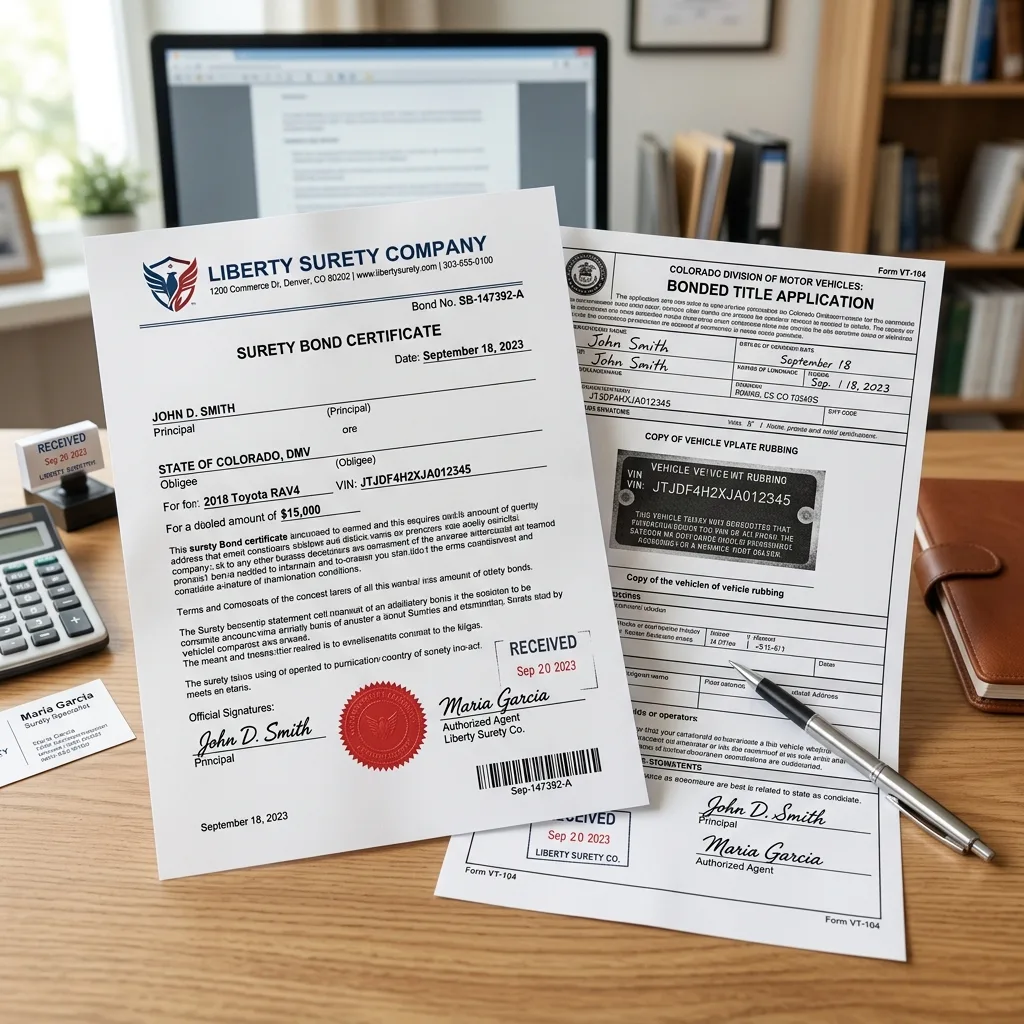
Bonded title — the universal fallback

When the manufacturer duplicate path is closed, the bonded title process becomes your universal fallback. A bonded title is a clean state-issued title backed by a surety bond that protects future claimants. Forty-one states accept bonded titles, and the document is legally equivalent to a standard title for registration, insurance, financing, and operation.
The bond amount is a multiple of appraised value. Most states require 1.5x. California, Florida, Georgia, Connecticut, and New Mexico require 2x. You do not pay the bond as a lump sum. You buy a surety bond by paying a one-time premium, typically one to two percent of face value. A twenty thousand dollar vehicle in a 1.5x state means a thirty thousand dollar bond with a premium of three to six hundred dollars.
Vehicles above twenty thousand dollars often require underwriting. The surety examines credit, source of funds, chain of possession, and any VIN records. Underwriting adds three to seven days. For powersports units, trailers, and used cars under twenty thousand dollars, no underwriting is required and the bond is issued same day.
The workflow involves a VIN inspection by law enforcement or authorized inspector, an appraisal, bond purchase, and submission to the state DMV. The DMV issues the bonded title within two to four weeks. After three years with no claims, the bonded title automatically converts to a clean standard title.
States that do not allow bonded titles
Nine states do not offer bonded titles when the chain of ownership cannot be reconstructed through MCO documentation: Delaware, Hawaii, Idaho, Illinois, Indiana, Kansas, Kentucky, Louisiana, and Ohio. Buyers in these states have three options.
The first is to register the vehicle in a state that accepts bonded titles, wait three years for conversion, and transfer the clean title back to the home state. This is administratively complex and adds years to the timeline.
The second is a court-ordered quiet title action, which we cover next. Quiet title is the universal solution for ownership disputes that cannot be resolved through administrative DMV channels. It is more expensive than a bond but works in every state.
The third is a Montana LLC. Montana accepts a wider range of ownership proofs than most states, processes bonded titles efficiently, and does not require Montana residency. We cover Montana in detail below.
When to go to court for a quiet title
A quiet title action is a civil court proceeding that establishes legal ownership when all administrative paths have failed. You file a petition in state court, identify prior owners and lienholders, serve notice through certified mail and sometimes newspaper publication, and request a court order declaring you the lawful owner.
The cleanest result is a court order binding every party named in the proceeding. Once signed, no prior owner can claim the vehicle. This is more durable than a bonded title because the bond protects against monetary claims but does not extinguish ownership disputes. A quiet title order extinguishes them permanently.
The downside is cost. Attorney fees for a contested quiet title action run fifteen hundred to five thousand dollars. Filing fees add two to four hundred dollars. Publication adds another one to three hundred. Total cost typically lands between two and six thousand depending on complexity.
Use the quiet title path when no MCO exists, no bill of sale exists, the vehicle was bought in cash years ago, the bonded title path is closed, or the vehicle is highly valuable and you need an unimpeachable ownership document. Quiet title is overkill for a five thousand dollar UTV and right-sized for a hundred thousand dollar collector car.
Three real recovery case studies
Three buyers, three different MCO disasters, three different paths out.
Case study one: Texas private seller, Polaris RZR XP 1000
A Houston buyer found a 2024 Polaris RZR XP 1000 on a powersports classifieds site. The seller had purchased the unit new eight months earlier and was selling for cash with the original MCO. The buyer paid twenty-eight thousand dollars and took possession. At the Texas county tax office, the clerk pointed out the MCO assignment block was completely blank. The seller appeared as original buyer on the dealer assignment but had never reassigned the document.
The Texas bonded title path was the answer. He obtained a VIN inspection at the sheriff’s office, secured an appraisal, purchased a thirty-thousand-dollar bond at a $350 premium, and submitted the packet. Eighteen days later he had a Texas bonded title. Four months later he transferred it into a Montana LLC for permanent registration, paying no Texas annual property tax going forward.
Case study two: Colorado dealer bankruptcy, Can-Am Maverick
A Boulder woman bought a 2024 Can-Am Maverick from a Front Range dealer. Three months later the dealer filed Chapter 7 bankruptcy. She discovered the MCO had never been submitted to Colorado DMV and the assignment block was unsigned. She contacted Can-Am directly with her bill of sale, photo ID, and notarized affidavit. Can-Am issued a duplicate MCO in nine business days, naming her as direct assignee from the factory.
The Colorado DMV then lost her application during processing, leading to a six-week nightmare involving multiple in-person visits and escalation to a district supervisor. She switched to a Montana LLC the following spring and never set foot in a Colorado DMV office again.
Case study three: Florida dirt bike collector, Kawasaki KDX200
A Tampa collector bought a 1987 Kawasaki KDX200 from a private seller in Georgia. The seller had bought it new in 1987 and kept it in a barn for thirty-seven years. Georgia does not require titles for dirt bikes, so the MCO was never submitted to any DMV. Water damage from a roof leak obscured the dealer assignment date and buyer information block.
Florida DMV would not accept the damaged document. Kawasaki could not issue a duplicate because records were too old. The collector pursued a Montana bonded title: VIN inspection, NMVTIS report, notarized MV-10, and a small surety bond. Three weeks later he had a Montana bonded title and registered the dirt bike under his Montana LLC for under five hundred dollars all-in.
Montana LLC — handling blank MCOs the smart way
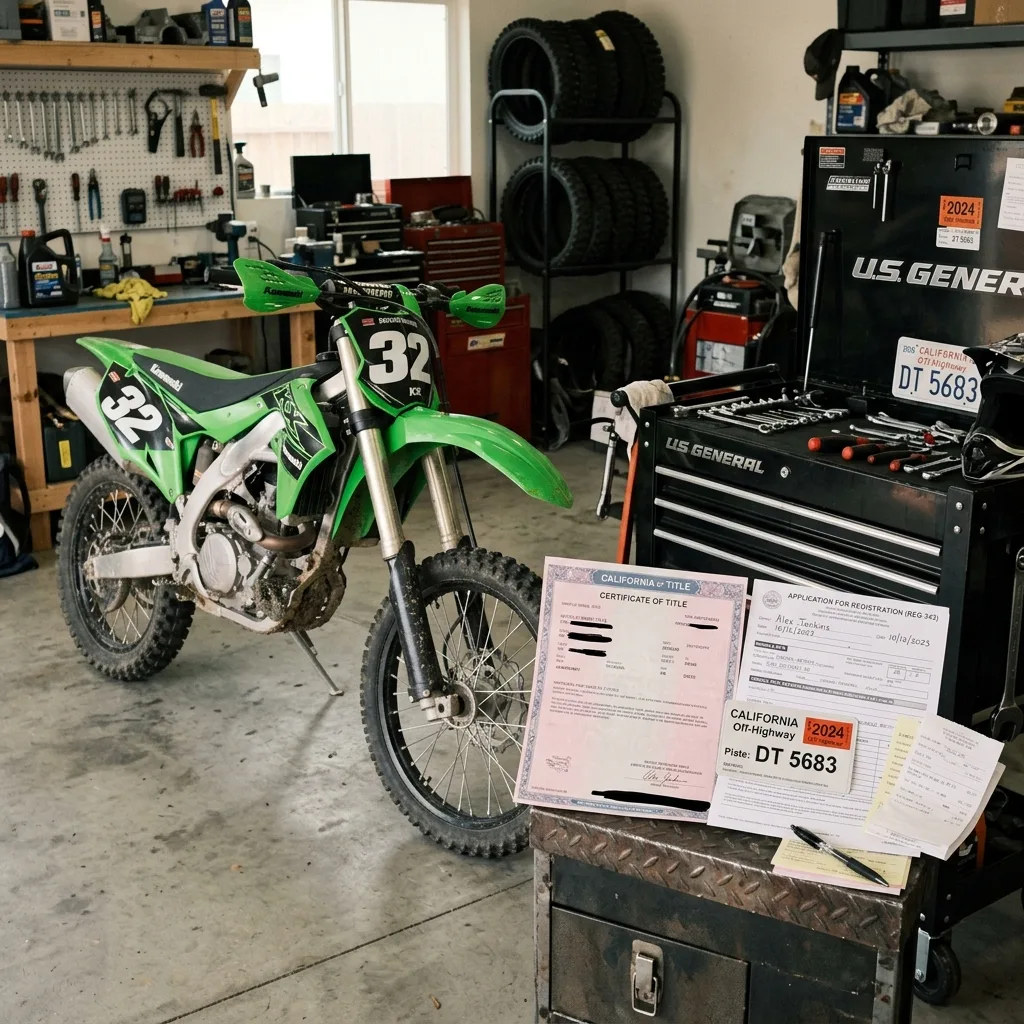
Montana has quietly become the most flexible state in the country for blank MCO problems. It accepts a broader range of alternative ownership proofs than most states — a bill of sale, canceled check, dealer invoice, or prior out-of-state registration can all substitute for a flawed MCO. The bonded title process integrates NMVTIS history checks. And Montana charges no state sales tax on vehicle purchases.
The Montana bonded title workflow starts with a VIN inspection at a county sheriff’s office or by a Montana-authorized inspector. Out-of-state inspectors certified by their home state can perform the inspection on Montana letterhead. The buyer then orders an NMVTIS history report to establish no prior title record, salvage flag, or theft report.
The notarized MV-10 application is the centerpiece of the submission. It captures the chain of possession, buyer’s affidavit, and supporting documentation. The buyer attaches the bill of sale, original incomplete MCO if available, VIN inspection, NMVTIS report, and surety bond. The packet goes to the county treasurer, which forwards it to the state title bureau in Helena.
Montana issues bonded titles in two to four weeks. After three years, the bonded title converts automatically to a standard clean Montana title. Vehicles eleven years and older qualify for permanent registration, eliminating annual renewal fees.
For UTV, ATV, dirt bike, and trailer buyers, Montana is particularly accommodating. The state recognizes the documentation realities of off-road equipment and accepts simpler ownership proofs than most full-size auto registries. Buyers who could not register at home because of blank MCO issues find that Montana accepts their documentation without difficulty.
Zero Tax Tags handles the entire Montana process, including the bonded title path. We coordinate the VIN inspection, order the NMVTIS report, prepare the MV-10, secure the surety bond, and submit to the county treasurer. The buyer signs and notarizes one packet of documents.
Dealer non-compliance and your legal rights
When a dealer refuses to release your MCO at sale, they are violating state dealer licensing law. The MCO is the buyer’s property the moment the sale is complete. In cash transactions it goes to the buyer. In financed transactions it goes to the lienholder, never to the dealer’s filing cabinet.
The most common illegal excuses include “the manufacturer will not let us release it,” “we always mail it separately after registration,” “your title is being processed in our back office,” and “the document is not ready yet.” All are false. Manufacturers do not control dealer release after sale. There is no back office processing required between dealer and buyer.
Your first step is a certified demand letter referencing the specific sale, requesting release within ten business days, and citing the state dealer licensing statute. Most dealers comply within forty-eight hours.
If the dealer still refuses, file a complaint with the state dealer licensing authority. The licensing board can suspend or revoke a dealer’s license for non-compliance. Add a small claims court action for conversion under tort law if damages are significant. Loss of use damages can include rental costs, missed work, storage fees, and depreciation while you cannot register.
Buyer leverage: A certified demand letter referencing the state dealer licensing statute resolves more than ninety percent of dealer MCO disputes within a week. Dealers know that a licensing complaint can cost them their entire business. The threat alone is usually sufficient.
Is this legal?
Every recovery path in this guide is fully legal. Manufacturer duplicates are issued under standardized title bureau procedures. Bonded titles are statutorily authorized in forty-one states. Quiet title actions are routine civil proceedings. Montana LLC registration is used by thousands of vehicle owners.
The process becomes legally questionable only when a buyer fabricates documents, alters existing ones, or misrepresents the chain of possession. Forging a dealer signature is a felony in every state. Whiting out fields and reprinting is a felony. Submitting a falsified bill of sale to a manufacturer is a felony. The legitimate paths exist precisely so buyers do not take illegal shortcuts.
Montana LLC registration has been challenged in court and upheld in every meaningful case. A Montana LLC is a Montana resident for state law purposes. Vehicles owned by a Montana resident are properly registered in Montana. The owner of the LLC has the legal right to register LLC property in the state where the LLC is organized.
The Montana LLC structure is protected under the Commerce Clause and Full Faith and Credit Clause of the U.S. Constitution. Every state is required to recognize valid Montana registration. The vehicle is owned by the Montana LLC — a Montana entity — so state registration requirements for individual residents do not apply. Zero Tax Tags builds every LLC with genuine formation, real registered agent service, and full documentation, which is why the structure holds up across all fifty states.
Who benefits most
The Montana LLC route with bonded title support fits several buyer profiles. Powersports buyers who discovered an incomplete MCO after picking up a UTV or ATV benefit from Montana’s flexible documentation rules and absence of state sales tax. Buyers whose dealer went out of business benefit from Montana’s willingness to accept manufacturer duplicates and bonded titles together.
Private market buyers with never-titled MCOs benefit from Montana’s efficient bonded title processing. Collectors of vintage motorcycles, dirt bikes, classic cars, and historic vehicles often face MCO problems because the original documentation was issued decades ago. Montana’s recognition of older documents and acceptance of NMVTIS reports as supporting evidence makes vintage registration significantly easier.
Buyers in the nine non-bonded-title states find Montana indispensable. Buyers of luxury vehicles with irregular MCOs benefit from Montana’s straightforward bonded title process and lack of property tax going forward. RV and motorhome owners use Montana to convert paperwork chaos into clean registration.
For buyers in rare situations involving unusual state-specific documentation requirements, Zero Tax Tags reviews each case individually and recommends the cleanest path — whether that is Montana registration, manufacturer duplicate request, or in-state bonded title. Call our team and we will identify the right solution for your paperwork situation.
Our process
Zero Tax Tags handles the entire blank MCO recovery and Montana registration process for clients in all fifty states. We start with an intake call to review your purchase documents and identify the right recovery path, whether dealer call-back, manufacturer duplicate, bonded title, or court proceeding.
| Day 1: | Submit your MCO and supporting paperwork through our secure portal. We review for completeness and file your Montana LLC the same day. |
| Days 1–2: | Montana LLC formation complete — same business day in most cases, second business day at the latest. |
| Days 2–4: | Title transferred into the LLC name at the Montana county treasurer. |
| Days 4–7: | Permanent Montana plates shipped directly to your door within 3–5 business days of title completion. |
Total cost depends on the recovery path. A simple Montana registration with a clean MCO is $899 in year one and $270 per year thereafter (5-year total: $1,979). The bonded title path adds the surety bond premium, typically $100 to $600. A manufacturer duplicate adds $25 to $100 in manufacturer fees. We provide a transparent quote during the intake call before any work begins.
FAQs
Can I drive my vehicle with a blank MCO while I work on recovery?
You can drive on private property. You cannot legally operate on public roads without registration, and registration requires a complete title chain. Some states issue temporary permits during title disputes, but these are not universal.
How long does the manufacturer duplicate MCO process take?
Powersports manufacturers issue duplicates in seven to ten business days. Auto manufacturers run eight to fifteen. Luxury manufacturers can take three to six weeks because of fraud screening. The clock starts when the manufacturer receives a complete packet.
What if my dealer is in business but refuses to fix the MCO?
Send a certified demand letter referencing the state dealer licensing statute and request a response within ten business days. If the dealer still refuses, file a complaint with the state dealer licensing authority. More than ninety percent of disputes resolve within a week of a certified letter.
Is a bonded title as good as a regular title?
Yes, for nearly every practical purpose. It is legally equivalent for registration, insurance, financing, and operation. The bond protects future claimants for three years, after which it converts automatically to a clean standard title.
Can I use a Montana LLC if my MCO is from a non-bonded-title state?
Yes. The state where the MCO was issued does not control your registration options. Montana accepts MCO documents and bonded title applications from all fifty states.
What if I lose my Montana bonded title before the three years are up?
Montana issues replacement bonded titles on request. The replacement carries the same bond status and conversion timeline. The original three-year clock is preserved. You do not start over.
Ready to fix your blank MCO and stop overpaying state taxes?
Vehicle owners across the country have used our blank MCO recovery service to turn paperwork disasters into clean Montana titles. You are next.