26 min read

On this page
- + Mistake #1: name errors (LLC killer)
- + Mistake #2: VIN errors and typos
- + Mistake #3: date discrepancies
- + Mistake #4: broken chain of assignments
- + Mistake #5: odometer disclosure issues
- + Mistake #6: dealer signature errors
- + Mistake #7: white-out and alterations
- + Mistake #8: notarization failures
- + Mistake #9: lienholder information gaps
- + State-by-state strictness comparison
- + Correction timelines and costs
- + Manufacturer duplicate MCO process
- + How to spot errors before submission
- + How to fix common errors
- + Case studies: when mistakes cost real money
- + Why Montana LLCs are scrutinized
- + The Montana escape hatch
You bought a new vehicle. You have the “birth certificate,” the Manufacturer’s Certificate of Origin (MCO) or Manufacturer’s Statement of Origin (MSO). You sent everything off to the DMV or your registration service, expecting license plates in the mail.
Instead, you got a rejection letter.
Or worse, you got your entire packet mailed back to you in a sad, crumpled envelope with a sticky note slapped on the cover sheet.
In the world of vehicle titling, a single typo on an MCO is the difference between cruising down the highway and owning a very expensive driveway ornament. The title bureaus of Florida, California, Ohio, Texas, and Montana do not grade on a curve. They are strict, literal, and unforgiving of certificate of origin mistakes.
The Montana MVD does not call you to ask for clarification. If there is a mistake, they reject the application. Florida and California operate the same way, with even more aggressive cross-referencing in the background. Florida cross-checks every VIN against manufacturer databases. California flags name variations through algorithmic matching. Ohio demands a sworn law enforcement VIN inspection for any discrepancy.
A simple MCO error typically adds 4 to 8 weeks to your timeline. A VIN error requiring law enforcement verification can add 6 to 12 weeks. A notarization failure adds another 2 to 3 weeks. Meanwhile, your temporary tags are expiring, your insurance company is asking questions, and your asset is in limbo.
At Zero Tax Tags, we see hundreds of MCOs every month. Below are the nine most common mistakes, the state-by-state strictness rankings, the manufacturer duplicate MCO process, and the timelines and costs you should expect when something goes wrong.
Mistake #1: name errors (the #1 killer of LLC registrations)
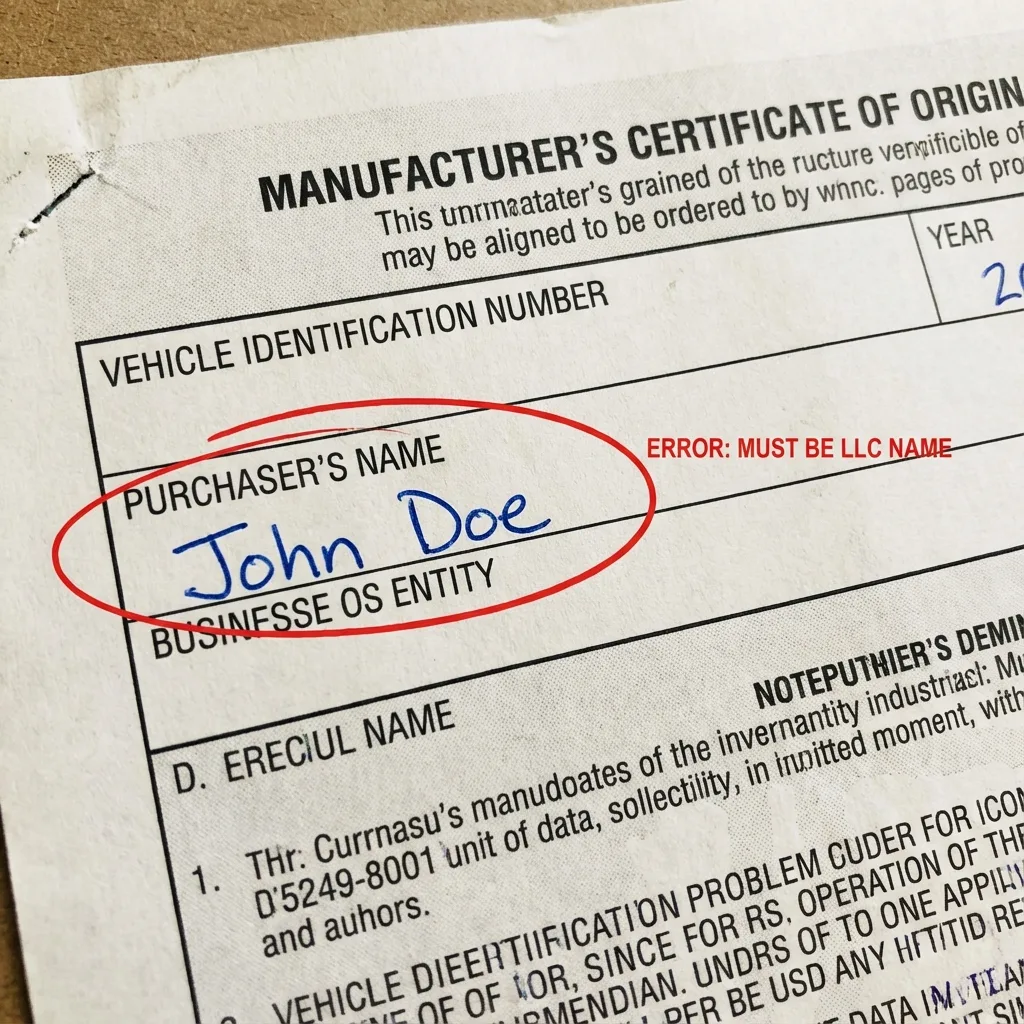
This is the most frequent rejection we see, particularly for clients setting up a Montana LLC to save on sales tax. When you buy a vehicle to be registered to a Montana LLC, the LLC is the buyer. Not you. Not your spouse. Not “John Smith dba Smith Holdings.”
The name on the MCO must match the LLC name exactly as it appears on the Articles of Organization filed with the Montana Secretary of State. Florida and California go further with name-matching algorithms that flag even minor variations. “Bob” instead of “Robert” gets bounced. A missing middle initial gets bounced. The system assumes fraud first.
Common scenarios that trigger rejection
- Personal name vs. LLC name: the dealer puts “John Doe” on the MCO, but you’re registering to “Doe Adventures LLC.” Rejected. You’d owe sales tax to transfer from John to the LLC, defeating the point of forming the entity.
- The “AND/OR” trap: Montana does not recognize “OR” on titles the way you’d expect. If an MCO says “John Smith OR Jane Smith,” Montana treats it as “AND,” meaning both parties must sign every subsequent document.
- Misspellings: if your LLC is “Fast Cars Montana LLC” but the dealer types “Fast Cars MT LLC,” it gets rejected for not matching the legal entity name.
- Missing suffixes: if your driver’s license says “Jr.” or “III” and the MCO doesn’t, identity verification escalates to manual review.
- Punctuation drift: “Smith Holdings, LLC” with a comma versus “Smith Holdings LLC” without. Most states ignore this. Florida and California sometimes do not. Fix is a notarized name affidavit, 3 to 4 weeks to resolve.
Real-World Example: A client formed “Blue Sky Overland LLC.” The dealer’s F&I guy typed “Blue Sky Overland” on the MCO, omitting the “LLC.” The Montana MVD rejected the title because “Blue Sky Overland” is not a registered legal entity. That missing three-letter acronym caused a 5-week delay and two temp tag extensions.
Resolution depends on severity. A trivial misspelling can sometimes be fixed with a notarized affidavit (3-4 weeks). A complete mismatch (personal name versus LLC) requires a duplicate MCO from the manufacturer, covered in detail later.
Mistake #2: VIN errors and typos
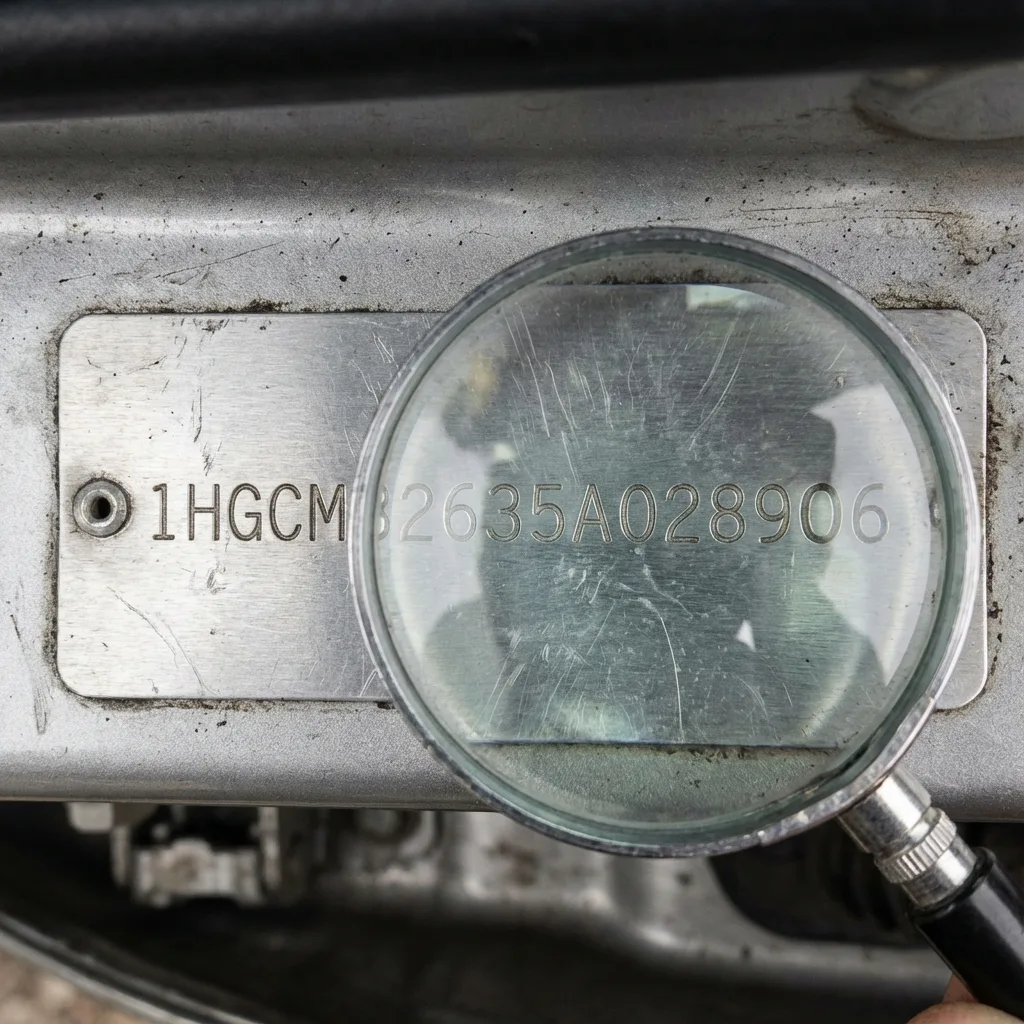
The VIN is the fingerprint of your car. If the VIN on the MCO does not match the VIN on the vehicle, or even just looks off from the standard 17-character format, the DMV shuts it down. VIN discrepancies are the single most common rejection cause nationwide. Dealers type these manually. Fingers slip. F&I systems autofill the wrong stock number.
The “O” vs. “0” problem
In standard VIN logic for any vehicle built after 1981, the letters I, O, and Q are never used. If a dealer types the letter “O” instead of the number “0,” the DMV system flags it as an invalid VIN within seconds. The same goes for I/1 substitutions.
Transposed numbers
Type “68” instead of “86” and the MCO legally describes a vehicle that does not exist or belongs to someone else. In Florida, this triggers automatic cross-reference against the stolen vehicle database and the National Insurance Crime Bureau. If your transposed VIN matches a real stolen vehicle, the application gets escalated, not just rejected.
Truncated VINs
Sometimes a printer is misaligned and the last digit of the VIN gets cut off. Even if you “know” what the number is, the document is invalid if the full 17-digit string isn’t clearly visible.
Florida and Ohio law enforcement VIN verification
Florida and Ohio require law enforcement VIN verification when any mismatch is detected between the MCO, the dashboard VIN plate, and the federal certification label inside the door jamb. A sworn officer must physically examine the vehicle, photograph the VINs, and submit a verification report before the title can be issued. Adds 4 to 8 weeks on top of other corrections.
Real-World Example: We received an MCO for a brand new UTV. The VIN on the document ended in ‘4’. The VIN on the frame ended in ‘9’. The dealer grabbed the wrong paperwork from the file cabinet. Without our pre-check, the client would have titled a vehicle they didn’t own, creating a legal nightmare requiring unwind through the state.
Mistake #3: date discrepancies
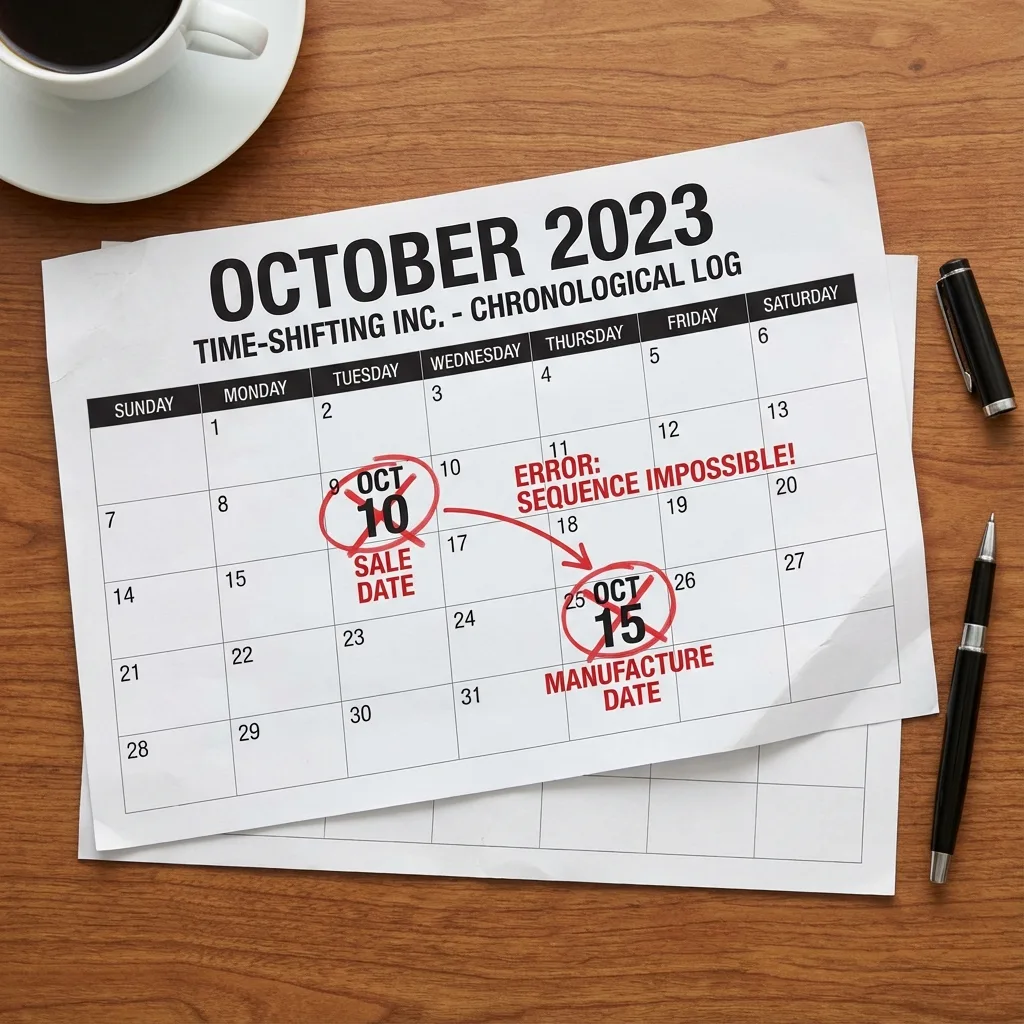
Dates on legal documents tell a story. If the story doesn’t make chronological sense, the DMV assumes fraud and rejects the file.
The “Back to the Future” error
We often see MCOs where the “Date of Sale” is listed before the “Date of Manufacture.” Happens when dealers pre-fill paperwork for a custom order or F&I systems autofill today’s date into a build-date field. The DMV computer flags this as a chronological impossibility.
Date format confusion
Imported vehicles or international manufacturers sometimes use DD/MM/YYYY format. A dealer writing “13/05/2024” gets rejected by a US clerk as an invalid month. BMW, Mercedes, and certain motorcycle brands have printed MCOs with European date conventions that require a Statement of Fact to clarify.
Odometer vs. sale date
The odometer disclosure statement has a date next to the mileage. If the Odometer Date is after the Date of Sale, the paperwork implies you drove the car before you bought it, which invalidates the odometer reading under federal law.
Stale MCOs
Texas flags MCOs older than 30 days from the recorded sale date and requires a Statement of Fact explaining why registration was delayed.
Mistake #4: broken chain of assignments
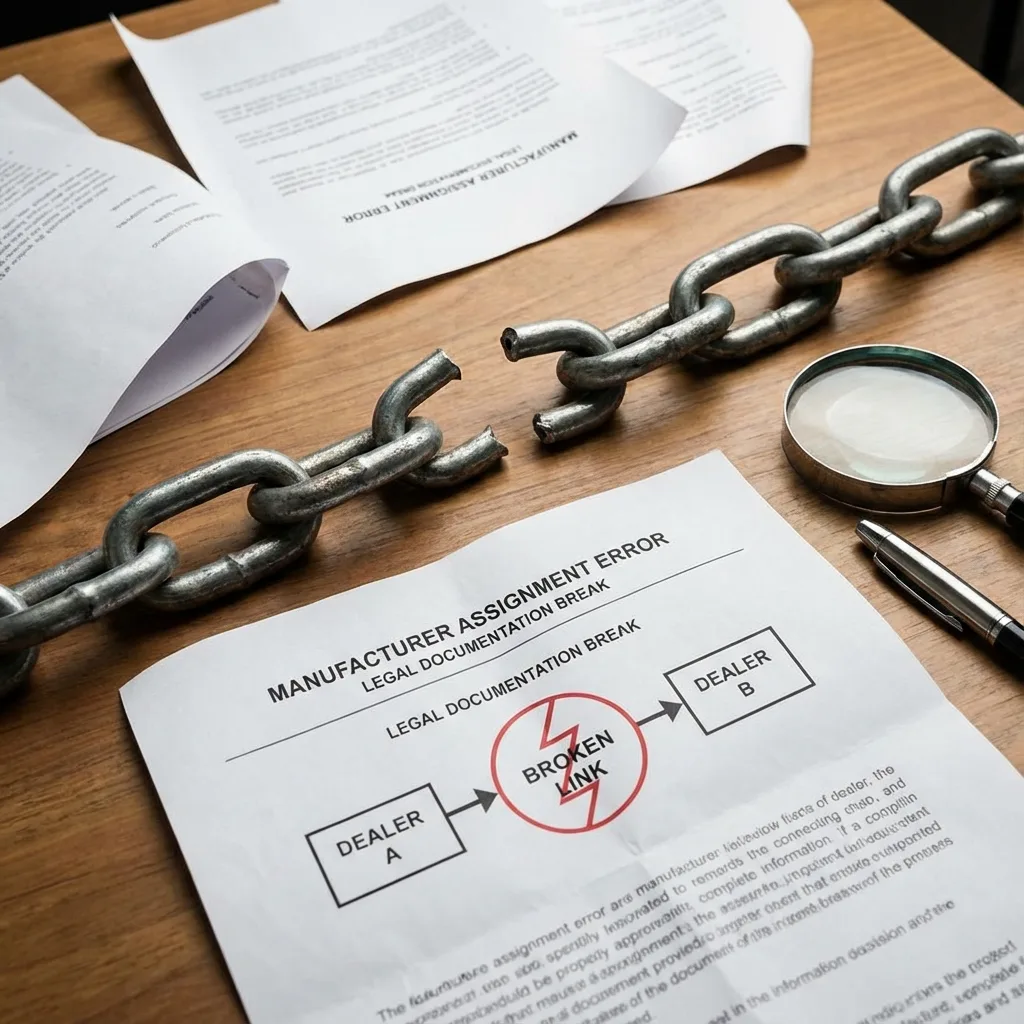
An MCO functions like a baton in a relay race. It starts with the manufacturer.
- Manufacturer assigns it to Dealer A.
- Dealer A checks the “First Assignment” box and assigns it to You.
However, dealer trades happen constantly.
- Manufacturer assigns to Dealer A.
- Dealer A trades the car to Dealer B.
- Dealer B sells it to You.
The Mistake: If Dealer A assigns it directly to Dealer B, but Dealer B forgets to complete the “Second Assignment” section before sending it to you, the chain is broken. You cannot skip a link. Florida and California will not issue a title where the chain shows ambiguity at any point. Each reassignment must be fully completed with signature, printed name, dealer license number, date of transfer, and the buyer’s accepting signature.
UTV, motorcycle, and powersports MCOs are especially prone to this. Powersports inventory moves between dealers more often than cars, and the smaller paper format leaves only two or three reassignment blocks. Once those run out, dealers staple separate reassignment forms, which most states do not accept without a corresponding affidavit.
Real-World Example: A client bought a Ford Raptor. The MCO showed Ford Factory assigned to “Metro Ford.” The client bought from “Country Ford.” No assignment from Metro to Country existed. The title was rejected immediately. Resolution required tracking down the Metro Ford F&I manager (who’d changed jobs) for a notarized retroactive assignment. Total delay: 6 weeks.
Mistake #5: odometer disclosure issues
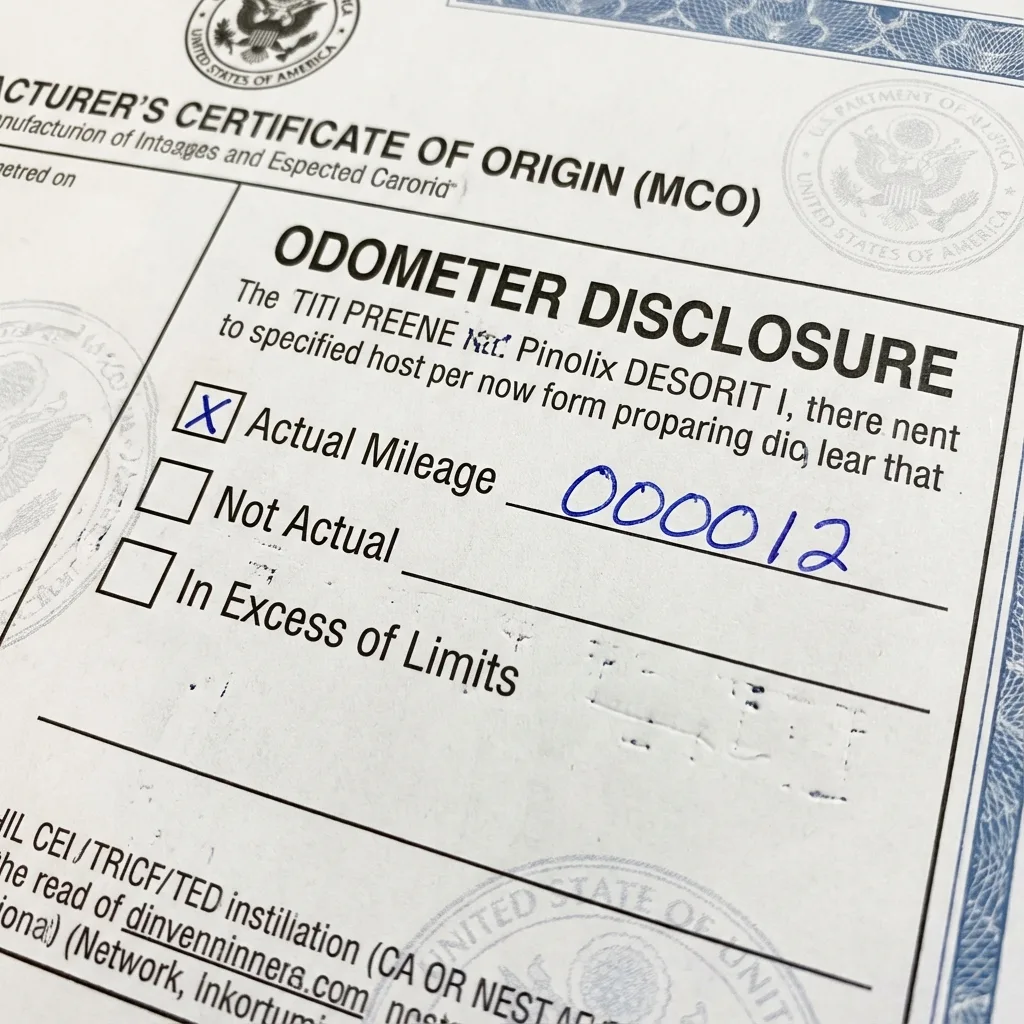
The Federal Odometer Act is federal law, governed by NHTSA, not the states. Get the odometer disclosure wrong and you don’t just have a state problem; you have a federal one.
Missing mileage
If the mileage box is blank, the MCO is invalid. The only workaround is a corrective affidavit signed by the original disclosing party, notarized and resubmitted.
“Actual” vs. “Not Actual”
There are checkboxes next to the mileage:
- Actual Mileage: The number is correct.
- Not Actual/Exempt: The odometer is broken or the vehicle is old enough to be exempt.
- In Excess of Mechanical Limits: The odometer rolled over.
On a new vehicle with an MCO, the box must be checked “Actual Mileage.” A “Not Actual” brand on a brand-new car destroys resale value permanently. Your $90,000 truck loses $15,000-$25,000 in resale because someone clicked the wrong box.
Decimal and tenths errors
Federal law requires odometer readings as whole miles only, no decimals. Illinois explicitly prohibits decimal readings. If the odometer says “15.6” and the dealer writes “156,” you just bought a “new” car with 156 miles on it according to the state.
Original signatures required
Odometer disclosure requires original signatures by both seller and buyer. Power-of-attorney signatures are not acceptable under federal regulation. The buyer (or LLC member, signing in person) must sign personally. We routinely catch this when clients try to delegate the entire transaction remotely.
Resubmission timeline
Corrections require the original disclosing parties to re-execute the form. If the F&I manager has left the dealership, you must track down a current authorized representative. Adds 5-10 business days when cooperative, 3-4 weeks when not.
Mistake #6: dealer information and signature errors
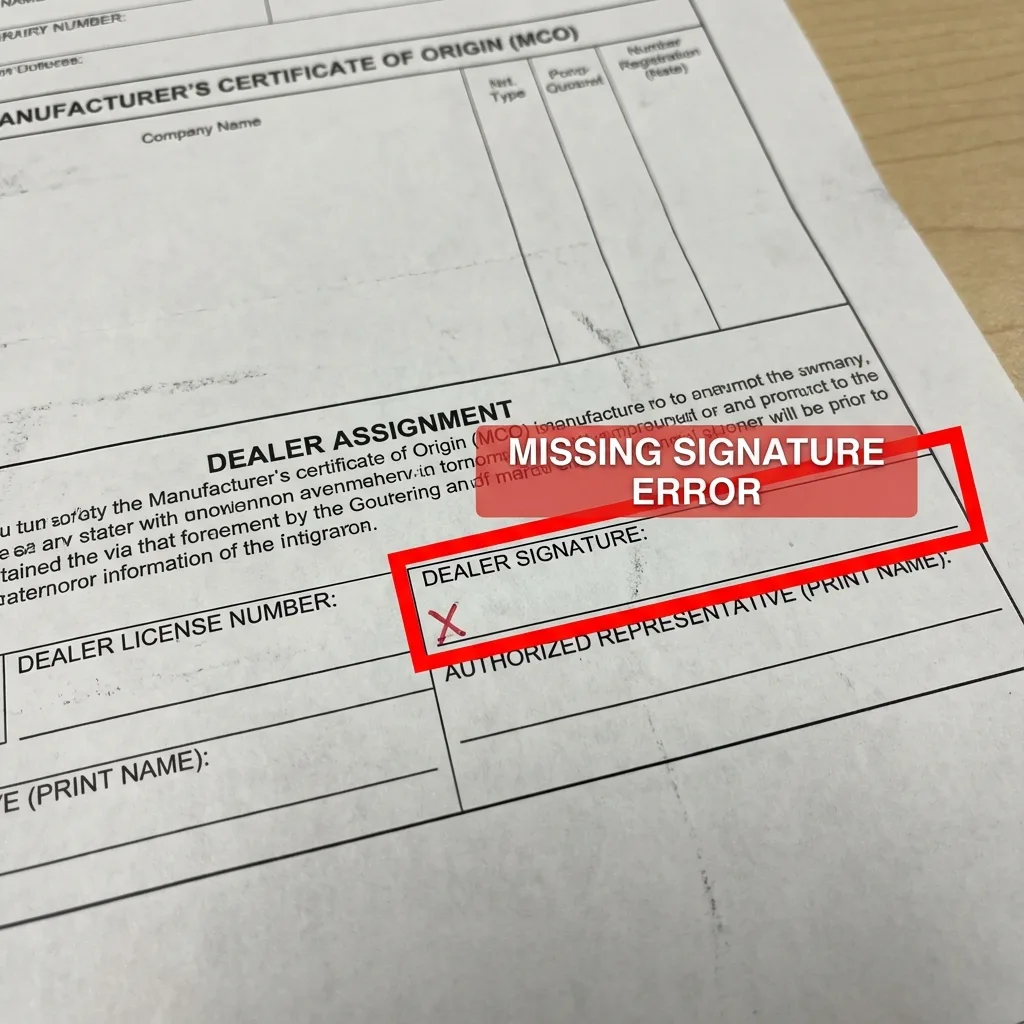
The MCO requires an authorized representative of the dealership, the manufacturer agent, and the buyer, all signing in their designated blocks. Miss any one and the document is dead on arrival.
The “Ghost” signature
Dealers print the MCO, fill out buyer info, and forget to sign the “Authorized Representative” line. An unsigned MCO has no legal weight.
Missing manufacturer agent signature
The manufacturer agent signature on the front is the one most people never check. They assume manufacturers wouldn’t ship a document without signing it. They do. Florida classifies these as “improperly issued” and requires a duplicate, adding 7-10 business days minimum.
License number mismatches
The dealer must list their Dealer License Number. Multi-rooftop dealer groups are notorious for mismatches: the selling rooftop is “Smith Auto Plaza Inc.” but the corporate license is held under “Smith Holdings Group LLC dba Smith Auto Plaza.”
Buyer signature errors
For an LLC purchase, the authorized member signs and prints “as Member of [LLC Name]” next to the signature. Clients who sign their personal name without the LLC designation make the buyer appear to be the individual rather than the entity, invalidating the LLC tax structure.
Mistake #7: white-out and alterations (universally rejected)
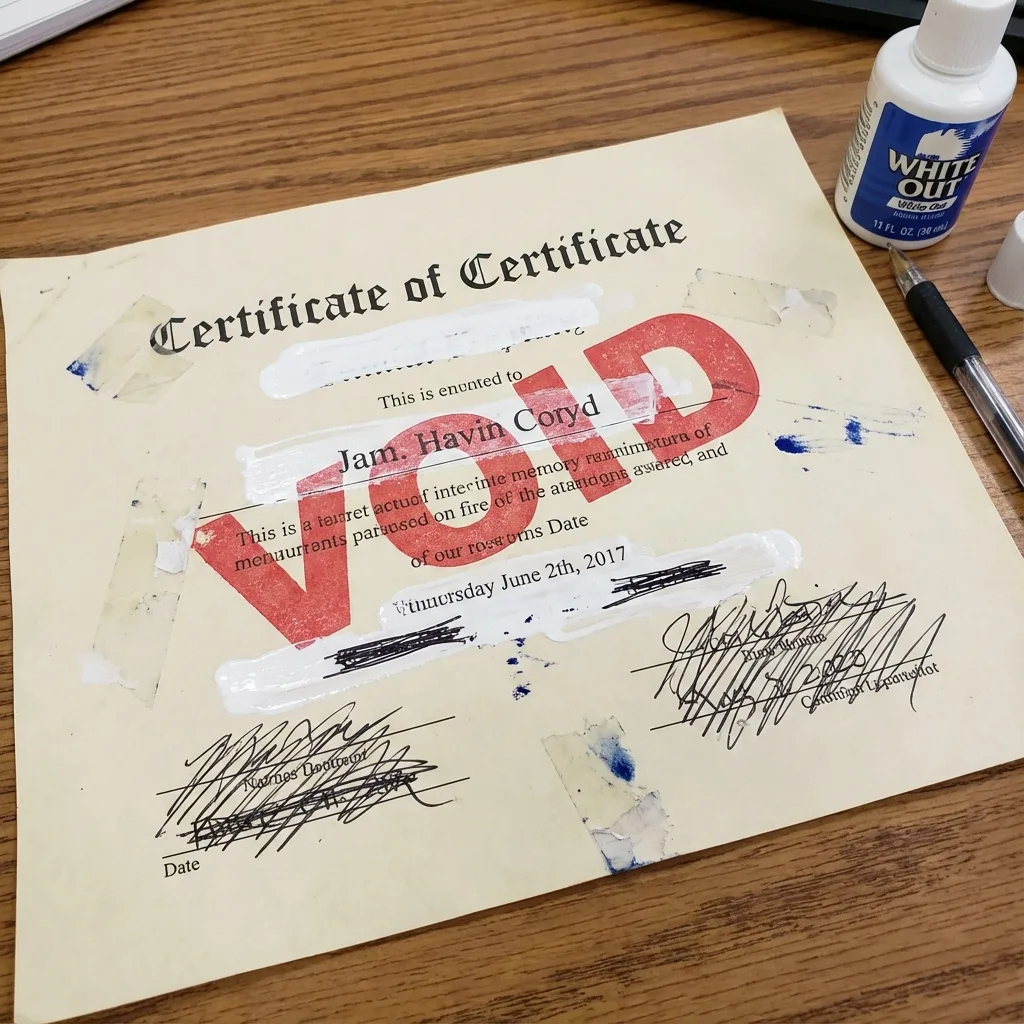
CRITICAL WARNING: You cannot use White-Out (correction fluid) on an MCO. Ever.
Florida, Texas, Louisiana, and California all maintain absolute prohibitions against white-out or erasures on an MCO. Florida deems any altered MSO invalid on receipt and requires a complete replacement from the manufacturer. No affidavit fixes this. The document is void.
Why title bureaus react this way
The MCO is the foundation of the entire title chain. White-out is treated as presumptive fraud because it could hide a prior owner, a different VIN, or a different sale price. The title bureau cannot tell what was underneath.
The correct correction procedure
- Single line through the incorrect entry, original remains legible
- Correct information written immediately adjacent
- Initial and date the correction by the party making it
- Texas accepts only line-through corrections with initials and date
- Louisiana requires notarized affidavits for alterations beyond minor name corrections
The fix when it’s already happened
You cannot un-white-out a document. The only path is a duplicate MCO from the manufacturer. Plan on 7-10 business days minimum, up to 4 weeks for slower brands.
Mistake #8: notarization failures (the hidden killer)
Many MCO corrections require a notarized affidavit. The notarization is where everything goes sideways. We see notary errors invalidate otherwise-clean correction packages twice a month, costing clients another 2-3 weeks each time.
The six most common notary failures
- Missing notary language: the affidavit must include phrases like “Subscribed and sworn before me.” Without these jurat phrases, it isn’t a legal notarization.
- Wrong county listed: the notary must list the county where signing occurred, not where their commission is registered.
- Missing commission number: most states require the commission number stamped on the document. Dry self-inking stamps leave partial impressions treated as missing.
- Missing commission expiration date: must be legible.
- Notary on a different page: Ohio requires the notary block and sworn statement on the same physical page. A separate page stapled to the affidavit voids the entire document.
- Wrong type of notarization: jurat versus acknowledgment are different acts. Using the wrong one triggers rejection.
Pro Tip: Use a bank-employed notary or UPS Store notary. They handle dozens of vehicle title affidavits weekly. Mobile notaries who specialize in real estate closings often miss the small details vehicle title bureaus require.
Mistake #9: lienholder information gaps
If you financed the vehicle, the lender must be recorded as the first lienholder. Missing or incomplete lienholder data prevents title issuance in nearly every state. Required fields: complete legal name, full mailing address, lien date, and in some states the lender’s ELT number.
Texas requires Form VTR-18 (notarized correction affidavit) for any post-submission lienholder correction. New Jersey allows lenders to submit a “no lien” letter when lien info was entered in error and the vehicle was actually paid in cash.
The cash sale that looks financed
Buyer pays cash, but the dealer’s F&I system autofills a lender block from a previous deal. The MCO leaves the dealership listing “Wells Fargo” or “Capital One Auto” as a lienholder on a loan that never existed. Fix is a corrective affidavit from the dealer or a “no lien” letter from the falsely-named lender. Adds 2-4 weeks.
Montana LLC considerations
If you finance through a personal-name loan but try to title under an LLC, the lien structure breaks. Most lenders will not allow collateral to be titled to an entity they did not underwrite. Either pay cash for LLC vehicles, or underwrite the loan through the LLC itself with a personal guarantee.
State-by-state strictness comparison
Not every state treats MCO errors the same way. Some run sophisticated cross-referencing systems that catch errors humans would miss. Others rely on visual inspection by a clerk, which is slower but more forgiving. Knowing which state will be processing your application changes how much margin for error you have.
States with the highest tax revenue at stake (Florida, California) have built the most sophisticated verification systems. Montana operates on a more open framework. That permissiveness is a substantial part of why Montana LLC registration works for vehicles that would face documentation hurdles elsewhere.
Correction timelines and costs by error type
When something goes wrong, the immediate question is how long it will take to fix and how much it will cost. The answer depends on which mistake you’re facing and how cooperative the dealer or manufacturer turns out to be. The table below covers the realistic ranges based on hundreds of corrections we’ve processed.
The most painful number is the 6-12 weeks for VIN discrepancies requiring law enforcement verification. You cannot speed up a sworn officer inspection. Florida and Ohio do not accept emailed photos. They want the officer’s personal certification.
The manufacturer duplicate MCO process
When a correction affidavit won’t fix the problem, you need a duplicate MCO. Each manufacturer handles this differently. The process below covers the three most common ones we deal with.
Polaris (Powersports, Off-Road, Ranger, RZR)
- Timeline: 7-10 business days
- Cost: Free
- Phone: 1-800-765-2747
- Process: Mail request or call. Duplicate is sent to the registered owner address on file.
- Note: If you are not the registered owner (e.g., the dealer never registered the unit to you), you must visit the dealer in person with proof of ownership (original bill of sale) to initiate the request.
Indian Motorcycle
- Timeline: 7-10 business days
- Cost: $25 processing fee
- Phone: 1-877-204-3697
- Process: Phone request preferred. Indian charges the fee to the dealer or to the owner directly via card on file.
Ford Motor Company
- Timeline: Varies by region; expect 2-4 weeks
- Cost: Varies; sometimes free for dealer-initiated requests
- Process: Ford routes duplicate MCO requests through the original selling dealer or the state DMV. There is no direct customer hotline. The selling dealer must initiate the request through Ford’s regional title services office, which then mails the replacement.
- Critical: If the original selling dealer has gone out of business, the path becomes the state DMV’s bonded title process or, in extreme cases, a court-ordered title.
General manufacturer guidance
For brands not listed above (BMW, Honda Powersports, Yamaha, Kawasaki, Sea-Doo, Can-Am, Harley-Davidson):
- Contact the original selling dealer first. They have the easiest manufacturer path.
- If the dealer is unreachable, contact the manufacturer’s title services line directly.
- Provide the VIN, original sale date, and proof of ownership.
- Most manufacturers only mail duplicates to the registered owner address. If you’re not the owner of record, you must visit a dealer in person with proof of ownership.
Time-Saver: When you call the manufacturer, ask whether they can ship the duplicate via overnight or expedited mail. Most will, often for an additional $25-50 fee. On a vehicle sitting unregistered with expiring temp tags, paying $50 to save a week is a no-brainer.
How to spot errors before submission (the Zero Tax Tags pre-check)

Most people don’t look closely at their MCO. They assume the dealer knows what they’re doing. Dangerous assumption. Dealers employ humans, and humans make data entry errors at roughly 1 in every 30 transactions per internal F&I quality audits.
Before mailing documents to anyone, lay the MCO on a table and run this 90-second audit:
- Name Check: Does “Purchaser” match your LLC name exactly? Including “LLC”, commas, periods, capitalization.
- VIN Check: Read the VIN on the MCO backward. Then the Bill of Sale VIN backward. Then the dashboard VIN backward. All three must match.
- Manufacturer Signature Check: Is there a printed manufacturer agent signature on the front? If not, the MCO was improperly issued.
- Dealer Signature Check: Is there a signature in the “Seller” assignment block on the back?
- Buyer Signature Check: Is yours in the “Buyer” block, with “as Member of [LLC Name]” for LLC purchases?
- Odometer Check: Number filled in? “Actual Mileage” checked? No decimals?
- Chain Check: Is the dealer on the front the same one assigning to you on the back, or is there a missing intermediary?
- Date Check: Date of Sale after Date of Manufacture? Odometer Date same as or before Date of Sale?
- Alteration Check: Any crossed-out words, white-out, or scribbles? If yes, stop.
- Lienholder Check: If financed, lender complete? If cash, section properly blank or “None”?
At Zero Tax Tags, we perform a rigorous Pre-Check on every document package. We audit the MCO, Bill of Sale, application forms, LLC operating agreement, and EIN documentation. Mistakes get flagged before they enter the MVD’s 8-week black hole.
Related guides to prevent certificate of origin mistakes:
How to fix common errors
So, you found a mistake. Now what?
Do NOT write on the MCO yourself. Do not try to fix it with a pen. You will void the document.
1. The Statement of Fact (Form MV100)
For minor clerical errors (like a slightly misspelled address or a date that is obviously a typo), Montana allows the use of a Statement of Fact (Form MV100). This is a notarized affidavit where the dealer or buyer explains the error.
- Example: “I, the dealer, inadvertently wrote the date as 2025 instead of 2024. The correct date is…”
- Zero Tax Tags can help draft these for you to ensure they meet MVD standards.
- Most other states have an equivalent form (Texas VTR-18, Florida HSMV 82040, California REG 256, etc.).
2. The Statement of Correction (Form MV11AB)
This is used specifically to correct discrepancies on Montana title applications. It often needs to be signed by the dealer who created the original document.
3. Getting a duplicate MCO
For major errors (wrong VIN, a name that is completely wrong, use of white-out, missing manufacturer signature) you cannot use an affidavit. You must contact the dealer and request a duplicate from the manufacturer following the process outlined in the section above. Plan on 7-10 business days minimum.
4. Bonded title (last resort)
If the MCO is permanently lost, destroyed, or the manufacturer cannot or will not issue a duplicate (rare but it happens with discontinued brands or bankruptcy situations), the bonded title process is your fallback. You purchase a surety bond equal to 1.5x the vehicle’s value, which insures the state against any future ownership claim. The state then issues a “bonded title” that becomes a regular title after a 3-year claim window expires. Montana is one of the friendliest states for bonded title issuance.
Case studies: when mistakes cost real money
Every paragraph above is abstract until it happens to you. Here are three real situations we’ve worked through, with names changed and identifying details adjusted, but the consequences exactly as they unfolded.
Case 1: the $175,000 white-out disaster
A Southern California high-line dealer prepped the MCO for a special-order Lamborghini going to a Montana LLC buyer. The F&I manager misspelled the LLC name, dabbed white-out over it, and reprinted the correct name on top in a slightly different ink color. We caught it during pre-check. The dealer pushed back; we sent California Vehicle Code language and Florida HSMV bulletins. Lamborghini’s North America title services confirmed the document was void.
The duplicate MCO took 18 business days because Lamborghini routed it through Italy. The temp plate expired. The car sat on the lot. Total cost to the dealer in floorplan interest, lost commission, and reputation: roughly $4,800 plus a one-star Yelp review that’s still up.
Case 2: the used UTV with the broken chain
An Arkansas buyer purchased a two-year-old Polaris RZR Pro R from a private seller for $32,000. The MCO had passed through three previous hands: original dealer, wholesale powersports auction, and a smaller resale dealer who never recorded their assignment. The title bureau rejected the application because two assignment links were missing.
Resolution required notarized affidavits from the auction house and the original Polaris dealer, plus internal verification from Polaris. Total elapsed time: 11 weeks. Total cost in notary fees and coordination: about $650. The buyer rode the unit zero times during that window.
Case 3: the Range Rover comma
A Texas physician formed “Lone Star Medical Holdings LLC” for a $148,000 Range Rover Sport SVR. The dealer’s F&I system autofilled “Lone Star Medical Holdings, LLC” with a comma. The Articles of Organization had no comma. Rejected. The notary then put the wrong county on the corrective affidavit. Another rejection. Re-execution added two more weeks.
Total delay from a single comma: 7 weeks. Two temp tag extensions. A canceled Colorado road trip because the physician would not drive an unregistered $148,000 SUV across state lines.
Why Montana LLCs are scrutinized more heavily
The Montana MVD knows LLC registrations are often out-of-state owners. They are vigilant about ensuring the LLC is in “Good Standing” with the Secretary of State and that the EIN matches IRS records. If your MCO says “Smith Consulting” but your EIN belongs to “Smith Consulting LLC,” the mismatch triggers rejection.
This is why using an experienced service like Zero Tax Tags matters. We know the difference between a mistake that needs a Statement of Fact and one that requires a new MCO. We know which Montana counties process LLC titles faster (Lewis and Clark, Missoula). We coordinate the full correction loop instead of leaving you to chase the dealer, manufacturer, notary, and MVD simultaneously.
The Montana escape hatch: when errors are so bad Montana becomes the solution
There is an irony in writing a guide about avoiding MCO mistakes when registering through Montana: Montana itself is often the answer when MCO mistakes have destroyed your ability to register a vehicle elsewhere.
Montana’s registration system is, by design, less stringent than California’s or Florida’s. It lacks the sophisticated cross-verification those states run. The state issues titles based on documented ownership, not algorithmic suspicion.
Where Montana’s permissiveness becomes a lifeline
- Damaged or missing VINs: Montana issues Montana-assigned VINs for vehicles whose original plate has been destroyed or rendered unreadable, allowing legal titling without manufacturer intervention.
- Specialty vehicles with unclear documentation: custom builds, rare imports, and vintage powersports units often title successfully in Montana when they cannot title elsewhere.
- Unclear chain of title: Montana’s bonded title process is more accessible than most states’, and the state will issue titles based on bill-of-sale documentation when an MCO is lost.
- Prior rejection issues: vehicles that hit walls in Florida or California can often be titled in Montana through an LLC.
What this is not
Montana’s permissiveness is not a license to launder stolen vehicles. The state runs background checks, verifies VINs against NMVTIS, and refuses to title vehicles flagged in interstate databases. The permissiveness applies to clerical and documentation issues, not legal ownership questions.
The Practical Reality: Montana issues plates for the life of the vehicle (no annual renewals), charges no statewide sales tax, and operates a registration framework that handles complex documentation gracefully. For vehicles where MCO mistakes have created issues elsewhere, Montana LLC registration through Zero Tax Tags is often the cleanest path to a legal, registrable title.
Don’t let a typo park your ride
A rejection letter is a liability. Your vehicle is unregistered, temp tags are burning, and you cannot legally drive the asset. Insurance and lienholders start asking questions. If you bought through an LLC for tax reasons, the transaction sits exposed during the entire correction window.
Don’t rely on the dealer. They sell cars; we register them. The dealer’s interest ends when the deal funds. Your interest in the title is just beginning.
Let Zero Tax Tags review your documents. We catch errors, guide fixes, and coordinate with manufacturers when duplicates are needed. Year one is $899 ($699 service + $200 LLC formation). Year two onward: $270 ($150 registration + $120 annual filing). Five-year total: $1,979. Less than what one Florida rejection costs you in expired temp tags and canceled trips.
Ready to Avoid Certificate of Origin Mistakes?
Get your MCO reviewed by Montana title experts before submission. We catch errors that cost you 4-8 weeks.