
23 min read

On this page
- + The no-sales-tax myth
- + What the document fee actually is
- + The real cost: what you pay at the DMV window
- + The NADA book value trap
- + The new 2025 EV surcharges
- + Real Delaware buyers, real shock
- + The Montana LLC solution
- + Is this legal? Yes.
- + Who this is built for
- + The Zero Tax Tags process
- + Timeline: day 1 to day 7
- + Frequently asked questions
- + Stop overpaying at the Delaware DMV
You moved to Delaware because there’s no sales tax. Nobody told you about the document fee.
Delaware vehicle tax is the silent shock buyers feel the moment they slide their new title across the DMV counter. You shopped Wilmington dealerships and Newark lots assuming the First State’s famous “no sales tax” promise meant zero-tax car ownership. Then the clerk hands you a printout, points at a line near the bottom, and your stomach drops. The number on that line is the Delaware document fee, and on a $65,000 SUV it comes out to $3,413. That is not a typo. That is what Delaware quietly charges in place of the sales tax everyone else gets warned about — and as of October 1, 2025, the rate jumped from 4.25% to 5.25% under House Bill 164, with no cap at any price point.
If you bought a $52,000 BMW 3 Series last week in Dover or you are about to drive a Porsche home from a Pike Creek showroom, your Delaware vehicle tax bill follows the same brutal arithmetic. Five and a quarter percent of every dollar of purchase price, every single time the title transfers, with no cap and no mercy on luxury, performance, or commercial vehicles. The Delaware Division of Motor Vehicles simply calls it the document fee, but the dollar damage is identical to a sales tax — and in many cases worse, because Delaware bolts on a NADA book value floor that overrides what you actually paid.
Below: how the document fee actually works, what the NADA floor costs buyers who negotiate well, what the new 2025 EV surcharges stack on, and how Delaware residents are using a Montana LLC to skip the whole thing. Montana has no document fee, no vehicle sales tax, no property tax on vehicles. Above $25,000, the math almost always points to Montana — and we’ll show you the numbers plainly.
Understanding Delaware vehicle tax: what the document fee actually is

Delaware advertises itself as one of five states with no general sales tax. That part is true at the cash register of a Christiana Mall electronics store or a Rehoboth Beach restaurant. It is misleading, however, the moment a vehicle enters the picture. When the legislature decided not to impose a traditional sales tax, it built a parallel revenue mechanism aimed squarely at vehicle transactions: the document fee. Functionally, the document fee operates exactly like a sales tax. Politically, it is called something else so the no-sales-tax slogan can survive intact on highway welcome signs.
The document fee is calculated on the purchase price of the vehicle, or on the National Automobile Dealers Association (NADA) Clean Retail value, whichever is higher. That second clause is the trap most buyers never see coming. If you negotiate hard at a Hockessin used car lot and walk away with a 2022 Tahoe for $38,000, but the NADA book pegs that same trim at $43,000, the Delaware DMV calculates your document fee on $43,000. Your great deal is treated by the state as if you got the average deal. The 5.25% applies to a number you never actually paid.
House Bill 164, signed into law and effective October 1, 2025, raised the rate from 4.25% to 5.25%. That is a 23.5% increase in the tax burden on every vehicle transaction in the state. The bill also did not introduce a cap. There is no ceiling. A $250,000 Lamborghini Urus pays the full 5.25% on the entire purchase price, the same percentage as a $25,000 Honda Civic — but in dollar terms, the luxury buyer hands over more than $13,000 just for the privilege of titling the vehicle. The bigger the purchase, the more painful the math.
The document fee is not a one-time historical relic. Every time a Delaware-titled vehicle changes hands — sold, gifted outside immediate family, transferred between unrelated parties — the 5.25% triggers again on the new transaction value. Generational ownership inside a household is the only common scenario that reliably avoids it.
Title fees pile on small but predictable charges: $35 for a clean title, $55 if there’s a lien (most financed vehicles). Annual registration on a passenger vehicle under 5,000 pounds is a flat $40 per year. Those line items are minor compared to the document fee, but they round out the actual Delaware vehicle tax picture every owner pays. The headline cost — and the reason this article exists — is the 5.25% document fee.
The real cost: what you actually pay at the Delaware DMV window

Abstract percentages are easy to wave away. Specific dollar figures, lined up by vehicle, hit harder. Below is what Delaware buyers actually owe in document fees on common vehicle types — purchase price multiplied by 5.25%, plus title and one year of registration. These are the numbers that show up on the DMV printout the day you finalize a title transfer.
That last row is worth lingering on. A Delaware retiree who buys a $180,000 Class A diesel pusher pays $9,450 in document fees on the day of title transfer — almost ten thousand dollars handed to the state for no service rendered. The motorhome doesn’t get any state-funded amenities the buyer doesn’t already pay for through gas tax, registration, and federal use taxes. The fee exists because the state can charge it.
Stack five years of ownership on top of these numbers and the picture gets bleaker. A typical Delaware household trades vehicles every five to seven years. If you and a spouse each own a $50,000 vehicle and trade them on a five-year cycle, you’ll cycle through approximately $5,250 in document fees per vehicle, per trade. Across a working career of 30 years, that’s an extra $30,000 to $40,000 in pure friction cost — money that doesn’t go toward the car, the loan, or any service. It’s the cost of staying titled in Delaware.
The NADA book value trap nobody warns you about
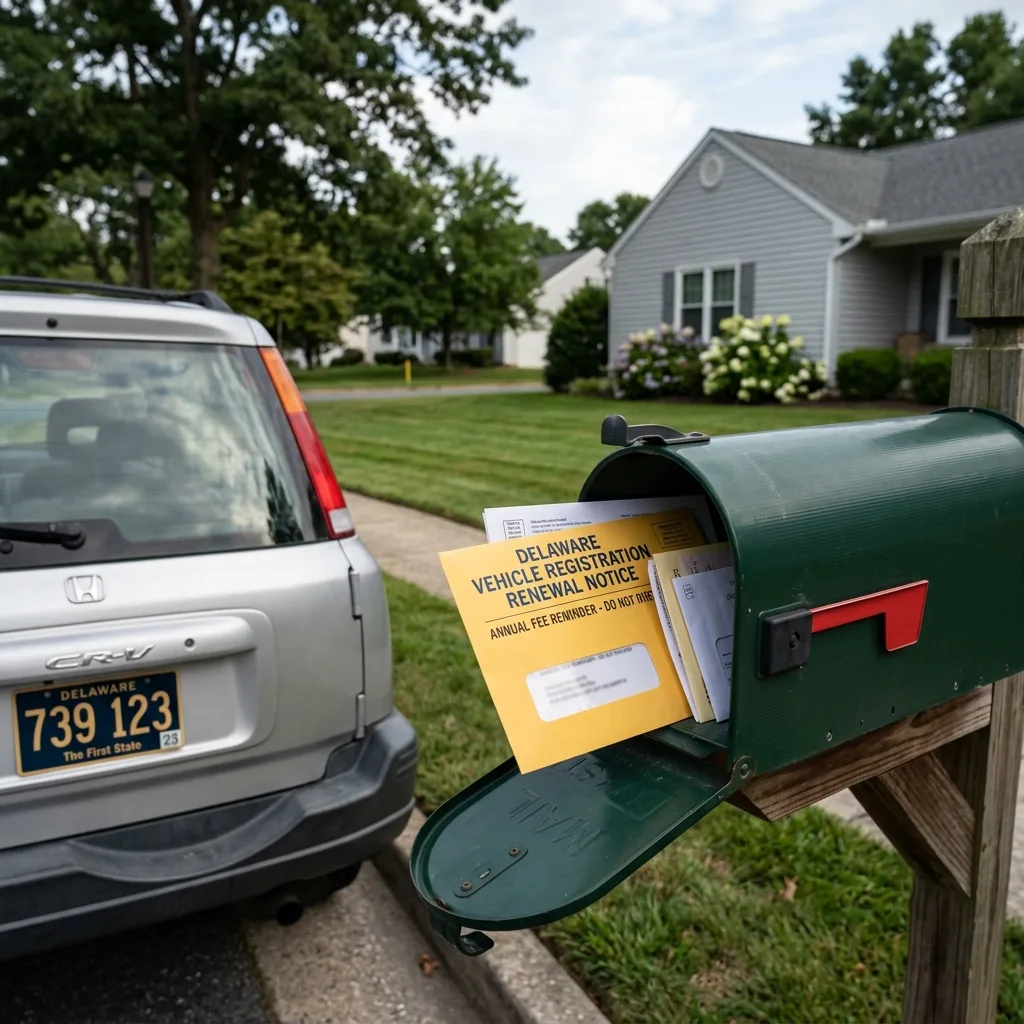
The cleanest version of the Delaware vehicle tax story is also the angriest one. Imagine you find a private seller in Smyrna selling a low-mileage 2022 Toyota 4Runner. You haggle, you walk, you come back, and you finally sign at $38,500 — a strong deal because the seller needs cash quickly. You arrive at the DMV proud of your negotiating, ready to title the vehicle. The clerk runs the VIN, pulls up NADA Clean Retail, sees $44,000, and says: “Document fee will be $2,310.” You start to correct her — you only paid $38,500 — and she shakes her head. Delaware uses the higher number.
That is the NADA floor. The DMV calculates the document fee on whichever value is higher: the actual purchase price or the NADA Clean Retail book value. The state’s logic is that this prevents tax avoidance through under-reported private-party deals. The reality is that it punishes every buyer who actually negotiates well. If you find a motivated seller, an estate sale, a divorce sale, an out-of-state owner trying to unload a vehicle quickly, or a private deal where the seller simply doesn’t know the market — Delaware refuses to recognize the discount you earned.
A Wilmington buyer who paid $40,000 for a used Audi Q5 with NADA value of $46,000 will pay $2,415 in document fees, not the $2,100 the actual price would suggest. The state pockets the extra $315 — every time a private deal undercuts the book.
Dealer transactions usually escape the NADA floor because the dealer’s invoice price is treated as gospel — the state assumes a dealer wouldn’t underprice a sale to cheat the document fee. Private-party buyers carry the burden. This is one of the most regressive features of the Delaware system, because private deals are exactly how budget-conscious buyers get into reliable used vehicles. The state effectively penalizes thrift.
New 2025 EV surcharges: another fee on top of the document fee

Effective the same October 1, 2025 date as the document fee hike, Delaware introduced annual EV surcharges that stack on top of the standard $40 registration. The state’s official rationale is that EV drivers don’t pay gas tax, so they should contribute to road maintenance through a separate fee. The fees are tiered by vehicle type and weight class.
For a Rivian R1T owner in Newark, the math reads like this: $3,885 in document fees on day one, then $110 per year in EV surcharge for as long as the vehicle stays Delaware-titled. Hold the truck eight years, and the EV fee alone has added $880 — on top of the original document fee shock. For a heavier BEV like a GMC Hummer EV pickup that crosses the 6,000-pound line, the surcharge climbs to $150 per year.
Honest disclosure: Montana also charges an annual EV surcharge — $130 per year for BEVs under 6,000 pounds, $70 for plug-in hybrids. Montana’s BEV fee is actually slightly higher than Delaware’s $110. The argument for Montana is not the EV surcharge. The argument is the document fee. Eliminating a one-time $3,885 charge swamps any small annual EV surcharge difference. EV buyers benefit from Montana the same way every other vehicle owner does — through the absence of the 5.25% upfront hit. The annual EV fees are roughly a wash.
EV math: skip the document fee in Montana, save $3,885 immediately. Pay an annual EV fee in either state — the gap between $110 (Delaware) and $130 (Montana) is $20 per year. The document fee savings dwarfs the EV fee comparison by orders of magnitude.
Real Delaware buyers, real shock at the counter
Sarah, Wilmington finance professional, $88,000 Porsche Cayenne
Sarah works at one of the major financial institutions in downtown Wilmington and lives in a townhouse in the Trolley Square area. She bought a Porsche Cayenne to replace an aging 5 Series — partly as a reward for a promotion, partly because she wanted something more practical for weekend trips to her parents’ place near Lewes. The dealer quoted her financing, taxes, and “fees” as one bundled number, and she signed without reading every line.
When the title arrived in the mail with the breakdown, the document fee jumped off the page: $4,620. She had assumed Delaware’s no-sales-tax reputation meant the bundled “fees” couldn’t be more than a thousand dollars, maybe two. She called the dealer, who confirmed: that’s the document fee, that’s how it works, that’s been Delaware law for years. She did some math on a notepad. If she had purchased the same Cayenne under a Montana LLC, the document fee would have been zero. The full $4,620 stayed in her account. By her second Cayenne five years from now, the savings on that one type of vehicle alone would have funded a serious vacation.
Marcus, Newark tech worker, $74,000 Rivian R1T

Marcus works remote for a tech company headquartered out of state and lives in a new build near the University of Delaware. He ordered a Rivian R1T directly from the manufacturer, expecting the buying experience to feel as straightforward as buying a phone. It mostly did — until the Delaware DMV title process. The document fee on $74,000 came to $3,885. Then he received notice of the new $110 annual BEV surcharge, effective right around the time his registration came due.
Marcus is the type of buyer Delaware’s document fee hits hardest: someone who deliberately chose an EV to lower long-term costs, only to find the state has stripped most of the front-loaded savings via the document fee. He started researching Montana LLC registration after his second tank — sorry, charge — when the cumulative cost of “owning a clean truck in Delaware” finally cracked. He ran the numbers, saw the $3,885 he could have kept, and reached out.
The Hendersons, Dover retirees, $180,000 Class A motorhome
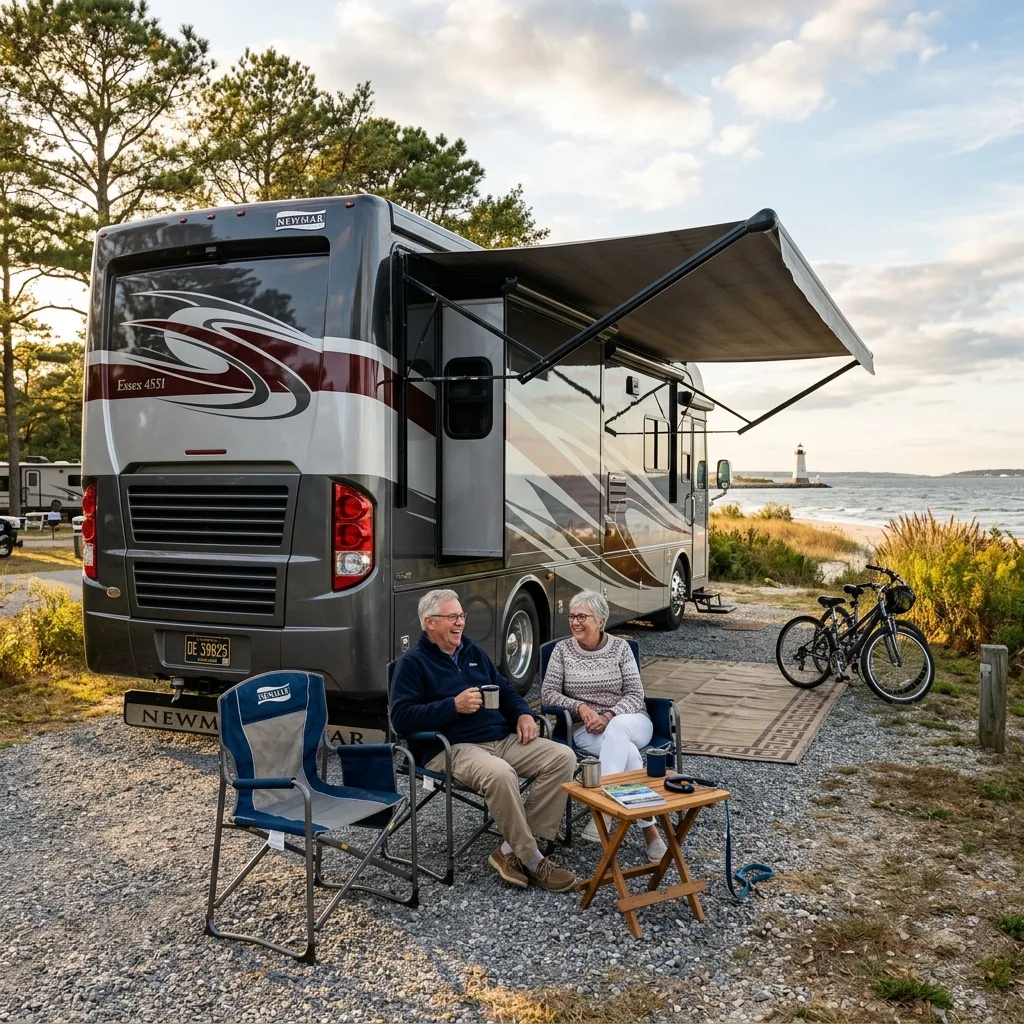
The Hendersons sold the family home in northern Dover after both retired and bought a new-to-them 40-foot Class A diesel motorhome to spend their next several years touring the country. The coach was beautiful — full air ride, residential refrigerator, the works — and they paid $180,000 for it. The document fee Delaware charged them: $9,450. The Hendersons had budgeted for fuel, insurance, maintenance, campground fees. They had not budgeted for nearly ten thousand dollars to the State of Delaware just for the title.
RV owners are the segment where the document fee math becomes most punishing, because RV purchase prices are large and full-time RV owners often don’t even spend most of the year in Delaware. The Hendersons learned about Montana LLC registration from a fellow camper at a Maryland state park — a Pennsylvania couple who had registered their Class A in Montana years ago and saved thousands. The Hendersons did the math, chose Montana, and saved the entire $9,450. They used part of the savings to upgrade their satellite system.
David, Rehoboth Beach contractor, fleet of 3 vans
David runs a residential remodeling company out of Sussex County and decided to upgrade his fleet of work vans all at once. Three new Mercedes Sprinter cargo vans at roughly $58,000 each — $174,000 total. The Delaware document fee bill: $9,135. In one calendar year, David handed Delaware nearly ten thousand dollars solely in document fees on vehicles his business needs to operate. Combined with title fees and registration, his out-of-pocket DMV cost crossed $9,400.
David’s accountant introduced him to the Montana LLC option after seeing similar fleet operators in Maryland and New Jersey use the structure. For three vehicles at once, the per-vehicle Montana cost is dramatically lower than the per-vehicle Delaware cost. David expects to upgrade vans every five to seven years going forward, and the document fee savings on each cycle will roll back into the business as new tools, hires, or expanded service area.
The Montana LLC solution: how Delaware residents legally avoid the document fee
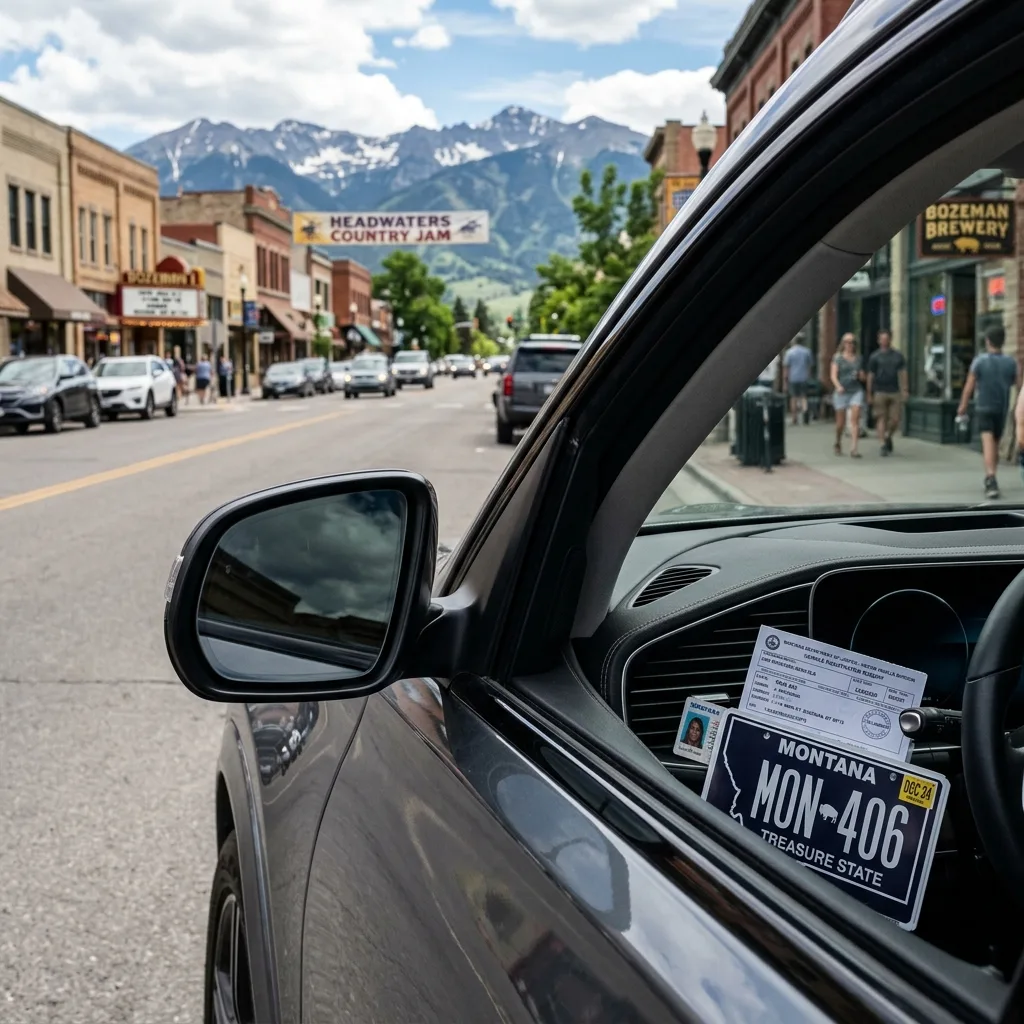
Montana taxes vehicles very differently than Delaware does. There is no document fee. There is no sales tax on vehicle purchases. There is no annual property tax on vehicles. There is no NADA book value floor that overrides what you actually paid. Montana funds road maintenance through fuel taxes, registration fees, and the new modest EV surcharge — and that’s it. The state treats a vehicle as a tool, not as a recurring revenue source to be assessed and re-assessed every year.
The structure is entirely legal: form a Montana LLC, title the vehicle in the LLC’s name, and register with the Montana Motor Vehicle Division. The vehicle’s owner of record is now a Montana entity, so Montana law governs. The Delaware document fee doesn’t attach because the transaction doesn’t occur under Delaware law — the LLC owns the vehicle, the LLC’s home state is Montana, the LLC pays Montana registration. Delaware’s document fee simply doesn’t reach a Montana entity.
This is not a loophole in any pejorative sense. It is the consequence of one of the most basic features of American federalism: states have the right to set their own vehicle taxation rules, and entities formed in one state are governed by that state’s law. Delaware itself takes advantage of this principle in reverse — half the Fortune 500 is incorporated in Delaware specifically because the state’s corporate law is favorable. The same federal framework that lets Delaware host major American corporations lets Montana host individual vehicle LLCs.
Montana cost structure for a typical client: $899 in Year 1 ($699 service fee plus $200 LLC formation), then $270 per year in Years 2 and beyond ($150 registration plus $120 annual LLC filing). Five-year total: $1,979. Compare that to a single Delaware document fee of $3,413 on a $65,000 SUV — the Montana structure pays for itself before the first registration renewal.
Is this legal? Yes — and the legal foundation is rock solid
The short answer is yes. The Montana LLC vehicle registration structure is fully legal and rests on three settled pillars of American law: federal Commerce Clause protection of interstate commerce, the legitimacy of the limited liability company as a real legal entity, and Montana’s clear statutory authority to title and register vehicles owned by Montana entities. None of it is grey area, and none of it requires an aggressive read of ambiguous statutes.
The Commerce Clause of the U.S. Constitution prevents any individual state from imposing taxes that unduly burden interstate commerce. A Montana LLC that legally owns and registers a vehicle in Montana is engaged in textbook interstate commerce. Thomas v. Bridges and similar cases affirm that a properly formed out-of-state entity is legally distinct from its members and entitled to its home state’s treatment of its assets, vehicles included.
The LLC isn’t a fiction or a shell. It’s a real company formed under Montana’s LLC Act, with a registered agent, a Montana mailing address, annual filing requirements, and actual legal obligations. Delaware uses this exact structure every time a Fortune 500 company incorporates in Wilmington: a real company, in a real state, with full legal standing. The vehicle LLC works the same way.
This is smart tax planning, not evasion. Tax evasion is failing to pay taxes that are legally owed. Tax planning is structuring your affairs so that the taxes legally owed are minimized. The Supreme Court has repeatedly affirmed that taxpayers have every right to arrange their affairs to minimize tax burden. Justice Learned Hand wrote nearly a century ago that “any one may so arrange his affairs that his taxes shall be as low as possible; he is not bound to choose that pattern which will best pay the Treasury.” That is the legal foundation Delaware Montana LLC clients rest on, and it has not been weakened.
Who this is built for

These are the Delaware buyers who benefit most from Montana LLC registration. If you recognize yourself in any of these profiles, the math almost always works in your favor.
- Anyone buying a vehicle priced over $25,000. Above this threshold, the document fee starts climbing past $1,300 and the Montana structure pays for itself within the first year of ownership. Above $50,000, the savings are dramatic. Above $100,000, they are life-changing over the ownership cycle.
- Wilmington corridor professionals. Finance, pharmaceutical, legal, and consulting professionals concentrated in New Castle County frequently buy in the $60,000 to $120,000 range. Multiple vehicles per household are common. Document fee savings stack across each one.
- RV and motorhome owners. Class A, Class C, and high-end Class B coaches typically run $100,000 to $400,000+. The 5.25% document fee on those purchase prices is the single biggest single-line tax item most retirees ever encounter. Montana eliminates it entirely.
- Car collectors with multiple vehicles. Collectors who rotate through classic cars, exotic sports cars, or limited-production vehicles trigger the document fee on every transaction. A collection of five vehicles cycling every few years generates document fees in the tens of thousands. Montana stops the meter.
- EV buyers. The document fee hits EVs as hard as any other vehicle, and on premium EVs ($65,000+), the front-loaded fee is brutal. Montana eliminates the document fee. The annual EV surcharge in Montana ($130) is comparable to Delaware’s ($110), so the EV fee is roughly a wash — but the document fee savings remains massive.
- Small business owners with vehicle fleets. Contractors, landscapers, plumbers, electricians, delivery operators, and trade businesses titling multiple vans or trucks pay the document fee on every unit. Fleet operators routinely save tens of thousands across a typical equipment cycle.
- Snowbirds and multi-state professionals. Delaware residents who spend significant time in Florida, the Carolinas, or other states benefit from Montana’s simple residency rules and lack of state inspection. The vehicle moves with them; the registration paperwork doesn’t have to fight against them.
- Anyone trading vehicles frequently. Every title transfer triggers the document fee again. Owners on a three- to five-year trade cycle pay the 5.25% over and over. Montana ends that cycle.
For very low-value vehicles under $15,000, the math is closer to break-even and depends on how long you plan to own the vehicle. In those cases, give us a call and we’ll run the numbers transparently — but for anything above $25,000, the math almost always favors Montana, and above $50,000 it is rarely close.
The Zero Tax Tags process: simple, three-step, hands-off
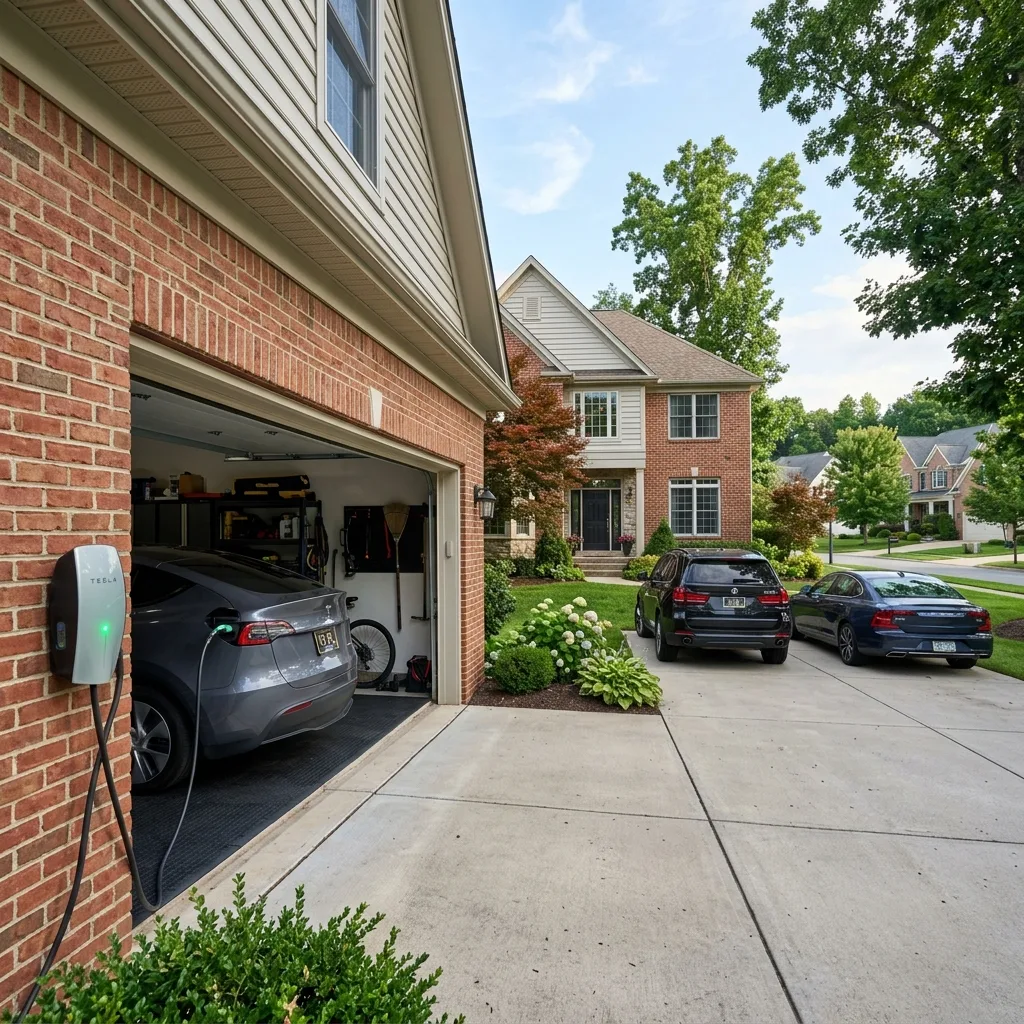
We’ve structured the entire process to require almost nothing from you beyond a few signatures and the vehicle’s purchase paperwork. Most clients spend less than thirty minutes of their own time across the full timeline. Here is how it works.
Step 1: We form your Montana LLC
Once you commit, we collect a short list of basic information — your name, mailing address, and details about the vehicle to be titled. We file the LLC formation documents with the Montana Secretary of State, secure your registered agent (us), and obtain the Montana Tax ID. The LLC is a real Montana entity with a real Montana address and is yours for the life of the vehicle.
Step 2: We handle Montana titling and registration
We coordinate the title transfer to your new Montana LLC and register the vehicle with the Montana Motor Vehicle Division. Your Montana plates and registration documents arrive by mail. There is no Montana vehicle inspection required. There is no need for you to ever visit Montana.
Step 3: You drive
You receive your Montana plates, registration, and title. You install the plates and you go on with your life. We handle the annual LLC filing and the registration renewal each subsequent year. You receive renewals by email and your responsibilities reduce to roughly nothing.
Timeline: from day 1 to day 7
| Day 1: | Submit your paperwork through our secure portal. We review for completeness and file your Montana LLC the same day. |
| Days 1–2: | Montana LLC formation complete — same business day in most cases, second business day at the latest. |
| Days 2–4: | Title transferred into the LLC name at the Montana county treasurer. |
| Days 4–7: | Permanent Montana plates shipped directly to your Delaware address within 3–5 business days of title completion. |
Start to finish: about a week. We update you at each step.
Frequently asked questions
Do I need to live in Montana to do this?
No. The LLC is a Montana entity. You remain a Delaware resident, you keep your Delaware driver’s license, and you keep paying Delaware income tax. The vehicle is owned by a Montana company. That is the legal structure that makes the whole thing work.
Is there a Montana vehicle inspection?
No. Montana does not require state vehicle inspections for passenger vehicles, light trucks, RVs, or most personal-use vehicles. You never have to take the vehicle to Montana for any inspection.
What about Delaware’s $40 per year registration fee — do I still pay it?
No. The vehicle is no longer titled or registered in Delaware. It is titled and registered in Montana. You pay Montana’s registration costs (which are flat and modest) and you do not pay Delaware’s $40.
Does this work for EVs?
Yes. The biggest savings for EV buyers is eliminating the 5.25% document fee — which on a $74,000 Rivian R1T is $3,885 you keep. You will still pay Montana’s $130 annual BEV surcharge, which is comparable to Delaware’s $110 — those are roughly a wash. The structural win is the document fee, not the annual EV fee.
What about the NADA floor — does Montana have anything similar?
No. Montana does not use NADA Clean Retail or any book-value floor when registering vehicles. There is no document fee at all in Montana, so there is no calculation that would need a floor. Private deals are private deals.
How long does the whole thing take?
About a week from start to plates in hand. LLC forms day one, title transfers days two through four, plates ship days four through seven.
Can I do multiple vehicles?
Absolutely. Many of our clients add a second, third, or full fleet of vehicles to the same Montana LLC. The economics get better with each additional vehicle since the LLC is already formed and operating.
What if I sell the vehicle later?
You sell it the same way you’d sell any vehicle — the LLC transfers the title to the new buyer. If you keep the LLC active, you can simply title your next vehicle into the same LLC. Most clients keep the LLC alive across decades and many vehicles.
Stop overpaying at the Delaware DMV window
The Delaware vehicle tax system was designed to look painless from a distance. No sales tax, the marketing brochures say. Then you walk into the DMV with a $65,000 SUV, watch the clerk type in the price, and a $3,413 document fee appears in front of you. The Hendersons paid $9,450 on a single motorhome. David paid $9,135 on three vans in one calendar year. Sarah handed over $4,620 on a Porsche she didn’t realize would carry a five-figure tax bill. The 5.25% rate is now permanent. The NADA floor is now permanent. The EV surcharges are now permanent. The only variable left is whether you continue funding all of it.
Montana LLC registration is the legal exit. It is not a trick. It is not a grey area. It is the same federal-law structure Delaware itself uses to host half the Fortune 500. Five years of ownership through Zero Tax Tags costs $1,979 total — less than a single Delaware document fee on a moderately equipped SUV. The break-even moment, for any vehicle priced above $25,000, arrives almost immediately.
Ready to stop overpaying Delaware vehicle taxes?
Delaware vehicle owners have saved millions with Montana LLC registration. You’re next.
See how Montana LLC registration helps owners in other high-tax states:
- Arizona Vehicle Tax: How to Stop Paying $1,000+ Every Year
- Virginia Vehicle Tax: Stop Paying America’s Highest Car Tax
- North Carolina Vehicle Tax: The Tag Tax Trap