
24 min read
On this page
- + The Paramus Moment Every NJ Buyer Knows
- + What Is the New Jersey Vehicle Sales Tax?
- + The Luxury Surcharge Trap (LFIS)
- + Registration Fees and Annual Costs
- + The Real 5-Year Cost by Vehicle Type
- + Who Gets Hit Hardest in New Jersey
- + The Montana LLC Solution
- + Is This Legal?
- + Three Real New Jersey Case Studies
- + Our Process and Timeline
- + Frequently Asked Questions
The Paramus Moment Every New Jersey Buyer Knows
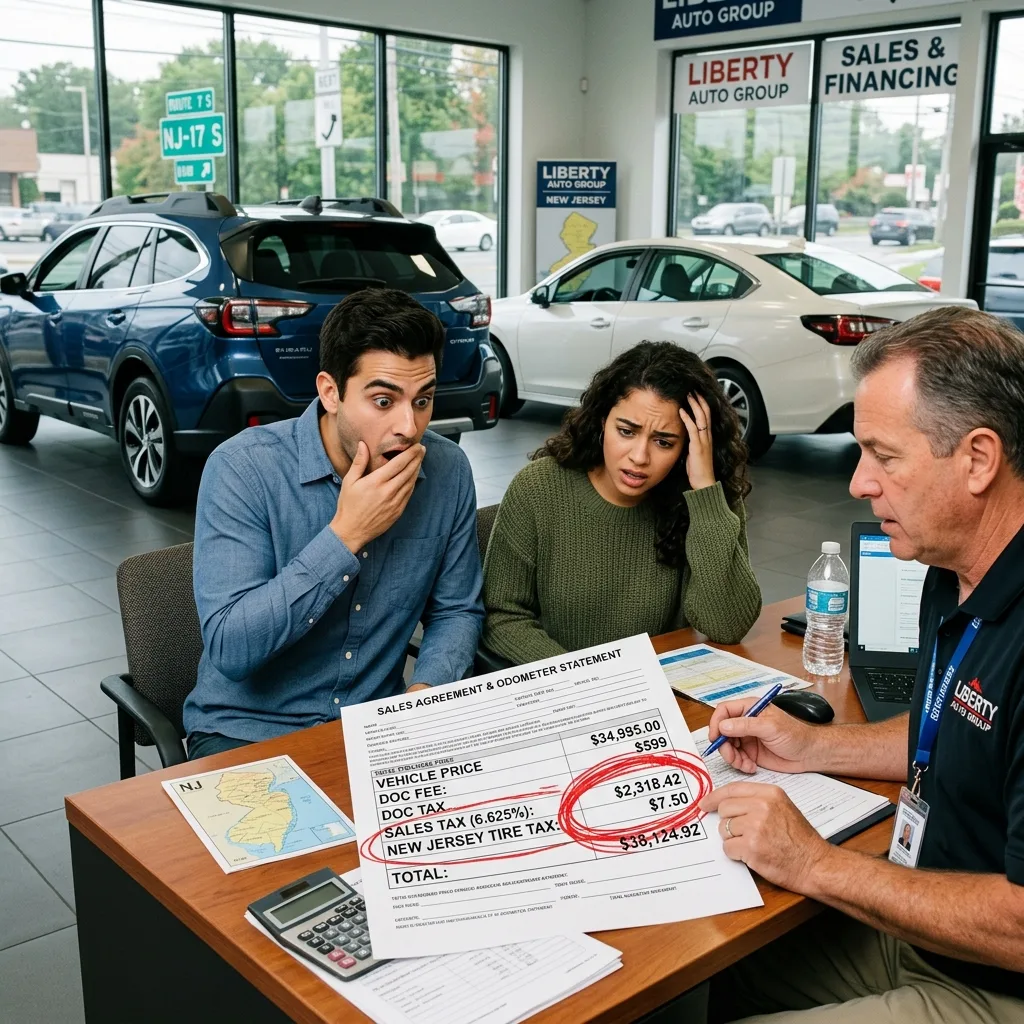
New jersey vehicle tax is the unwelcome surprise that turns a celebratory car purchase into a sour negotiation at the finance desk. It happened to David Castellano of Paramus on a Saturday morning at a dealership on Route 17. He had spent three months researching, comparing, and negotiating. He got the BMW X5 down from $74,200 to $68,500. He shook hands with the salesman. He felt great. Then the finance manager slid the paperwork across the desk and the line item read: New Jersey Sales Tax: $4,538.13. Plus a Luxury and Fuel-Inefficient Vehicle Surcharge of $274. Plus title and registration. Plus documentation. By the time the dust settled, David’s $68,500 BMW had become a $74,300 transaction, and almost five thousand of those dollars went straight to Trenton.
This is the moment every New Jersey vehicle buyer eventually faces. The sticker price is theater. The negotiation is theater. The actual cost is whatever the state decides to extract on top, and the new jersey vehicle tax structure has been designed to extract aggressively from anyone who buys, registers, or garages a car in the Garden State. The 6.625% statewide sales tax applies uniformly across all 21 counties. No escape valve. No county discount. And if your vehicle is anything nicer than a base model commuter car, there’s a luxury surcharge waiting on top.
What follows covers every layer of the new jersey vehicle tax system, what it actually costs over five years across different vehicle classes, who gets hurt the most, and how a Montana LLC structure lets New Jersey residents own vehicles without paying the 6.625% sales tax to begin with. The math, the case studies, the legal foundation. Whether it makes sense for you depends on what you drive and what you spend. For the official rules, the New Jersey MVC has everything, but understanding what the rules say and what they cost you in practice are two very different things.
What Is the New Jersey Vehicle Sales Tax?
The new jersey vehicle tax is technically called the New Jersey Sales and Use Tax, applied at a flat 6.625% on the purchase price of any motor vehicle bought or registered in the state. Unlike New York, where county and city add-ons push the effective rate above 8.875%, New Jersey keeps things deceptively simple. The same 6.625% applies whether you buy in Bergen County, Cape May County, or Sussex County. No Urban Enterprise Zone discounts on motor vehicles. No local option for municipalities to chip in less. The state takes every penny.
The tax is collected by the dealer when you buy from a franchised dealership, or paid directly by you at the New Jersey MVC when you complete a private-party transaction. In a private sale, you cannot avoid the tax simply because no dealer touched the deal. When you walk into the MVC to title and register a vehicle you bought from a neighbor, the agent calculates the new jersey vehicle tax based on the purchase price you declare on the title transfer documents, and you write a check before you walk out with your plates.
How the taxable base is calculated
New Jersey does offer one genuine break: the trade-in credit. You can subtract the value of your trade-in from the purchase price of your new vehicle before calculating sales tax. So if you buy a $50,000 car and trade in a $20,000 car, you only pay 6.625% on the $30,000 difference. That saves $1,325 compared to states that tax the full purchase price regardless of trade. It’s one of the few actual breaks in New Jersey’s vehicle tax structure, and it should not be overlooked when comparing total cost of ownership.
The trade-in credit only applies when the trade and the purchase happen as a single transaction at the same dealer. Sell your old car privately for cash and then buy a new one, and you owe the full 6.625% on the entire purchase price. The state designed it this way deliberately. Dealers love it because it pushes you toward trading in rather than selling privately, where you’d likely get more money. Trenton loves it because most buyers don’t think hard enough about the comparison and end up trading at below-market value, losing more in equity than they save in tax.
Used vehicles and the Bill A573 question
Used vehicles are taxed at the same 6.625% as new ones. A 2018 used Toyota Camry purchased for $18,000 generates $1,192.50 in sales tax to New Jersey, the same rate that would apply to a brand-new Camry off the production line. There has been legislative discussion about Bill A573, which proposed cutting the used vehicle tax rate in half to 3.3125%, but the bill has not advanced into law and the status remains unclear as of 2026. For now, every used car buyer pays the full rate.
Title transfers must be completed within 10 working days of the purchase date. Miss that window and the MVC charges a $25 late penalty before processing your transfer. New Jersey does not negotiate on this deadline, and the penalty stacks on top of the standard $60 title fee, or $85 if there is a lien on the vehicle.
The Luxury Surcharge Trap (LFIS)

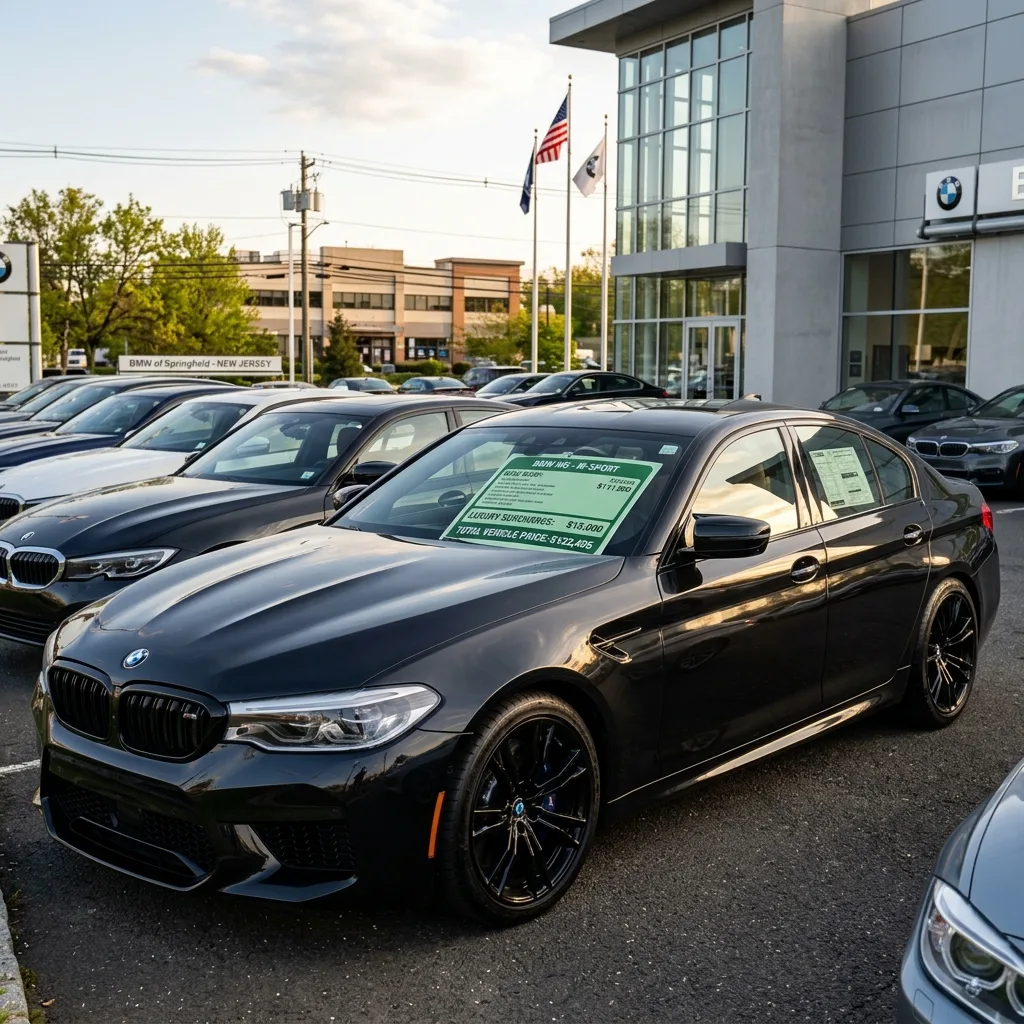
Buy a vehicle that crosses the $45,000 price threshold or has a combined fuel economy under 19 miles per gallon, and the new jersey vehicle tax stacks an additional layer on top of the standard 6.625%. This is the Luxury and Fuel-Inefficient Vehicle Surcharge, known as the LFIS, adding another 0.4% to the taxable purchase price. The LFIS applies to the gross purchase price before your trade-in credit. So even if your trade brings the taxable amount under $45,000, if the sticker was above that line, the surcharge is owed.
The 0.4% might sound small. It is not, when you look at the dollar figures on real luxury vehicles. A $60,000 luxury sedan generates $3,975 in standard sales tax plus $240 in LFIS surcharge, totaling $4,215 to New Jersey before you drive off the lot. Push that up to a $90,000 Range Rover and you’re looking at $5,962.50 in sales tax plus $360 in LFIS. A $130,000 Porsche 911 Turbo? $8,612.50 in sales tax plus $520 in LFIS, totaling $9,132.50. Every one of those dollars disappears the moment you sign the contract, never to be recovered.
The fuel economy trap
The other side of the LFIS catches buyers who never thought of themselves as luxury purchasers. Any vehicle with a combined EPA fuel economy under 19 mpg triggers the surcharge regardless of price. That sweeps in popular pickups like the Ford F-250 and Ram 2500 in their gas configurations, large SUVs like the Chevrolet Suburban and Cadillac Escalade, and many performance vehicles. A $55,000 F-250 used by a New Jersey contractor for actual work triggers the LFIS because the truck doesn’t sip fuel, even though there’s nothing remotely luxurious about its purpose. The state doesn’t care about your use case. It cares about the EPA combined number on the window sticker, and if that number is below 19, you pay.
How New Jersey defines the threshold price
The $45,000 threshold is not based on what you negotiated or what you actually paid. New Jersey applies the surcharge to the gross sales price as listed on the bill of sale, which includes dealer-installed options, destination charges, and any factory-equipped extras that come on the vehicle. So a buyer who negotiates a $52,000 BMW X3 down to $44,500 still pays the LFIS, because the gross sales price before the discount crossed the line. The same logic applies to leased vehicles: New Jersey calculates the LFIS against the agreed capitalized cost, not the residual, which means a three-year lease on a $48,000 Acura MDX still triggers the surcharge on the full capitalized amount. Out-of-state buyers who think they can dodge the surcharge by purchasing in Pennsylvania or Delaware run into a use-tax assessment when they title the vehicle at the New Jersey MVC. The state’s definition of taxable price is whatever the dealer wrote on the original invoice, not what the buyer ended up financing or paying after rebates.
Combined tax examples
The hard truth: A New Jersey buyer of a $165,000 Mercedes G-Wagon hands over $11,591 to the state of New Jersey before they have driven a single mile. That is not a fee for service. That is not a contribution toward roads or registration. That is a one-time wealth extraction event tied to the act of legal ownership, and the state collects regardless of whether your G-Wagon sits in the driveway or runs Uber rides through Newark.
Registration Fees and Annual Costs

Beyond the one-time sales tax hit, the new jersey vehicle tax system also captures money every year through registration fees. New Jersey uses a weight-based registration schedule, which means heavier vehicles cost more to register annually than lighter ones. For passenger vehicles, the fee ranges from $35.50 for pre-1970 vehicles under 2,700 pounds up to $84.00 for new vehicles over 3,500 pounds. Most modern SUVs and trucks fall into the higher tier because curb weights have crept upward across virtually every model line over the past two decades.
The weight-based structure penalizes practical buyers. A family that needs a three-row SUV to haul kids and gear pays a higher registration fee than a single commuter in a small sedan, despite the SUV family already paying more in sales tax and more in fuel taxes. The state taxes the same family three times for the same purchasing decision. New Jersey is consistent only in its appetite.
The EV surcharge: going green costs extra
Effective July 1, 2024, New Jersey began charging an additional $250 per year to register a zero-emission vehicle, separate from the standard weight-based registration. The state structured the EV surcharge to escalate: it climbs to $290 per year by 2028. The justification is that electric vehicles don’t contribute to gasoline tax revenue, so the state needs another way to capture road-use revenue from EV drivers. What they landed on is a flat fee, applied uniformly, regardless of whether the EV drives 5,000 miles per year or 25,000. A retiree in Cape May who barely uses her Tesla for short trips pays the same EV surcharge as a Newark commuter doing 80 miles per day.
Annual cost stack-up
The Real 5-Year Cost by Vehicle Type
Looking at a single year of ownership understates how much New Jersey extracts. The real picture shows up when you compound the upfront sales tax with five years of annual registration fees and any applicable surcharges. Below are four representative vehicle profiles showing the total tax burden over a five-year ownership window. These numbers don’t include gasoline taxes, tolls, insurance surcharges, or municipal personal property assessments. Pure state vehicle taxes only.
The Tesla Model X buyer pays more total state tax over five years than the Cadillac Escalade buyer despite both vehicles costing the same upfront. The EV surcharge stacks at $250 per year, rising to $290 by 2028, adding $1,250 to $1,500 in incremental fees that the Escalade owner avoids. New Jersey’s stated environmental priorities and its actual tax policy point in opposite directions. The EV buyer who thought they were doing the right thing ends up subsidizing the gas-guzzler next door.
Who Gets Hit Hardest in New Jersey

The new jersey vehicle tax doesn’t hit every buyer equally. Some absorb it relatively painlessly. Others get crushed. Which category you’re in matters for deciding whether the Montana LLC alternative makes sense for you.
1. Luxury and high-end buyers
The single most exposed group is the luxury car buyer. Anyone purchasing above $45,000 triggers the LFIS surcharge on top of the standard 6.625%. The absolute dollar burden grows linearly with price. A buyer of a $200,000 Mercedes-Maybach pays roughly $14,050 in combined sales tax and surcharge to New Jersey, more than the entire purchase price of a serviceable used Honda Civic. The luxury market in northern New Jersey, particularly in Bergen, Essex, and Morris counties, generates an outsized share of state vehicle tax revenue precisely because these buyers have nowhere to go with the upper-tier rates.
2. Frequent upgraders and car enthusiasts
If you change vehicles every two or three years rather than driving the same car for a decade, the new jersey vehicle tax compounds against you. Every transaction triggers a fresh 6.625% hit. A buyer who churns through five vehicles in ten years, each priced at $50,000, pays five separate sales tax bills totaling $16,562. A neighbor who bought one $50,000 vehicle in 2016 and still drives it pays $3,312 once. The tax code rewards stability and punishes mobility, even when trade-ins offset the cost partially. Car enthusiasts, lease cyclers, and small-business owners who upgrade their vehicles regularly take the worst beating.
3. Electric vehicle owners
EV owners get hit twice: they pay the full 6.625% on the purchase price (and many EVs cross the $45,000 LFIS threshold, triggering the surcharge despite zero tailpipe emissions), then pay the $250 annual EV registration surcharge on top of standard registration. Over five years, an EV buyer easily pays $1,500 to $2,000 more in state vehicle taxes than a gasoline-equivalent buyer at the same price point.
4. First-time buyers and recent graduates
For young professionals making their first major vehicle purchase, the new jersey vehicle tax is often the largest single dollar shock of their adult lives. A first job out of college, a $35,000 Toyota RAV4 on a five-year loan, and suddenly there’s $2,318 of sales tax stacked on top of the price, plus title and registration. Most first-time buyers haven’t budgeted for this. They show up at the dealership thinking they need $35,000 plus a down payment, and they leave needing $38,000 plus a down payment to actually drive away. The math destroys young buyers.
5. Snowbirds and multi-state residents
New Jersey retirees who spend winters in Florida or the Carolinas face a particular pain point. They want to register their vehicles where they actually use them most, but New Jersey’s residency rules make this complicated. Maintain a primary residence in New Jersey and the state expects your vehicle registered there, even if you spend six months a year elsewhere. Try to dodge by registering in another state while keeping NJ as your tax domicile and you invite a use-tax assessment. This is the group Montana LLC structures were built for, because the LLC, rather than the individual, owns the vehicle.
The math for a typical snowbird couple is brutal. Take a couple in Brick Township who own a $78,000 Lincoln Navigator for the long drive to their Naples condo and a $42,000 Subaru Outback for local errands when they’re in New Jersey six months of the year. The Navigator triggered $5,168 in sales tax plus $312 in LFIS at purchase. The Outback added another $2,783 in sales tax. That is $8,263 in one-time taxes on two vehicles they only use part-time in New Jersey, plus $168 per year in registration fees they pay on vehicles parked in a Florida driveway from November through April. Many snowbirds eventually shift their tax domicile to Florida outright, but most don’t want the hassle of giving up New Jersey residency for estate planning, family proximity, or healthcare reasons. The Montana LLC route lets them keep their New Jersey address and still avoid the upfront extraction.
The Montana LLC Solution: How It Works

Montana has no state sales tax. Zero. None. Not on cars, not on luxury cars, not on EVs, not on motorcycles, RVs, boats, or anything else with a title. This is a deliberate competitive advantage Montana has cultivated for decades, and the federal full faith and credit clause requires every other state to recognize Montana titles and registrations issued to Montana entities. The mechanism is straightforward: a limited liability company formed in Montana, owned by you, can purchase, title, and register a vehicle in Montana. The LLC owns the vehicle. The LLC pays no sales tax because Montana imposes none. The LLC pays modest annual registration fees that scale with vehicle age, not value. You, the human being living in New Jersey, drive the vehicle as a member of the LLC.
This is not a loophole that exists by accident. It is a fully established legal structure used by tens of thousands of vehicle owners across the country, from RV enthusiasts and exotic car collectors to ordinary professionals who simply do not want to pay 6.625% to the state of New Jersey on top of every vehicle they buy. The savings on a single $80,000 vehicle is over $5,300 in immediate sales tax avoided, and the structure pays for itself many times over within the first year on most luxury purchases.
What you save in hard numbers
Year one of the Montana LLC structure costs $899 total. That covers the LLC formation fee, the registered agent setup, the first year of annual filings, and the title and registration of your first vehicle. Year two and every year after costs $270 ($150 registered agent fee plus $120 annual LLC filing). Over five years, the all-in cost is $1,979. Compared to even a moderately priced luxury vehicle in New Jersey, the savings begin within the first thirty days and keep compounding for as long as you own the vehicle.
Is This Legal?
Yes. Three laws make this work: the Montana Limited Liability Company Act, which permits any U.S. citizen or non-citizen to form a Montana LLC; the Montana Department of Transportation regulations, which let Montana LLCs title and register vehicles in Montana regardless of where the LLC’s members live; and the federal full faith and credit clause of the U.S. Constitution, which requires every other state to recognize the legal acts of sister states, including title and registration documents issued by Montana to a properly formed Montana LLC.
The vehicle is owned by the Montana LLC — a Montana entity — not by the New Jersey resident personally. New Jersey’s tax requirements apply to vehicles owned by New Jersey residents; the Montana LLC is not one. Under the Commerce Clause and Full Faith and Credit Clause, New Jersey must recognize Montana’s title and registration for vehicles owned by Montana entities. The LLC genuinely owns the vehicle as a business asset, maintains a Montana registered agent, files annual reports with the Montana Secretary of State, and has operating documents that reflect the actual ownership relationship. Zero Tax Tags handles every piece of that compliance work so the structure remains solid for the life of your vehicle ownership.
Plain English: Montana law lets the LLC own the vehicle. Federal law requires New Jersey to recognize Montana titles. Your job is to maintain the LLC properly. Our job is to handle every piece of that maintenance for you and keep the structure airtight.
Three Real New Jersey Case Studies

The Short Hills surgeon
Dr. Marcus Chen is a cardiothoracic surgeon based at a major hospital in Newark, residing in Short Hills. He purchased a 2025 Porsche Cayenne Turbo GT for $198,000. Under standard New Jersey purchase, his sales tax would have been $13,118 with another $792 in LFIS surcharge, totaling $13,910. He worked with us in spring 2025 to form a Montana LLC and title the Cayenne in Montana. His total first-year cost through our service was $899. His net savings on day one was $13,011. He drives the Cayenne to and from the hospital, to weekend trips upstate, and to medical conferences across the East Coast. The LLC is properly maintained. He intends to upgrade to a 911 Turbo S in 2027 and expects to repeat the savings on that purchase.
The Princeton tech founder
Sarah Patel founded a software company in Princeton and exited in 2024. She spent some of her exit proceeds on a Tesla Model S Plaid configured at $112,000. The standard New Jersey burden would have been $7,420 in sales tax, $448 in LFIS surcharge, and an additional $1,250 in EV surcharges over the first five years, totaling $9,118. Her Montana LLC structure cost $899 in year one, with $270 per year ongoing. Five-year savings: roughly $7,140. She uses the Model S as her primary vehicle and credits the saved capital toward her seed fund’s first investment.
The Cape May snowbird
Robert and Linda Costa are retired educators who split time between Cape May and Naples, Florida. They bought a 2025 Cadillac Escalade IQ EV for $129,000 to handle the long drive south each November and back each April. The standard New Jersey burden would have been $8,544 in sales tax, $516 in LFIS surcharge, and $1,250 in EV surcharges over five years, totaling $10,310. They formed a Montana LLC through our service, with first-year cost of $899 and ongoing $270 per year. Their five-year savings exceed $8,300, which more than covers their winter rental in Naples.
Our Process and Timeline

The Zero Tax Tags process is built to be hands-off. No trip to Montana. No paperwork to chase. You give us the vehicle info and ID documents we need, and we handle everything from LLC formation to plate delivery.
| Day 1: | You complete a brief intake form. We initiate your Montana LLC filing with the Montana Secretary of State and assign your registered agent. You receive a confirmation email with your file number and timeline. |
| Day 2: | Your Montana LLC formation is approved by the state. We prepare the operating agreement, EIN application, and vehicle title transfer documents. You sign the operating agreement electronically. |
| Day 3: | Your LLC’s federal EIN is issued. We coordinate with your dealer (or the seller if private party) to title the vehicle directly in the LLC’s name in Montana. Plates and registration are processed. |
| Days 7-14: | Montana plates and registration documents arrive at your New Jersey address by overnight carrier. You install the plates and start driving. |
| Year 2+: | We handle your annual Montana LLC filing and registered agent renewal. You pay $270 per year and forget about it. Plates renew automatically. |
Frequently Asked Questions
Will the New Jersey MVC come after me for use tax?
The state pursues use-tax assessments when it can show that a vehicle is primarily garaged in New Jersey by a New Jersey resident on a personally owned vehicle registered out of state. The structure we set up is corporately owned, where the LLC, not you personally, owns and registers the vehicle. The LLC is legally domiciled in Montana, maintains its Montana registered agent, and files its Montana annual reports. We have helped thousands of clients in similarly aggressive tax states maintain this structure successfully.
Do I need to drive my vehicle to Montana?
No. The vehicle never needs to set tire in Montana for the registration to be valid. Montana titles and registers vehicles based on LLC ownership, not physical location. Your plates ship to your New Jersey address by carrier and you install them at home.
What about insurance?
You insure the vehicle through your existing insurer or any major national carrier. You disclose that the vehicle is owned by your Montana LLC and garaged at your New Jersey residence. The insurance market is well established for this ownership structure and rates are typically comparable to standard personal policies.
Can I finance a vehicle through the LLC?
Yes. Most major lenders are familiar with LLC titling and will write the loan to the LLC with you as a personal guarantor. We coordinate the financing paperwork with your lender and your dealer to ensure the title issues correctly the first time.
What if I already have a loan on a vehicle I want to move into the LLC?
This requires coordination with your existing lienholder. Your current lender holds the title until the loan is satisfied, so any transfer of ownership into the Montana LLC needs the lender’s written consent. In practice, most lenders will agree if the LLC assumes the loan with you as personal guarantor and the lien is reflected on the new Montana title. The cleaner path for many buyers is to refinance the loan at the same time, which lets us issue a fresh Montana title with the new lender’s lien recorded from day one. We handle the lender coordination, the payoff request, and the title transfer paperwork as part of the service.
Does this affect my New Jersey driver’s license?
No. Your driver’s license is a separate document from your vehicle title and registration. You keep your New Jersey driver’s license, your New Jersey voter registration, and your New Jersey residency for every other purpose. The Montana LLC owns the vehicle. You drive it under your personal New Jersey license, just as any employee or family member can drive a company-owned vehicle. Insurance carriers and law enforcement understand this distinction, and there is no requirement to obtain a Montana license to drive a Montana-titled vehicle.
What happens if I sell the vehicle?
The LLC sells the vehicle to the buyer. The proceeds flow to the LLC, which can distribute them to you. There is no Montana sales tax on the sale (Montana has no sales tax), and as the seller you are not collecting tax on behalf of any state. The buyer’s own state handles any applicable tax on their end.
Does this work for used vehicles?
Absolutely. The structure works identically for new and used vehicles. If you are buying a $60,000 used Mercedes from a private seller, the LLC purchases the vehicle and titles it in Montana, saving the same 6.625% you would have owed at the New Jersey MVC.
What if I move out of New Jersey?
The structure follows you. The LLC remains domiciled in Montana regardless of where you live, and the vehicle remains registered in Montana. If you move to Florida, Texas, or Pennsylvania, nothing changes. We continue handling your annual Montana filings just like before.
What is the total cost in year one and beyond?
Year one is $899 total. That covers Montana LLC formation, registered agent setup, operating agreement, EIN, vehicle titling, and registration. Year two and every year after is $270 ($150 registered agent fee plus $120 annual LLC filing fee). Over five years, your all-in cost is $1,979. Compare that against the $5,000 to $14,000 in New Jersey sales tax and surcharges you avoid on a typical luxury vehicle, and the math is straightforward.
Compare Other High-Tax States
See how Montana LLC registration helps owners in other high-tax states:
- Arizona VLT Problem: How to Stop Paying $1,000 Every Single Year
- Nevada’s 8.25% Car Tax: The Hidden Cost Nobody Tells You About
Ready to Stop Overpaying New Jersey Vehicle Tax?
NJ vehicle owners save thousands with Montana LLC registration. Year one is $899. Year two and beyond is $270. No dealership surprises. No 6.625% hit.