
24 min read
On this page
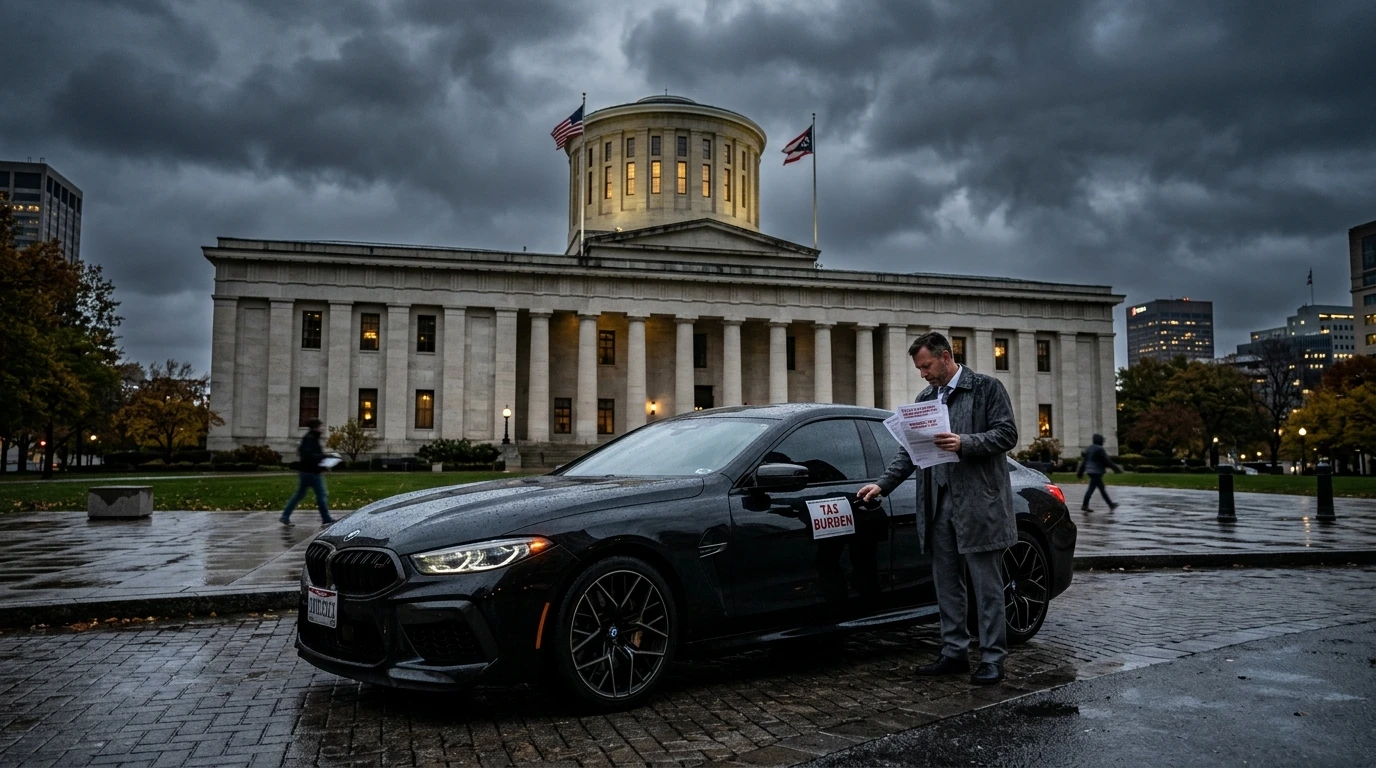
Ohio vehicle tax is the line item nobody warns you about until you’re standing at the BMV window with a dealer’s bill of sale in one hand and a checkbook in the other. Ask Brandon, a 38-year-old software architect who lives in Dublin, just outside Columbus. Last March he walked into a Franklin County BMV office to title his new BMW M5 Competition, sticker price $122,400. He had budgeted for the car. He had budgeted for insurance. He had even budgeted for the high-octane fuel his new German missile would inhale on the drive to Easton.
What he had not budgeted for was the woman behind the plexiglass sliding a piece of paper across the counter with a single number circled in blue pen: $9,792.
That was the sales tax. Not the title fee. Not the registration. Not the documentation fee his dealer had already extracted on the way out the door. Just the Ohio sales tax owed at title transfer, calculated at 8.00% of his purchase price, payable today, in full, before the BMV would hand him a temporary tag.
Brandon had moved to Ohio from Texas in 2022. He chose Ohio partly because the state has a relatively modest income tax and Columbus had recruited him aggressively. Nobody in HR mentioned that buying a luxury car in Franklin County in 2025 would cost him roughly the same as two semesters at Ohio State.
“I genuinely thought ‘no income tax’ states were the expensive ones,” Brandon said, recounting the exchange to his accountant a week later. “I had no idea Ohio was charging me eight percent for the privilege of registering a car I already paid for.”
What if that $9,792 didn’t have to happen?
What Is Ohio Vehicle Tax? The Sales Tax Sucker Punch
Ohio vehicle tax is, technically, just sales tax applied to vehicle purchases. But the way Ohio applies it makes it one of the more punishing one-time taxes in the Midwest. Every time a vehicle changes hands in Ohio, the state and your county of residence collect a percentage of the purchase price. That money is due at title transfer, paid through the Ohio Bureau of Motor Vehicles, and it’s not refundable, deductible, or negotiable.
The state base rate is 5.75%. That alone would be tolerable. Indiana sits at 7%, Illinois ranges from 6.25% to over 10% depending on locality, and Michigan is at 6%. Ohio, on paper, looks competitive.
The problem is what happens after the state takes its 5.75%. Ohio counties are allowed to layer “piggyback” surcharges on top of the state rate, and special transit authorities like the Central Ohio Transit Authority (COTA) can add their own slice on top of that. By the time you write the check, you’re often looking at 7.5% to 8.25% of the vehicle’s full purchase price.
For specifics on how this is administered and what’s currently owed, the official source is the Ohio Department of Taxation, which publishes the county-by-county rate matrix and updates it whenever a transit authority adjusts its surcharge. As of April 1, 2025, COTA raised its rate, and Columbus along with several surrounding counties got more expensive overnight.
Formula: Vehicle Purchase Price × Combined County Rate = Ohio Sales Tax Due. There is no cap. There is no deduction for being a resident, a veteran, a teacher, or a first-time buyer. You write the check at title transfer or you don’t drive the car home.
You pay this at the Ohio BMV window, and you pay all of it at once. The state does not offer payment plans on vehicle sales tax. There is no installment option. You either bring a cashier’s check or you walk out without plates. The only legal way to avoid this entire transaction, short of not buying a vehicle, is to have a non-Ohio entity make the purchase. We’ll get to that.
Ohio’s County Piggyback System: How Your Zip Code Costs You Thousands
Ohio’s tax code does something subtle that most buyers don’t catch until the bill arrives. The state authorizes each of its 88 counties to add a local surcharge on top of the 5.75% state rate. Counties use this revenue for general operations and, in some cases, for transit authorities that operate across multiple counties. The result is a patchwork rate map where two buyers purchasing identical vehicles in adjacent counties can owe wildly different tax bills.
The COTA increase that took effect April 1, 2025 is a perfect example. The Central Ohio Transit Authority raised its sales tax surcharge, and that increase rippled through Franklin County (Columbus) and into the COTA-served portions of Delaware, Fairfield, Union, and Licking counties. Licking County now sits at 8.25%, the highest combined rate in Ohio. Columbus residents in Franklin County jumped to 8.00%. If you bought a $100,000 vehicle in Columbus in March 2025, you paid $7,500. Buy that same vehicle in April and you pay $8,000. The car didn’t change. The tax did.
Here’s where Ohio sits today across its major metros, with the corresponding tax owed on an $85,000 vehicle:
The most common misconception we hear from new clients is that they can dodge this by driving across a county line and buying from a “cheaper” dealer. You cannot. Ohio sales tax on vehicles is determined by your county of residence, not the location of the dealership. A Cleveland resident who buys a car in Stark County still owes 8.00% Cuyahoga rate. The dealer simply collects the buyer’s home county rate and remits it. There is no Ohio version of New Hampshire-shopping.
Warning: Moved to Columbus in 2025? The April COTA increase means you’re paying 8.00% on every vehicle purchase, up from 7.50% before the change. On a $100,000 car that’s an extra $500 lost to a transit authority you may never use.
Ohio’s Annual Vehicle Fees: The Tax That Keeps Taking

If Ohio only hit you once at purchase, you could grit your teeth and move on. The state does not stop at the title transfer. Every year you keep a vehicle, you owe more.
The base annual registration fee is $36, a flat number that doesn’t scale with vehicle value. By itself it’s manageable. Compared to Virginia’s annual personal property tax that runs into the thousands, Ohio’s $36 looks almost reasonable. The problem is what gets piled on top.
If you drive an electric vehicle, Ohio charges you a $200 annual surcharge on top of the $36 base registration. That brings your annual total to $236 just to keep your plates current. The state’s reasoning is that EV drivers don’t buy gasoline, which means they don’t pay the state’s gas tax that funds road maintenance. Ohio decided to recover that revenue by charging EV owners a flat fee that, in many cases, exceeds what a comparable internal-combustion driver would pay in gas tax over a year.
Hybrid owners get hit too, just less aggressively. The hybrid surcharge is $100/year on top of base registration, so $136 total annually. The state assumes hybrid drivers buy roughly half as much gas, so it bills them roughly half as much in surcharge.
Title fees add another $18 to $23 at initial purchase, plus up to $5 in county fees. Dealer documentation fees, capped at the lesser of $250 or 10% of the contract price, add another bite. None of these are individually outrageous. Together they form a steady drip.
Run the math on a Columbus EV owner who buys a $120,000 Lucid Air Grand Touring. Year one: $9,600 in sales tax, $36 registration, $200 EV surcharge, plus title and documentation fees. Total year-one Ohio cost: roughly $9,900. Years two through ten: $236/year × 9 = $2,124. Cumulative ten-year Ohio cost: $12,024 in pure taxation, before insurance, fuel equivalent, or maintenance.
Note: Ohio calls the $200 EV fee a “road usage fee” since EV drivers skip the gas tax. The state is making sure you pay one way or another. Choose electric to save money on fuel and Ohio finds the savings on its own ledger.
Now contrast Ohio with Montana. Montana has no sales tax. None. Zero. Not 1%, not a “reduced rate for vehicles,” not a piggyback county surcharge waiting in the wings. Montana also eliminated its annual personal property tax on vehicles back in 2005. Montana charges $130/yr for battery electric vehicles and $70/yr for PHEVs — far less than Ohio’s $200 and $100 annual surcharges. The state also charges a small base registration fee and that’s effectively the end of the conversation.
The Real Cost of Owning a Vehicle in Ohio vs. Montana
Let’s put actual numbers on this. Generic percentages don’t change behavior. Dollar figures do. Below is the five-year total cost of vehicle taxation in Ohio’s three largest metros compared to a Montana LLC structure. The Ohio figures include the one-time sales tax plus five years of base registration. The Montana figure includes one-time LLC formation and five years of standard maintenance.
*Montana LLC: $899 in year one ($699 service + $200 LLC formation) plus $368/year thereafter ($150 registration + $120 filing) equals about $2,371 over five years. Zero sales tax, zero annual surcharges, flat predictable cost.
Look at the column carefully. For any vehicle priced above $85,000, the Montana LLC structure saves you more in year one than the entire five-year cost of running the LLC. The break-even point is roughly $55,000 to $60,000, depending on county. Below that line, Ohio’s system is cheaper than maintaining a Montana entity. Above that line, every additional dollar of vehicle value flows straight to your savings.
Reality check: If you own a $165,000 vehicle in Cuyahoga County, Ohio charged you $13,380 just to register it. Montana’s total five-year cost for the same vehicle: $3,196 (including the $825 luxury fee for vehicles over $150k MSRP). You’re ahead by $10,184 by the end of year one and stay ahead forever.
The Class A motorhome row is where things get genuinely silly. A $280,000 RV in Cuyahoga County costs $22,580 in Ohio sales tax and registration over five years. That’s a Honda Civic in tax. You could buy a second car with what you handed Ohio just to register the first one.
Ohio’s Used Vehicle Tax Trap: No Trade-In Credit for You

One of Ohio’s least-advertised traps lives in the fine print of the trade-in credit. When you buy a new vehicle from a licensed Ohio dealer and trade in your old one, the state calculates sales tax on the difference between the purchase price and the trade-in allowance. A $120,000 new car with a $30,000 trade-in is taxed on $90,000. That’s reasonable, and most buyers understand this part.
Here’s what most buyers do not know: the trade-in credit applies only to new vehicles purchased at a licensed dealer. Buy a used vehicle, whether through a private sale or even from a dealer, and the trade-in credit disappears. You owe sales tax on the full purchase price, with no deduction for whatever you traded.
Run a real example. You sell your old SUV privately for $25,000. With that cash you walk into a dealer and buy a used $85,000 BMW M5. In Franklin County you owe 8.00% on the full $85,000, which is $6,800. If that BMW had been new, your $25,000 trade would have reduced the taxable amount to $60,000, cutting your tax to $4,800. The difference, $2,000, is pure Ohio extraction caused entirely by the vehicle being used rather than new.
The same logic punishes savvy buyers who shop the certified pre-owned market to save on depreciation. You think you’re saving money by buying a one-year-old luxury car at 70% of MSRP. Ohio quietly claws back some of those savings by denying you the trade-in credit you would have received on a new purchase.
Then there’s the out-of-state rule. If you buy a vehicle in another state and pay sales tax there, Ohio gives you credit for what you paid, but only up to Ohio’s rate. Buy in Indiana at 7% and Ohio collects the remaining roughly 1% when you title the vehicle here. Buy in low-tax Oregon and you pay the full Ohio rate at title transfer. The state’s “use tax” exists specifically to close this loophole.
Warning: Ohio’s use tax ensures that whatever you paid in sales tax elsewhere, Ohio makes you whole, for Ohio’s benefit. You cannot fully escape by buying in a neighboring low-tax state. The only way out is for the buyer to not be an Ohio taxpayer in the first place.
Who Ohio Vehicle Tax Hits Hardest
Ohio’s flat-percentage sales tax is, by design, regressive at the top. It costs the same percentage whether you’re buying a $25,000 commuter car or a $250,000 collector piece. The dollar consequences scale with vehicle value, and certain buyer profiles get pummeled while others barely notice.
The first group is Columbus and Cleveland tech professionals who buy six-figure cars on a regular cycle. The Short North in Columbus and the Crocker Park area in Westlake are filled with software executives, surgeons, and finance partners who treat a new luxury car as a three-year commodity. At 8.00% per swap on a $130,000 vehicle, that’s $10,400 in Ohio sales tax every three years, or roughly $3,500 per year just to keep current with the new model. Over a 20-year career, that habit costs $70,000 in Ohio tax alone.
Second is the RV and motorhome crowd. A Class A diesel pusher with full luxury appointments runs $280,000 to $500,000. In Cuyahoga County, a $380,000 Tiffin Allegro Bus generates $30,400 in Ohio sales tax at purchase. Most RV owners are retired or semi-retired and they intend to spend half the year traveling, which makes the Ohio tax bill feel especially out of place. You’re paying Ohio for a vehicle that will be in Florida, Arizona, and Maine far more than it will be in Ohio.
Third, and perhaps most punished, are electric vehicle buyers. EV owners get hit twice. They pay the full Ohio sales tax on the higher purchase price typical of EVs (Tesla Model S, Lucid Air, Porsche Taycan, Mercedes EQS), then pay the $200 annual surcharge for the privilege of not buying gasoline. A Cincinnati buyer of a $130,000 Taycan pays $10,140 in sales tax plus $200/year forever. The state effectively penalizes the choice of cleaner technology.
Fourth are car collectors who rotate inventory. Every purchase is a fresh tax event. Sell a Ferrari, buy a Lamborghini, owe Ohio another five figures. The state has no concept of an “exchange” for tax purposes outside the narrow new-vehicle trade-in rule.
Fifth are business fleet owners. Executive transport companies, mobile service businesses, and corporate fleets that replace vehicles on two- or three-year cycles see Ohio sales tax as a recurring operating expense that compounds across every unit.
The Montana Solution: Buy Once, Pay Nothing

Montana has no sales tax. That’s not a slogan. It’s the actual state tax code. Montana never adopted a general sales tax, and as a result it does not tax vehicle purchases. There is no 5% rate, no 1% transit surcharge, no county piggyback. The number is zero.
Montana also does not levy an annual personal property tax on vehicles. The state eliminated that tax in 2005. What remains is a modest registration fee, paid once and renewed annually at very low cost.
The structure that takes advantage of this is straightforward. You form a Montana limited liability company, a real legal entity registered with the Montana Secretary of State. The LLC has its own EIN, its own registered agent in Montana, and its own legal existence. The LLC purchases the vehicle, the LLC titles it in Montana, the LLC registers it in Montana, and Montana issues plates to the LLC. Ohio is never a party to the transaction because no Ohio resident or Ohio entity is buying the vehicle. An LLC organized under Montana law is a Montana taxpayer for purposes of vehicle sales tax. Ohio’s sales tax applies to Ohio residents purchasing vehicles. The LLC isn’t an Ohio resident.
The legal foundation: Montana eliminated its personal property tax on vehicles in 2005. It has never had a vehicle sales tax. This isn’t a loophole that opened up overnight. It’s a feature of Montana law that has been on the books for decades and is used by tens of thousands of out-of-state vehicle owners every year.
Here’s what the math looks like for a $120,000 sports car bought by a Columbus resident at 8.00%:
The savings shown are net of every cost associated with the LLC structure. They are not gross numbers spun for marketing. The $7,373 is what actually stays in your account at the end of five years compared to handing the same money to the Ohio BMV.
Is Montana LLC Vehicle Registration Actually Legal?
Yes. Montana has allowed non-resident LLC vehicle registration for decades. The state’s economic development model openly accommodates out-of-state owners forming Montana entities, and Montana’s Secretary of State maintains a streamlined LLC formation process specifically because the volume of these filings is significant.
The legal mechanism is straightforward: the vehicle is titled to the LLC. The LLC is a Montana entity. Montana law governs the title and registration. Under the U.S. Constitution’s Commerce Clause and Full Faith and Credit Clause, states cannot block legitimate out-of-state entity vehicle registrations. The vehicle is owned by the Montana LLC — a Montana entity — not by the Ohio resident personally. Ohio’s sales tax statute reaches transactions in which an Ohio resident or Ohio entity acquires a vehicle; a Montana LLC is neither.
The structure works because the LLC is a real legal entity with articles of organization on file with Montana, a registered agent with a Montana street address, the legal capacity to hold title to property, and the ability to sue or be sued in court. Montana has the authority to register vehicles owned by Montana entities, a right backed by decades of federal court precedent.
The legal foundation: Montana LLC vehicle registration is not a gap in the law or an unintended consequence — it is how Montana’s registration and LLC system is designed to function. Federal constitutional protections ensure that Montana’s right to register vehicles owned by Montana entities cannot be overridden by another state’s tax preferences.
Four Ohio Vehicle Owners Who Stopped Paying

The numbers are abstract until you see them attached to real people. Here are four Ohio buyers, all in different counties and different situations, who walked into our process in the last 18 months. Names changed, situations real, dollar figures pulled from actual files.
Marcus, Columbus Tech Founder (Franklin County)
Vehicle: 2024 Porsche 911 Turbo S, $230,000 out the door. Ohio tax bill at title transfer: $18,400 at the 8.00% Franklin County rate. Marcus runs a SaaS company headquartered in the Short North with clients in 14 states. He replaces his daily driver every two years because he uses it as a moving billboard for the company brand and clients see him roll up to off-sites. At $18,400 per swap, his vehicle tax bill was averaging $9,200 per year. His CPA noticed the line item during a routine review and suggested looking at a Montana LLC structure given the company’s existing multi-state operations and the legitimate business use case.
Result: Montana LLC formed in 11 days. The Porsche was purchased and titled to the LLC. Ohio sales tax paid at title transfer: zero, because there was no Ohio title transfer. Total cost for the structure: $899 in year one, then $368/year ongoing.
Marcus, on the phone with his accountant after the plates arrived: “I was literally handing Columbus $18,000 for a piece of paper. My CPA said it was the most expensive license plate in Ohio.”
Diane, Cleveland RV Owner (Cuyahoga County)
Vehicle: 2025 Tiffin Allegro Bus 45OPP, $380,000. Ohio tax bill: $30,400 at the 8.00% Cuyahoga rate. Diane and her husband retired in 2023 after 35 years of running a small manufacturing business in Mentor. They had planned for the RV for five years. They had not planned for $30,000 in Ohio sales tax on a vehicle they intended to spend six months a year living in, traveling between Florida in winter and the Pacific Northwest in summer.
Result: Montana LLC. The Tiffin is titled to the LLC, registered in Montana, plated in Montana. The couple’s permanent Ohio residence is unchanged for income tax purposes. Their RV simply doesn’t share that residency. Ohio vehicle tax: zero.
Diane, after the first cross-country trip with the new plates: “We live in this thing half the year. Why is Ohio taxing our vacation?”
Kevin, Cincinnati EV Fleet Owner (Hamilton County)
Vehicles: Fleet of 4 Tesla Model S Plaid units at $110,000 each, used for his executive ground transport service. Ohio tax bill: $34,320 at 7.80% Hamilton rate, plus $800/year in EV surcharges ($200 × 4 vehicles). Kevin upgrades his fleet every three years because his clients expect current-generation vehicles. Each replacement cycle was costing him $34,000+ in Ohio sales tax, plus the state was charging him an extra $800 per year specifically for choosing electric.
Result: Montana LLCs structured for the fleet. The annual EV surcharges disappeared because the vehicles aren’t registered in Ohio. Per-vehicle savings on each new purchase: roughly $8,580 after netting LLC costs.
Kevin’s note to his operations manager: “Ohio taxes me more because I chose electric vehicles. Montana doesn’t care what you drive.”
The Hoffman Family, Akron Collectors (Summit County)
Vehicles: 1967 Ford Mustang fastback ($195,000), 2023 Chevrolet Corvette Z06 ($130,000), vintage Airstream trailer ($85,000). Ohio tax bill on the collection acquired over three years: roughly $28,700 at the 7.00% Summit rate. The Hoffmans built the collection slowly, and each purchase was its own tax event. They had no idea there was an alternative until their estate attorney mentioned the Montana LLC structure during a routine trust review after the Airstream purchase pushed their out-of-pocket vehicle tax over $25,000.
Result: New vehicles and major purchases now flow through the Montana LLC. Their existing titles are being reviewed individually for whether transfer makes economic sense given depreciation and remaining ownership horizon.
Mr. Hoffman, recounting the conversation with his attorney: “We didn’t know this was legal until our attorney told us. We’d paid Ohio $28,000 for the privilege of owning cars we restore ourselves.”
Who Benefits Most from Montana LLC Registration

The structure isn’t right for everyone. The buyers who benefit most share certain characteristics. If you see yourself in two or more of these profiles, the math almost certainly works in your favor.
- Luxury vehicle buyers ($85,000+): The break-even point on a Montana LLC sits between $55,000 and $60,000 in vehicle value. Anything above that and you save money in year one. A $150,000 vehicle in Columbus saves you about $9,500 in year one alone after netting LLC costs.
- RV and motorhome owners: Class A and Class C RVs routinely exceed $250,000. Ohio sales tax on a $300,000 motorhome is $24,000 in Cuyahoga County. The same RV through Montana costs $2,371 over five years. Your trip out west just paid for itself.
- Electric vehicle owners: EVs are taxed twice in Ohio, once at purchase and again every year via the $200 surcharge. Montana eliminates both. A $120,000 Tesla saves $9,600 in sales tax plus $200 every year forever.
- Car collectors: Multiple vehicles compound the tax problem. Five collector cars averaging $120,000 each generates $48,000 in Ohio sales tax across the collection. Montana lets you assemble that collection without Ohio’s cut.
- Frequent vehicle rotators: If you trade vehicles every two or three years, every cycle is a fresh Ohio tax bill. The Montana LLC is a one-time setup that pays dividends across every subsequent purchase.
- Snowbirds and multi-state residents: If you split time between Ohio and Florida, Arizona, or another warmer state, you have a legitimate non-Ohio nexus that strengthens the structure’s fit.
- Business owners with multi-state operations: If your company already operates in multiple states, adding a Montana entity to hold vehicles is a clean structural fit that an Ohio CPA can integrate into existing tax planning.
How Zero Tax Tags Gets You Registered

You don’t need to fly to Helena. You don’t need to find a registered agent on Craigslist. You don’t need to figure out which forms the Montana DMV expects in what order. We handle the entire process from formation to plates in your hand.
Our service includes Montana LLC formation with the Secretary of State, registered agent service for the life of the entity, EIN registration with the IRS, all Montana DMV paperwork, title transfer coordination with your dealer or seller, and physical plate delivery to your Ohio address. The only thing you do is sign the paperwork we send and provide the vehicle information.
| Day 1: | Submit your MCO and supporting paperwork through our secure portal. We review for completeness and file your Montana LLC the same day. |
| Days 1–2: | Montana LLC formation complete — same business day in most cases, second business day at the latest. |
| Days 2–4: | Title transferred into the LLC name at the Montana county treasurer. |
| Days 4–7: | Permanent Montana plates shipped directly to your door within 3–5 business days of title completion. |
Frequently Asked Questions
1. Do I need to visit Montana to set this up?
No. The entire process is handled remotely. You sign documents electronically, we file with the Montana Secretary of State, our registered agent service provides the required Montana street address, and the DMV paperwork goes through our Helena office. Plates ship directly to your Ohio address. Most clients never set foot in Montana, though many enjoy visiting because they finally have a reason to take the road trip.
2. What happens when I sell the vehicle?
The LLC sells the vehicle. The buyer titles it in their state under their own structure. The LLC remains in place, ready to acquire your next vehicle without redoing the formation work. Many of our clients keep the same LLC for years and use it across multiple vehicle purchases.
3. Can I insure a Montana-plated vehicle in Ohio?
Yes. Major insurance carriers, including Progressive, Geico, State Farm, and the specialty exotic carriers, write policies on LLC-owned, Montana-titled vehicles garaged in Ohio. The policy lists the LLC as the named insured with you as a permitted driver. We provide insurance broker referrals if you need help finding a carrier.
4. How much does Zero Tax Tags charge?
Pricing depends on services selected, but full-service setup runs $899 in year one — that covers LLC formation, registered agent, Montana DMV paperwork, and plates. Annual renewal runs $270 ($150 registration + $120 filing fee). We provide a written quote before you commit and there are no hidden fees. We provide a written quote before you commit and there are no hidden fees added at the end.
5. Can I register multiple vehicles under one LLC?
Yes, and it’s the most cost-effective approach for collectors and fleet owners. One Montana LLC can hold title to as many vehicles as you want. The LLC’s annual maintenance cost stays roughly the same whether it holds one vehicle or ten. For a five-car collection, the per-vehicle annual cost drops to about $140.
6. What if Ohio changes its rules?
Ohio cannot retroactively tax a vehicle that was lawfully purchased and titled by a non-Ohio entity. If Ohio passes new rules in the future, those rules apply to future transactions, not to past ones. Our clients have been operating under this structure for years across multiple states’ attempts at restrictive legislation, and the Montana LLC framework has held up consistently. We monitor legislation in Ohio and will alert clients if any specific change requires adjustment.
See how Montana LLC helps owners in other high-tax states:
- Arizona VLT: How to Stop Paying $1,000+ Every Year
- Virginia Car Tax: Stop Paying the Highest Vehicle Tax in America
- North Carolina Vehicle Tax: The Tag Tax Trap
- South Carolina Vehicle Tax: The No-Inspection Lie
- Arkansas Vehicle Tax: Hidden Wealth Extraction
Ready to Stop Overpaying Ohio Vehicle Tax?
Ohio vehicle owners have paid millions in avoidable sales tax. Montana LLC registration changes that, legally and permanently.