26 min read
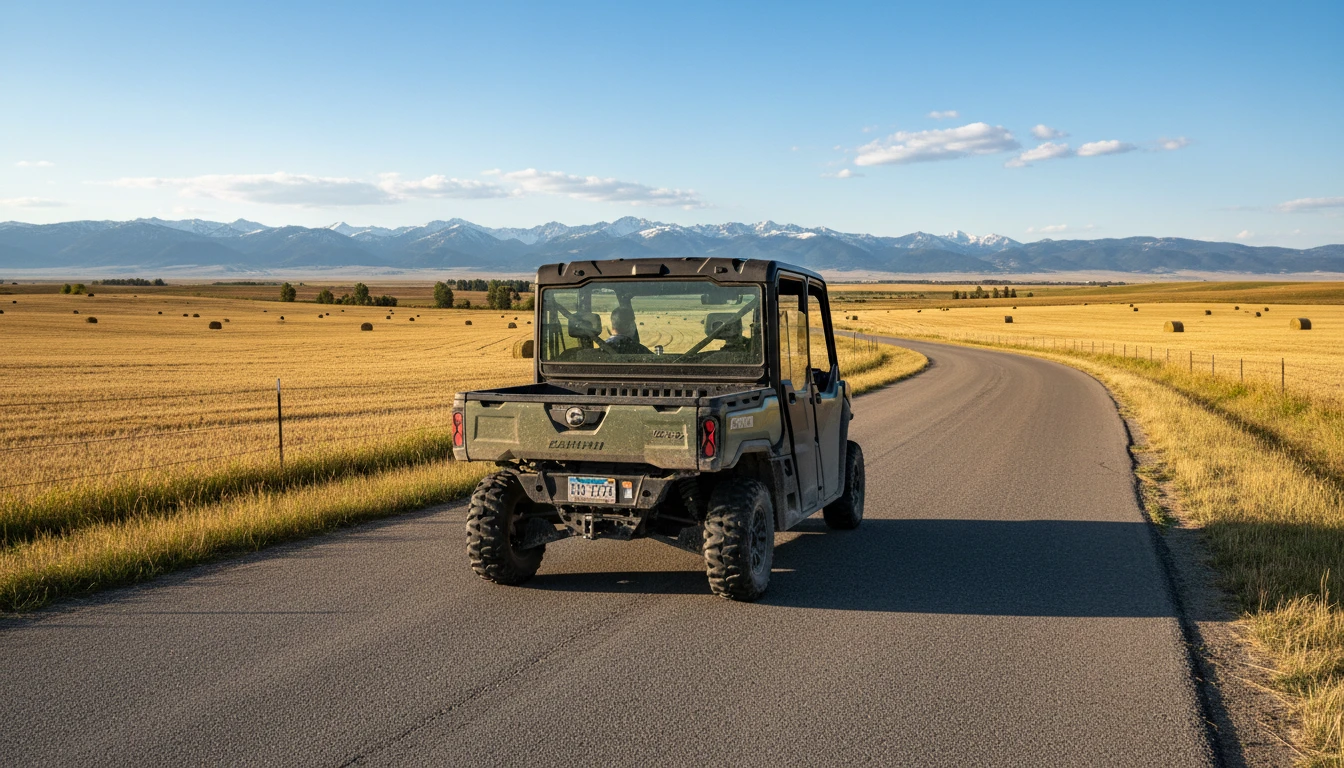
Idaho is one of the few high-tax states that actually lets you make a UTV street-legal. You can register a Can-Am X3 or a Polaris Ranger with a restricted vehicle license plate, slap on a horn and a mirror, and ride county roads between trailheads. That part Idaho gets right. The problem is everything that happens before you turn the wheel for the first time.
You pay 6% sales tax at purchase. On a $45,000 X3 MAX Turbo RR, that’s $2,700 written into the dealer contract before the salesperson hands you the key fob. Then you pay $15 a year forever for the OHV sticker and the restricted plate. You buy mandatory liability insurance because Idaho law requires it for any vehicle that touches a public road. You meet a list of equipment requirements that reads like a DOT checklist. Or, you skip all of that. A Montana LLC owns the machine for $749, one time, with a permanent plate that never renews. Idaho honors out-of-state registration through standard reciprocity. The math, as you’ll see, is uncomfortable for anyone who already wrote a check to the Idaho State Tax Commission.
On this page
Idaho’s OHV Registration System
Idaho’s off-highway vehicle system has two registration tracks, and you need to understand both before you sign anything at a dealership. The first is the OHV certificate of number, governed by Idaho Code § 67-7122. Every ATV, UTV, and off-highway motorbike operated in Idaho must carry one. It costs $12 a year, or $24 for a two-year cycle, and it covers off-road use on public lands, BLM trails, and Forest Service routes. Without it, you can’t legally ride at St. Anthony, the South Hills, or anywhere on Sawtooth National Forest. Idaho Parks and Recreation enforces it.
The second track is the restricted vehicle license plate, authorized under Idaho Code § 49-402(4). This is the plate that lets you take your UTV onto county roads and designated public streets. It carries the distinctive “R” prefix. It renews January 1 at $3 a year. Combined with the OHV sticker, that’s $15 annually for a street-legal Idaho UTV, every year, for as long as you own the machine. It sounds modest. Across a decade of ownership, you’ve paid $150 in renewal fees on top of the upfront sales tax. Across the typical 15-year lifespan that most ranch UTVs see in Idaho, you’ve paid $225. That’s all administrative friction with no underlying state service attached to it.
To qualify for that “R” plate, your machine has to pass equipment compliance. Idaho requires headlights, tail lights, and brake lights. A rear-view mirror. A horn audible at 200 feet. A muffler rated 96 dB or quieter. DOT-approved tires. Seat belts are mandatory for any rider, not optional, regardless of cab configuration. The state also requires liability insurance at $25,000 bodily injury per person, $50,000 per crash, and $15,000 property damage. That’s a real recurring premium, not a checkbox.
The 2025 legislature softened one piece of this in March of last year. House Bill 13, signed March 17, 2025, updated helmet rules so that riders under 18 are now exempt from the helmet requirement only when the UTV has both a certified roll cage and functioning seat belts. If your kid’s machine has either one missing, the helmet rule still applies. The change aligns the law with how modern side-by-sides are actually built. You still need to verify your cage certification and document it for compliance.
Then there’s the sales tax. Idaho applies a flat 6% statewide rate on vehicle purchases. Unlike Colorado, which layers municipal taxes onto the state rate, or Utah, which lets counties add their own surcharge, Idaho doesn’t have local sales taxes on vehicles. Boise, Coeur d’Alene, Twin Falls, Idaho Falls, Pocatello, even Sun Valley all charge the same 6%. Sun Valley has local option taxes, but those apply to lodging and dining, not to the UTV you bought from a dealer down the road. The rate is uniform. The check is the same size no matter which county you live in.
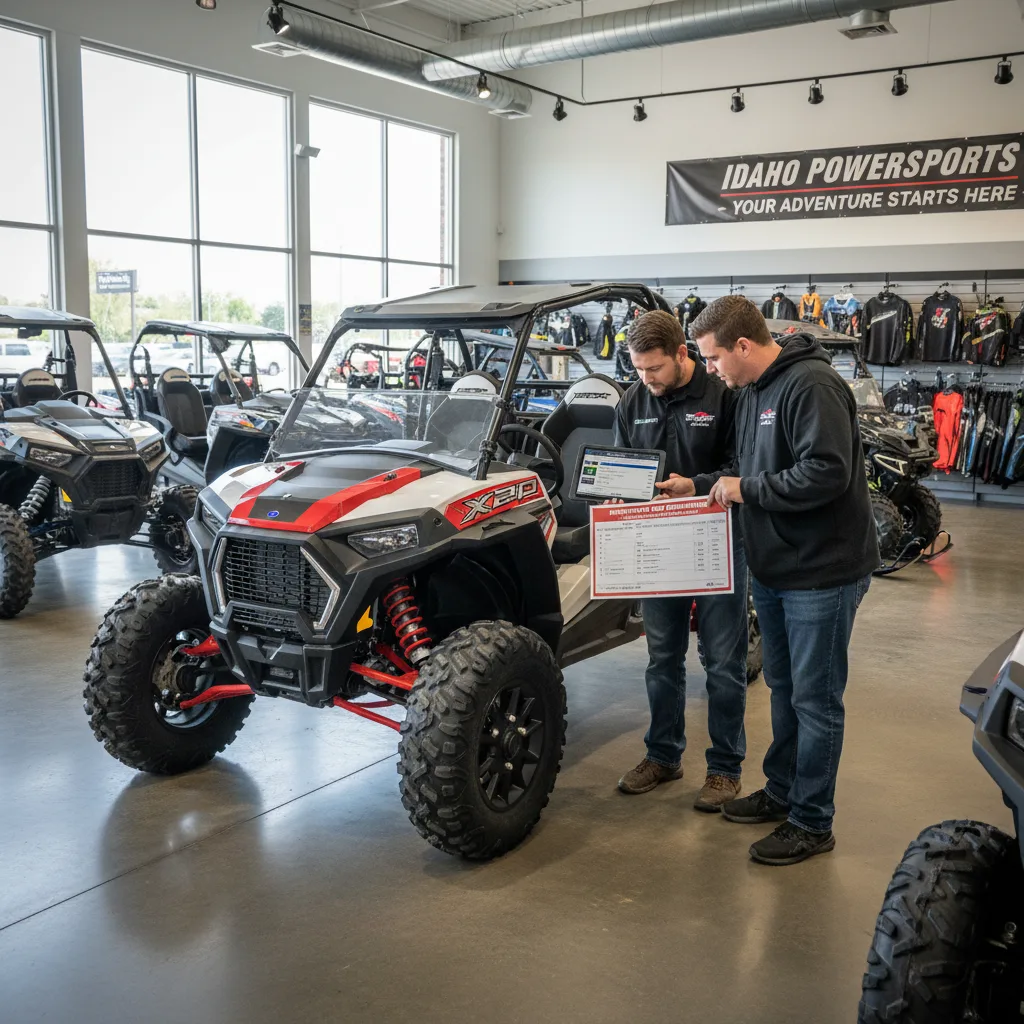
The 6% reality check. Walk into an Idaho dealership for a $45,000 Can-Am X3 MAX Turbo RR and the bottom line on your purchase order shows $47,700. The extra $2,700 is sales tax. It is not a fee for a service, not a registration, not insurance. It is a transfer to the state that funds general operations. You will never see it again, and Idaho does not refund it if you sell the machine next year.
There is one exemption Idaho buyers frequently ask about, and the answer is the wrong one. Idaho’s agricultural sales tax exemption, codified under § 49-426 and parallel tax provisions, explicitly excludes ATVs and UTVs from the list of qualifying farm machinery. Tractors, balers, combines, and qualifying implements get the exemption. Side-by-sides do not, even when they are the only vehicle your hand uses to move fence wire or run a hay crew. This is the single most common misconception we see from ag buyers. A Polaris Ranger XP 1000 purchased for a working ranch in Custer County is taxed exactly the same as one purchased by a Boise tech founder for weekend recreation. The agricultural exemption will not save you.
The ag exemption myth. Idaho’s farm equipment sales tax break does not apply to ATVs or UTVs, period. The state has been clear about this in audit guidance. You can use a Defender 100% of the time for cattle work, calve out of it, and still owe the full 6% at purchase. The exemption is structured around traditional farm implements, and side-by-sides were intentionally left out when the rule was written.
Where Idaho Riders Actually Ride: Best OHV Areas by Region
Idaho has a riding scene most outsiders underestimate. The state runs from the Owyhee high desert in the south to the dense conifer forests of the north, with the Sawtooth and Frank Church wilderness anchoring the middle. There are more than 6,000 miles of legal motorized trail across BLM and Forest Service land, plus dedicated OHV recreation areas and dune systems. Here’s where Idaho riders actually spend their time, broken out by region.
Eastern Idaho: The Dune Capital
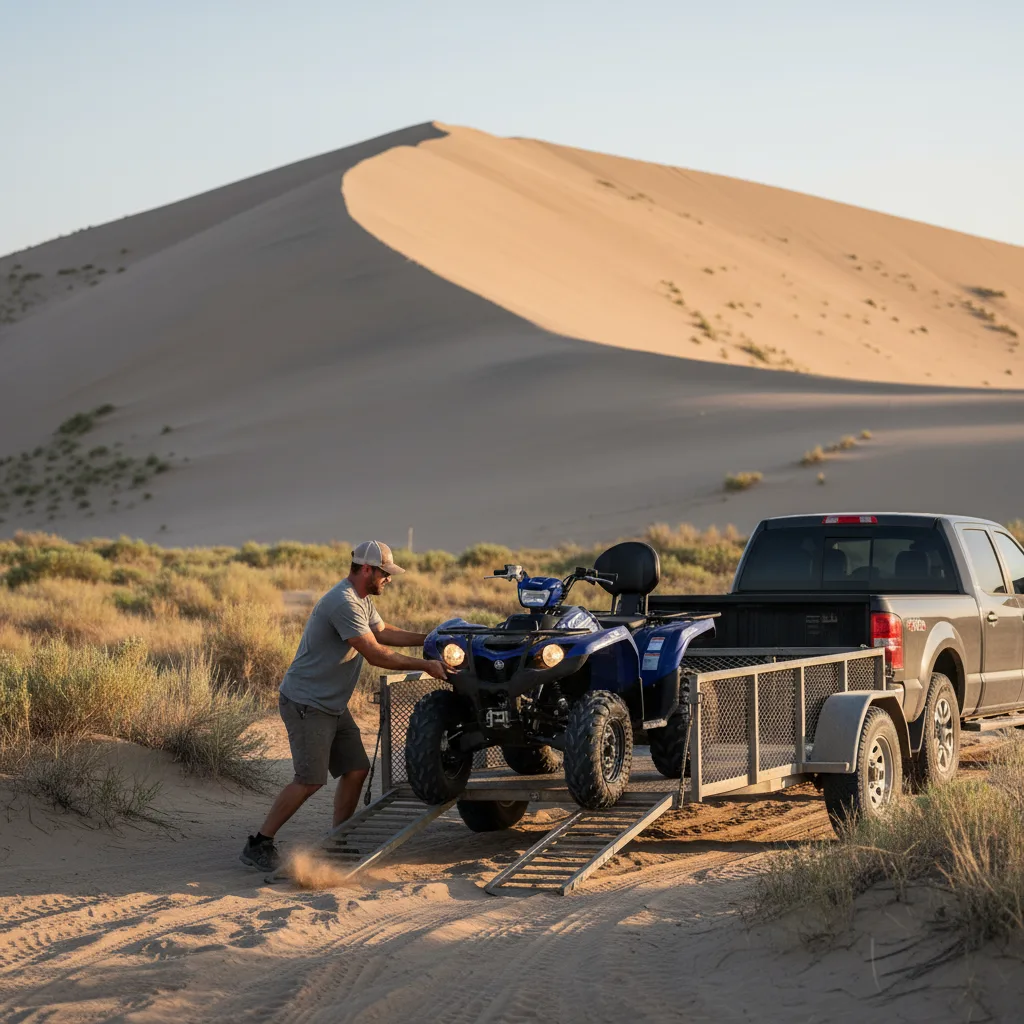
St. Anthony Sand Dunes is the headline attraction. Managed by the Bureau of Land Management, the dune field sits eight miles west of the town of St. Anthony in eastern Idaho. It runs 23 miles end to end and includes the largest single dune in the Great Basin: 3.5 miles long, 600 feet tall, made of pure white quartz sand. The pass system is $10 per day or $40 for a seven-day permit, paid through the BLM. Every OHV class works here, including sand rails, dune buggies, and full-frame UTVs with paddle tires. Primitive camping is available throughout the recreation area, and the place runs year-round with seasonal closures on a small portion to protect kearny buckwheat habitat. If you ride one place in eastern Idaho, this is it.
Central Idaho: Sawtooth Country
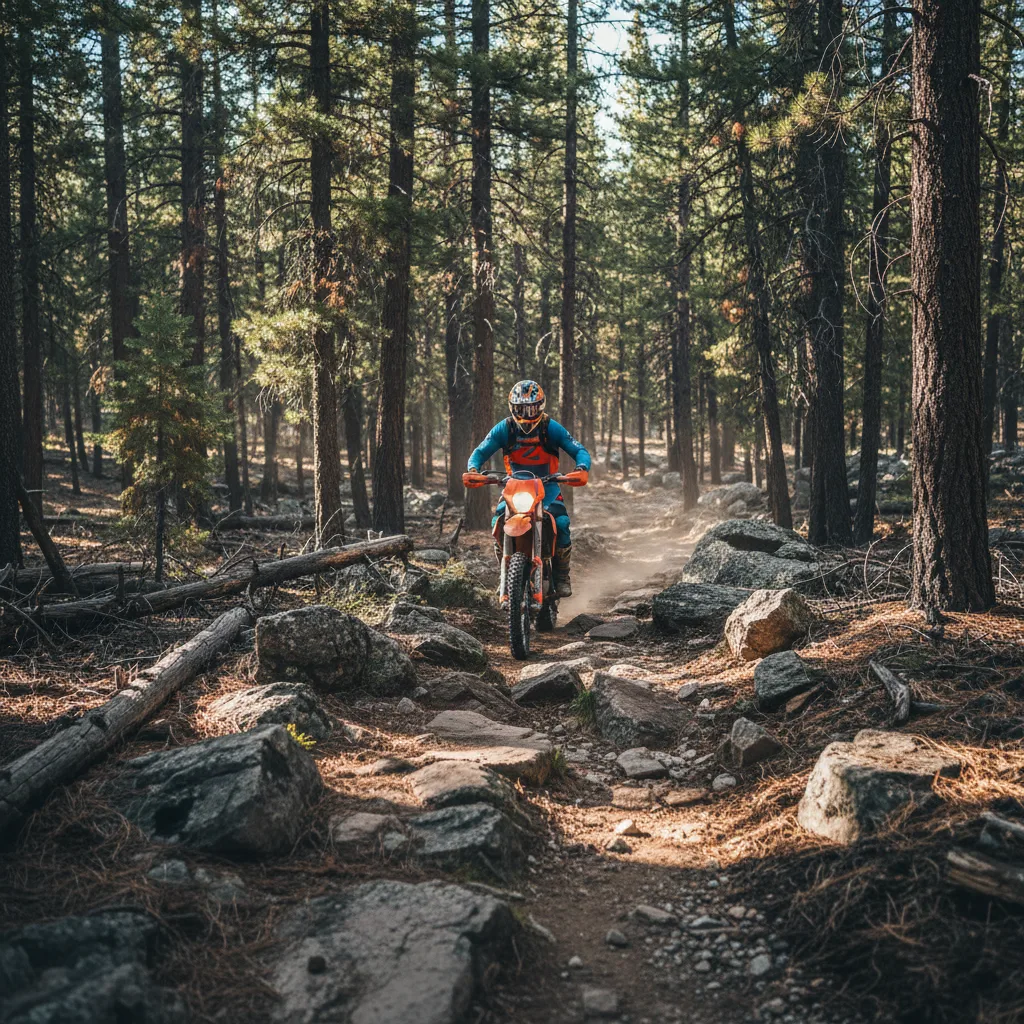
The Sawtooth National Forest OHV system spans the Minidoka and Fairfield Ranger Districts and contains more than 500 miles of motorized trail. There are no entry fees because it’s national forest, though some routes are restricted to vehicles 50 inches wide or narrower. That width limit matters: a stock Polaris Ranger XP 1000 is 62.5 inches wide and is excluded from a significant fraction of the network. Smaller Trail-class UTVs and full-width-legal 50-inch machines have the run of the system. Campground fees run $5 to $40 per night depending on amenities. The OHV-specific campgrounds, including Baumgartner, Clear Creek, Diamondfield Jack, and Father & Sons, fill up fast in July. The season opens once snow clears, typically mid-June, and runs through October until the first hard storms close higher elevation routes.
The Lochsa River and Powell Ranger District, technically in the Nez Perce-Wallowa-Whitman complex, sits in east-central Idaho. It is steep, remote, and dense. Riders here move through river-cut canyons and old-growth conifer forest. The roads are narrow enough that larger UTVs sometimes struggle on tight switchbacks. July through September is the peak window. It rewards owners who like solitude over scenery-with-an-audience.
The Frank Church-River of No Return Wilderness itself is closed to motorized use, but the adjacent BLM access roads around the wilderness boundary remain open. This is some of the most remote riding in the continental United States. High clearance is recommended, primitive camping is the only option, and you should not go in without redundant communications and fuel margin. The reward is country that almost nobody else sees on a side-by-side.
The Clearwater National Forest in the north-central part of the state offers extensive forest roads with scattered OHV trail designations. The terrain is tall conifer, low-density human presence, and a long season for the lower elevations.
Southern Idaho: High Desert and South Hills
The South Hills, or Cassia Division of Sawtooth National Forest, sits 40 minutes south of Twin Falls. The terrain is a mix of mountain and forest, riddled with designated trails. There are no fees. ATVs, UTVs, and motorcycles share most routes. The season runs June through October. For Twin Falls families, the South Hills is the default weekend ride. You can leave the driveway after breakfast, be on a trail by 10, and home for dinner.
The Hammett Gulch and Bennett Hills area sits at the BLM and USFS transition near Hagerman in south-central Idaho. It is rolling, with sagebrush and scattered timber. There are no fees. It is consistently quieter than the Sand Dunes, which is its main selling point for riders who don’t want to compete for line of sight. Some width restrictions apply on the trickier routes.
The Owyhee Canyonlands, on BLM land in the southwest corner of the state along the Nevada and Oregon borders, are some of the most remote terrain in the lower 48. Free primitive camping, no fees, mostly road riding with some long-haul trail connectivity. Services are essentially nonexistent. If you ride here, you bring everything you might need, twice over.
Treasure Valley and Boise Area
Boise National Forest OHV routes give Treasure Valley riders more than 500 miles of motorized USFS trail within driving distance of home. No fees. ATVs up to 50 inches wide work on most routes, alongside motorcycles. The Motor Vehicle Use Map (MVUM) is required reading and required carry. The season is June through October.
The Boise River Wildlife Management Area, managed by Idaho Department of Fish and Game, has limited motorized access. The Boise Front segment opens 10 miles to motor vehicles from May 1 through November 15. The Charcoal segment opens 7 miles from September 1 through December 31. The winter closure protects 5,000 to 8,000 wintering mule deer that move through the area. It is not a dedicated OHV recreation destination so much as hunter access for big game seasons.
The Real 5-Year Cost of Idaho ATV Registration
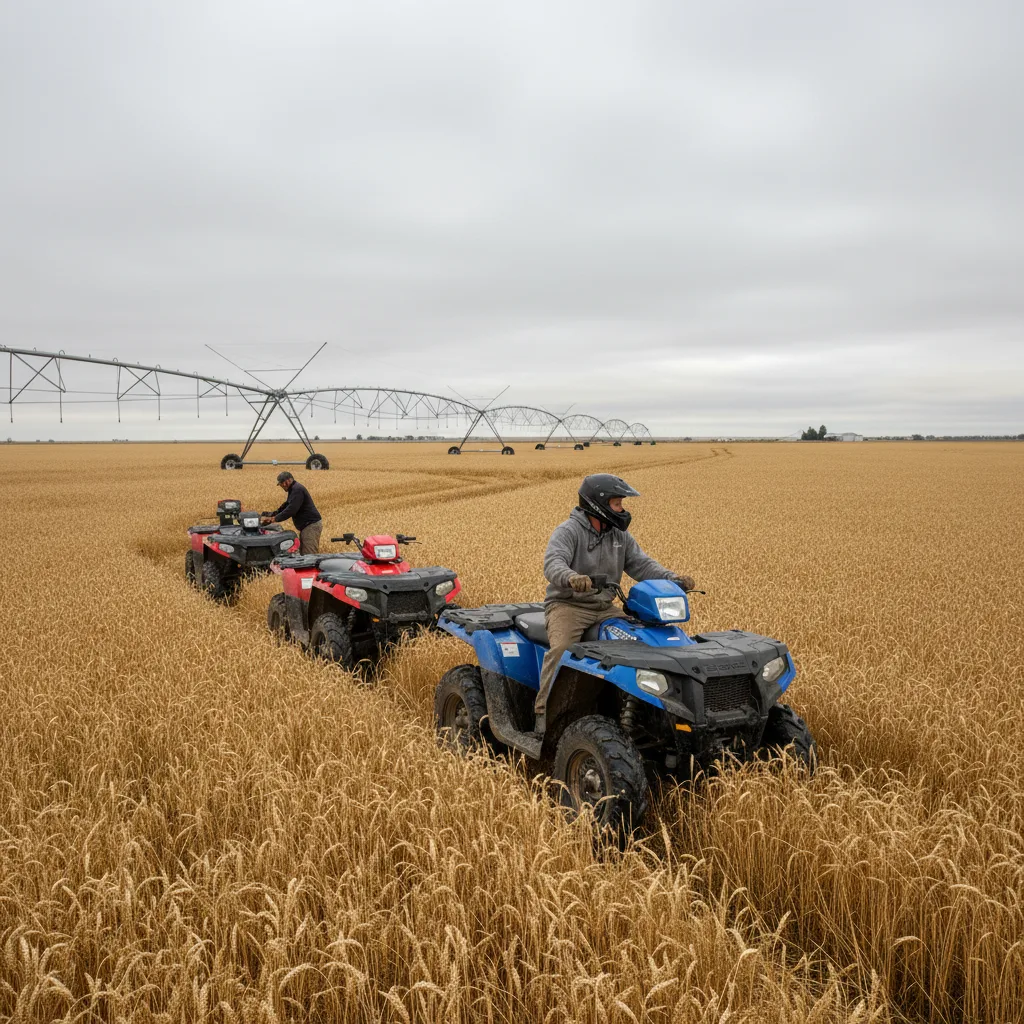
Forget what the dealer’s monthly payment quote says. Four common price points, with the Montana alternative beside each one:
Even at the entry-level $15,000 price point, you are $226 ahead with Montana over five years. At $25,000, the gap opens to $826. At $35,000, it’s $1,426. At $45,000, it’s a clean $2,026. Where it really compounds is past year five, because UTVs are not five-year vehicles in Idaho. Ranch operators keep Defenders for 10 to 15 years. Hunters keep Rangers for similar timelines. Sand Dunes regulars often hold premium machines 7 to 10 years before trading.
At year 10, your Idaho annual fees have grown another $75. At year 15, they’ve grown another $150. Montana, meanwhile, sits at $749 forever. The permanent plate doesn’t renew. Compounded across a realistic ownership horizon, the $45K X3 owner saves closer to $2,176 by year 10 and $2,326 by year 15. The $35K Defender owner saves closer to $1,576 and $1,726 respectively. Those numbers do not include the cost of mandatory liability insurance for street use, which Idaho requires and Montana plates do not trigger as a state condition. They do not include the time and inconvenience of equipment inspection at the dealer or shop. They are the floor, not the ceiling.
The Montana LLC Solution
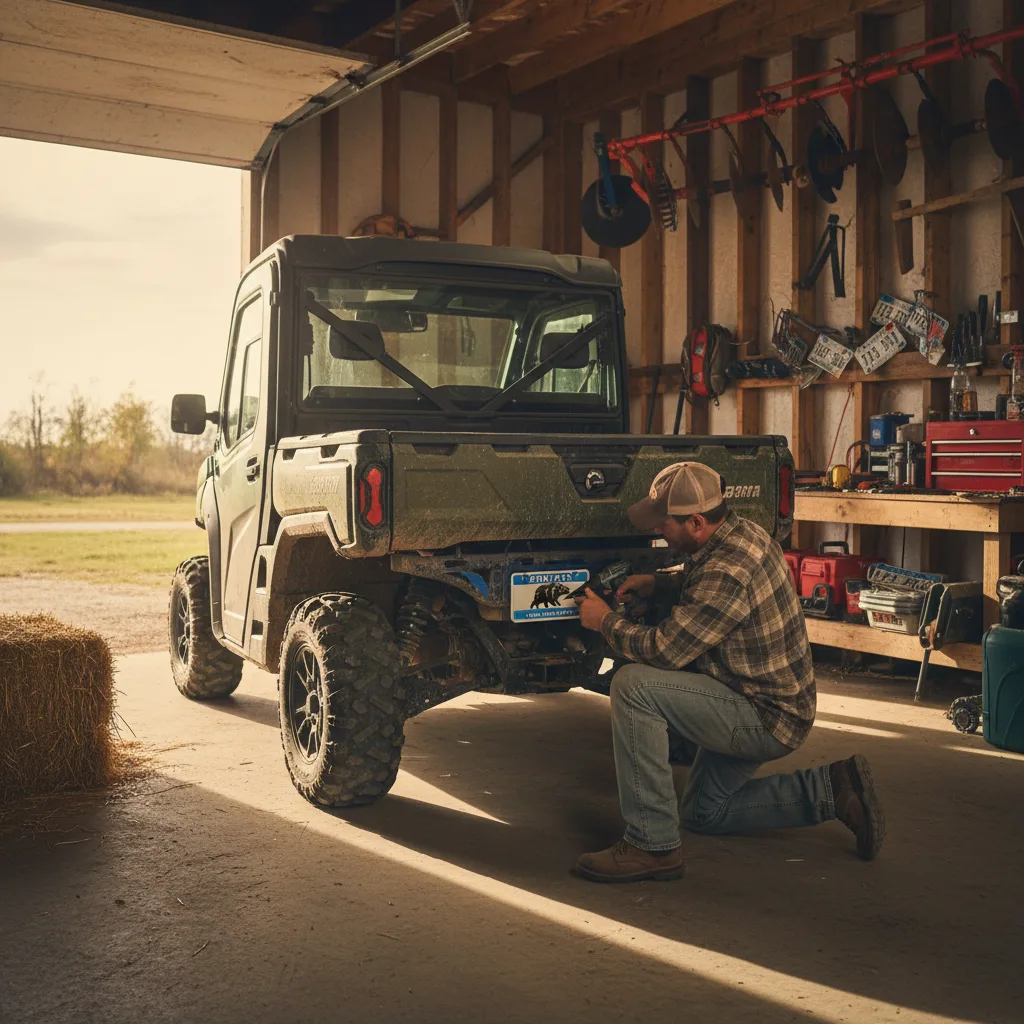
You form a Montana limited liability company. The LLC is a real legal entity, with a Montana registered agent, an EIN, and articles of organization on file with the Montana Secretary of State. The LLC, not you personally, becomes the owner of the UTV. The vehicle is titled in Montana, where there is no general sales tax on motor vehicle purchases. The Montana county treasurer issues a permanent plate, which under Montana law does not expire and does not require annual renewal for off-highway and certain qualifying vehicles. Idaho recognizes that out-of-state registration under standard reciprocity principles, the same way it recognizes a Washington-plated work truck or a Wyoming-plated trailer.
The cost is $749, total, one time. That breaks down as $549 for the full registration service, which includes title work, county treasurer filings, plate procurement, and shipping to your door, plus $200 for LLC formation through the Secretary of State. There is no $15-a-year sticker. There is no equipment compliance inspection. There is no state-mandated liability insurance requirement triggered by the registration itself. The plate is permanent. You are done.
No inspection. No annual renewal. No annual insurance requirement for road use. Just a permanent plate. Montana doesn’t run an OHV sticker program for vehicles titled in Montana that you ride out of state. The plate is the registration. There is no separate fee, no expiration date, and no recurring filing.
What you get when the process is complete: a Montana title in the name of your LLC, a Montana permanent plate, a registered agent address in Montana that handles state correspondence, and a clean ownership structure that you can reuse for the next UTV, the next motorhome, the next trailer, or the next vehicle entirely. The LLC is the asset. The plates ride with the vehicles inside it.
Case Studies
1. Boise tech professional, $45K Can-Am X3 MAX Turbo RR

The buyer is a senior engineer at a Boise-based software company. He commutes to a downtown office two days a week and works remotely the rest. The UTV is his weekend reset button. He rides the Boise National Forest network most Saturdays in summer, then makes the four-hour drive to St. Anthony Sand Dunes twice a year, usually a long weekend in May before the spring deer migration and one in late September before the snow line drops. The X3 MAX Turbo RR is the four-seat version because his wife and two teenage daughters come along on the Sand Dunes trips. He bought new from a Boise dealer at $45,000 out the door, before tax.
The Idaho path: $2,700 sales tax at signing, plus $75 in OHV and restricted plate fees across five years. Total: $2,775. Plus annual liability insurance, plus equipment inspection time, plus the $15 renewal he has to remember every January. The Montana path: $749 once. Net five-year savings, $2,026. Across the seven-year horizon he actually expects to keep this machine before trading up, savings grow to $2,131. He told us during onboarding that he had been about to sign the dealer purchase order when a friend in Coeur d’Alene mentioned the LLC. The friend had gone Montana three years earlier on a Polaris Pro XP. He pulled out of the dealership, made the call, and we had his plates seven days later.
2. Coeur d’Alene outdoors family, $35K Can-Am Defender MAX
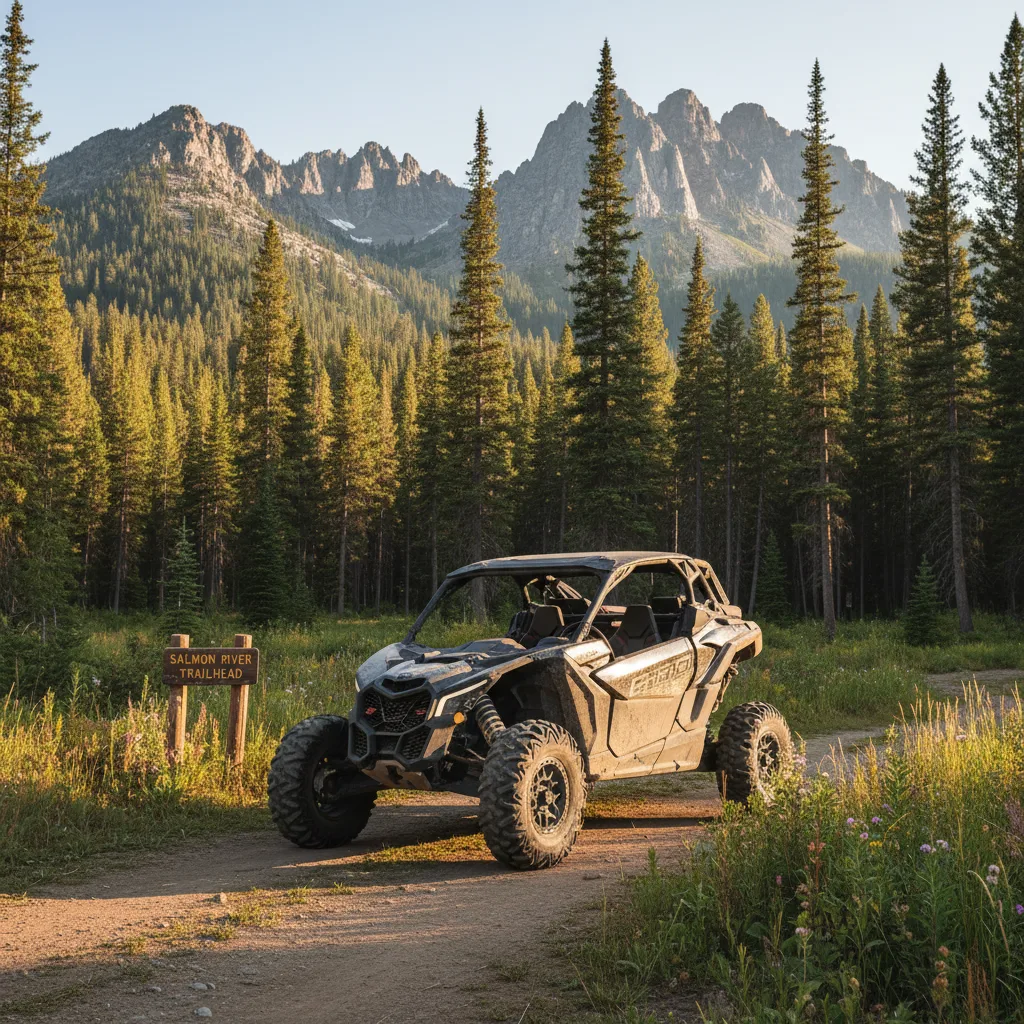
This buyer runs a small construction firm in Coeur d’Alene. He hunts elk in the Clearwater National Forest every fall with his two adult sons, and the family takes long weekend camping trips into north Idaho’s backcountry through the summer. The Can-Am Defender MAX HD10 Lone Star edition is the do-everything vehicle. Six-seat configuration for the grandkids, full bed, gun rack mount, winch. He paid $35,000 plus options out the door. The Defender’s job description includes hauling spike camp gear up logging roads, pulling a meat trailer out of dark timber after a successful hunt, and ferrying his wife and grandkids around the family cabin property north of Sandpoint.
The Idaho path: $2,100 in sales tax, $75 in five-year OHV and restricted plate fees, total $2,175. Plus the liability insurance he’s required to carry to ride county roads to the trailheads. The Montana path: $749. Net five-year savings, $1,426. Because he plans to keep this Defender for the full 12 to 15 years he typically gets out of work-class side-by-sides, the lifetime delta is closer to $1,600 in pure fee-and-tax terms, before insurance and inspection time. He told us he had originally assumed the agricultural sales tax exemption would apply because the Defender does occasional fence work and trail clearing on his property. We had to confirm what his accountant had already told him: Idaho specifically excludes ATVs and UTVs from the ag exemption. Even at 100% farm use, you pay 6%.
3. Twin Falls family, $25K Polaris Ranger XP 1000
The third case is a Twin Falls family of four with a $25,000 Polaris Ranger XP 1000 NorthStar Edition. Heated cab, full doors, the works. They ride the South Hills almost every weekend from June through October. The 40-minute drive from Twin Falls to the Cassia Division trailheads makes it a half-day trip rather than a weekend expedition. Once or twice a year they trailer the Ranger east to St. Anthony for a long weekend. The wife uses the Ranger for chore work around their five-acre property north of town the rest of the time, hauling hay for two horses and three goats.
The Idaho path: $1,500 in sales tax, $75 in five-year fees, $1,575 total. The Montana path: $749. Net five-year savings, $826. They told us during the initial call that the $826 sounded like a modest win until they realized they would have to renew the OHV sticker and the restricted plate every January for as long as they owned the Ranger, on top of carrying liability insurance for any time they were on a county road between the property and the trailhead. The mental friction of one more annual renewal on a list that already includes vehicle registration, hunting licenses, and ATV stickers was as much of a sell as the dollar savings. They went Montana and the plates arrived a week later.
4. Idaho Falls entry buyer, $15K Polaris Trail 450
The fourth case is the one that trips most people up. An Idaho Falls buyer, retired federal employee, bought a $15,000 Polaris Trail 450 as a first machine for his grandson to ride with him on day trips into Sawtooth and St. Anthony. He almost didn’t bother with Montana. The dollar savings on a $15K machine looked too thin to justify the effort. $900 in sales tax, $75 in five-year fees, $975 total Idaho, versus $749 Montana, for a net of $226 over five years. He told us he initially thought Montana only made sense for premium machines.
What changed his mind was running the numbers past year five. The Trail 450 is the kind of machine you keep, hand down to family, or sell for parts a decade out. At year 10 the Idaho total is $1,050. At year 15, $1,125. The Montana total stays at $749 forever. The permanent plate compounds. By year 10 he saves $301, by year 15 he saves $376, and that is before counting the OHV-sticker friction of remembering a January renewal for 15 straight years. He also realized the LLC was reusable. When he replaces his Class C motorhome in two or three years, the same Montana entity will own that too. The fixed $200 LLC setup gets amortized across multiple vehicles. He pulled the trigger. The plate arrived in a week.
Is This Legal?

Yes. The structure is LLC law combined with standard interstate vehicle reciprocity. The Montana LLC owns the vehicle. The vehicle is titled and registered in Montana. Idaho, like every other state, recognizes valid out-of-state vehicle registration when that vehicle is operated in Idaho. This is the same principle that lets a Washington-plated work truck cross into Coeur d’Alene every day, or a Wyoming-plated cattle trailer run between Cody and Boise without re-registering.
The case law on out-of-state LLC vehicle ownership is well-settled. Thomas v. Bridges, the Louisiana Supreme Court decision in 2013 that put much of the existing case law on solid footing, confirmed that an LLC formed in one state and operating a vehicle through interstate reciprocity is a valid arrangement that does not constitute tax evasion. The LLC must be a real entity. It must have real filings. It must have a real registered agent. It must have an EIN if the operating structure calls for one. We handle all of that as part of the $749 fee. None of it is paperwork theater. Every piece is a substantive filing with the Montana Secretary of State, the IRS, and the Montana Department of Justice for the vehicle title transfer.
What makes this work in Idaho specifically is § 49-402(4) and the broader Idaho Transportation Department reciprocity framework, which honors out-of-state plates on vehicles whose registered owner is domiciled out of state. Your Montana LLC is the registered owner, and the LLC’s principal office address is in Montana. The vehicle inherits the LLC’s domicile for registration purposes. Idaho residents driving Idaho-titled vehicles owe Idaho registration. Idaho residents driving Montana-LLC-titled vehicles owe Montana registration, which was paid up front and which Montana does not renew annually for a permanent OHV plate.
Who This Is Built For
The Montana structure fits a specific set of Idaho buyers. Here’s who gets the most out of it.
Boise-area buyers writing checks for $25,000-plus machines. Once you cross the $25K threshold, the math gets undeniable. $826 in net savings on a mid-range Ranger over five years. $1,426 on a Defender. $2,026 on an X3. The $749 LLC cost recovers in the sales tax alone, and the permanent plate compounds for as long as you own the vehicle.
Northern Idaho hunters and outdoor families. If your UTV is part of your fall hunting strategy, your summer camping operation, and your overall outdoor identity, you’re keeping it 10 to 15 years. The longer the holding period, the more the permanent plate matters relative to Idaho’s annual $15 sticker. Coeur d’Alene, Sandpoint, and Bonners Ferry buyers consistently see the strongest ROI.
Agricultural operations buying Defender, Ranger, or Pioneer class machines. The Idaho ag exemption will not save you 6% at purchase. Side-by-sides are excluded. Montana is the only structural alternative that removes the sales tax from the equation entirely. If your operation already runs other equipment through pass-through entities, adding a UTV LLC fits naturally into the existing structure.
Families who plan to upgrade in 5 to 7 years. The LLC is reusable. When you trade up from the Ranger to the X3, or when the kids age out of the Trail 450 and you replace it with something faster, the same Montana entity owns the new machine. The $200 LLC formation cost amortizes across every vehicle that ever passes through it.
Multi-machine owners. One LLC, multiple titles, multiple permanent plates. The marginal cost of adding the second UTV, the trailer, the motorhome, or the boat is $549 each, with no additional LLC fee. The fixed overhead disappears across a fleet.
Anyone who hasn’t signed yet. The single most actionable moment is before the dealer collects the 6%. Once the sales tax is paid to Idaho, you cannot retroactively refund it through a Montana retitling. You can still go Montana with an Idaho-titled vehicle, but the calculus changes. Call before you sign. If you’re on the fence about whether the math works for your specific machine, we’ll run the numbers for free.
Our Process
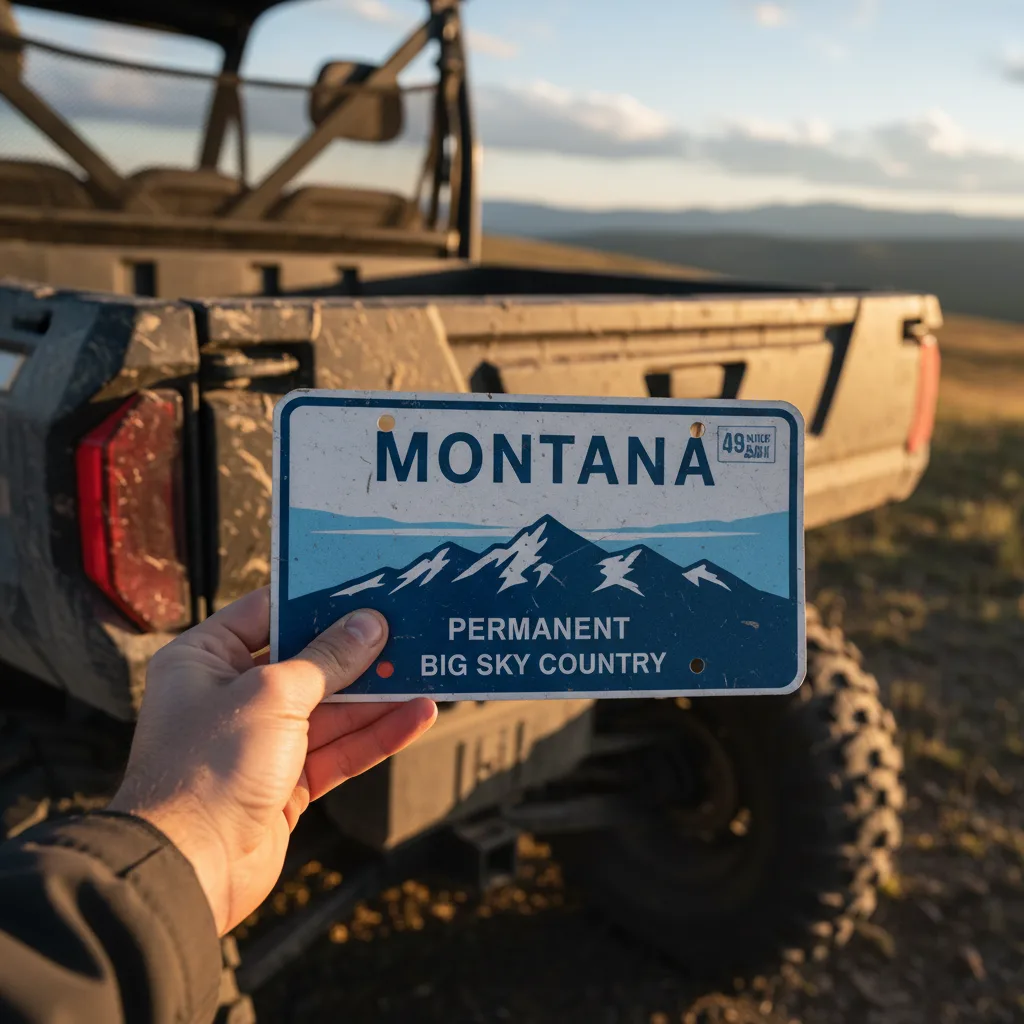
Full-service means we do every step. You provide the vehicle information, the purchase documents, and a signed agency form. We do the rest. LLC formation in Montana, EIN application, registered agent setup, title transfer through the appropriate Montana county treasurer’s office, plate procurement, and shipped delivery to your Idaho address. The $749 fee is fixed and covers everything end to end. There are no surprise costs, no add-ons, no recurring charges after delivery beyond a small annual LLC maintenance filing in subsequent years, which we handle for you at a transparent rate.
You don’t fly to Montana. You don’t visit a county courthouse. You don’t stand in line at a DMV. You hand us the paperwork on the front end and the plate arrives at your door on the back end. The work in the middle is administrative, well-documented, and we do it every day for clients across all 50 states.
Timeline: Day 1 to Permanent Plates
| Day 1: | You submit paperwork through our intake. Your LLC is filed with the Montana Secretary of State the same day. EIN application goes to the IRS in parallel. |
| Days 1–2: | LLC formation completes. Registered agent activated. EIN typically issued within 24 hours. Title paperwork prepared for Montana county treasurer. |
| Days 2–4: | Vehicle title transferred at the Montana county treasurer’s office. Permanent plate issued in the name of the LLC. |
| Days 4–7: | Permanent plates and title shipped to your Idaho address. You install the plate. You ride. |
Seven days is the standard window from intake to plates in hand. Occasionally it runs faster. Occasionally a county treasurer’s calendar pushes it a day or two. We tell you upfront if there’s any reason your specific timeline will be different.
FAQs
1. Does Montana registration satisfy Idaho’s street-legal requirements?
Idaho recognizes valid out-of-state registration under standard interstate reciprocity. A Montana-plated UTV operated in Idaho is treated like any other out-of-state-registered vehicle traveling through or based in Idaho. Idaho residents are required to re-register vehicles within 90 days of establishing residency, but if the Montana LLC owns the vehicle and the LLC is the registered owner, you are not claiming Idaho residency on the vehicle itself. The LLC is domiciled in Montana. The vehicle inherits that domicile. The Montana plate is the registration.
2. Do I still need the Idaho OHV sticker?
The Idaho OHV certificate of number is tied to use on public lands within Idaho, not to vehicle registration. If you ride BLM or Forest Service land in Idaho, the operator is responsible for OHV stickers under § 67-7122 regardless of where the vehicle is registered. That’s separate from the registration question. The Montana plate replaces Idaho’s restricted vehicle license plate requirement. The OHV sticker for public-land access remains a separate operator-side fee if you ride on public Idaho lands. We tell every client this directly: Montana solves registration. Land-use stickers are a different system.
3. Is liability insurance required with a Montana plate?
Montana does not impose Idaho’s specific $25K/$50K/$15K liability minimums as a registration condition. That said, we always recommend appropriate liability coverage for any vehicle that touches a public road, including UTVs. The Montana plate doesn’t trigger Idaho’s mandatory insurance verification at registration, but reasonable commercial-line or personal-line coverage is standard risk management. Your insurance agent can quote a Montana-titled UTV the same way as any other titled vehicle.
4. How long does the process take?
Seven days from intake to plates in hand is the standard timeline. Day 1 we file your LLC. Days 1 through 2, formation completes and EIN issues. Days 2 through 4, title transfers at the Montana county treasurer. Days 4 through 7, plates ship to your Idaho address. Some clients see it move faster. We will tell you upfront if anything specific to your file will push the schedule.
5. What happens at renewal?
For a Montana permanent plate on an off-highway vehicle, there is no renewal in the traditional sense. The plate doesn’t expire. The LLC itself has a small annual maintenance filing with the Montana Secretary of State, which we handle on your behalf. You do not need to remember a January 1 deadline. You do not get a renewal notice that arrives with a $15 charge. The plate stays on the vehicle as long as the LLC owns it.
6. Can I retitle a UTV I already bought in Idaho?
Yes. If you’ve already paid Idaho 6% sales tax, the bad news is you cannot recover that payment through a Montana retitling. The good news is the permanent plate still pays off across the remaining ownership horizon. We routinely retitle existing Idaho-owned UTVs into Montana LLCs. The process is the same; only the upstream sales tax sunk cost differs. Call us before you sign on the next machine.
7. Is the LLC reusable for future vehicles?
Yes, and this is one of the features most clients don’t think about until they’re adding a second vehicle. One LLC can own multiple vehicles. Add a motorhome next year, a trailer the year after, a second UTV when the kids age up. Each additional vehicle adds the $549 registration service fee, but you do not pay the $200 LLC formation fee again. The fixed overhead disappears across a multi-vehicle fleet.
8. What about insurance?
Your existing insurance carrier will write coverage on a Montana-LLC-titled vehicle the same way they write coverage on a personally-titled one. The named insured changes from you personally to the LLC, with you as the operator. Most carriers handle this routinely. We can recommend brokers experienced with this structure if your current carrier balks. The premium does not materially change because of the titling structure; rate is driven by vehicle value, operator history, and use, not by the legal owner’s name.
See how Montana LLC registration helps off-road and vehicle owners in other states:
- Utah ATV & UTV Registration 2026: Sales Tax, Street-Legal Rules, and the Montana Fix
- Texas ATV & UTV Registration 2026: The Sales Tax Trap and the Street-Legal Loophole
- Arizona Vehicle Tax: How to Stop Paying $1,000 Every Year
Idaho Has the Trails. Montana Has the Plate.
Idaho is home to St. Anthony Sand Dunes, the Sawtooth OHV system, and some of the best mountain riding in the Northwest. You don’t need to pay 6% sales tax and $15/year in renewal fees to access any of it. Montana LLC registration is $749 once. Permanent plate. About a week to your door.