
25 min read
On this page
- + The NADA Trap
- + How Oklahoma Vehicle Tax Actually Works
- + What It Costs: Real Numbers by Vehicle Type
- + The NADA Problem Explained
- + Case Studies: Four Oklahoma Owners
- + How Montana LLC Eliminates the Tax
- + Is This Legal?
- + Who Benefits Most
- + Zero Tax Tags Process
- + Timeline: Day 1 to Day 7
- + Who This Is Built For
- + FAQs
- + Final Step
The NADA Trap

The oklahoma vehicle tax is a magic trick. You buy a car. You pay the price you negotiated. Then the state shows up at the title office and says the car is actually worth more than you paid, and you owe tax on the higher number. That is not a glitch. That is the system, written into law, and Oklahoma has been running it on residents for decades.
Here is what happens at the counter. You roll up to Service Oklahoma with a bill of sale showing $40,000 for a used SUV. The clerk pulls up the NADA average retail value and it says $44,000. You owe 4.5% on $44,000, not $40,000. The extra $180 in tax is on income you never received, on a value you do not actually own, on a sale that did not happen at that price. Welcome to Oklahoma.
The legislature finally noticed how absurd this is. House Bill 1183, signed May 22, 2025, eliminates the NADA adjustment scheme. Starting July 1, 2026, tax will be calculated on the actual sales price like every other normal state. But it is not July 2026 yet. Right now, today, this week, every used vehicle transaction in Oklahoma is still being taxed on a number a private valuation company in McLean, Virginia decided your car is worth. And new vehicles are taxed on full sticker, no matter what you actually paid.
The combined rate is 4.5%, which sounds modest until you do the math on a $75,000 BMW or a $180,000 motorhome. The state takes its cut, and then keeps taking it through registration fees that ride along behind the purchase tax for the next two decades of ownership.
This article walks through exactly how the oklahoma vehicle tax is structured, why the NADA system has been quietly inflating bills for years, what a Montana LLC registration actually does, and how four different Oklahoma owners would come out the other side. There is real math, real case studies, and an honest section on where the savings are small versus where they are gigantic.
How Oklahoma Vehicle Tax Actually Works
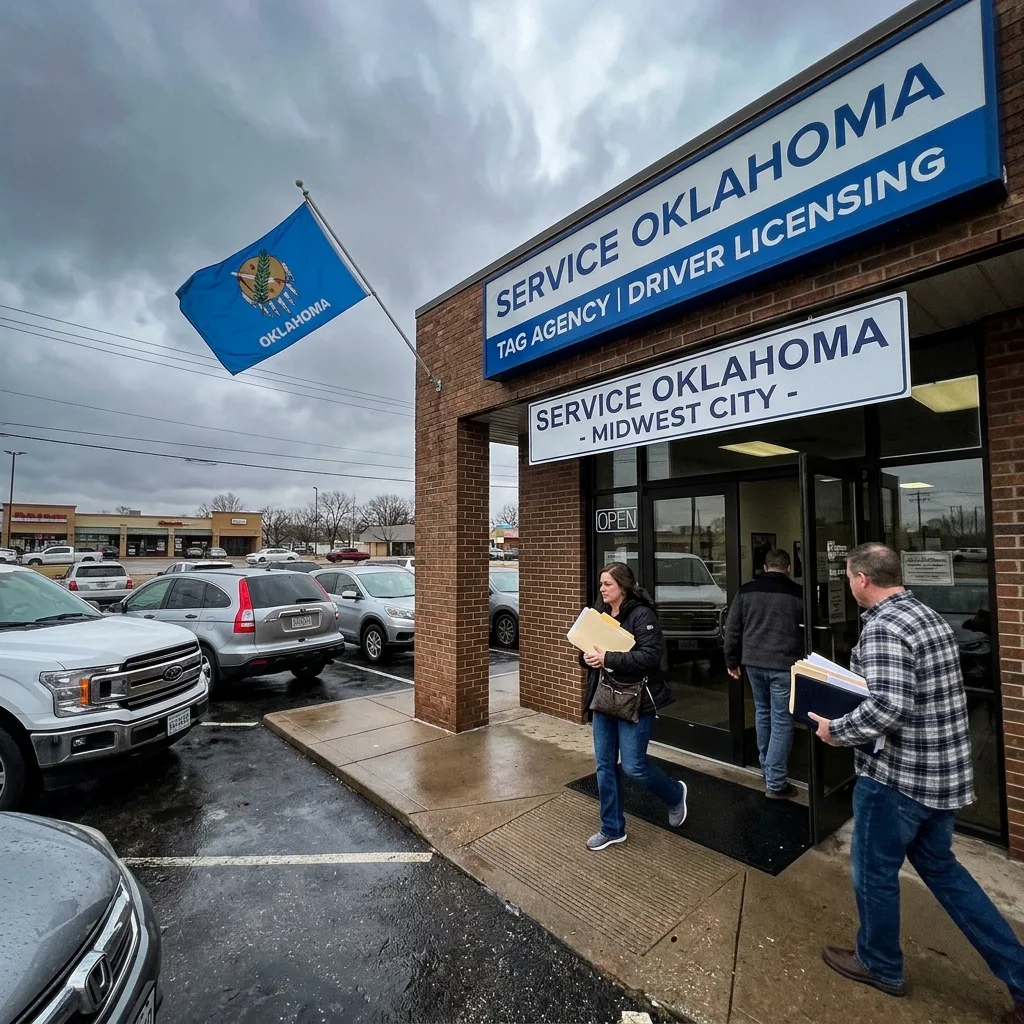
The oklahoma vehicle tax at point of purchase is two stacked taxes that act like one. There is a 3.25% excise tax and a 1.25% sales tax, which together come to 4.5% of the assessed value. Both apply at the title transfer, both are collected by Service Oklahoma, and both are calculated against the same number: the NADA average retail value for used vehicles, or the actual sales price for new ones if there is no NADA listing yet.
There is no county tax layer. Oklahoma is unusual in that respect. Most southern states pile a county or municipal rate on top, but Oklahoma collects uniformly statewide. That is the closest thing to good news in this entire system.
After the purchase tax, you owe an annual registration fee. The fee is flat and age-based, structured so newer vehicles pay more and older vehicles pay less:
Stacked on top of the registration fee is a $11 title fee and a $17 owner transfer fee at purchase, plus a $1.50 insurance verification fee. Small individually, but they add up across a household with three or four vehicles.
Miss the registration deadline and the late penalty is $1 per day starting on day 31, capped at $100. That cap is hit at exactly 100 days late, after which the meter stops but your tag is still expired and the next traffic stop becomes a much bigger problem.
The trade-in trap: Oklahoma offers no trade-in tax credit. If you trade a $30,000 truck toward a $75,000 SUV, you still owe 4.5% on the full $75,000 NADA value, not on the $45,000 difference. Texas, Kansas, and most surrounding states give you the credit. Oklahoma does not.
Then there are the EV surcharges. Under the DRIVE Act (Title 68, Section 6511), effective January 1, 2024, electric vehicle owners pay an additional annual fee on top of the standard registration. A Tesla Model Y under 6,000 pounds pays $110 per year. A Rivian or Hummer EV in the 6,001 to 10,000 pound bracket pays $158 per year. Anything 10,001 pounds and up pays $363 per year. Plug-in hybrids pay 75% of the BEV rate for their weight class. The state’s own data shows EVs are a fraction of total registrations, but the fees are calculated as if they have somehow uniquely escaped paying for roads.
About the roads, though. Oklahoma’s revenue distribution for vehicle excise and sales tax sends 36% to schools, 35% to local governments, and 25% to the state general fund. Roads get the leftovers. So the next time someone tells you EV owners need to pay their fair share of pavement, ask them where the other 96% of vehicle tax revenue goes.
What It Costs: Real Numbers by Vehicle Type
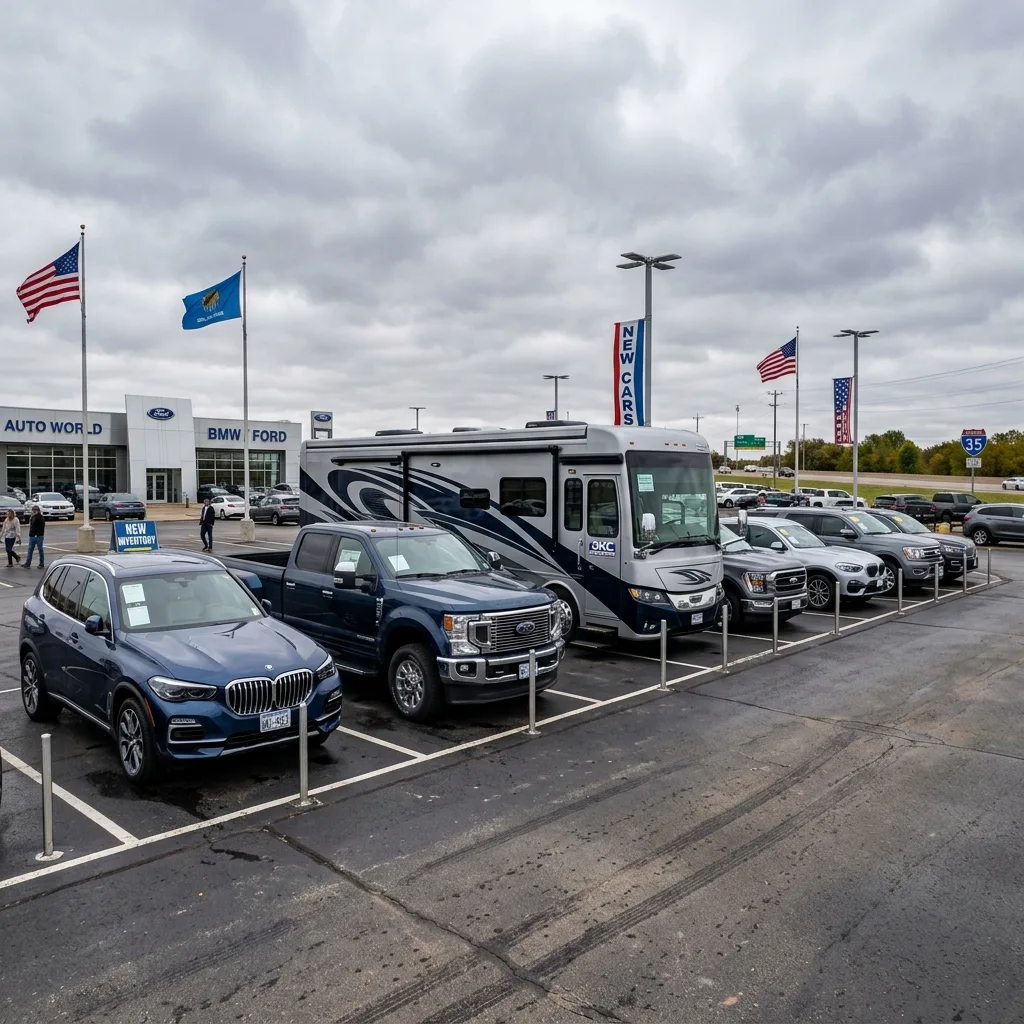
Percentages are easy to dismiss. Dollar figures are harder to wave away. Here is what the oklahoma vehicle tax actually costs across five years of ownership on common vehicle types Oklahoma residents buy.
Now the same vehicles registered through a Montana LLC using Zero Tax Tags:
Pay attention to the Tesla row. The savings on an EV are modest, around $641 over five years. We list it here because hiding numbers would be dishonest. Montana charges a $130 annual BEV surcharge, so the Montana side of the ledger goes up too. The Montana route still wins on an EV, but the win is small. On a motorhome, the win is more than $5,000. Match the strategy to the vehicle.
The headline math: a typical Oklahoma luxury SUV buyer is paying more in upfront tax than the entire five-year Montana LLC cost. The state takes $3,375 the day you sign the paperwork. Montana, through Zero Tax Tags, takes $899 the first year and $270 per year after that, total $1,979 across five years. The Oklahoma purchase tax alone exceeds the entire Montana lifecycle.
The NADA Problem Explained

NADA stands for the National Automobile Dealers Association, and its used vehicle pricing guide has been the bible of the dealer trade since 1933. It is a private publication. It is not a government valuation. It is a market index assembled from auction data, retail observations, and proprietary algorithms run by J.D. Power, which acquired the guide in 2015.
Oklahoma’s tax code instructs Service Oklahoma to use the NADA average retail value to compute excise tax on used vehicles. The legislature wrote that into statute because in 1985 it seemed reasonable. There was no real-time pricing data, no Carfax history reports for every transaction, no Manheim auction feeds, no online marketplaces. NADA was the only widely accepted reference. So the state plugged it in.
Forty years later, the world has private-party transactions visible on AutoTrader, CarGurus, Facebook Marketplace, and dozens of other platforms. Real prices are easier to verify than NADA estimates. But the statute still points to NADA, so the statute still controls.
The problem is structural. NADA “average retail” is what a clean, dealer-prepped vehicle should sell for from a franchised lot with a warranty and detailing. Private-party sales are almost always below that. So whenever an Oklahoman buys a used vehicle from a neighbor, an estate sale, an auction, or any non-dealer source, the assessed tax value is systematically higher than what they paid.
A 2022 used Tahoe sells private-party for $42,000 in Tulsa. NADA average retail is $46,500. The tax is 4.5% of $46,500, not $42,000. The Oklahoman pays an extra $202 in tax on $4,500 of phantom value they never received and a car they would not buy at NADA price in the first place.
HB 1183 changes this, but not until July 1, 2026. The bill was signed May 22, 2025, and it eliminates the NADA adjustment system. Going forward, tax will be computed on actual sales price. But every transaction between now and the effective date is still under the old rules. If you bought used last weekend, you got the NADA treatment.
And here is where the system gets quietly worse. NADA values for many vehicles, especially trucks, SUVs, and certain luxury cars, have been inflated by used-market shortages over the past several years. The guide reflects what dealers want to charge in a tight inventory environment. The state then taxes you against that high-water mark. The reform was overdue.
One more wrinkle for new vehicles. There is no NADA discount because the guide does not list current-model-year cars at their initial release. So new vehicles are taxed on the actual purchase price including options, freight, and prep. Trade-in is not deducted. Discount packages are not deducted. The full sticker, including the dealer documentation fee, is the tax base. Buy a $75,000 BMW X5 with a $200 doc fee and you pay 4.5% on $75,200.
Case Studies: Four Oklahoma Owners
Numbers in tables are abstract. Real owners are not. Here are four Oklahoma vehicle owners, all composites of clients Zero Tax Tags has worked with, walking through what the oklahoma vehicle tax took from them and what Montana registration changed.
Case Study 1: The Tulsa Physician and the BMW X5

Dr. Anika Patel is a forty-two-year-old cardiologist at a private practice off South Yale. She replaces her vehicle every four to five years and pays cash from a maintained brokerage account. In March, she ordered a 2024 BMW X5 xDrive40i with the M Sport package and a few options. Out-the-door price after dealer fees: $75,200.
At the Tulsa County Service Oklahoma counter, she paid 4.5% on the full purchase price: $3,384. Then a $96 first-year registration fee, $11 title, $17 transfer, $1.50 insurance verification. Total day-one government cost: $3,509.50.
Across five years she will pay roughly $470 in additional registration fees, putting her total Oklahoma cost at about $3,845.
If she had registered the same X5 through a Montana LLC using Zero Tax Tags, her year-one cost is $899 ($699 service plus $200 LLC formation), and years two through five are $270 each, for a five-year total of $1,979. Savings: $1,866. Enough to cover three months of her son’s private school tuition or the down payment on the boat she has been threatening to buy for two years.
Case Study 2: The OKC Retirees and the Tiffin Allegro Bus
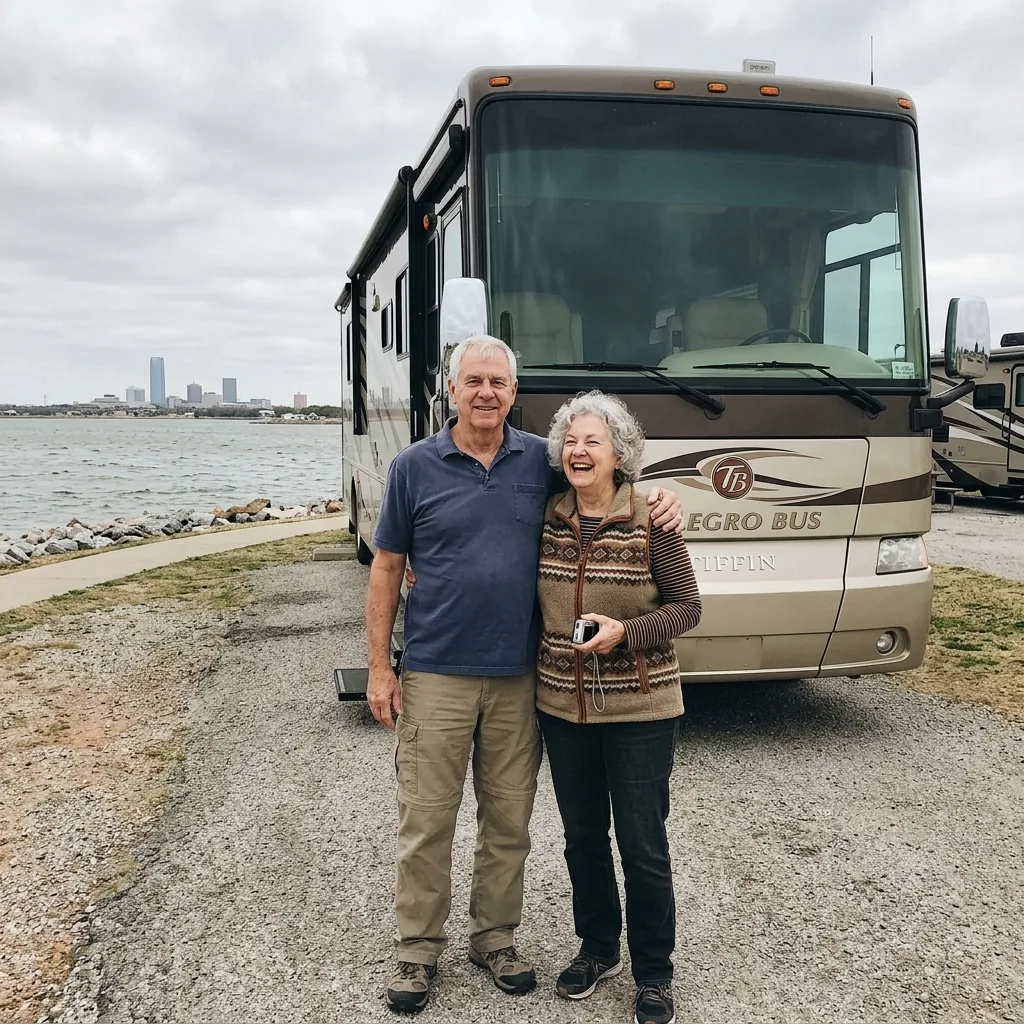
Mark and Diane Whitfield, both sixty-eight, retired from positions in the Oklahoma City energy sector and ordered a 2025 Tiffin Allegro Bus 40 IP, a 40-foot diesel-pusher Class A motorhome. Out-the-door price: $180,000. Their plan was the standard Oklahoma snowbird routine, six months in OKC, six months following the weather through Texas, Arizona, and Florida.
The Oklahoma County Service Oklahoma office collected 4.5% on the full $180,000 NADA value: $8,100. Plus the $470 of registration fees across five years and assorted transfer paperwork, their total Oklahoma cost projects to approximately $8,570.
Through Zero Tax Tags, the same motorhome registered in a Montana LLC costs $1,979 across five years. Savings: $6,591.
The Whitfields used the money to upgrade their satellite system, replace all six tires, and pay for a winter membership at a Phoenix-area resort. The math was not subtle. The state was charging them the cost of a luxury cruise to handle a registration that Montana would handle for a fraction of the price.
Case Study 3: The Edmond Contractor and the Two Trucks
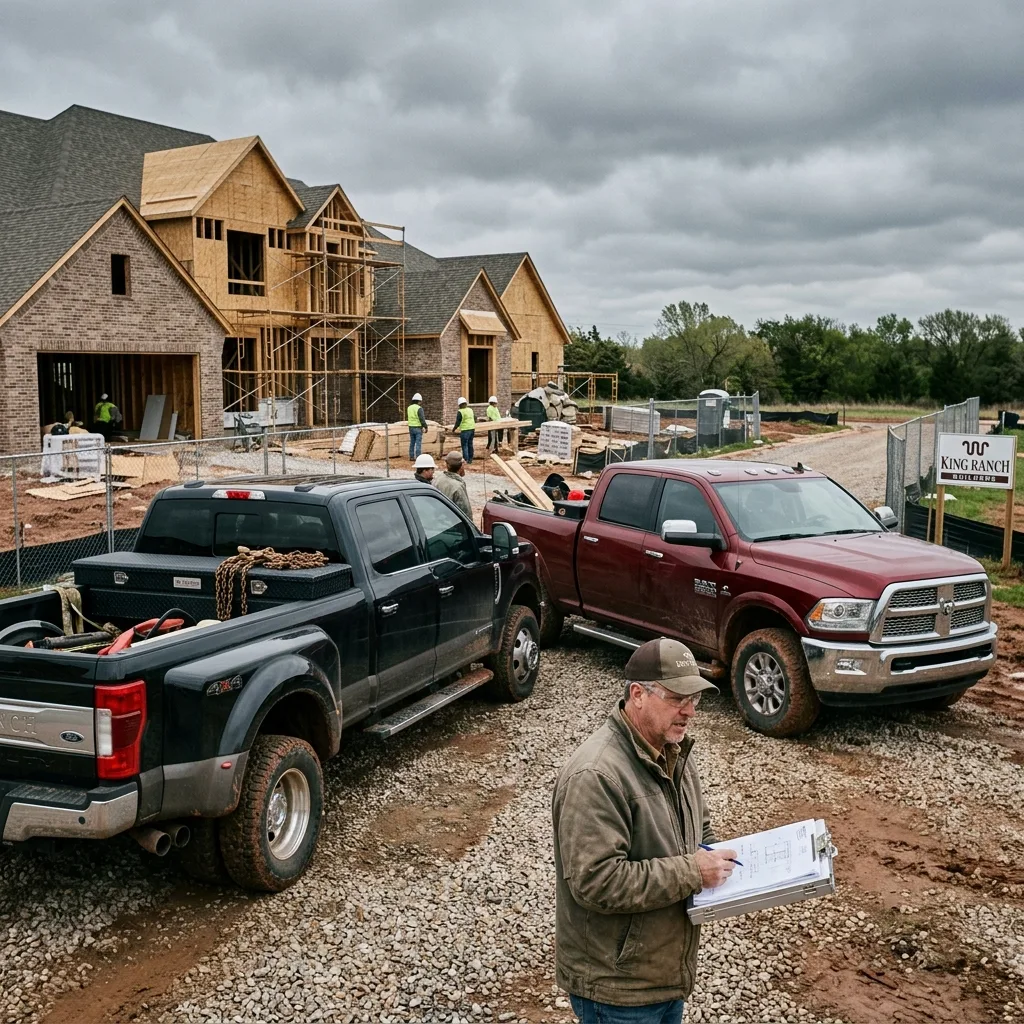
Brett Sandoval runs a custom home construction company in Edmond serving the upper end of the OKC metro market. He keeps two heavy-duty trucks in his fleet: a 2024 Ford F-350 King Ranch ($85,000 out-the-door) and a 2024 Ram 2500 Limited ($72,000 out-the-door). Both pull job-site trailers, both haul materials, both are essential to the business.
Oklahoma collected 4.5% on each at purchase: $3,825 on the F-350 and $3,240 on the Ram. Combined purchase tax: $7,065. Add five years of registration on both at roughly $470 each: $940. Total five-year Oklahoma cost for both trucks: about $8,005.
Brett moved both trucks under a single Montana LLC structure (the LLC can hold multiple vehicles). The five-year cost was $899 in year one for the LLC plus the first truck’s service, then $270 per year for the structure and an additional $270 annual filing for the second truck registration, putting his total cost across five years at roughly $3,500 for both vehicles combined. Savings: about $4,500 across the two trucks.
For a contractor, that is one more job site cleanup crew for a season, a tool inventory upgrade, or a quarterly tax payment funded.
Case Study 4: The Broken Arrow EV Owner
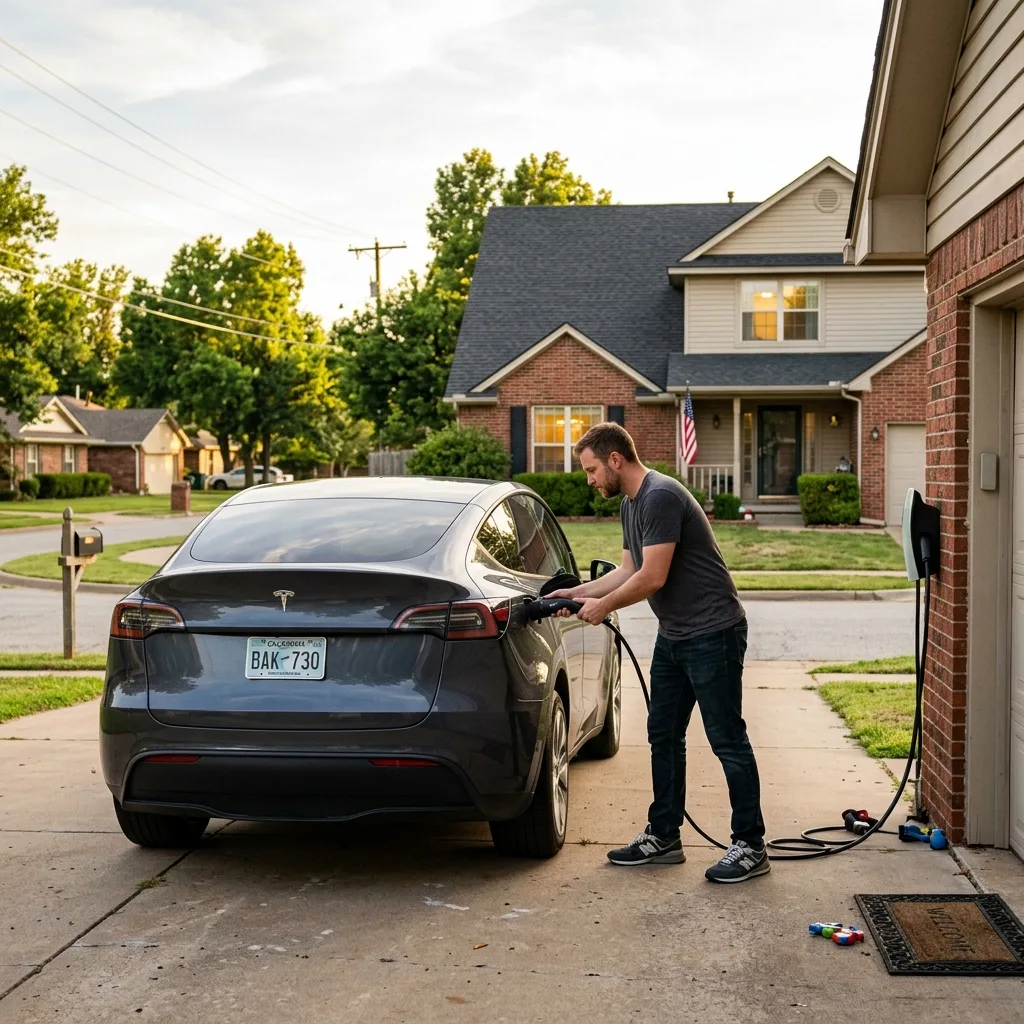
Justin Reyes works in healthcare IT and lives in a new build in Broken Arrow. He bought a 2024 Tesla Model Y Long Range, out-the-door $50,000. He drove off the lot proud of his fuel savings, and then the Oklahoma DRIVE Act surcharge hit.
Purchase tax of 4.5% on $50,000 came to $2,250. First-year registration: $96. EV surcharge: $110. Plus the $11 title, $17 transfer, $1.50 verification. Five-year EV surcharges total $550. Five-year registration adds another $470. Total Oklahoma cost: about $3,270.
Justin’s Montana route through Zero Tax Tags runs $1,979 over five years for service and registration, plus Montana’s own BEV surcharge of $130 per year. Across five years that adds $650. Total Montana cost: about $2,629. Savings: $641.
Modest. We know. Justin’s math on this was straightforward. He ran the numbers, saw that he saves $641 across five years, and decided that $641 still beats the alternative. He also liked that his Tesla is no longer caught in Oklahoma’s EV fee escalation, which has gone up twice since 2020 and shows no sign of stopping. The Montana surcharge has been flat. Every dollar saved is a dollar he did not hand the state to fund things that are not roads.
How Montana LLC Eliminates the Tax
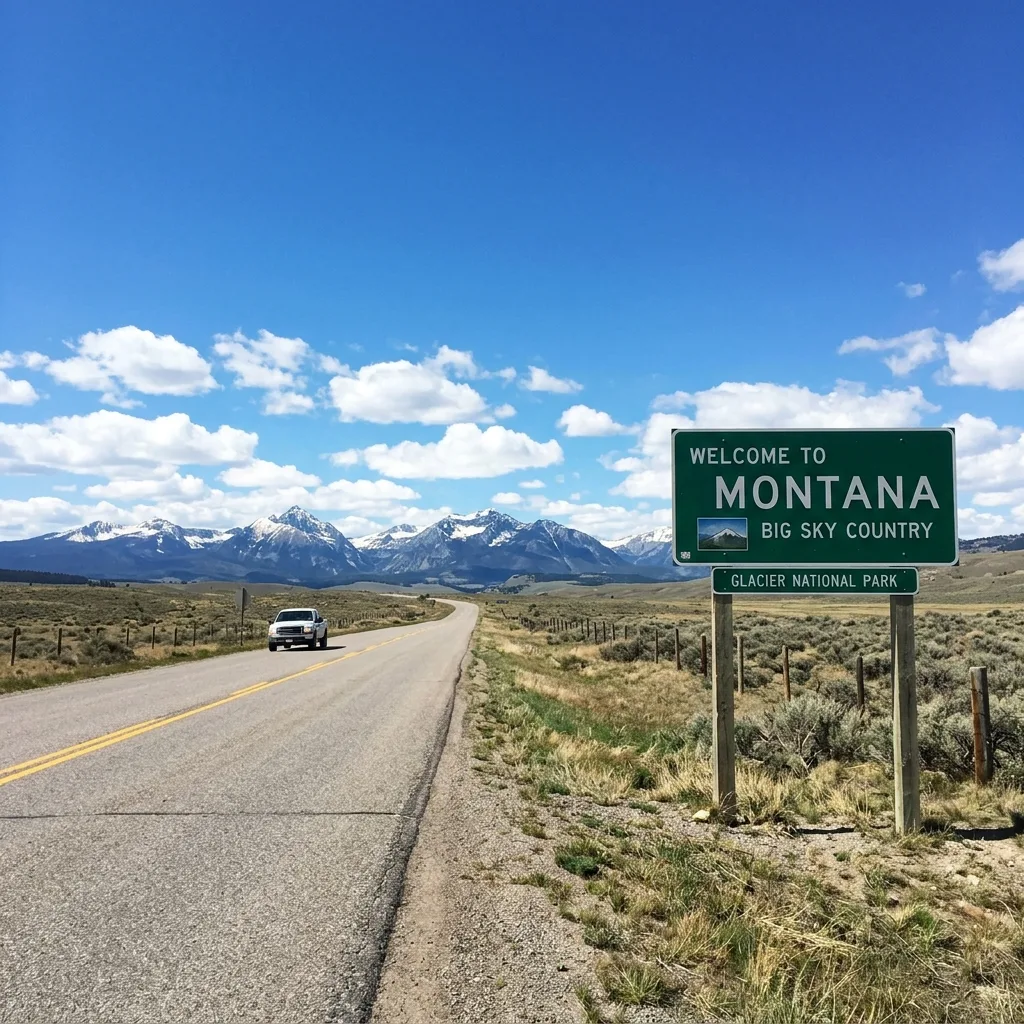
Montana does not have a state sales tax. Period. Not on cars, not on furniture, not on appliances. The state funds itself through income tax, federal land lease revenue, mining royalties, tourism, and a property tax structure that is unusual for the western United States. Vehicle registration is collected at the county level and is modest, typically $100 to $150 per year for standard passenger vehicles depending on the county.
This is not a loophole. This is Montana’s tax policy, set by the Montana legislature, applied to every vehicle titled in the state regardless of whether the owner is a third-generation rancher or a Limited Liability Company organized by an out-of-state member.
You form a Montana LLC. The LLC takes title to your vehicle, becoming the registered owner of record. The Montana county treasurer issues permanent plates, and the LLC owes Montana’s modest registration fee, not Oklahoma’s 4.5% excise plus annual fees.
You, the human, remain the manager and sole member of the LLC. You retain full control, full use, and full economic interest in the vehicle. The legal title sits with the LLC, not you personally.
Honest disclosure on Montana fees: Montana does charge an electric vehicle surcharge: $130 per year for BEVs under 6,000 pounds and $70 per year for plug-in hybrids. So the Montana side of the ledger is not zero for EV owners. We disclose this on the front page because the math should be transparent. Even with the Montana surcharge, EV owners still come out ahead, just by less than gas vehicle owners do.
The reason this works for Oklahoma residents in particular is that Oklahoma, like every other state, recognizes out-of-state vehicle registrations as valid. An Oklahoma police officer pulling over a Montana-plated vehicle has no probable cause to investigate further. The plates are real, the registration is real, the LLC is real, and the title trail at the Montana county clerk is real. There is nothing fake about the structure.
The savings come from one fact: the Oklahoma 4.5% excise and sales tax is owed only when a vehicle is titled in Oklahoma. If the vehicle is titled in Montana from the start, that tax is never triggered. The Oklahoma annual registration fee is also avoided because the vehicle is registered in Montana, not Oklahoma.
Is This Legal?

Yes. Here is why, in plain English.
The United States Constitution’s Commerce Clause and the Privileges and Immunities Clause guarantee citizens the right to organize businesses across state lines. A Montana LLC is a Montana legal entity, governed by Montana law, with rights and obligations the same as any other Montana business. There is no federal restriction on who may form an LLC in which state.
Tax minimization through lawful structure is a recognized right. The Louisiana Supreme Court ruled in Thomas v. Bridges (2014) that taxpayers are permitted to arrange their affairs to lawfully reduce taxes, and that doing so through a properly formed business entity is not evasion. The case dealt with an LLC structure used to manage vehicle ownership. The court affirmed the legitimacy of the arrangement.
The standard Zero Tax Tags client uses a Montana-registered vehicle for genuine multi-state travel: business mileage, second homes, RV trips, vacation properties, recreational use that spans state lines. That kind of multi-state operating profile is descriptive of the typical client, not a legal requirement, but it does fit with the use case Montana law was built to accommodate.
The Internal Revenue Service has not challenged Montana LLC vehicle structures as a category. State revenue departments, including Oklahoma’s, do not have jurisdiction over how a Montana LLC titles its property. The LLC pays Montana fees, follows Montana law, and operates within the framework of Montana’s choice not to impose a sales tax on vehicles.
Zero Tax Tags works exclusively within these legal parameters. The LLC is real, registered with the Montana Secretary of State, with a real registered agent and a real operating agreement. The title transfer is recorded with a real Montana county treasurer. The plate is issued by Montana, not printed in a basement.
Bottom line: Forming a Montana LLC and titling a vehicle in that LLC’s name is legal under federal law and Montana law. Oklahoma has no statute prohibiting Oklahoma residents from being members of out-of-state LLCs or driving vehicles owned by those LLCs.
Who Benefits Most
Not every vehicle purchase is a good candidate for Montana registration. The savings scale with purchase price and vehicle category.
Doctors, lawyers, energy executives, and business owners in the Tulsa and OKC metros are the highest-frequency clients. On a $75,000 to $100,000 luxury SUV, the savings typically run $1,800 to $3,000 across five years. The Zero Tax Tags fee pays for itself in year one.
RV and motorhome owners are where the math gets dramatic. A $150,000 Class A motorhome carries $6,750 in Oklahoma purchase tax. A $250,000 diesel coach carries $11,250. Montana savings on motorhomes routinely exceed $5,000 across five years. If you are an Oklahoma snowbird with a coach, you are leaving four to five figures on the table every ownership cycle.
Collector and exotic car owners face a specific problem: inflated NADA values on vehicles that spend most of the year in a garage. A Porsche 911, a restored Bronco, a Land Rover Defender all carry book values that have nothing to do with what you paid or how often you drive it. Montana registration removes the punitive purchase tax and the annual cost on vehicles that may only see road use a few weekends a year.
Small fleets and contractors. Three trucks, two trailers, a service van. A single Montana LLC can hold multiple vehicles. Contractors in Edmond, Norman, Stillwater, and the Tulsa metro who run two or three work vehicles see savings approaching five figures across the fleet.
EV owners frustrated by surcharge stacking. The Oklahoma DRIVE Act surcharge has only one direction it can go. Montana’s BEV fee has been flat at $130. The savings on an individual EV are modest, but the predictability of the Montana fee structure has real value when you are budgeting for a vehicle you plan to own for eight or ten years.
Anyone buying used right now. The HB 1183 reform does not take effect until July 2026. Every used transaction between now and then is still under the old NADA system, meaning you owe tax on a number you did not pay and may never have agreed to. Montana registration sidesteps that calculation entirely.
Snowbirds and dual-residence households. Oklahomans with second homes in Arizona, Texas, Colorado, or Florida split time across states. The vehicle is in motion. Montana registration is the cleanest match for a multi-state ownership pattern.
Zero Tax Tags Process
The Zero Tax Tags process is built to handle every step of the Montana LLC and registration workflow without requiring you to travel, mail original documents to strangers, or deal with state offices directly.
Step one is the secure client portal. You upload your driver’s license, vehicle information, and purchase documentation. Our team reviews everything for completeness, drafts the Montana LLC formation documents, and prepares the title transfer paperwork.
Step two is LLC formation. We file the Articles of Organization with the Montana Secretary of State. Most filings complete the same business day. The LLC operating agreement is prepared, the Employer Identification Number is obtained from the IRS, and a registered agent is assigned within Montana.
Step three is title transfer. The vehicle is titled in the LLC’s name at the Montana county treasurer of record. This is where the Oklahoma tax obligation is bypassed: the vehicle never enters the Oklahoma title system.
Step four is plate issuance. Montana issues permanent plates that ship directly to your address. No annual sticker, no renewal trip, no in-person visit required for the typical client.
The flat pricing structure: Year 1 is $899, which covers the $699 service fee plus the $200 Montana LLC formation cost. Years 2 onward are $270 per year, covering the $150 Montana registration fee and the $120 annual LLC filing. Five-year total: $1,979.
The price quoted is the price paid. No hidden charges, no upcharges by vehicle value.
Timeline: Day 1 to Day 7
| Day 1: | Submit paperwork through Zero Tax Tags secure portal. We review for completeness and file your Montana LLC the same day. |
| Days 1-2: | Montana LLC formation complete — same business day in most cases, second business day at the latest. |
| Days 2-4: | Title transferred into the LLC name at the Montana county treasurer. |
| Days 4-7: | Permanent Montana plates shipped directly to your door within 3-5 business days of title completion. |
Start to finish, about one week from submission to plates in hand. The slowest part is the postal service. Everything we control on our end is typically wrapped in 48 hours.
Who This Is Built For
This service is built for Oklahomans who refuse to pay tax on phantom NADA values, who plan to keep their vehicles long enough that the savings compound, and who want the same registration setup that thousands of high-net-worth households across the country already use.
If you are a Tulsa or OKC professional buying a vehicle in the $60,000-plus range, start here. The Oklahoma 4.5% on a single luxury SUV exceeds your entire five-year Montana cost. You recover the Zero Tax Tags fee in the first transaction and pocket savings for years two through five.
RV owners, motorhome buyers, and fifth-wheel haulers are among our most frequent callers, and the reason is obvious once you run the numbers. The Tiffin, Newmar, Foretravel, and Entegra coaches Oklahomans love come with five-figure Oklahoma tax bills. Montana registration is purpose-built for owners with multi-state travel patterns.
If you own a Porsche, Ferrari, Land Rover Defender, restored truck, or vintage muscle car, you are getting hit twice: inflated NADA values and an annual registration fee on a vehicle you may drive fifty weekends a year. Montana treats these vehicles the way they actually function: occasional-use property with a registration cost to match.
If you run a small fleet, a contracting business, or a real estate operation with multiple vehicles, a single Montana LLC can hold all of them. The cost-per-vehicle drops as the structure scales. Edmond and Norman contractors with two or three trucks typically see savings approaching five figures across the fleet.
EV owners have a reasonable gripe. Oklahoma’s DRIVE Act surcharge has gone up twice since 2020. Montana’s BEV fee has been flat at $130 for years. The dollar savings on an individual EV are modest, but the predictability is worth something when you are planning an eight-year ownership cycle.
If you bought or are about to buy a used vehicle where NADA exceeds your purchase price, the HB 1183 reform does not help you yet. It does not take effect until July 2026. Every purchase between now and then is still under the old NADA system. Montana registration sidesteps that calculation entirely.
And if your household runs two or more vehicles, has a second home in another state, or simply wants a registration structure that is predictable, lawful, and not dependent on what J.D. Power’s algorithm decided your car is worth today, this is the option. Tens of thousands of households across all fifty states already operate this way. The legal foundation is solid and decades old. The math is in the tables above.
FAQs
Is registering in Montana actually legal for Oklahoma residents?
Yes. Federal law guarantees the right to form a business entity in any state. Montana law permits any LLC, regardless of member residency, to title and register vehicles in Montana. Oklahoma law does not prohibit residents from being members of out-of-state LLCs. The legal foundation is well-established and decades old.
Will Oklahoma come after me for taxes?
Oklahoma cannot collect excise or sales tax on a vehicle that is not titled in Oklahoma. The tax is triggered at Oklahoma title transfer. If the vehicle never enters the Oklahoma title system, the tax obligation is never created. The state does not have an enforcement mechanism for vehicles legally titled in other jurisdictions.
How long does the process take?
Start to finish, about one week. The Montana LLC files the same business day or the next. The title transfer happens within two to four business days. Permanent plates ship within three to five business days of title completion. Most clients have plates in hand within seven calendar days of submission.
What vehicles qualify?
Cars, trucks, SUVs, motorcycles, RVs, motorhomes, fifth-wheels, travel trailers, boats, off-road vehicles, and most other titled vehicles can be registered through a Montana LLC. Commercial vehicles with interstate operating authority have separate compliance requirements; our team will walk you through the right fit for your specific vehicle.
How much does Zero Tax Tags charge?
Year one is $899, which includes $699 for the service and $200 for the Montana LLC formation. Years two onward are $270 per year, covering the $150 Montana registration and the $120 annual LLC filing. Five-year total: $1,979. No hidden fees, no upcharges by vehicle value.
Does Montana charge me anything annually?
Yes, modestly. Montana charges an annual registration fee, typically $100 to $150 for standard vehicles depending on the county. Electric vehicles pay an additional $130 per year for BEVs under 6,000 pounds or $70 per year for plug-in hybrids. The Zero Tax Tags $270 annual fee covers the registration plus the LLC annual filing requirement.
What about the NADA reform, should I wait until July 2026?
You can wait, but the reform only changes the tax base from NADA to actual sales price. The 4.5% rate is unchanged. The annual registration is unchanged. The EV surcharge is unchanged. The reform reduces tax on some used purchases where NADA exceeded sales price, but it does nothing for new vehicle purchases (already taxed at full price) and nothing for the recurring annual fees. The Montana strategy is independent of the reform; it eliminates the purchase tax entirely, not just the NADA adjustment.
I drive an EV, is this still worth it?
Honestly, the savings are smaller. On a $50,000 Tesla Model Y, the five-year savings are about $641. That is positive, but it is not the four-figure savings you see on luxury SUVs or motorhomes. We disclose this openly. The Montana strategy makes sense for EVs if you also value surcharge predictability (Montana’s fee has been flat, Oklahoma’s has gone up) and if your EV is your primary or only vehicle. For high-mileage commuter-only EVs in the $30,000 to $40,000 range, the math is tighter and we will tell you that during your consultation.
See how Montana LLC registration helps owners in other high-tax states:
- Virginia Vehicle Tax: Stop Paying the Highest Vehicle Tax in America
- Nevada Vehicle Tax: The 8.25% Hidden Cost
- North Carolina Vehicle Tax: The Tag Tax Trap
Final Step
Ready to Stop Overpaying Oklahoma Vehicle Taxes?
Oklahoma vehicle owners are escaping the 4.5% NADA trap with Montana LLC registration. You’re next.